Rediscovering west London’s lost landscapes: Six millennia of change and continuity at Sipson Farm

Today, Heathrow is Europe’s busiest airport – but the underlying and surrounding river terraces have long been a rich hunting ground for archaeologists, concealing a palimpsest of buried landscapes. Since the late 1960s, they have seen dozens of excavations ahead of quarrying and development. Robert Cowie reports on one such project.
Start
This article is from Current Archaeology issue 431


Subscribe now for full access and no adverts

A century ago, land to the north and west of London was part of Sir John Betjeman’s rural idyll – but since then the area has been gradually absorbed by the capital’s suburbs and associated infrastructure, and today it is bisected by motorways and dominated by Heathrow Airport, with its attendant warehouses, car parks, and hotels. Despite such depredations, though, patches of farmland and other open spaces survive, as do the scattered remnants of Middlesex villages – but decades of excavations have revealed evidence of much earlier occupation.

Over the years, numerous large green-field sites in the Heathrow area have become available for archaeological investigation, revealing expanses of prehistoric and historic landscapes. Indeed, it is not uncommon for two or more contiguous excavation sites in the locality to span a kilometre or more. Just 500m (0.3 miles) north of the airport, Sipson Farm lies at the southern end of one such group (its immediate neighbour being the 23.6ha (58 acre) site of the former Imperial College Sports Ground, ICSG), nestled in the north-east corner of the historic manor and parish of Harmondsworth, on arable land between the village of Harlington and the M4 Heathrow spur. There, excavations by MOLA progressed at intervals, over the course of five years, as large blocks of farmland became available to dig in advance of gravel quarrying, ultimately uncovering more than 13ha (32 acres) between 2010 and 2014.

During this work, we experienced several of the problems common to excavations on gravel terraces. In these environments, cultivation has often removed traces of ancient land surfaces and occupation levels, with typically only the lower parts of features dug deep enough to penetrate into or through the natural brickearth surviving. Local ground conditions mean that bone preservation is poor, and artefacts are often scarce, so that the age of many archaeological features can only be inferred from their alignment or position in relation to others whose date is known. Nevertheless, the make-up of this particular site meant that illuminating clues survived. There are no nearby streams, with the nearest rivers being the Colne and the Crane, each about a half-hour walk respectively to the west and east. This meant that those using the site before the advent of piped water relied heavily on waterholes and wells, especially for watering livestock, and we encountered many of these features – some of which, fortunately, contained waterlogged deposits that yielded well-preserved organic finds, including rare wooden objects, and plant and animal remains. In all, the wider project exposed more than 1,800 features, representing thousands of years of human history.
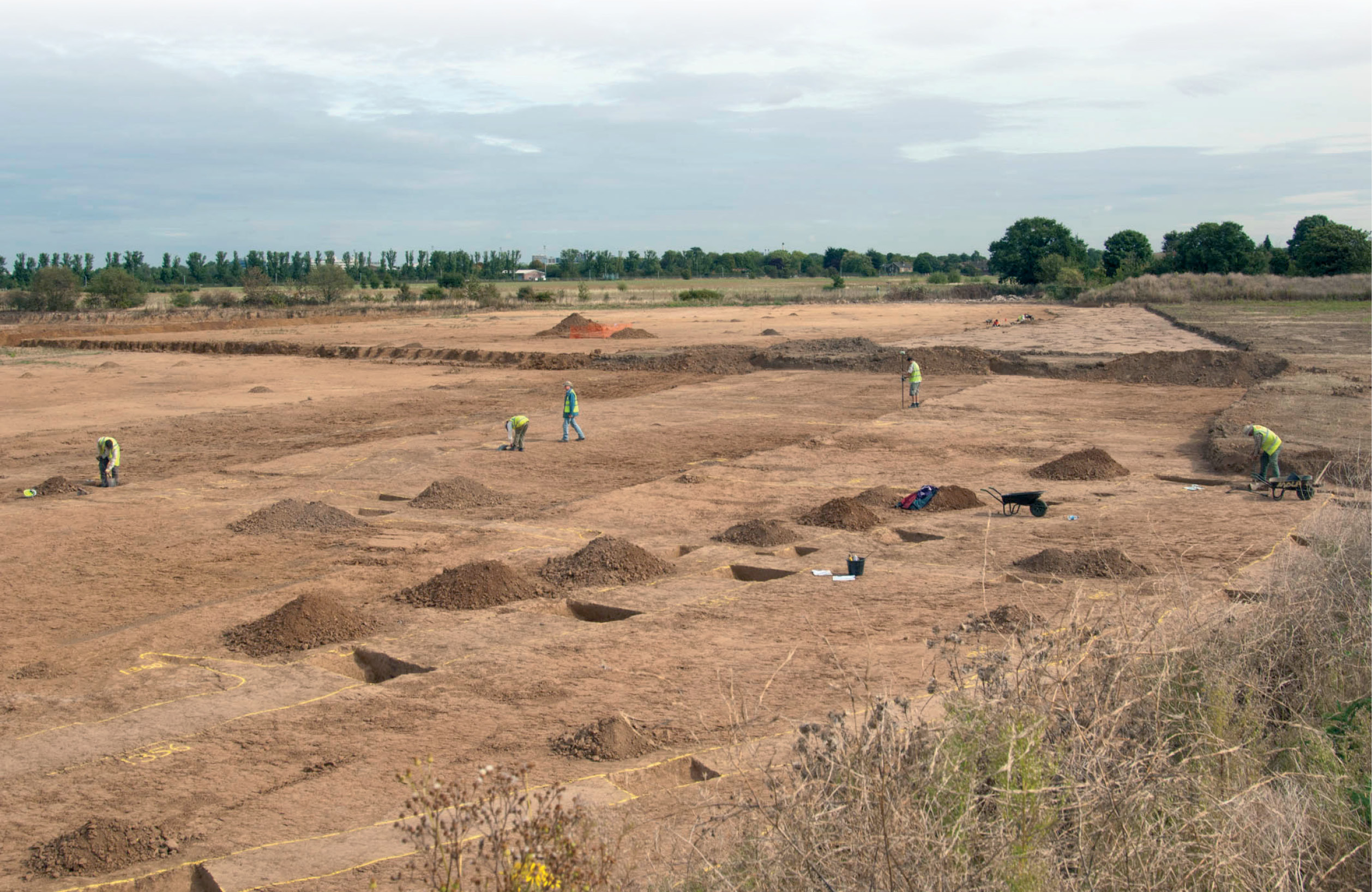
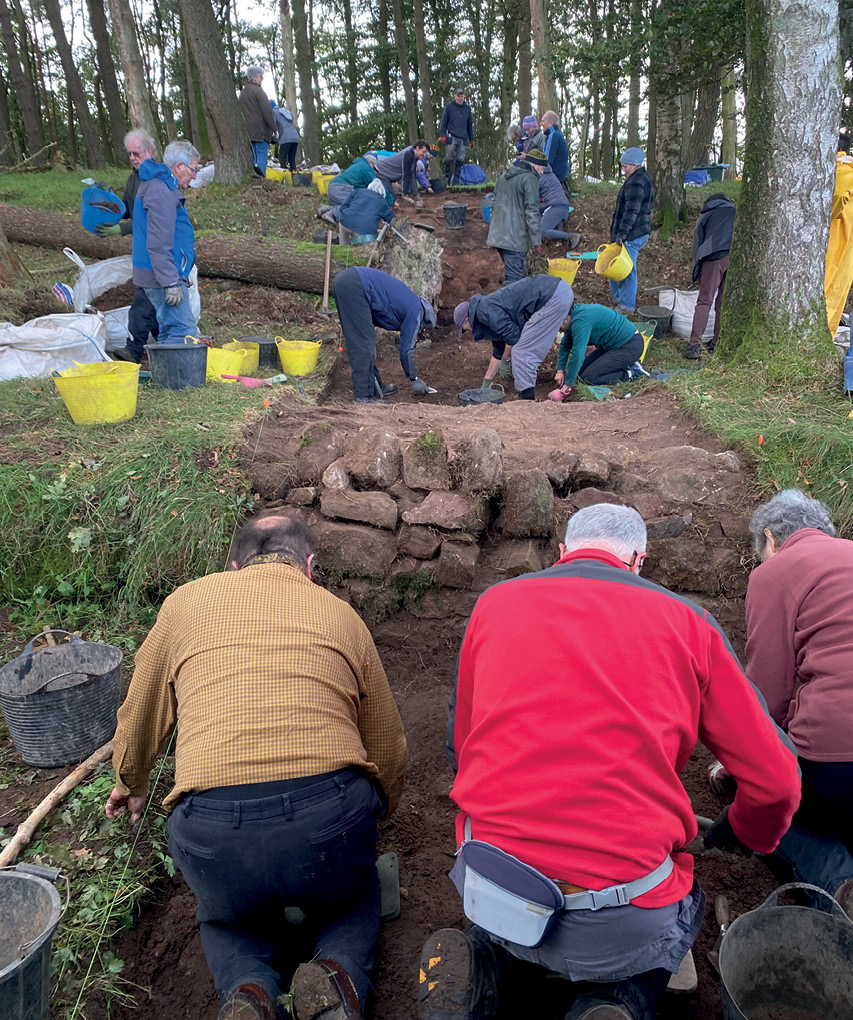
Overlooking excavations at Sipson Farm, near Heathrow Airport, where investigations between 2010 and 2014 revealed evidence of more than six millennia of human activity.

Clearing the land

Our story begins in the Neolithic period, when pollen recovered from nearby sites suggests that large areas of hitherto forested river terraces were partially cleared for settlement, farming, and the construction of earthwork monuments. At Sipson Farm, the western half of the site produced no evidence of activity of this period, suggesting that this portion was perhaps still wooded at that time, but the eastern half yielded some 15 small pits and a ring ditch.

The pits contained apparently ‘placed deposits’ of struck flint and possible burnt offerings of meat (represented by sheep- and cattle-sized bone) and charred cereal grains, crab apples, sloes, and hazelnut shells. This combination suggests that the site’s early farming community practised a mix of arable cultivation and stock rearing (although no evidence for livestock enclosures of this date was found), as well as gathering fruit and nuts from the woods or possibly hedgerows. Some of the pits produced Early Neolithic Plain Bowl or Late Neolithic Grooved Ware, too, testifying to the longevity of this occupation. The ring ditch, meanwhile, produced pottery comparable to local Middle Neolithic impressed wares, suggesting that it may have been roughly contemporary with two Middle or Late Neolithic earthworks of similar scale that were previously excavated less than 300m (984ft) to the east at ICSG. These comprised a double ring-ditch and a penannular ditch, both of which were associated with cremation burials. At Sipson Farm, we found no direct evidence of a funerary function, but it is possible that this monument may have attracted similar rites.
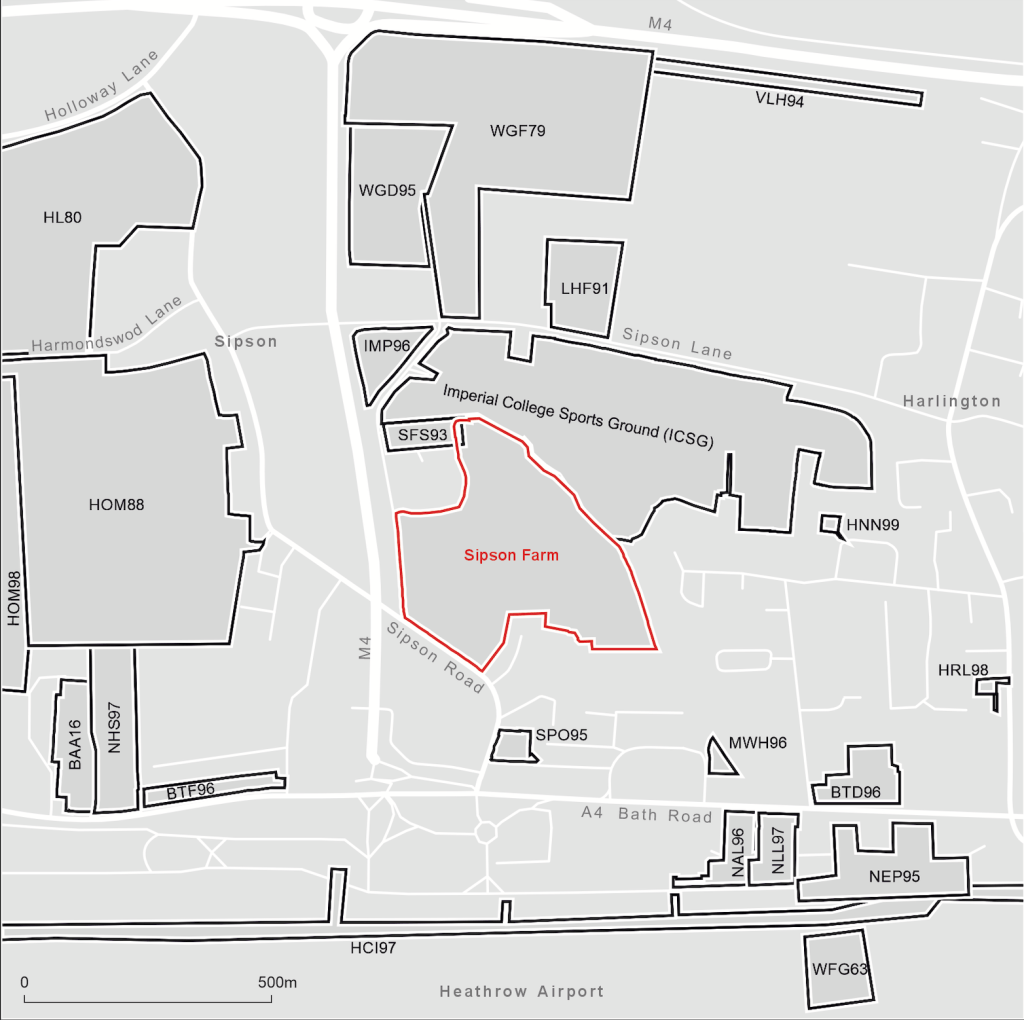
 The location of the site.

The ring ditch had an external diameter of 15.4m (50.5ft), large enough to suggest that its construction was a team effort, perhaps by an extended family or a local community. At times this group may have also worked with others to help build the much larger monuments located nearby, such as the causewayed enclosures at Datchet (see CA 351), Staines, and possibly east Bedfont, all of which are roughly between one and two hours’ brisk walk from Sipson Farm. These sites probably provided foci for gatherings, perhaps for trading and for social or spiritual purposes. Another particularly large and enigmatic monument, which was 3km (1.9 miles) to the west of Sipson Farm, was the Stanwell Cursus. This comprised two parallel quarry ditches spaced about 20m (66ft) apart, which ran for more than 3.6km (2.2 miles), flanking a central bank (perhaps a processional causeway?). Its course has been traced from its possible terminal near Junction 15 of the M25, continuing across Heathrow’s Terminal 5 (CA 256), before disappearing beneath the modern village of Stanwell (CA 99).
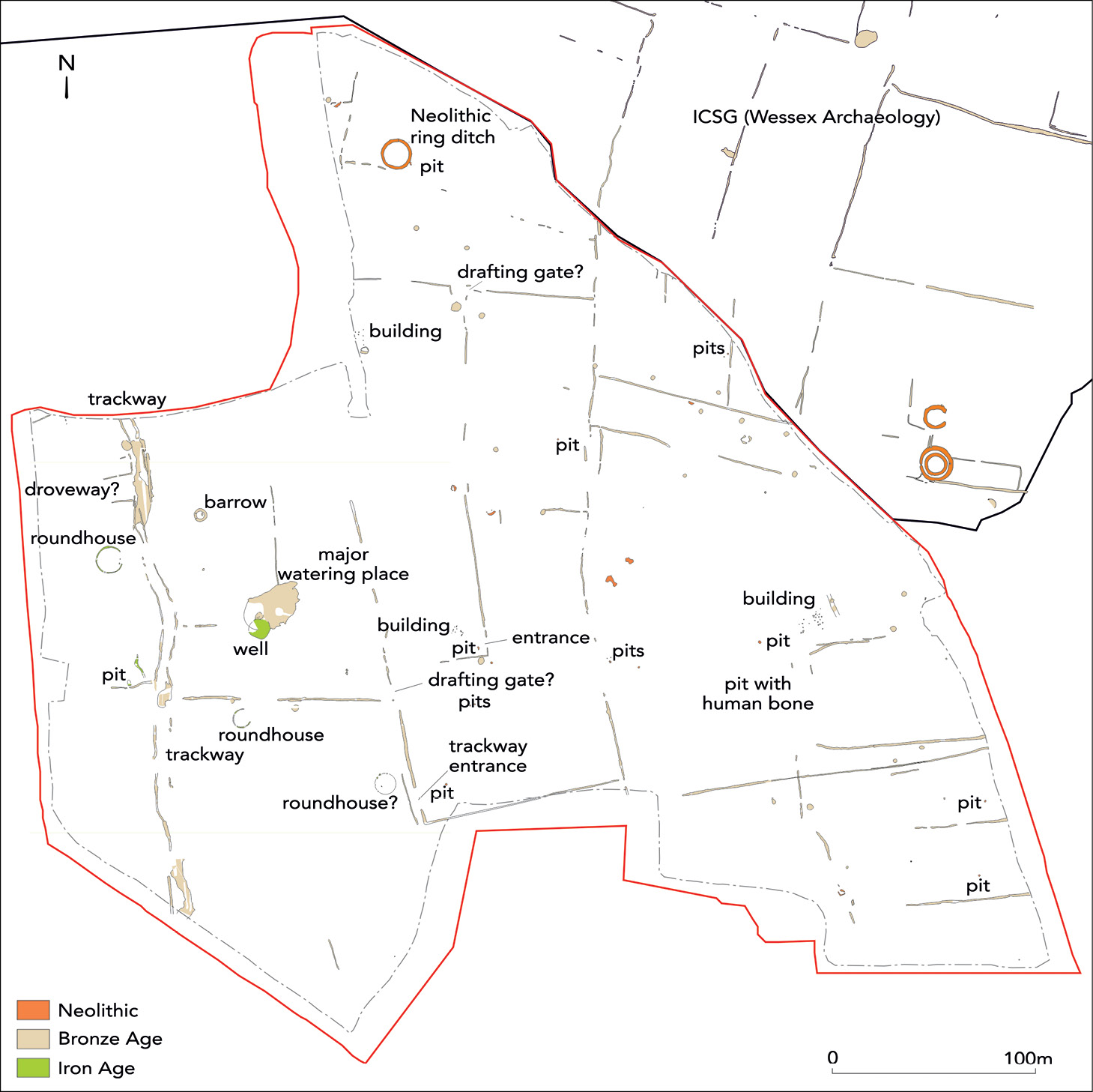
Selected prehistoric features in the area of the excavation. Details of those on the ICSG site are courtesy of Wessex Archaeology.

Dividing up the land

Further transformations came during the Bronze Age, when the entire site was divided into rectangular fields delineated by ditches. Dating evidence at Sipson Farm is hazy, but data from nearby sites suggests this process began in the middle of the 2nd millennium BC. The field system was extensive, running across the ICSG site and others further north, and it reflects similarly dramatic developments that were taking place elsewhere at this time. These changes can be seen both in the wider Heathrow area and across ‘lowland’ Britain, south of a line stretching from the Bristol Channel to the Wash, especially along river valleys (notably of the Thames) but also on downland and on Dartmoor and Bodmin Moor. They might represent social change, too, with the divisions possibly denoting individual or communal ownership of land, and suggesting a considerable degree of social cohesion and cooperation.

The new field boundaries at Sipson Farm were thoughtfully designed. Some carefully negotiate earlier earthworks, including a slight deviation made to avoid the Neolithic ring ditch, and the presence of at least two possible drafting gates and some two dozen waterholes – often located near the corner of fields, where animals could be easily corralled – suggest that this landscape was conceived with livestock management in mind. Stockproof field boundaries would have been essential to prevent farm animals from wandering, to protect them from predators, and, at times, to allow them to be segregated by sex and age. They would have also enabled pasture to be grazed in rotation. How was this achieved? Plant remains from a Late Bronze Age waterhole suggest the presence of nearby hedgerows, so we might imagine ditches with banks topped in this way. It would take several years to create a stockproof hedgerow, but once established they could be coppiced and harvested for fruit, nuts, fuel, and materials for making wattle hurdles that could be used in buildings or to create strong but lightweight panels suitable for closing off field entrances, among other purposes.

The Neolithic ring ditch.

Some of the fields were connected by ditched trackways, and one particularly long-lived route, located in the western part of the site, survived in one form or another until about the 11th century, and was the focus of activity in even later periods. This trackway ranged from 2m to 7m (6.6ft to 23ft) wide and, unlike the relatively straight field boundaries, its north–south course was curiously sinuous. These puzzling features may have been designed to control the movement of livestock: bends in the route were possibly intended to limit sightlines to short stretches, while the narrower sections could be more easily closed off with temporary barriers to direct animals in or out of adjacent fields. Shallow hollows could be seen along some stretches, particularly in areas close to possible field entrances and where the track was joined by another, which might reflect heavier wear caused by clustering livestock. We found traces of a possible fence running parallel to the trackway as well, in the form of a row of six post-holes 12m (39ft) from its route.

 The outline of a Bronze Age ring ditch that surrounded a small barrow.

Livestock required water, and our excavations uncovered numerous waterholes. Most were isolated and scattered within the fields, but there was one dense cluster that formed a ‘major watering place’. The waterholes were simple constructions: large, very steep-sided pits that survived to depths of up to nearly 3m (9.8ft). Water may have been drawn from them by lowering containers from the top or by climbing down to fetch it – possibly using log ladders with notched steps (at least five have been found in nearby excavations), though in some cases one side of a waterhole was gently ramped, providing easy access for livestock and people.

The remains of three timber buildings were widely scattered across the fields, together with pits containing burnt material including plant remains – and, in two cases, cremated human bone, a sample of which produced a date of 1290-1120 BC. These were not the only hints of funerary activity: a small ring ditch measuring 6.3m (20.7ft) across, probably marking the location of a barrow, was identified within an enclosed area measuring about 4m (13.1ft) in diameter. The ditch contained charcoal and bone ash, including some from an adult human, derived from either a cremation burial or a pyre, and this monument appears to have been a continued focus of activity, as burnt material from a later pit cutting its silted ditch produced radiocarbon dates of c.930-810 BC.

One way to photograph large, flat sites: Maggie Cox with a camera mounted on a telescopic stand.

Occupation in the Heathrow area became increasingly nucleated during the Middle Iron Age, and at Sipson Farm a small settlement was established in the 4th or 3rd centuries BC, with the relict Bronze Age field system lying on either side of its main trackway. A pair of penannular gullies (one of which contained charred remains including a barley grain dated to 400-190 BC) point to the presence of at least two roundhouses whose entrances faced east, away from the prevailing wind, while a semicircle of post-holes possibly represents a third building. These structures were widely spaced around a ramped waterhole in the ‘major watering place’, and plant remains from this feature speak of largely open pasture and heath, with trees and shrubs possibly growing in nearby hedgerows. Meanwhile, evidence of insects including dung beetles indicate that the Iron Age population were also engaged in animal husbandry.

The ‘major watering place’ where successive, long-lived waterholes were in use from the Bronze Age to the Roman period. 

In the shadow of Londinium

Features dated to the Late Iron Age and early Romano-British period were fairly scarce, but those that we did find (mostly pits and ditches) show a continuation of farming activities and the continued use of earlier constructions. A small pit cut into the silted Bronze Age ring ditch, which produced cremated bone as well as a charred barley grain dated to c.50 BC-AD 80, suggests that the barrow was still a landmark during this period, while a waterhole contained wheat grain that produced exactly the same radiocarbon date, as well as plant and insect remains evoking cultivated open ground and livestock including sheep.

Moving further into the Roman period, during the late 1st and 2nd centuries AD a number of modest farming settlements were established on the west London gravels, including at Sipson Farm. There, the Bronze Age trackway was widened on an impressive scale, probably for use as a drove-road. Most of its excavated length was comparable in width to modern A roads, but towards the south it bulged out to a width of 42m (138ft) – broader than the six-lane M4 Heathrow spur. Single rows of ditched enclosures on either side of this trackway may have surrounded farmsteads, or they could have corralled herds next to its route. A few associated pits, gullies, waterholes, and a timber box-framed well were discovered within some of them but, typically for the area, structural evidence was scarce, limited to a small cluster of apparently random post-holes and a few fragments of tile and daub. The latter would probably have come from relatively humble dwellings or agricultural buildings.

The gully of an Iron Age roundhouse crossed by an early Roman enclosure ditch.

The character of this Roman settlement was similar to others of this period recorded around Heathrow during previous investigations. These were smaller and seemingly less prosperous than rural roadside settlements that have been excavated on the major Roman routes radiating from Londinium (CA 260), yielding poorer finds assemblages in terms of quantity, quality, and range, and often comprising little more than meagre hauls of pottery. As the Sipson Farm settlement was about 26km (16 miles) from Londinium and just over 3.2km (2 miles) from the London–Silchester road, it seems probable that it and its neighbours would have provisioned communities living along this highway, as well as sending goods to the inhabitants of Londinium, who in the 2nd century AD may have numbered some 30,000. If the settlement’s fortunes were linked to the provincial capital, this might explain why we find less evidence for activity at Sipson Farm in the 3rd and 4th centuries, perhaps reflecting a more widespread decline in Roman London and its hinterland at this time. Nevertheless, scattered ditches, waterholes, and a possible pond show that the area had not been entirely abandoned.

From Anglo-Saxon estate to medieval manor

Early medieval activity was similarly scarce, although some Romano-British ditches may have remained open in the Early Saxon period (one contained three potsherds from a jar dated to the 6th century) and an undated but probable sunken-featured building was found nearby. Such paucity of evidence is typical of nearby excavation sites, with traces of Early Saxon settlement generally found much closer to the Colne and Crane. Also, as at many other sites in the locality, there was no sign of later Saxon activity on the site before the 11th century, although a charter of 831 records a large estate at Harmondsworth (on which the later manor and parish may have been based), which suggests that a community had existed somewhere in the surrounding area.

The Romano-British drove-road flanked by ditched enclosures in the mid-1st to 2nd century.

We do know that the site saw two distinct phases of change in 11th and 12th centuries, although broad pottery dating makes it impossible to say exactly when the transition between these occurred. During the first phase (possibly pre-1066) a narrower trackway, adjoined by two new enclosures, was laid out roughly on the line of the Roman drove-road. This suggests that either the route had continued to be used during intervening post-Roman centuries, or sufficient vestiges survived to enable its reinstatement. The second phase then witnessed a major reorganisation of the landscape, including the replacement of the trackway and adjoining enclosures with numerous small, ditched fields and enclosures that extended across the southern half of the site. A scattering of new pits and waterholes were also created at this time. It is possible that this transformation was instigated by the Abbey of Sainte-Trinité du Mont, by Rouen, which in 1069 was granted the Manor of Harmondsworth, including Sipson Farm. But, despite these changes, the site’s long history of agricultural activity continued: charred remains from various features indicate the cultivation of cereals, peas, and vetch.

Medieval fields, enclosures, and buildings dated to about AD 1050/1100-1200, but probably established following the Norman Conquest.

As for later medieval activity, fewer features were dated to the 13th-15th centuries, but we did find two long east–west ditches that may have been ‘furlong’ boundaries marking the limit of cultivation strips (although they were actually about a half furlong apart). These ditches roughly coincided with the outline of an open field known as ‘Sipson Field’, and one of them survived into the later 19th century, when it bounded orchards shown on an Ordnance Survey map of 1866. In the south-west corner of the site, we found a concentration of enclosure ditches and waterholes too, as well as a well-shaft that produced a number of interesting artefacts, ranging from part of a 13th-century cooking pot and well-preserved wooden remains from hazel withies to fragments of a large lathe-turned bowl, an offcut from an oak plank, and, possibly, part of a ladder. Most significantly, we also found fragments of a wheel rim which had a thin, plank-like section – much broader than Roman examples or more recent wooden wheels, but similar to those of the wagon from the 9th-century Oseberg ship burial in Norway.

The medieval wheel, as reconstructed by timber specialist Damian Goodburn.

Landscape, longevity, and legacies

Sipson Farm presents an intriguingly mixed picture. Some periods left significant and long-lasting legacies on the site. Archaeological evidence suggests that the most transformative episodes included Neolithic woodland clearance and monument building, the development of Bronze Age field systems, the construction of the Roman drove-road and adjoining enclosures, and the putative late 11th- or 12th-century reorganisation of manorial land. Prehistoric and later earthworks formed an important part of the local landscape, with some forming obvious foci for social, funerary, and spiritual activities, and later serving as convenient landmarks for establishing boundaries. Jon Cotton (an authority on London’s prehistory) suggests that the Neolithic earthworks at Sipson Farm and ICSG, as well as two banked enclosures that once stood on what is now the eastern part of Heathrow Airport, may have influenced the parish boundary between Harmondsworth and Harlington.

Other periods, however, left little impression discernible to the archaeologist. Locally, the Early Bronze Age, and much of the Iron Age and Anglo-Saxon periods, are will-o’-the-wisps. At Sipson Farm, activity from the Iron Age until the Norman Conquest focused on small areas in the western part of the site, beyond which there was little evidence for activity. Nevertheless, it seems likely that in these apparently blank areas Bronze Age field boundaries were maintained as mature hedgerows – essential for the arable farming and stock rearing that was practised on the site by successive communities.

The excavated evidence from Sipson Farm is similar to that recovered from other sites in the Heathrow area. Indeed, cumulatively, a coherent pattern of landscape development has emerged from fieldwork undertaken by various organisations since the late 1960s. Regardless of differences in method, all published accounts agree reassuringly on generalities, although each new publication adds nuance and detail. This article follows the release of a full report on excavations at Sipson Farm, and anticipates a forthcoming MOLA publication on prehistoric and Roman remains found between 1979 and 1997 at several sites mainly to the north of Heathrow Airport during excavations by Museum of London archaeologists, often in partnership with volunteers of the West London Archaeological Field Group (see ‘Further reading’ below). The latter reports on excavations that may seem to younger readers to be of a bygone era, but it provides an up-to-date synthesis that puts the discoveries at Sipson Farm and many other sites on the ‘west London gravels’ into context. As our understanding of the area’s archaeology evolves, long-vanished communities come into sharper focus, repopulating landscapes now associated more with airports and infrastructure.


Further reading:
• J Cotton and N J Elsden (forthcoming) Prehistoric and Roman Evidence from the Middle Thames Terraces in the London Boroughs of Hillingdon and Hounslow (MOLA e-Publication).
• R Cowie (2024) ‘Prehistoric and historic landscapes at Sipson Farm, Sipson, London Borough of Hillingdon: archaeological excavations 2005-2014’, Transactions of the London and Middlesex Archaeological Society 75: 1-106.

All images: MOLA

By Country

Popular
UKItalyGreeceEgyptTurkeyFrance

Africa
BotswanaEgyptEthiopiaGhanaKenyaLibyaMadagascarMaliMoroccoNamibiaSomaliaSouth AfricaSudanTanzaniaTunisiaZimbabwe

Asia
IranIraqIsraelJapanJavaJordanKazakhstanKodiak IslandKoreaKyrgyzstan
LaosLebanonMalaysiaMongoliaOmanPakistanQatarRussiaPapua New GuineaSaudi ArabiaSingaporeSouth KoreaSumatraSyriaThailandTurkmenistanUAEUzbekistanVanuatuVietnamYemen

Australasia
AustraliaFijiMicronesiaPolynesiaTasmania

Europe
AlbaniaAndorraAustriaBulgariaCroatiaCyprusCzech RepublicDenmarkEnglandEstoniaFinlandFranceGermanyGibraltarGreeceHollandHungaryIcelandIrelandItalyMaltaNorwayPolandPortugalRomaniaScotlandSerbiaSlovakiaSloveniaSpainSwedenSwitzerlandTurkeySicilyUK

South America
ArgentinaBelizeBrazilChileColombiaEaster IslandMexicoPeru

North America
CanadaCaribbeanCarriacouDominican RepublicGreenlandGuatemalaHondurasUSA

Discover more from The Past

Subscribe now to keep reading and get access to the full archive.

Continue reading