Subscribe now for full access and no adverts
In February 2023, the Egypt Centre (Swansea University) received more than 800 objects from the Royal Pump Room Museum in Harrogate as a three-year loan. During this period, the collection is being researched and made available to Egyptologists and the wider public, both online and in three temporary exhibitions. Thirty objects were chosen for the first of these displays, Causing Their Names to Live, inspired by a common vivification formula found on statues, stelae, and other objects. One of the most important concerns for ancient Egyptians was that their names would be remembered. In the autobiography of an official called Mentuhotep, he says that ‘anyone who shall remember my good name, I will be his protector in the presence of the great god’. The official Intef even goes as far as to hire a Lector ‘so that my name would be good, and so that the memory of me would last [until] today’.
The centrepiece of this first exhibition is a seated statue of a lady called Senetra (HARGM10634), the upper half of which is now missing. Fortunately, the inscriptions on the sides and back of the chair survive, revealing that the statue was dedicated by her father Nebamun ‘in order to cause her name to live’. Did Senetra die young with no children to undertake the vivification duties? The statue is probably the only surviving object dedicated to this lady, which makes it particularly poignant.

Stelae
Seven of the objects displayed in the exhibition are stelae, including that of Hetepnesmin which was featured in the previous article (see AE 142). The earliest (HARGM3591) dates to the Thirteenth Dynasty (c.1795-1650 BC). Made of limestone, the stela contains incised decoration divided into three registers. In the upper lunette are two large wadjet-eyes. The second register consists of three lines of hieroglyphs containing the offering formula addressed to Osiris. In the lower register, two standing figures are shown facing each other, with a large table of offerings located between them. On the left is a male figure, who holds a lotus (lily) flower in his left hand. The inscription identifies him as Iwefenirpeseshi. Opposite is his mother, who holds a duck by the head. The hieroglyphs in front of her face identify her as Neferhotep. Stylistically, the stela comes from Upper Egypt, possibly from the necropolis of er-Rizeiqat.

The front face of a limestone stela (HARGM3586), dating to the Twenty-sixth Dynasty (c.664-525 BC), has painted decoration divided into three registers, surrounded by blue framing lines. In the upper lunette is a winged sun disc flanked by uraei. Directly beneath the disk is a sekhem-sceptre flanked by large wadjet-eyes. The eyes are flanked by recumbent jackals atop platforms, facing towards the centre of the scene. In the central register, two men are shown on the right with their arms in adoration before Ra-Horakhty and Isis. The labels above identify the first figure as Padiamun, who is followed by Harsiese. Between the two men and the deities is a table of offerings consisting of a conical loaf in the centre, flanked by two round loaves. Ra-Horakhty is shown in mummiform, holding a was-sceptre and standing on the maat-plinth. He is falcon-headed and wears a solar disc. Behind him, Isis has her left hand raised in adoration. She wears the Hathoric crown consisting of the solar disc set between the horns of a cow. The lower register contains three lines of hieroglyphs, which begin with the offering formula addressed to Osiris. The inscription also states that the stela was commissioned for Padiamun, the son of Harsiese, both of whom are shown in the register above. Stylistically, the stela comes from the site of Abydos.

The large sandstone stela, HARGM3595, probably dates to the Ptolemaic Period (c.332-30 BC). The stone used for the stela has been reused from an earlier monument, as is evident from the traces of hieroglyphs present on the base. The content of the stela has been divided into three registers, with decoration in sunk relief. In the lunette is a winged sun disc, representing the god Behdety, with pendant uraei. A sky sign separates the lunette from the central scene, where a recumbent bull faces right, before an offering table. Though unlabelled, the bull wears a headdress consisting of a solar disc with double plumes, which is associated with the god Montu (Buchis) at Armant. Behind the bull is a winged solar disc with a single pendant uraeus. The lower register consists of three lines of a demotic text that mentions Psenmont, son of Psenmont. The personal name Psenmont, which evokes the god Montu, also suggests that Armant is the provenance for this stela.

Five of the stelae on loan from Harrogate date to the 4th to 7th centuries AD and come from the neighbourhood of Thebes, including the round-topped rectangular limestone stela HARGM3587. The architectural design includes a triangular pediment containing a conch-like hemispherical feature over four identical columns and spiral decor above plant-leaf motif, all set on (or behind) a base or balustrade. Behind and above this, the area has palm fronds, flowers, and foliage. The doorway is replaced by a rectangle bearing a five-line Greek inscription reading ‘there is one God who helps. Ammonius’. Ammonius is a personal name that was common at this time.

Statues
In addition to the statue of Senetra, two further examples are included in the exhibition. One of these (HARGM12379) is a double statue dating to the Seventeenth Dynasty (c.1650-1550 BC). Crudely carved from limestone that has been painted brown, the statue depicts two naked boys standing on a plinth while holding hands. They are shown with shaved heads except for a twisted plait at the back. The reverse is inscribed with a single column of hieroglyphs for each figure, identifying the boy on the right as the ‘Child of the Kap’ Tetisoneb, and the one on the left by the same title, with a name also beginning in ‘Teti’. The remainder of the second name is missing due to some damage on the lower left corner of the statue’s back. The relationship between the two boys is unknown, although given their similar names and titles, it is possible that they were twins. Children of the Kap are believed to have been educated in the palace. This statue was found at Dra’ Abu el-Naga’ in 1898-1899 in one of the dumps outside the tomb of Djehuty (TT11), during the excavations of the Marquess of Northampton (undertaken by Wilhelm Spiegelberg and Percy Newberry).

Stelophorous statues (where the deceased is shown in a position of worship, holding an inscribed stela) were common at Deir el-Medina, particularly during the Ramesside Period (c.1295-1069 BC), and would have been placed in niches directly above the tomb of the deceased. One such statue (HARGM11863) that dates to this period shows a man wearing a long linen dress, with the folds outlined in red ink. His hands are raised in adoration with his fingers resting on the stela in front. The back and head are now missing. The stela would have consisted of seven lines, though only the first five lines are preserved. Above the text are remaining traces of a solar barque of the sun god Ra-Horakhty. The text consists of a solar hymn to the sun god on behalf of the owner. An additional line of hieroglyphs on the statue’s left side identifies the owner as the Servant in the Place of Truth (Deir el-Medina), Hay.

Shabtis
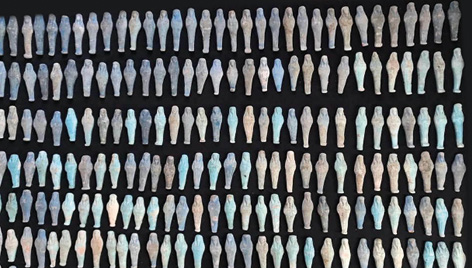
Of the 157 shabtis on loan from Harrogate, 11 are on display in the exhibition. One of the most important attributes of shabtis is that they are usually inscribed with the owner’s name; in some cases, they can even have the names of the parents. The shabtis in the exhibition belong to both royal and private individuals, including the beautiful shabti of Sety I featured in the previous article (see AE 142).

Pinedjem II was High Priest of Amun at Thebes from 990 BC to 969 BC and was the de facto ruler of the south of the country. His shabtis were discovered in the Deir el-Bahari cache (TT320) in 1881, and include a faience mummiform figure with bright blue glaze (HARGM7309), which is now part of the Harrogate Collection. The shabti wears a striated tripartite wig, and a black line is painted around the top of the head, but there are no additional loops or knot elements to indicate the seshed-band. The arms are crossed right over left, a hoe held in each hand. A rectangular seed bag with crossed fibres is suspended between the shoulders. The painted inscription is arranged into five remaining horizontal bands that run from right to left, defined with a line between each but not at either end. The text contains Chapter 6 of the Book of the Dead.

An overseer shabti for his daughter, the Divine Adoratrice Henuttawy (HARGM7263), is also on display in the exhibition. She wears a plain tripartite wig and a seshed-band with a twisted knot. This overseer was modified from a standard worker figure by the application of a protruding triangular kilt to represent the dress of daily life. This conversion can be seen, too, in the crossed hands which each hold a whip, rather than the one raised whip/one arm at the side posture more common of this type. The wig, face, and hands are modelled in relief, with the other details added in black ink. The painted inscription is arranged on the front of the kilt as a vertical column concluded by a horizontal cartouche. The text identifies the deceased as the Divine Adoratrice Henuttawy, whose shabtis were also discovered in the Deir el-Bahari cache.

Another faience mummiform shabti with light blue glaze (HARGM7311) depicts a man wearing a plain tripartite wig, which is painted black. The arms are crossed right over left, a hoe held in each hand. A rectangular seed bag with crossed fibres is suspended between the shoulders. The wig, face, and arms are modelled in relief, with the other details added in black ink. The painted inscription is arranged into a vertical column down the front and on to the feet. The text identifies the deceased as the God’s Father of Amun, Padiamun. By coincidence, an overseer shabti for the same person is already housed in the Egypt Centre collection (AB111).
Funerary cones
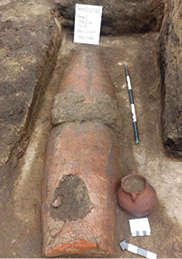
Funerary cones are small, conical objects used in ancient Egyptian burial practice and typically made of clay. They were most commonly placed around the entrance of a tomb chapel, particularly in the Theban necropolis. The Harrogate Collection consists of four such examples belonging to three individuals. One (HARGM10219) is inscribed for the Child of the Kap and Overseer of the Wab-priests of Amun, Nentawaeref, who lived during the Eighteenth Dynasty (c.1550 BC-1295 BC). The tomb of Nentawaeref remains undiscovered, although it was perhaps located in the el-Khokha necropolis, as many of his cones have been identified there. A second cone (HARGM10220), inscribed for the Chief of the Weavers, Iy, dates to the first half of the Eighteenth Dynasty. The cone is unusual in that it is in the shape of a prism rather than the typical cone. Additionally, the stamp has a vertical ovoid frame rather than circular one. Iy was buried in a tomb adjacent to TT12 in the Dra’ Abu el-Naga’ necropolis, which was recently rediscovered by the Djehuty Project. The remaining two cones (HARGM10642) belong to the Prophet of Montu and Secretary of the King, Hor. Hor is a well-known official who lived during the reign of Sheshonq VI in the Twenty-third Dynasty (c.800 BC). The tomb of Hor is currently unknown, although several cones have been excavated in or close to the Ramesseum, suggesting a possible provenance.

Other objects
The names of the deceased can live forever on other types of objects. The exhibition includes a travertine canopic jar without its lid (HARGM3727), dating to the Twenty-sixth Dynasty (c.664-525 BC). On the front is a lightly incised two-line inscription identifying the jar as belonging to the God’s Father and Chamberlain, Djedamuniwefankh. It also names his father Ankhmut and his mother Tasamtik. Thanks to the inscription, it was possible to identify a second jar for Djedamuniwefankh, which is housed in the Kunsthistorisches Museum, Vienna (ÄS 3584).

An interesting story is recorded on an ostracon from the village of Deir el-Medina (HARGM10823). It carries a hieratic letter written by the draughtsman Nakhtamun to his brother Khay and his son Baki. In the letter, Nakhtamun asks for some goose fat to be sent to ease their father Nebra’s illness. In a follow-up to this, an ostracon in Berlin (O. Berlin P. 14841) contains a letter written by Nakhtamun to Khay asking for a new portion of goose fat to be sent urgently because ‘the cat has eaten that which was sent yesterday’. Nakhtamun and his family are well-known from the village of Deir el-Medina during the reign of Ramesses II (c.1279-1213 BC).
All the objects on display in the Causing Their Names to Live exhibition can be viewed in an online trail, which is now available in 12 languages: https://harrogate.abasetcollections.com/Trails. Since the Harrogate Collection arrived in Swansea in February 2023, more than 80 individuals have been identified. By revealing their names, we are fulfilling the wish of the ancient Egyptians to have their names remembered.

Dr Ken Griffin is the Curator of the Egypt Centre, Swansea. Prior to this, he was a lecturer in Egyptology at Swansea University (2015-2018). He is also a member of the South Asasif Conservation Project (SACP), directed by Dr Elena Pischikova. His research interests include the rekhyt-people (see AE 38), the Harrogate Collection (see AE 142), and the collection of the Egypt Centre (see AE 116).
All images: the author, unless otherwise stated