Subscribe now for full access and no adverts
One of the most important excavations of the 1960s was undertaken by Professor W B Emery (1903-1971) at what came to be known as Saqqara’s ‘Sacred Animal Necropolis’ (SAN). One might therefore wonder why the work is now so little known, despite a renewed interest in animal mummies.
The main reason that Emery’s work is now chiefly known only to Egyptologists is the fact of his untimely death during the 1970-1971 season of excavation at the site. His aim had not been to unearth an animal necropolis, but rather to find the location of the burial site of Imhotep, architect of the Step Pyramid of pharaoh Djoser (c.2667-2648 BC). Emery reasoned that, since Djoser reigned during the Third Dynasty, the tomb of Imhotep would be among others belonging to that dynasty, on the desert plateau south-west of the present-day village of Abusir. In later times, Imhotep came to be regarded as a demi-god associated with both Ptah, as a patron of craftsmen, and Thoth, as a god of wisdom and learning. Emery reasoned that, because of this, a good place to begin excavation was an area of Third Dynasty tombs that had scattered Late Period and Ptolemaic pottery jars for ibis burials sacred to Thoth. As well as the surface indications of broken mummy pots, Emery knew that early travellers from the 17th century onwards had recorded visits to the area, describing underground galleries full of mummified birds – the precise location and extent of which were unknown in the 1960s.

The catacombs
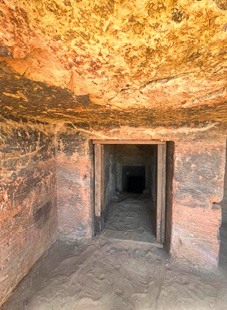
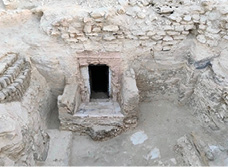
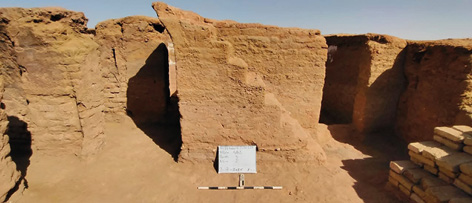
Emery did not expect to unearth two very extensive catacombs for ibis burials, another for falcons, one for baboons, and a series of Serapeum-like vaults for the cows that were the mothers of the Apis bull. These were set beside or near to an artificial terrace that originally supported a variety of small temples or shrines, some of which – in their day – had become so overcrowded that their votive bronze situlae and figurines had to be cleared and cached beneath the terrace itself, or within the catacombs.
Many of the structures and finds from the SAN were published in the years that followed Emery’s death. First of all, the South Ibis Catacomb was published by Professor Geoffrey Martin. Following work in the 1990s directed by Professors Harry Smith and Paul Nicholson, the Falcon, Baboon, and Mother of Apis Catacombs were published by Smith, Sue Davies, and Ken Frazer. The second of the Ibis Catacombs, now known as the ‘North Ibis’ to distinguish it from its southern neighbour, was newly discovered at the time of Emery’s death, and was not fully explored until the 1990s. It is currently being prepared for publication by Nicholson.
Together, these catacombs and their associated shrines and temples make up what is now known as the Sacred Animal Necropolis. There are also other burials for sacred animals at Saqqara, and we suggest that the term should be more widely applied to include the Serapeum on the west side of the Saqqara plateau, as well as the Catacombs of Anubis (see AE 123) and the reused tombs that served as the burial site for cats, both on the east side of the plateau; these are associated with the Anubieion and the Bubastieion temples respectively. In short, sacred animals at Saqqara are very prominent and it is not unreasonable to think of the entire area of north Saqqara, in a broad sense, as part of an extensive animal necropolis.

Relative chronology
The publications arising from examining these various catacombs and temples have each tried to provide a chronology for the catacomb or temple in question, and to describe the features of the sites. However, there has not yet been any general overview of the Sacred Animal Necropolis, nor of how the different structures relate to one another temporally.

A new project, generously funded by the Leverhulme Trust and titled ‘Dating the Dead: Chronology and Context at Saqqara’s Sacred Animal Necropolis’ is now attempting to bring together all the available evidence we have for dating the individual catacombs to see how the cults may have developed over time. For example, Nicholson has suggested that the North Ibis Catacomb is probably the earlier of the two ibis structures, but it has not, hitherto, been possible to demonstrate this. The North Ibis Catacomb has no inscriptional evidence, and the suggestion for its place in the development of the cults has had to be based on: (1) its location close to the ‘lake’ of Abusir (now a dried- up area to the north-west of Abusir village, but formerly the ancient ‘Lake of Pharaoh’); (2) the fact that it has its own terrace and garden away from the main temple terrace; and (3) that some of the birds buried there were not placed in pottery jars when burial in jars was the norm.
How then might the position of the North Ibis Catacomb in the development of the cults at Saqqara be determined, and how might we find evidence for the other catacombs? In the case of the bird catacombs, the fact that they have distinctive pottery jars may provide a key.

Pottery
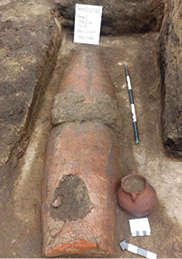
It was noticed from early in the 1990s that there are differences in the shapes and proportions of jars used within and between bird catacombs. The possibility that this difference could be chronologically significant was first suggested by Nicholson and the late Dr Nick Fieller (1947-2017). The basic hypothesis was that morphological change through time would be reflected in the metrical data of jars which, through careful statistical analysis, could inform a new relative chronology. After encouraging trial work completed by Fieller, this statistical approach has continued to be developed by the writers, together with Dr Eleanor Stillman and Shuwei Lin. Here, the use of ‘principal component analysis’ (a method of simplifying large amounts of data) has proven particularly useful and, by assessing the differences in the height and rim and base diameters of pots, has already produced results that clearly differentiate, not just between catacombs, but between different galleries in the same catacomb. This is extremely significant to the understanding of the internal development of these structures, and to the overall presentation of a new chronology of Saqqara’s Sacred Animal Necropolis.

Radiocarbon dating
The pots alone are not, of course, definitive and we aim to use radiocarbon dates to support the suggestions from the statistical work. In an ideal world, it would be possible to return to North Saqqara and take many dozens of new samples – preferably, bone and tissue – from individual galleries within each catacomb. Sadly, such work is not possible, but we are able to fall back on samples with good provenance, collected by Emery and – with the permission of the Egyptian authorities – exported to a variety of UK and European museums.
Our aim is to use the radiocarbon data, alongside the statistical analysis of mummy pots, and existing chronologies suggested by all those who have published on the individual catacombs, to propose a new chronology of the SAN. It is already possible to show that some cults underwent marked expansion over time. For example, the Anubis cult appears to develop rapidly in Ptolemaic and possibly also Roman times. This is based on the architecture of the two ‘dog’ catacombs on the east side of the plateau. The smaller dog catacomb – believed to be the earlier – has galleries which are only about one third as long as the galleries in the forepart of the larger dog catacomb. As one goes deeper into this larger catacomb, the individual burial galleries become longer, which suggests that more and more animals were buried each year. The evidence we have from the dog catacombs is that the larger one probably falls entirely within the Ptolemaic and Roman eras. This casts doubt on the idea that Roman disdain for Egyptian animal cults heralded the end of the SAN – an idea probably exaggerated through uncritical acceptance of Dio Cassius’ claim that Octavian denounced the divinity of the Apis bull. Instead, we wish to entertain the possibility that some of the animal cults continued to be active into the 1st century AD.

Documentary evidence
Where we have other evidence for dating, we will of course use it. For example, we know that the last inscription from the Mothers of Apis Catacomb refers to the time when Cleopatra VII was away from Egypt visiting Mark Antony in 41 BC, a date which probably marks the end of that particular catacomb. We also have a series of texts known as the Archive of Hor that date to the 2nd century BC. These are important for the general understanding of how the Saqqara animal cults functioned on a day-to-day basis.

At this point, one must distinguish between those sacred animals that were unique and embodied the living image of the deity – such as the Apis bull and, by association, its mother – and those that merely functioned as votive representations of the same species as the deity, for example the thousands of mummified ibis, falcons, dogs, and cats. It is interesting to speculate that, if the Mothers of Apis and Apis bull burials ceased early in the Roman Period, the emphasis may have shifted from the living images of the god (ba), whose burials were sponsored by the state, towards votive animals whose burials were, we believe, paid for by individuals, but administered and regulated by priests essentially acting on behalf of the state.
Here, the Archive of Hor becomes important as it is our main source for understanding the administration of the Ibis and Falcon cults. From it, we learn that there was a mass-burial once each year, where all those mummies that had been donated were taken from a ‘house of waiting’ for burial within the catacombs. It is likely that this pattern applied also to the cat and dog burials. In the case of the birds, each was supposed to have its own individual jar, but Hor reported that there had been a period of corrupt practice within the cult and, sometimes, the priests were putting several birds into one jar and pocketing the payment for individual jars. Following Hor’s exposure of this practice, new regulations were put in place.

The animal mummies
We do not know the exact mechanism through which visitors to Saqqara (for want of a better term, ‘pilgrims’) acquired their mummies. There are certainly different qualities of wrapping, some with appliqués, others not; some containing an actual bird, others only a part of a bird or no bird at all. There must have been some negotiation as to the quality of the mummy that was purchased, even though the pottery jars that housed them were of standard appearance at any given time.

While we might expect that galleries where one always finds one bird in one pot should post-date Hor’s exposure of sharp practice, we cannot be sure. Unfortunately, the jars are sealed and only a few have, with permission, been opened. It is clear, however, that the Archive has affected our perception of the cults as corrupt. For example, it has been assumed that any mummy not containing a whole bird, or containing no actual bird remains at all, was an example of fraud: a ‘fake’ mummy. More recently it has been suggested, primarily by Professor Dieter Kessler, that perhaps such mummies were magically made to represent actual birds via the ‘Opening of the Mouth’ ritual (or similar) and were, therefore, as important as mummies containing the remains of whole birds. If so, these so-called ‘fakes’ might better be designated as ‘pseudo-mummies’.

Above & below: Pots for falcon mummies. Those on the left are from Gallery 6-3 of the Falcon Catacomb, while those on the right are from Gallery 8 of the same catacomb. Note the difference in shape between the two sets.

Although the animal burials of Saqqara have been known for several hundred years, and despite the work carried out by Emery and his successors, we have much still to learn about their relationship to one another, their development over time, and the way in which they were perceived by those who donated votive mummies. For example, we do not know whether the individual donors saw the mummy for which they had paid. In the case of those donating a dog for the Anubis cult, it is likely that they, like other visitors, gained access to the plateau via the Anubieion temple, where they would have seen the temple pack of dogs – presumably healthy and adult. Did they assume that the mummy they wished to donate would be such an animal? In practice, many of the mummies from the Catacombs of Anubis seem to have died within hours or days of birth, and so are very small. Did the donors know? Did they care? Was it simply enough to have paid for the burial of the representative of a god? If donors knew that these animals had had very short lives and were killed for the cult, they cannot have felt any guilt over this, since they expected the animal to intercede with the god on their behalf. They may not have known that the animal was deliberately hastened to its death, or they may have chosen not to ask such a question.

Collating the evidence
In conclusion, our project aims to provide an overview of the cults and their chronology at North Saqqara. Rather than looking at each individually, we will piece together the evidence from all the cults, using whatever dating information we have. With a firmer chronology, we can start to look at how the social changes happening in Egypt from the Late Period to the Roman era may have affected the development and perception of the animal cults.

Acknowledgements:
The ‘Dating the Dead’ project is funded by the Leverhulme Trust (grant ref. RPG-2022-239) and we are indebted to them for their generous support. The project is based at Cardiff University in the School of History, Archaeology, and Religion.
All the fieldwork reported on here, by Emery, Martin, Smith, and Nicholson was carried out with kind permission of the Egyptian Antiquities Organisation/Supreme Council for Antiquities/Ministry of Antiquities, to whom we are most grateful for their help and cooperation.
We are indebted to all those who have contributed to fieldwork at Saqqara, and to statistical and scientific analyses.
Paul T Nicholson is Professor of Egyptian Archaeology at Cardiff University, UK. He has excavated at several sites in Egypt including Tell el-Amarna and Memphis. At Saqqara, he has investigated some of the animal catacombs and is the author of The Catacombs of Anubis at North Saqqara (Peeters-British Museum), published in 2021.
Henry Cosmo Bishop-Wright holds a PhD on Meroitic Sudan (2021) from the University of Exeter. After working as a curator at the British Museum, he moved to Cardiff University to work on Professor Paul Nicholson’s Leverhulme ‘Dating the Dead’ project.
All images: P T Nicholson, courtesy of the EES, unless otherwise stated