Subscribe now for full access and no adverts
Alexandria is a city with a long history. Founded by Alexander the Great in 331 BC, Alexandria became an important centre of Hellenistic civilisation, and Egypt’s capital for almost a millennium from the Graeco-Roman Period until the Islamic conquest of Egypt by Amr ibn al-Aas in AD 641.
There are three main Graeco-Roman necropolis sites across the city: the eastern and western cemeteries, and the Pharos Island cemetery. The eastern cemetery begins at el-Shatby, and extends to the south outside the eastern walls of the city at el-Hadara, and to the east through the areas of Camp Cezar, el-Ibrahimia, Sporting, Cleopatra, Sidi Gaber, Stanley, and Mustafa Kamel. It was in use from the Ptolemaic era until the 2nd century AD. The western necropolis, which includes the Kom el-Shuqafa catacombs, was used throughout the Ptolemaic era and the Christian period until the Arab conquest. It extends west from the Minet el-Basal area to include the cemeteries outside the western city walls at el-Wardian, Mafrousa, and Gabbari. The third necropolis is located on Pharos Island and includes Anfushi and Ras el-Tin.


Recent excavations
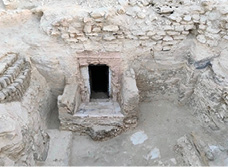
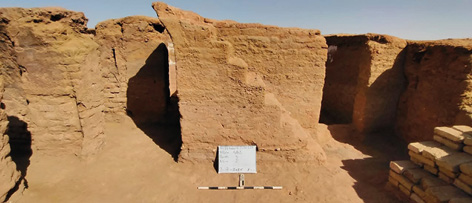
During the 2000s, ahead of proposed building work, Egyptian teams carried out excavations and rescue work in parts of the eastern cemetery near to el-Shatby, and excavated two Hellenistic tombs at the el-Haddad and el-Ibrahimia sites. Two large Graeco-Roman cemeteries were also discovered: one at el-Abd (2012-2019) and the second at Tanis Street (2013-2014). The Tanis Street site appears to have been in use during the Ptolemaic and Roman periods. Other work was carried out to the east at Sidi Gaber where, in 2018, a giant black granite sarcophagus was discovered (see AE 109, ‘News’).


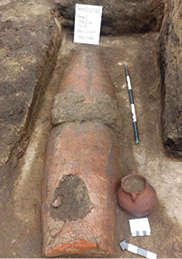
A closed cinerary urn discovered at the Tanis Street Site. Image: Nadia Abd-Elatif
Various types of graves were noted during the salvage excavations. At the Tanis Street site, the skeletons of adults and children were discovered inside limestone tombs. In some cases, the remains of painted plaster were found on the limestone slabs. Other types of burial in this area included simple burial pits, where the deceased was either placed directly in the pit, or in a coffin or burial jar. Intact and broken burial jars were found at the Tanis Street site.
Niche or loculus burials cut into limestone rock were found in the Hellenistic tomb at el-Haddad and in the Gabal el-Zaton cemetery at Gabbari. Cremation practices were also known in Alexandria, and the most important example from recent discoveries was a cremation burial in a Hadara vessel from el-Haddad. At the Tanis Street site, the remains of a broken pottery jar containing cremated bone were found in one burial, while a second burial was found to have a closed cinerary urn.

Various grave finds were discovered at the cemeteries. At the Tanis Street site in the eastern cemetery, these included a golden tongue and two leaf-shaped slips of gold that were found inside a broken skull, as well as oil lamps, perfume pots, beads, and coins.
The excavations at these cemetery sites show the extensive variety of burial types used, shedding further light on funerary practices in ancient Alexandria. Future analysis of the objects and human remains will hopefully reveal more about the people buried in the cemeteries.

Samar Ahmed Abu-Dahab is an archaeologist/bioarchaeologist in the Scientific Training Center of Western Delta and Alexandria, and a field trainer for Egyptian Inspectors in the field schools held by the Ministry of Tourism and Antiquities. She has participated in salvage missions and rescue excavations at various sites in Alexandria, including Tanis Street and el-Gabbari.
Further reading:
• M Borowik (2020) Funerary Practices in Ancient Alexandria in the Graeco-Roman Period (332 BC-AD 642): examples for syncretism in Alexandrian tombs and necropolises (Bachelor thesis, University of Warsaw).
• A Salem et al. (2022) ‘Rescue Excavation in Alexandria Eastern Cemetery: a case study from el-Haddad site’, in A Wahby and P Wilson (eds) The Delta Survey Workshop: Proceedings from Conferences held in Alexandria (2017) and Mansoura (2019) (Archaeopress Egyptology 41), pp.13-22.
CRE 2024: Current Research in Egyptology (CRE) is an annual postgraduate conference set up to facilitate research and promote bonds between British and international universities conducting research in Egyptology. Ahead of this year’s conference at the University of Liverpool (2-6 September), AE will preview six new research papers (three in this issue, and a further three in AE 144) by postgraduates attending the conference, beginning with recent excavations in Alexandria.