
Subscribe now for full access and no adverts
In the 1860s, the Yorkshire Museum received an unusual donation from Thomas Gott, a resident of Knaresborough. Gott was an ironmonger, but the metal plates, bowls, and other items that he had brought with him were much older than the objects that he was accustomed to working with. The artefacts were, in fact, the contents of a newly discovered Roman hoard, but Gott refused to reveal where this collection had been found. Even when he returned to the museum in 1876 to hand over the remaining portion of the hoard, Gott remained silent on the subject – and, as he died the following year, the secret of the source of the metalwork appeared to have died with him.
For almost 150 years, the mystery endured, and while today the objects – now known as the Knaresborough Hoard and displayed at the Yorkshire Museum – are recognised as one of the largest and most unusual hoards of late Roman metalwork ever found in Britain, no detailed analysis of the collection’s contents had ever been carried out, and little was known about how or where it had been discovered. This picture has dramatically changed, however, thanks to recent research based at Newcastle University. Recently published in The Antiquaries Journal (see ‘Further reading’ below), the study was carried out as part of the wider Knaresborough and Irchester Roman Hoards Project, which is led by James Gerrard, Professor of Roman Archaeology at the university.
The Knaresborough strand of this initiative included detailed analysis of historical documents and maps, drawing on special collections from Leeds University; in-depth research into the life of Gott himself, by Sally Gerrard; cutting-edge scientific analysis of the ancient metalwork at the Yorkshire Museum, by Marco Romeo Pitone; and the first comprehensive study of the hoard objects themselves, by Newcastle MA student Jessica DeMaso, through the Yorkshire Museum’s ‘Old Collections, New Questions’ initiative (funded by Arts Council England).
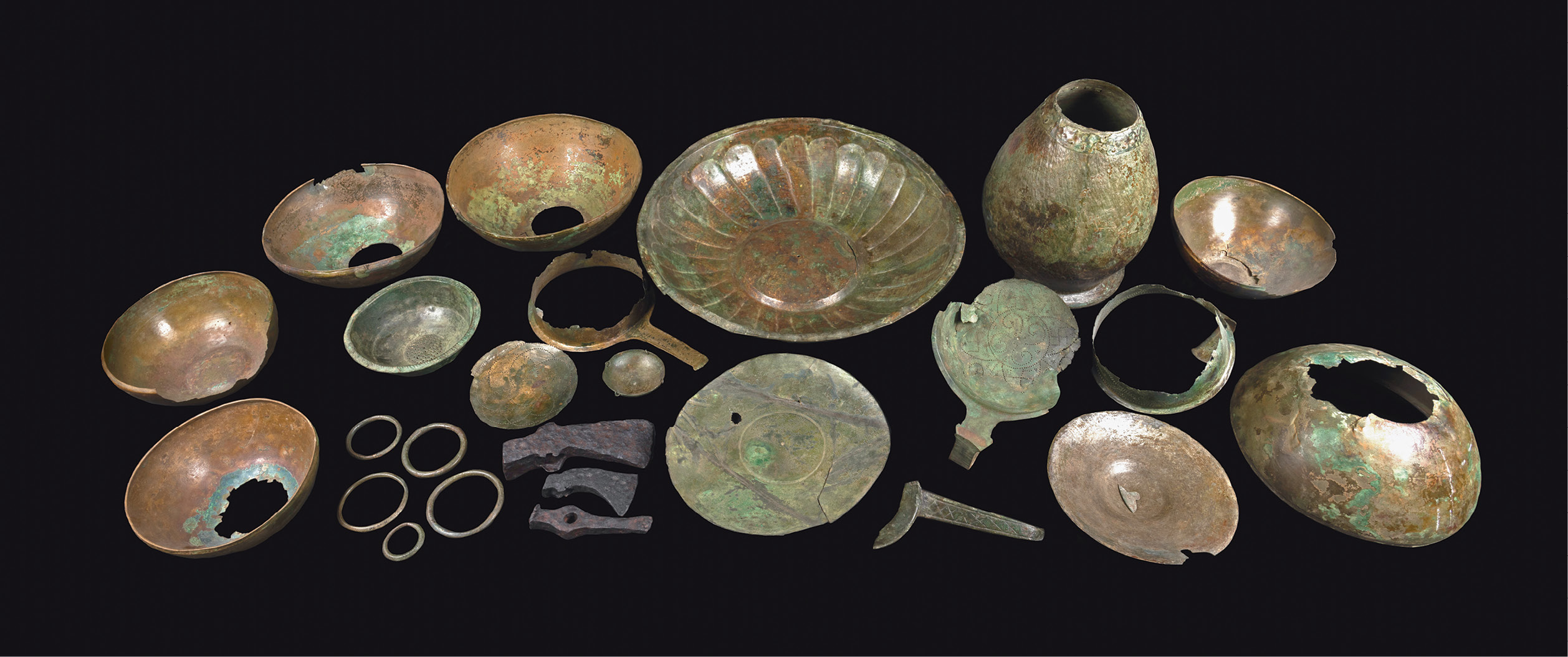
Taken together, the researchers’ work revealed new insights into the hoard’s contents, including how the objects may have been used and repaired before they were committed to the ground. The team is also now able to put forward a possible location for where they may have been buried, and to suggest a scenario to explain their discovery.
Illuminating objects
There are currently 30 Knaresborough Hoard items on display at the Yorkshire Museum, but the assemblage had once been much larger. Antiquarian sources studied by the researchers indicate that there had originally been enough to fill ‘a large sack’, even that the artefacts ‘would almost have filled a cart’ – what, then, happened to the rest? Again, historical documents reveal the sad truth: after the discoveries had been sent to Gott’s premises, an unfortunate oversight by his foundry foreman saw many of the Roman artefacts melted down and recast as new, Victorian objects, lost to archaeological study.
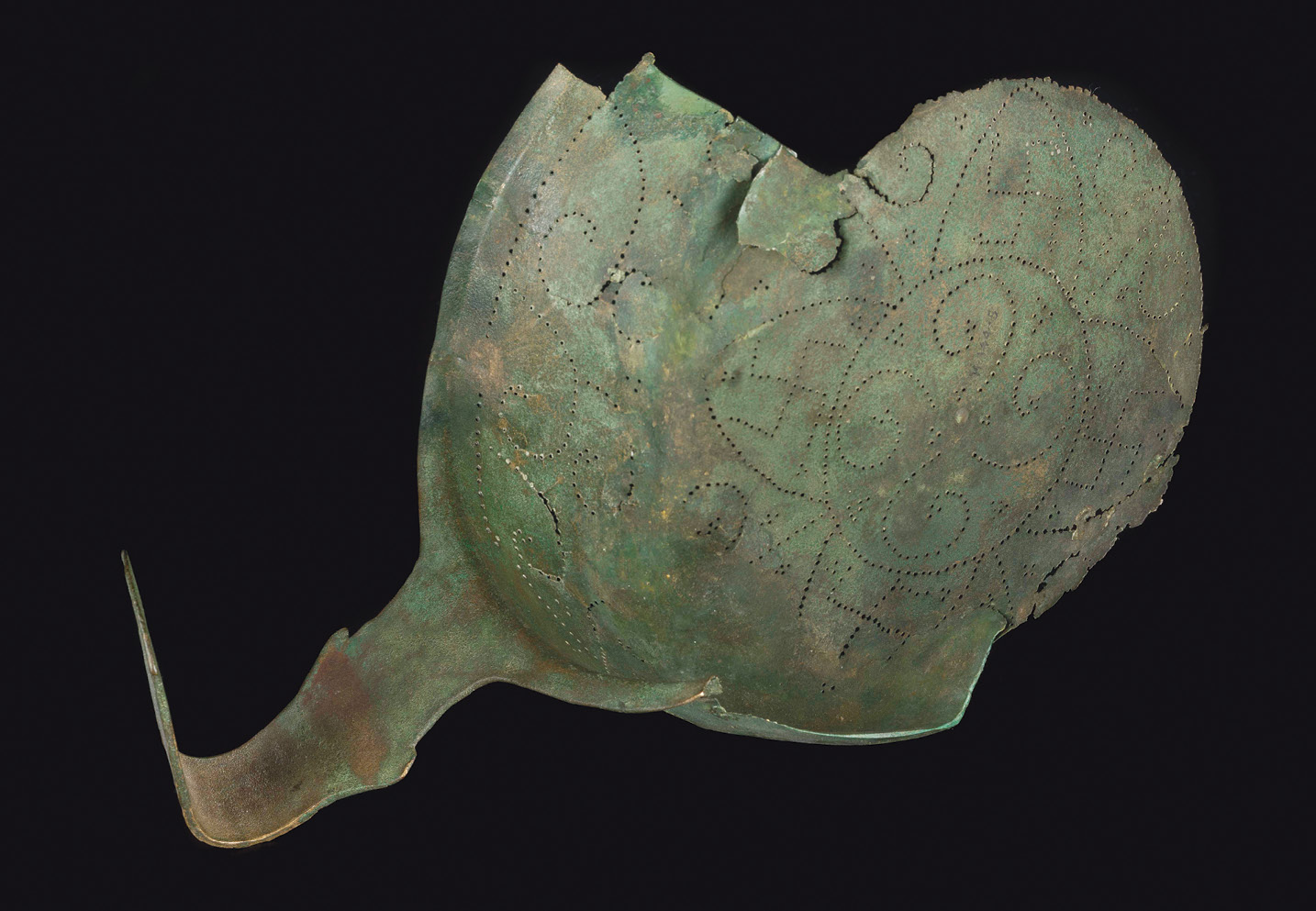
For the remaining pieces, however, much more information is available. The majority (26) are made of copper-alloy or leaded bronze, and for the most part they comprise tableware, including seven bowls, two plates, various strainers, a tall metal jar, and a handled pan and another, smaller pan with four loops for suspension, which probably came from a set of scales. As for the lost items, 19th-century notes attest that there had also been a cup (said to have been left in the possession of the anonymous landowner), oval plates with handles, more plates measuring 9in across, basins, dishes, and bridle bits.
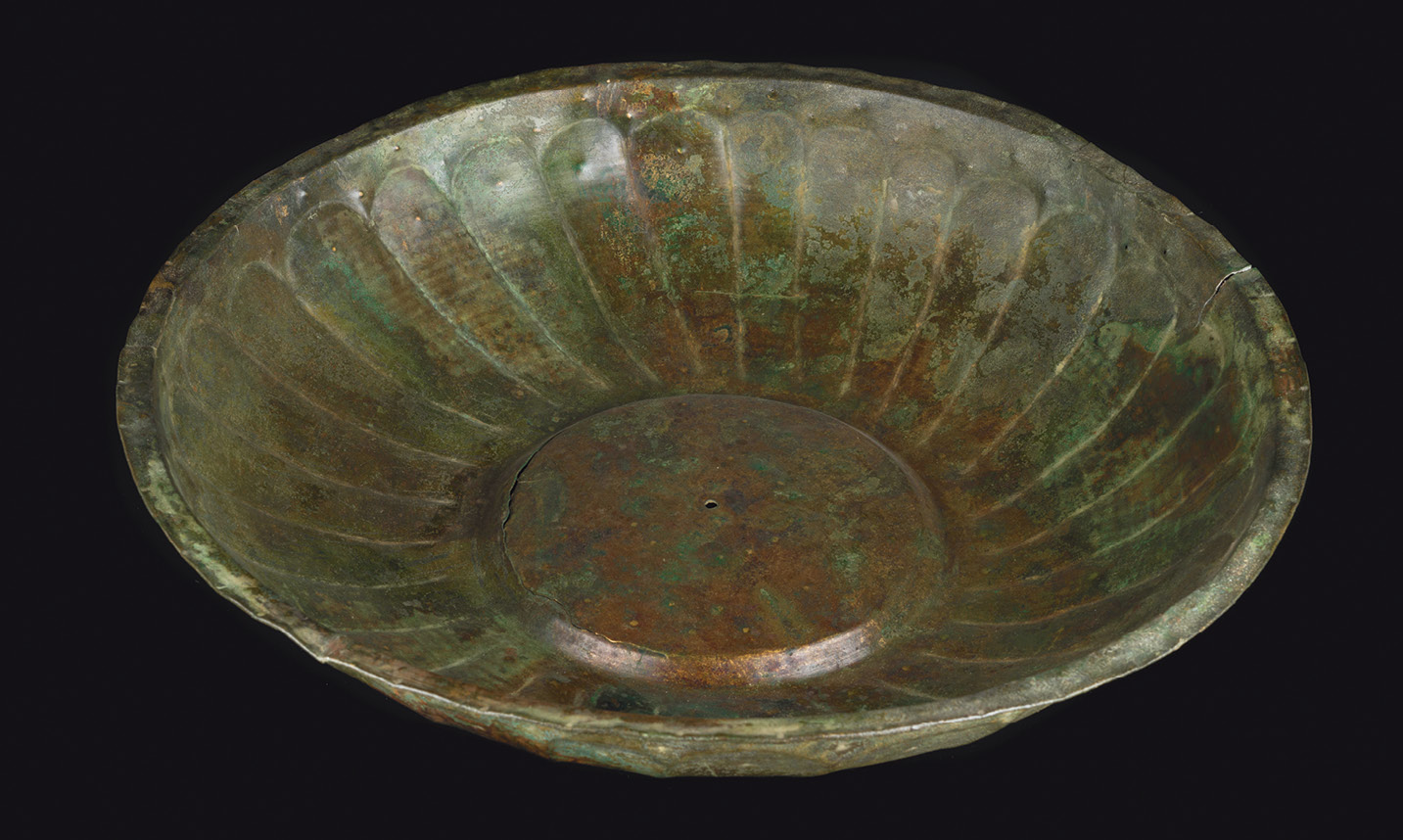
Particularly notable among the survivors is a large, fluted dish measuring almost 50cm in diameter and weighing over 2kg. Its scalloped design, forming 27 petals, replicates in copper-alloy a form of high-status platter that is more commonly seen in silver (such as in the 4th-century Mildenhall Treasure; see CA 229). The other six bowls in the group – which are of Irchester type, a well-known late Roman form – are smaller and less dramatic in appearance, but when highly polished their surfaces would have shone like gold, doubtless impressing any guests who might be invited to dine from them.
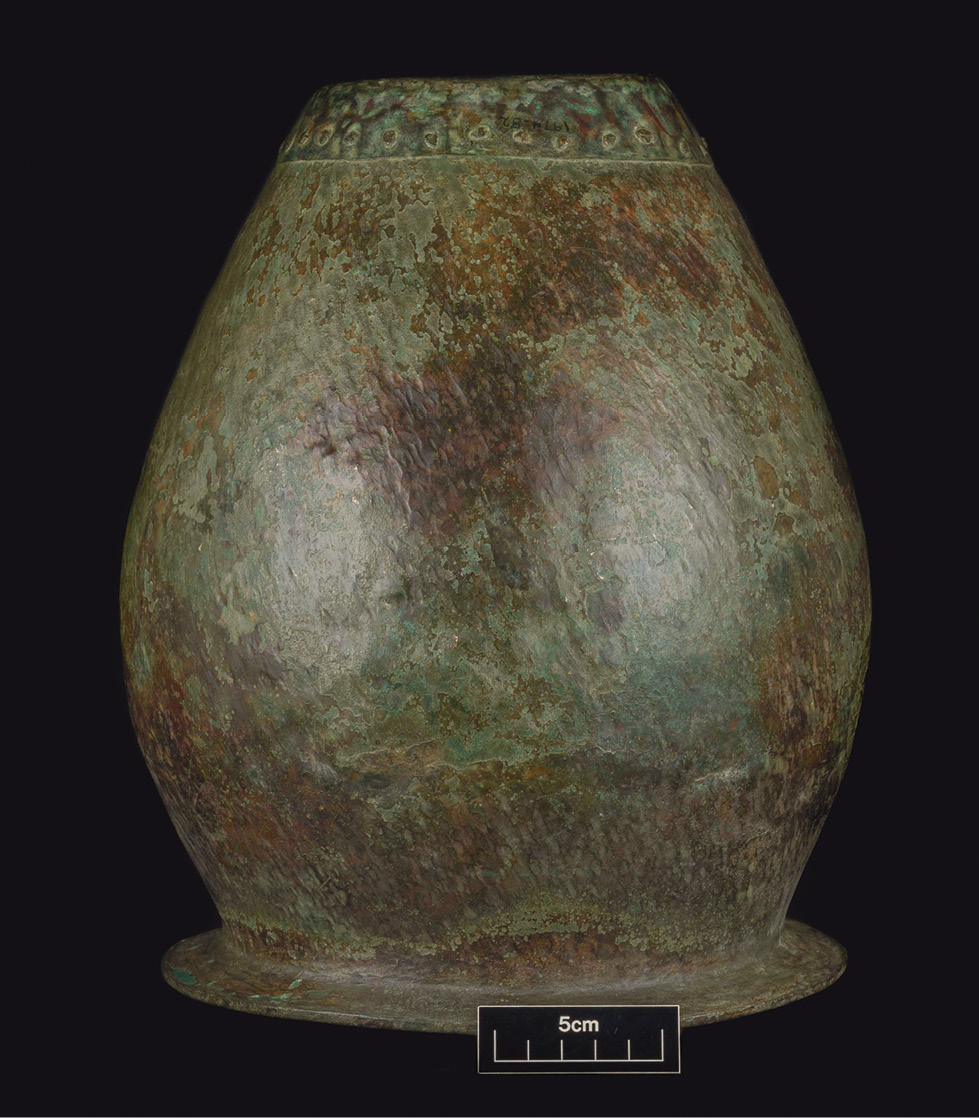
The handled pan is unusual, too: its handle, which is decorated with incised Xs, has a unique feature in the form of a now-broken protrusion on its underside, which may have helped the vessel to stand upright without being held. Finally, another idiosyncratic element of the hoard is a 30.5cm-tall vessel, made from leaded bronze but with a design that clearly imitates a common form of late Roman ceramic cooking pot. These items all evoke images of the creation or consumption of high-status meals; complementing them, the strainers (many of whose holes form intricately decorative patterns) may have been used to create infused beverages, perhaps flavoured beers or wines.

Practical finds
Alongside the elegant copper-alloy/bronze items, the Yorkshire Museum holds a handful of more practical iron objects from the hoard. These include two axes (one large, one small), an adze, and a smith’s cross-pein hammer, while 19th-century descriptions also mention lost ‘implements’ (perhaps more tools), a four-barred fire grate, a spur, and a ‘great quantity of nails’. These add a strikingly pragmatic aspect to an assemblage that might otherwise speak mainly of luxurious living, as the iron tools could have been used in a range of industrial activities, including wood- and metalworking. The iron grate, like the bronze jar described above, was perhaps used to prepare food, one step removed from the grand meals reflected by the dishes and bowls, while the scale pan is more likely a relic of commerce than the kitchen, owing to its small size.
As well as examining the artefacts by eye, the team carried out portable X-Ray Fluorescence (pXRF) analysis to explore the composition of the ancient alloys in their make-up: a process that showed up a number of ancient repairs and additions to the objects. We now know that the hoard items had not been new when they were buried – on the contrary, they had clearly had a long history of use, and some had required careful maintaining in order to prolong their working life.
The ‘cooking pot’ jar, for example, had undergone multiple repairs in antiquity. A hole in its body had been patched with resin and, while its base is missing, 27 rivets around the bottom of the vessel survive to testify to this being replaced at some stage, too. As for the Irchester-type bowls, one had acquired a ‘new’ base at some stage, with the replacement made of gunmetal in contrast to its leaded bronze body, while another had received a riveted patch.
After examining all the artefacts in the hoard, both surviving and attested only in written sources, the team believe that the assemblage dates to the very late 4th century. They note, however, that, while it is unusual for iron items to be included in late Roman vessel hoards, Knaresborough’s ferrous finds compare well with other known early and late Roman iron hoards. As a result, they float the idea in their paper that, although this might have been one discrete, rather idiosyncratic assemblage, the finds could represent two separate deposits made in close proximity.
Why, though, were these expensive items – made of materials that would have still been valuable even as scrap for recycling – buried in the first place? It could be that they were intended as a lavish votive offering or other ritual gesture – or, perhaps, they were not meant to be interred eternally. Given their value, perhaps these objects had been buried for safekeeping, with the intention of returning to recover them later. If this was the case, though, the objects’ owner never came back for them, and it appears that the hoard remained undisturbed until its rediscovery some 1,500 years later.

Location, location, location
Whatever the motivation behind the hoard’s burial, what can be discerned about how and where it was found? Despite Gott’s reticence, a clue (albeit one written decades after the discovery) comes from the Yorkshire Philosophical Society’s museum handbook of 1891. This text says that the hoard was found by ‘some drainers between Knaresborough and Aldborough’ – and we can add further details to this, thanks to a rather more contemporary source examined by the Newcastle researchers.
Antiquarian interest in the Knaresborough Hoard soared after the discovery of another, similar vessel hoard at Irchester in 1874. This collection comprised eight bronze vessels (five bowls, one ladle, and two strainers) stacked inside an iron-bound bronze tub, and is thought to date to the late 4th century. It was found during ironstone mining and, crucially, a report on its contents, published in 1876 – the same year that Gott donated the second portion of his own finds – also includes a note about its Knaresborough counterpart. There we learn that Gott’s hoard had apparently been uncovered by workers digging a drain some two miles north of Knaresborough.
After examining maps of the period, the team deduced that the best candidate for this location was a village called Farnham – a place that also has a link with Gott, as an advert in an 1864 edition of the Yorkshire Gazette attests that he owned property in the area. Just north-east of the village is the Low Hall estate, which was owned by Sir Charles Slingsby, and his lands there included a boggy area called the Bottoms. Significantly, the archive of Sir Charles’ estate papers includes a plan for a proposed new drain to go into this marsh, dated 1863. Could this be the 1864 drainage project that had reportedly produced the hoard? The plan clearly went ahead, as the drain is depicted on later editions of Ordnance Survey maps, and this area has another promising connection with Thomas Gott. Records attest that Sir Charles’ estate manager at Low Hall was one Frederick Hartley, and he, like Gott, was a member of the Knaresborough Improvement Committee.
In this light, the researchers propose a scenario whereby drainage workers found the hoard in the Bottoms and, perhaps because of the iron tools in its make-up, Hartley thought it might be of interest to his ironmonger colleague. If this is true, we don’t know if the metalwork came into Gott’s possession as a gift or if money changed hands; likewise, it is unclear if this event was open or illicit – might Gott have been reluctant to disclose the findspot because Sir Charles didn’t know about the hoard, or at least the full extent of its contents (given that a cup was reportedly left in the possession of the landowner)? Alternatively, it could have been an act with the blessing of the Baronet, who perhaps wanted to remain out of any excitement surrounding the discovery – this might explain why Gott remained reticent at the time of his 1876 donation, even though Sir Charles had died in a hunting accident years earlier.

Today, the area in question is an artificial lake, making further exploration of the potential findspot unlikely – but if the Knaresborough assemblage was a bog hoard, it would be very unusual, the team said. Of the 18 late Roman copper-alloy vessel hoards of the 4th-5th century that they cite, almost none were found in marshy ground. Although natural watery spaces were favoured for metal deposits in the early Roman period, by this later stage it appears that Romans preferred doing their hoard-burying on dry land. While the study has revealed many invaluable insights into the story of this enigmatic assemblage, then, the hoard continues to raise further questions, and to challenge our assumptions about what hoarding meant in Roman Britain.
Further reading
J Gerrard et al. (2023) ‘A multidisciplinary analysis of an antiquarian discovery: the Knaresborough 1864 hoard of late Roman vessels’, The Antiquaries Journal: https://doi.org/10.1017/S0003581523000197.
All Images: York Museums Trust and the Yorkshire Museum, reference number YORM H144