
Subscribe now for full access and no adverts
From the Cenotaph on London’s Whitehall to the more contested Bomber Command Memorial in nearby Green Park, war memorials loom large in our national consciousness. But, as we shall see, the way we remember the fallen, and the monumentation that involves, can be both deeply personal and highly political, as each generation seeks to recast the past in ways that inform both the present and the future.
For my new book Lest We Forget, I criss-crossed the United Kingdom to visit Britain’s 100 most outstanding memorials to war, speaking to families, veterans, military historians, and others to whom they matter the most, on a quest to gain a better understanding of how our patchwork quilt of nations went from fighting each other to fighting together. As Remembrance Day approaches, I have picked out just ten monuments – many of which, it should be noted, result from the rediscovered passion for statuary that was a feature of the 19th century – and which together offer a concise guide to Britain’s extraordinary military legacy, both then and now. Here is their story…
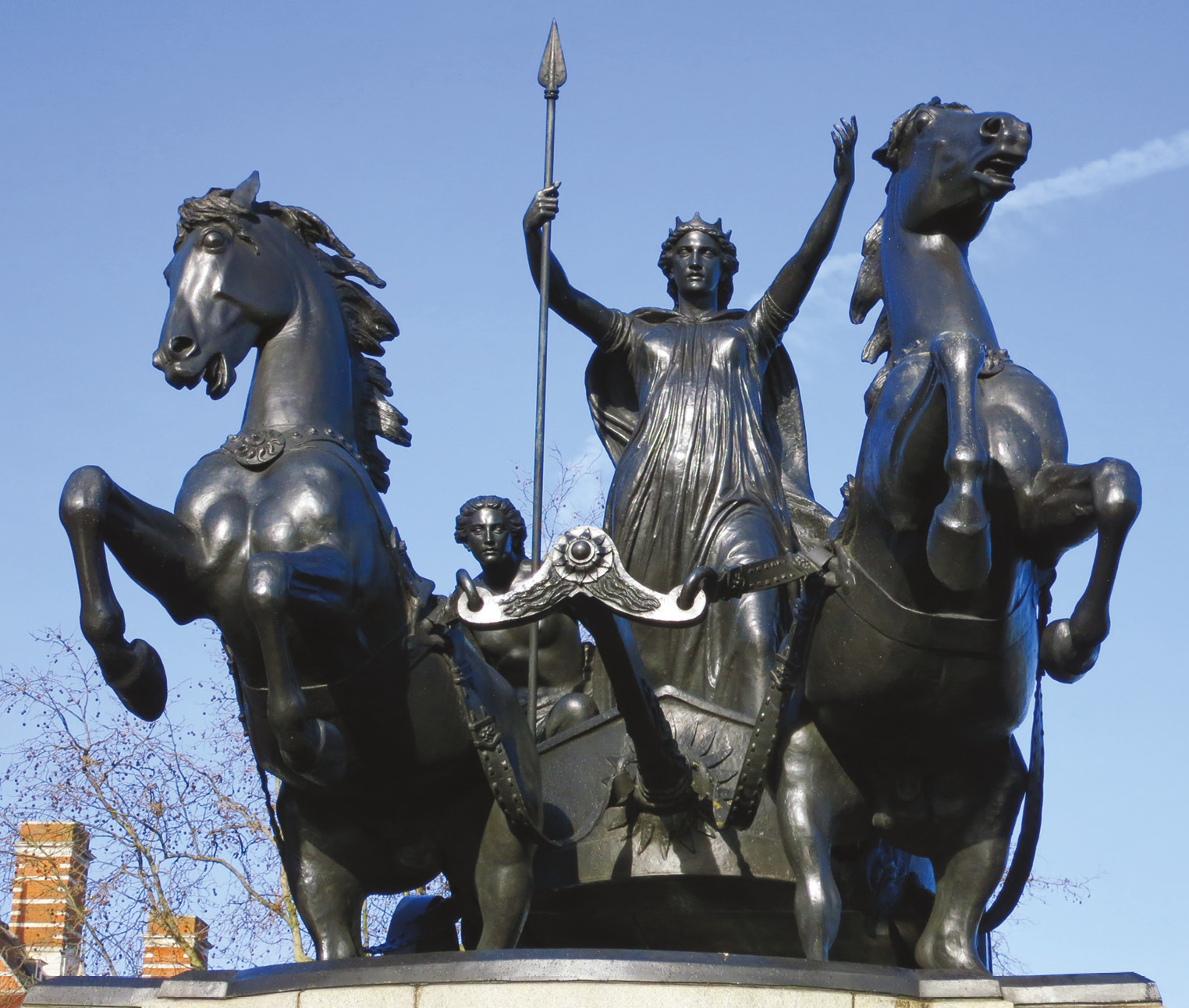
Boudica and her Daughters Westminster Bridge, London, 1902
‘Miss! Miss! I can see Boudica!’ Walking along Westminster Bridge, we make our way towards the famous bronze statue of England’s defiant Iceni queen, her horses straining towards the Houses of Parliament, her arms unfurled, unapologetic. Commissioned in the 1850s, and erected the year after Queen Victoria’s death in 1901, this is the Empire personified.
‘But I thought she was fighting the Romans, Miss!’ How do you explain to a class of eight-year-olds that the Boudica they are looking at really belongs to the later British Empire? If Boudica did exist (nowadays some historians query even that, though most believe Tacitus wasn’t a complete fantasist), we can be fairly certain she did not resemble Queen Victoria, and neither carried a Persian spear, nor drove a Roman chariot. But that is the Boudica that the sculptor Thomas Thornycroft designed. His recasting of England’s first female freedom fighter was primarily designed to embolden Britain’s imperial reach.
High above the children, Boudica’s own daughters hover, their naked breasts unmissable. A side note for adult learners: while failing to honour an agreement made with Boudica’s late husband, the Romans also raped her daughters. Raging Boudica went on to destroy Roman-occupied Colchester, St Albans, and London in AD 60 or 61. As I write two millennia later, Hamas is accused of sexual violence in the 7 October 2023 attacks. Raging Israel is accused of systematically destroying Gaza. And only relatively recently have rape and sexual violence been recognised as weapons of war. Boudica seems as relevant today as she was 2,000 years ago.
Alfred the Great Wantage, Oxfordshire, 1877
Within the Great British story, the celebration of much smaller Scotland and Wales fighting the oversized English has left an abundance of statuary commemorating the Celtic nations’ revered aggression. We love a plucky underdog. It is far harder, however, for Anglo-dominant Britain to crow about early England’s own victories. This queasiness concerning early English heroes who bested their nearest neighbours helps explain why Alfred the Great has acquired such prominence in statue form.
The original ‘England’s Darling’, and the only English king to be known as ‘the Great’, Alfred crucially made his name fighting a lethal foreign foe: the Vikings. Victorian England could not get enough of him; his statue form peppers the southern counties. A favourite stands in Market Place, Wantage, the unassuming town of his birth in 849. Carved by Queen Victoria’s cousin, the 19th-century sculptor Count Gleichen, from an 8ft lump of Sicilian marble, and sporting a chipped sword, he has never been more popular.
A local preacher explains that this founder of early England ‘arrived in a dysfunctional state with no army and no learning. And he was humble.’ But the real clue to Alfred’s enduring appeal lies in the last line of his Wantage plaque, which acknowledges that he saved ‘a land ravaged by a fearful enemy’. This bookish younger son, who never expected to be king, triumphed over the insolent Vikings, and then made good his Christian victory with a just peace, fortifications, and learning. His is the acceptable face of Englishness.

The National Wallace Monument Stirling, 1861-1869
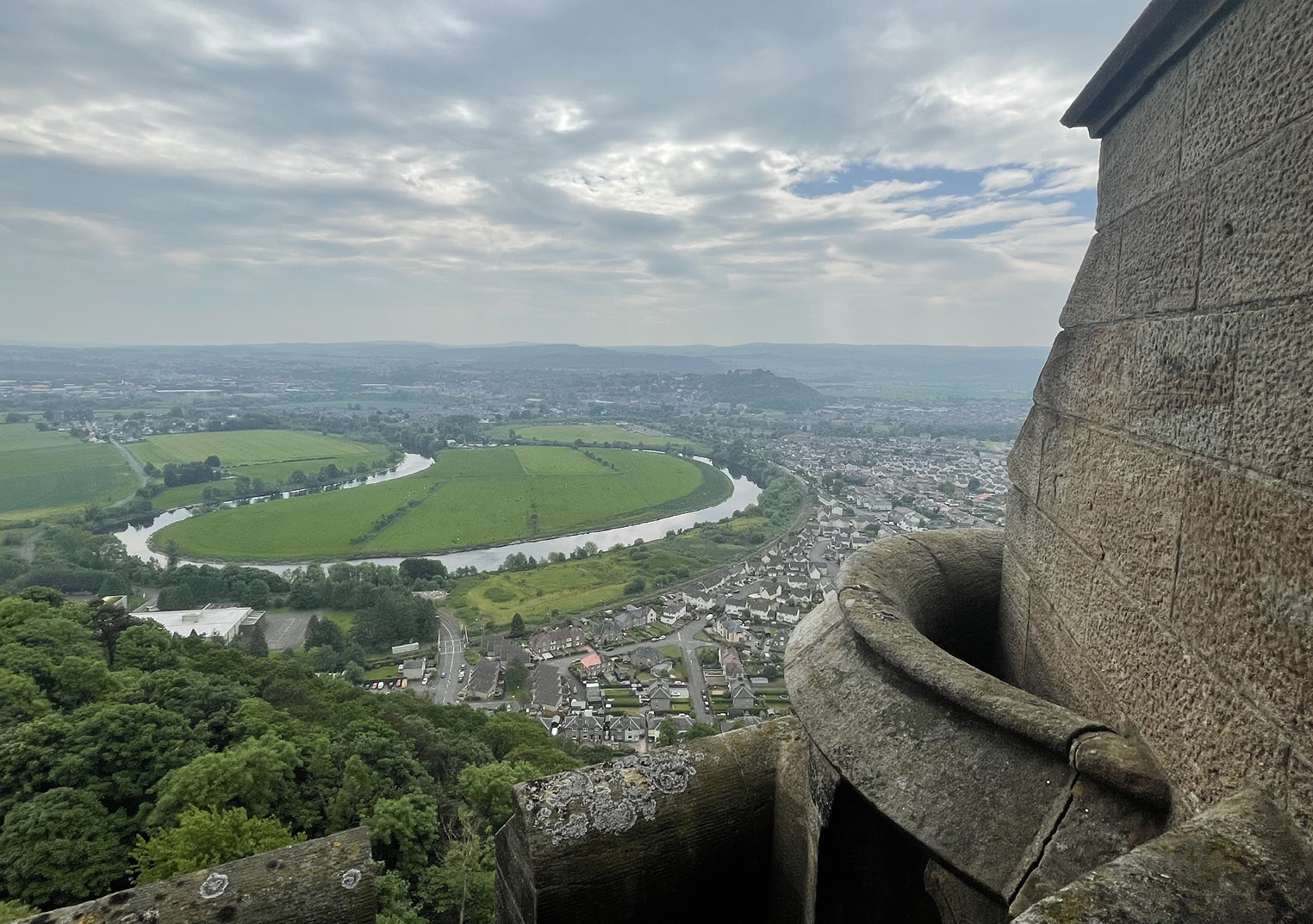
We have just completed a whistle-stop tour of William Wallace monuments in Stirling’s historic city centre, and Steven Hughes, the local tour guide, has left the biggest till last. ‘A craig is a rock. Stirling Castle is on one craig, the Wallace monument on another – Abbey Craig,’ he explains. As the saying goes: ‘He who holds Stirling, holds Scotland.’ I follow Steven’s McDuff tartan up 246 steps of remembering. He believes in the idea of Wallace as a medieval democrat, a low(ish)-born freedom fighter who held out against English suzerainty and bullying in the late 13th century.
The Wallace Monument itself arrived more than 550 years after Wallace’s exploits, a behemoth to remembering built in the 1860s, when Scotland was flaunting its own baronial style within the British union. Up we climb, to the Hall of Heroes. It celebrates 18 different Scottish heroes and is Steven’s least favourite floor. ‘Why give over a quarter of the monument to other heroes? Why can’t they go deeper into the Wallace story?’ Academics have likewise pondered Scotland’s dilution of its own indignant past, concluding that Victorian Britain would not tolerate anything too violently anti-English.
From the majestic summit, overlooking the site of Wallace’s landmark 1297 victory over the forces of King Edward I at the Battle of Stirling Bridge, the logic of trapping legions of English in the River Forth’s nearby horseshoe bend is immediately apparent. ‘Wow,’ I say. Steven insists: ‘After that, Edward Longshanks was never going to let Wallace survive.’ I nod. Standing atop this enormous, 220ft-high edifice, it’s easy to forget that William Wallace was ultimately defeated and killed, the victim of a brutal English execution.
Naseby Obelisk Naseby, Northamptonshire, 1823
Nothing speaks to our national story like a monument – the bigger the better. Today, all the talk is of a pending royal statue to commemorate Elizabeth II’s reign in London’s St James’s Park – a reminder of the royal continuity behind our national story. The appearance of uninterrupted monarchical rule is the reassuring narrative to which many of our monuments and statues speak. Even the decapitated Charles I enjoys a fine bronze equestrian state in Trafalgar Square, which (unlike the king it represents) is a remarkable survivor of the civil wars fought across three kingdoms between 1639 and 1653.
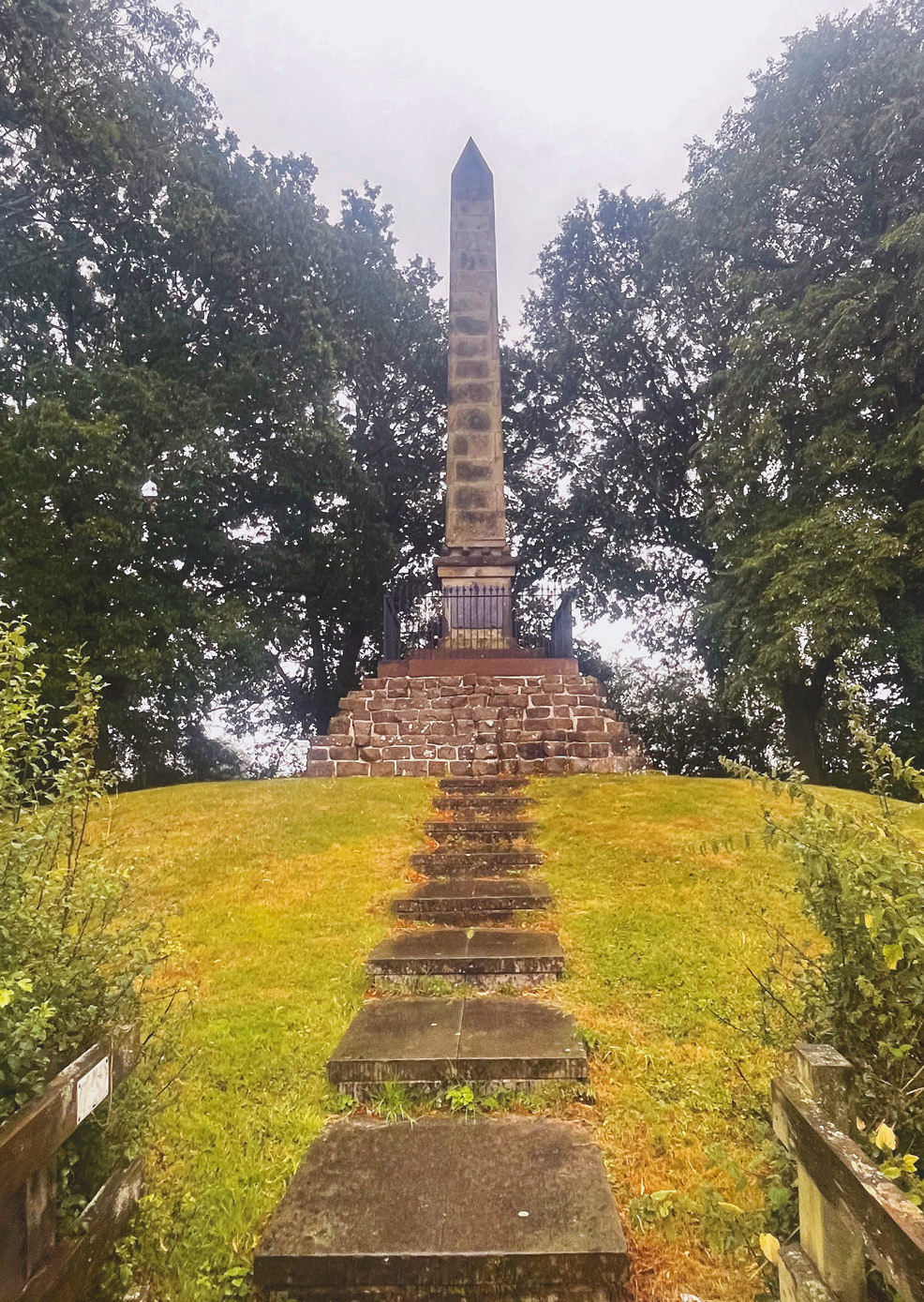
However, finding impressive monumentation to the killing fields of the 17th century, which saw proportionally more inhabitants of the British Isles die than the First World War, is a harder task. Cue an unremarkable obelisk in Naseby, erected on the one-time rendezvous spot for the Parliamentarians’ New Model Army under Sir Thomas Fairfax and Oliver Cromwell, ahead of their decisive victory on 14 June 1645 over the main Royalist army under Charles I and Prince Rupert. Built in 1823 (the ‘Cool Britannia’ era post-Waterloo), the obelisk is the largest memorial across a site begging to be repurposed into a significant historical landmark.
If irreconcilable world views in the 17th century saw the British Isles resort to arms, surely today’s culture wars, replete with street violence, find an echo in those times? The conflict has much to teach us about nascent Britishness, when an individual’s relationship with God and Parliament competed with their commitment to the King, pitching neighbours and nations, Puritans and Anglicans, royalists and republicans, each against the other.
In the words of the local grandee, Charles, Earl Spencer: ‘Some may think it is a shame that Naseby is not properly marked on the map as a vital element of this nation’s story. I think it is a disgrace.’
The Duke of Wellington Royal Exchange Square, Glasgow, 1844
The end of the Napoleonic Wars in 1815 heralded a rash of impressive monumentation across England, Ireland, and Scotland. The French scourge had finally been defeated both at sea and on land, fulsome proof that Great Britain was the predominant superpower. With Jacobite upheavals confined to the previous century, and keen to prove its heft within the union, Scotland was especially quick to build to victory. Horatio Nelson’s first monument arrived on Glasgow Green, a construction mission completed in 1807, some 36 years before the seafaring hero received his Column in London’s renamed Trafalgar Square. Likewise, Glasgow was the recipient of one of the Victorian era’s finest equine statues to the Duke of Wellington, the Battle of Waterloo’s famous general.
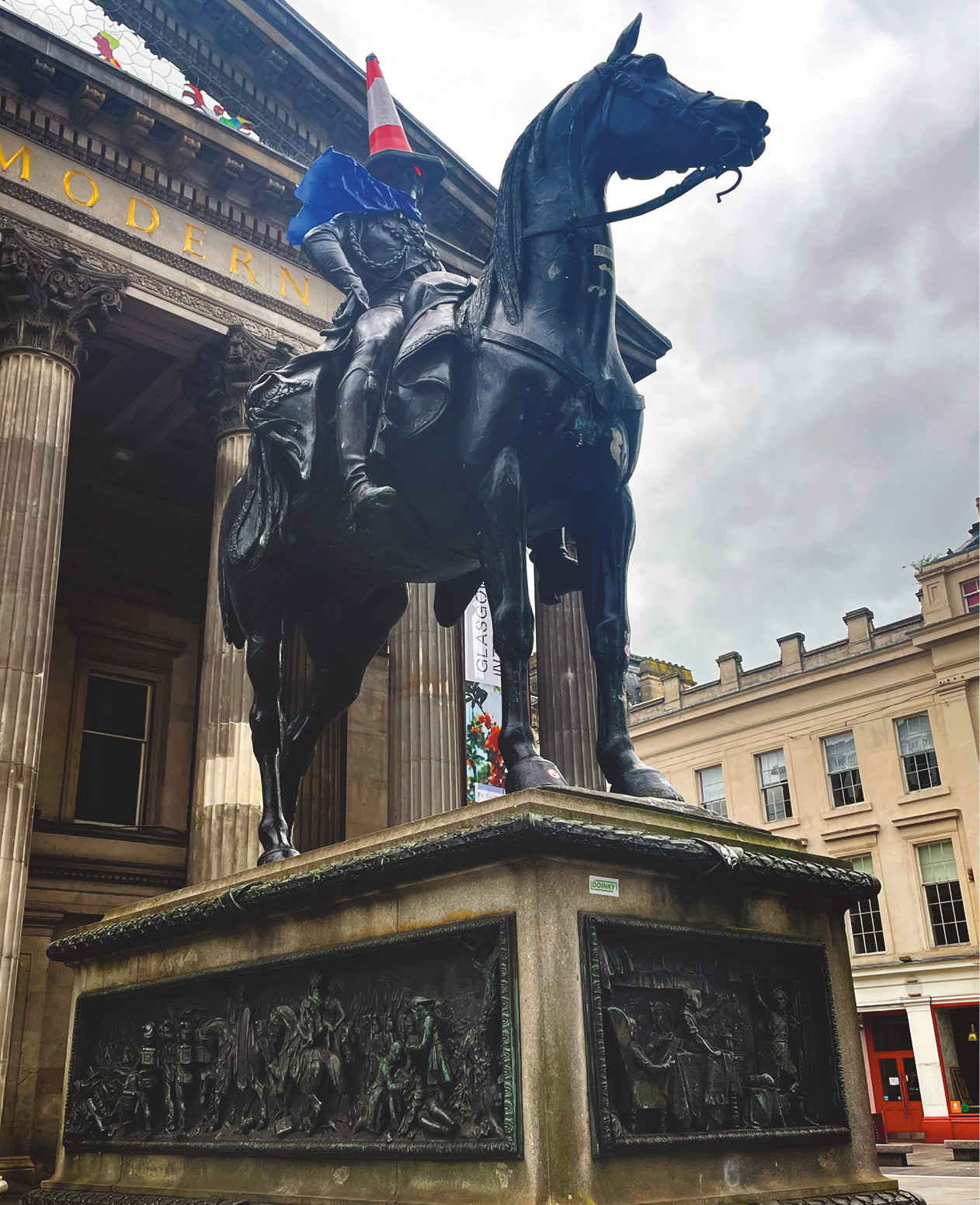
Italian sculptor Carlo Marochetti did a fine job of the hero-general and Copenhagen, his magnificent steed. But in contemporary Glasgow, people no longer visit the statue for Wellington or his horse – but rather for the traffic cone that for 40 years has famously and almost constantly been perched on the Duke’s head. A local man named Gavin Doig was responsible for the petition, and for the pushback against the local council when it tried to raise the statue’s plinth to stop the prank that has persisted since the 1980s. ‘Glasgow is not anti-British,’ he explains, ‘just anti-Establishment.’ Meanwhile, proof (if any were needed) that the Battle of Waterloo has experienced historical slippage can be found in the Iron Duke playing second fiddle to a traffic cone in Glasgow’s city centre.
Crimean War Memorial Bath Abbey Cemetery, Bath, 1856
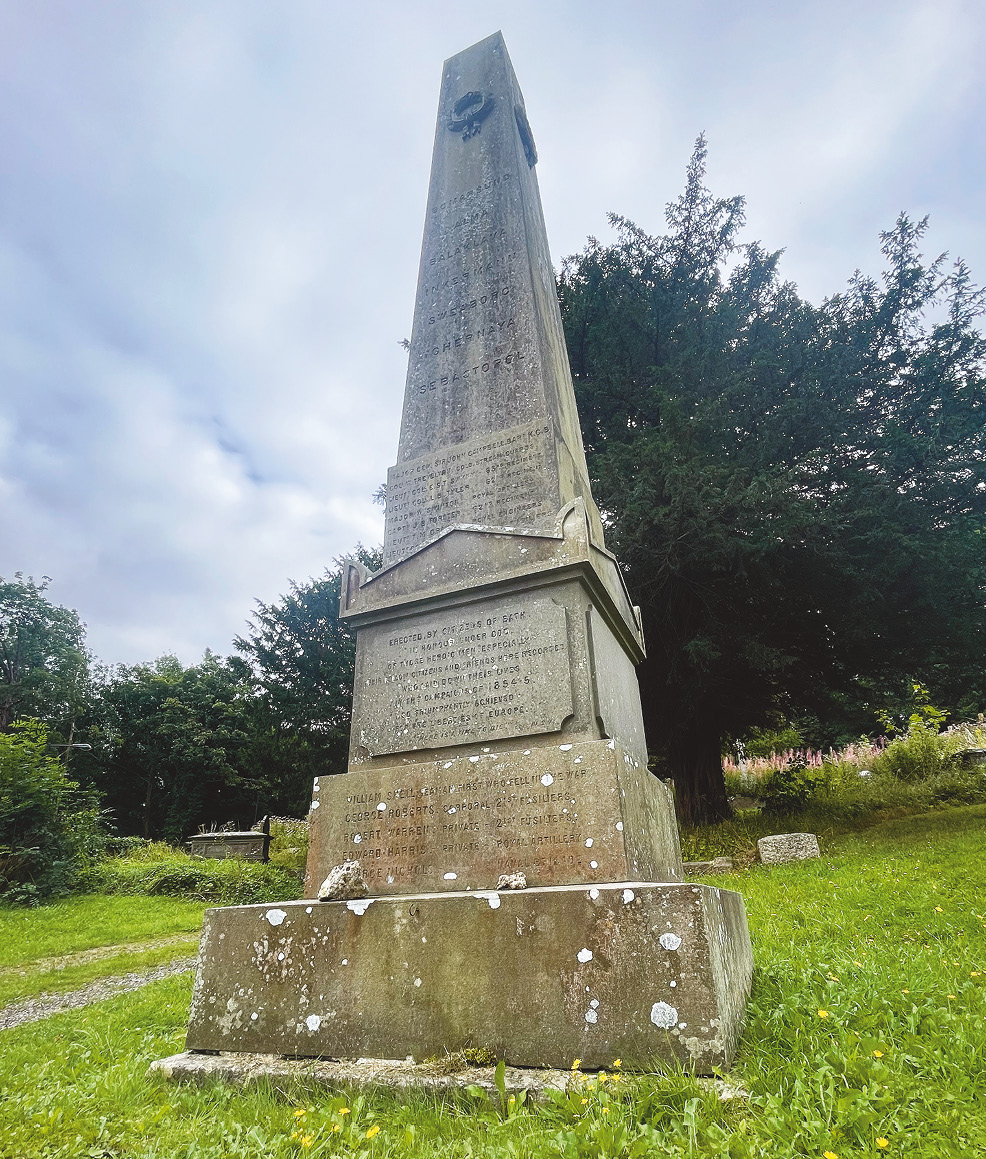
It is commonly assumed that the major gear change away from individual hero-worship to a more complex blend of commemoration – one that included the rank and file – came in the wake of World War I’s horrific death toll. Those in the know might point a corrective finger at the earlier Boer War, otherwise referred to as ‘the Forgotten War’ – which claimed 25,000 British lives for a pyrrhic victory in Imperial Britain’s Southern Africa (there is a Boer War Memorial somewhere near you) at the turn into the 20th century. But the first public monument I discovered that commemorated the rank and file was to the even earlier Crimean War, fought against the Russians by the French and British in 1853-1856. Another conflict marked by futile loss (two female nursing heroes, Florence Nightingale and Mary Seacole, speak to the main killer: disease), this war put Britain’s soldiers at the forefront of public consciousness for the first time. Never before had an uncensored press provided on-the-ground coverage and sketches of the horrors the military endured, nor of their heroism.
That the Crimean War Memorial in Bath commemorates the lives of 13 men, from major general to humble private, is testimony to the importance of the press at the time. Back then, the battle sites of Alma, Balaklava, Inkerman, and Sevastopol were household names. Today, conflict still rages in the region, and never has war-reporting been more important, or so dangerous. I spoke to the sister of Pierre Zakrzewski, a British-based Irish-French cameraman, who was killed when filming in Ukraine for Fox News in 2022. There is no monument to his service – nor to that of the growing number of his fallen journalistic comrades, now well into double figures. In Gaza, it is even worse, with press casualties from the current conflict numbering more than 200. Bath’s pioneering memorial is a reminder of the importance of the pursuit of truth amid the fog of war. Who will build to that?
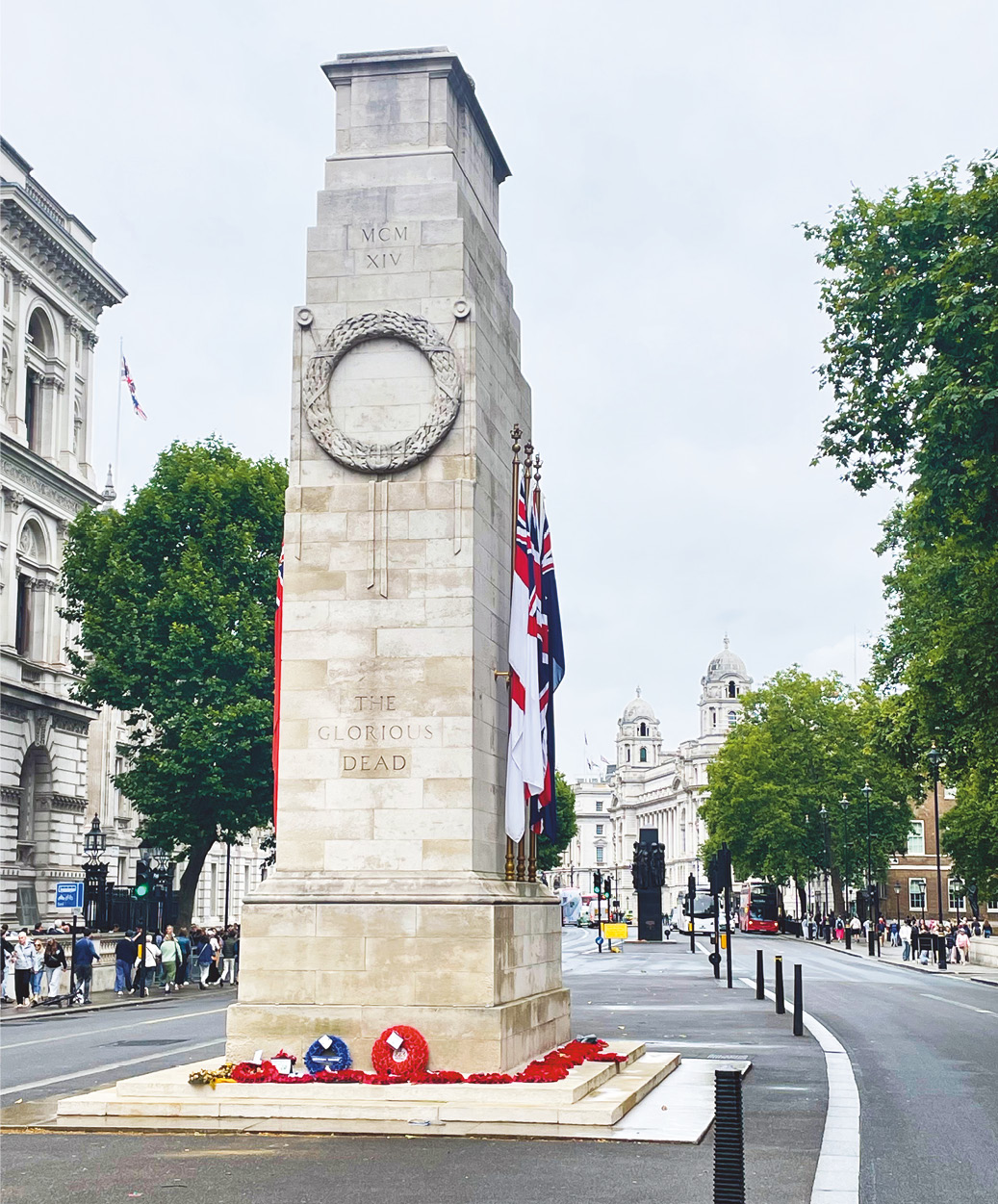
The Cenotaph Whitehall, London, 1920
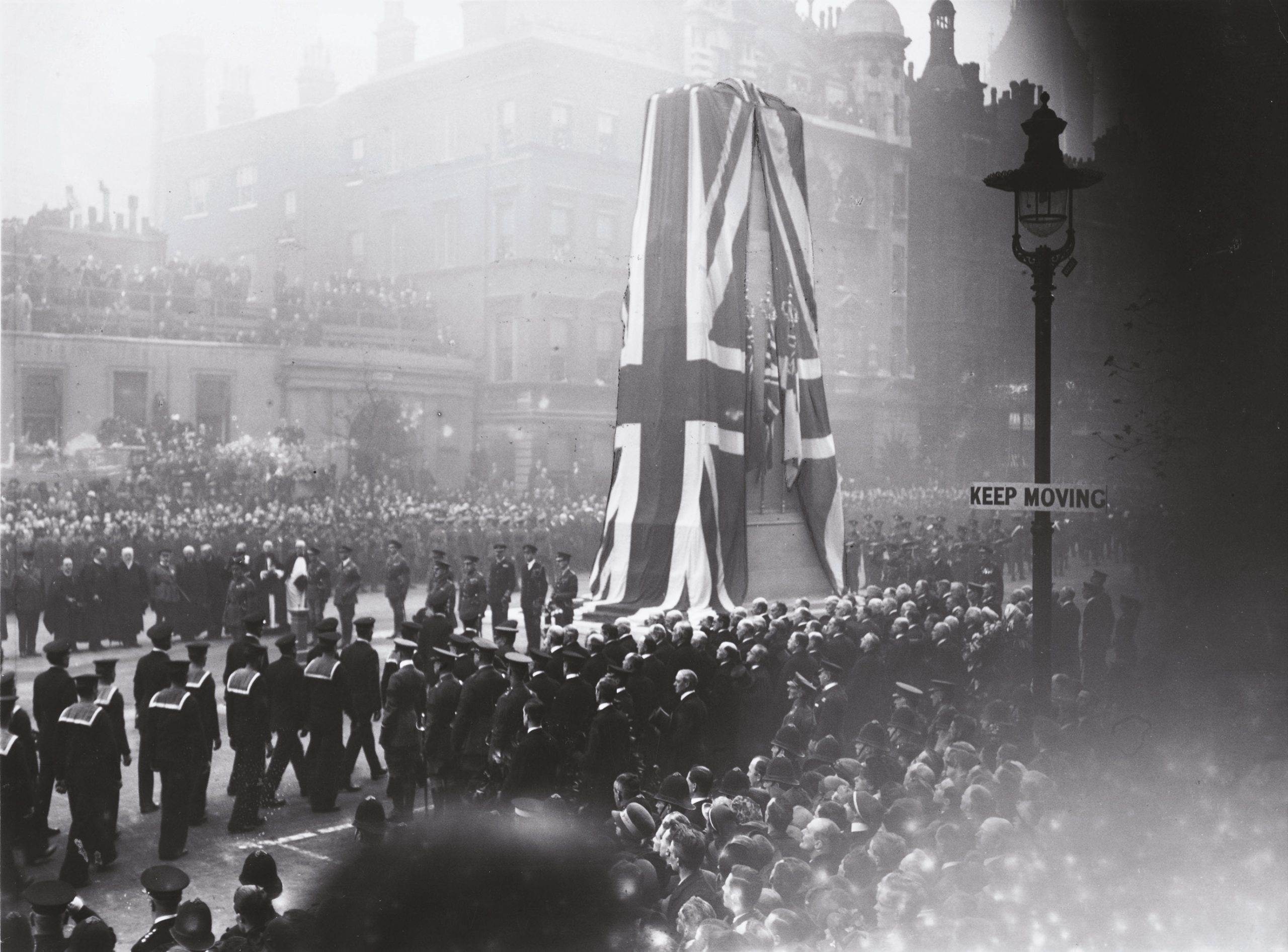
Much has been written about the design of this universal monument to war. Soon to be replicated in catalogues, stamped out in a variety of forms across the UK and beyond, architect Edwin Lutyens’ use of Classical form and eye for abstract perfection articulated a silent, universal grief few could criticise. The losses were so great from World War I’s mechanised killing spree that Victory Day quickly gave way to Peace Day, which saw a temporary structure symbolising an empty tomb recast into a permanent Cenotaph carved from Portland Stone.
It provided a unique structure for more than a million dead service personnel from across Britain and its empire, with the avoidance of religious or national symbolism gifting to future generations a monument that speaks to everyone, from the king to the unknown warrior. When George V unveiled the Cenotaph on the 11th hour on the 11th day in November 1920, the integral connection between commemoration, soldiering, and royalty was reaffirmed for the modern era. Walk down Whitehall today, stand before the extraordinary, eerily perfect Cenotaph, and who springs to mind? The Glorious Dead? Or Glorious Royalty? Or both? Stooping in the face of old age and infirmity, the monarch lays a scarlet wreath, and honours the fallen, then and now.
Commando Memorial Spean Bridge, Lochaber, 1952
I have driven a long way, sometimes on a single-track road, on a mission to arrive at the Commando Memorial, about ten miles from Fort William. The cloud sits low, a sodden grey blanket obliterating legendary views of Ben Nevis. Like war, Scottish weather is unpredictable.
I touch a wet metal boot at head height and look up at the monument, designed by Scott Sutherland, who in 1949 won a competition open to all Scottish sculptors. Three Commandos on a plinth, Action Men in battledress, stand tall with the accessories of their war – Tommy gun, Commando knife, binoculars. This was a rare early statue to World War II, unveiled by the Queen Mother in 1952. Post-1918 saw the largest outpouring of public art the country had ever witnessed – but it did not stop another conflict from taking place. Post-1945, in bombed-out Britain, other building projects took priority.
Across the UK, memorials to the Great War had to budge up and make space for the names of another generation of dead service personnel. The Commandos’ memorial was an exception made for an exceptional service: Winston Churchill’s brainchild, this elite fighting force was the prime minister’s solution to the dark days of 1940. Beleaguered Britain needed an extreme and unorthodox military force to fight outside conventional lines. This was much more than soldiering. And it came at a cost: 1,700 green berets lost their lives in World War II. Their outstanding memorial, located just miles from the original Commando Basic Training Centre at Achnacarry, on the exposed southern tip of Scotland’s Great Glen, speaks to that risk.

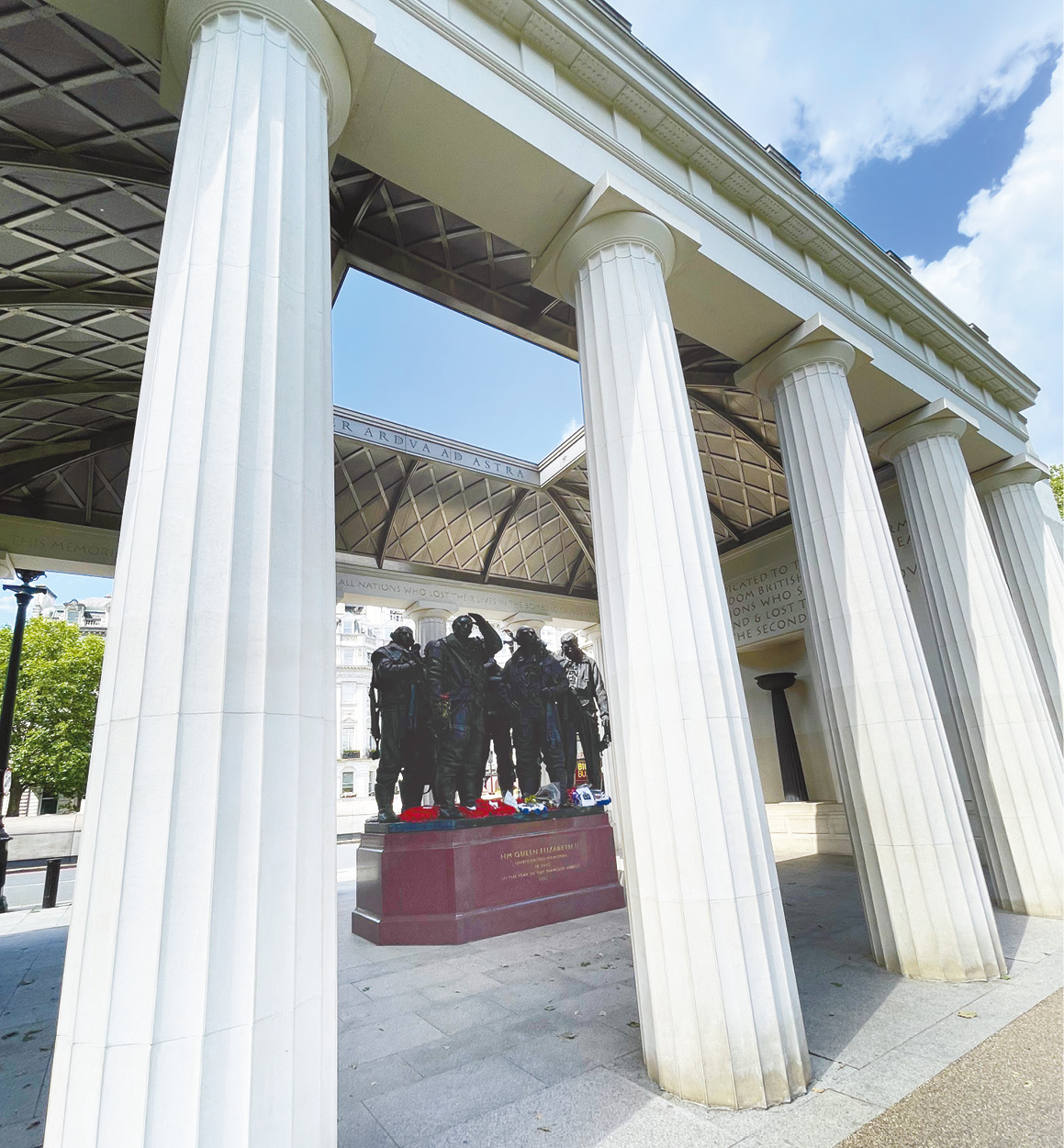
RAF Bomber Command Memorial Hyde Park, London, 2012
A recipient of the Distinguished Flying Cross (DFC), Colin Bell, now 104, was a Mosquito pilot during World War II. He is a slight man, around 5ft 6in tall, who flew for Bomber Command, mainly over Berlin, and mainly at night. ‘I was a path-finder out in front. I flew 50 raids over Berlin,’ he tells me. And unlike the 55,573 servicemen who never returned, Colin survived. ‘I’ve been lucky all my life.’
But post-war, as the decades rolled on, Colin and his fellow airmen were increasingly aware that their service had been overlooked in the commemorative landscape. The general reluctance to build monuments to World War II was dramatically reversed in the 1980s, when Thatcher’s Britain, at war in the Falklands and struggling in Northern Ireland, focused on its reputation as the country that had held out against the Nazis. This political impetus coincided with veterans reaching nostalgic old age, with the time and inclination now to look back on an extraordinary conflict that defined their youth. Memorial iterations continued apace – the nation remembered war leaders, Commonwealth nations, female service, dislocated children, and even animals. But the Bomber Command Memorial wasn’t unveiled until 2012 – a gigantic imperial edifice, whose sheer bulk compensated for its late arrival on the commemorative scene.
An uneasiness about Bomber Command’s legacy explains that delay. Post-war, Churchill had distanced himself from the carpet-bombing of Germany that had killed more than 400,000 civilians. There had been disquiet in Cabinet from 1944. But Arthur ‘Butcher’ Harris, head of Bomber Command, didn’t relent. ‘Harris was a remote, ruthless man,’ says Colin. ‘But he led us to victory. There is only one winner in war. It would not do to lose.’
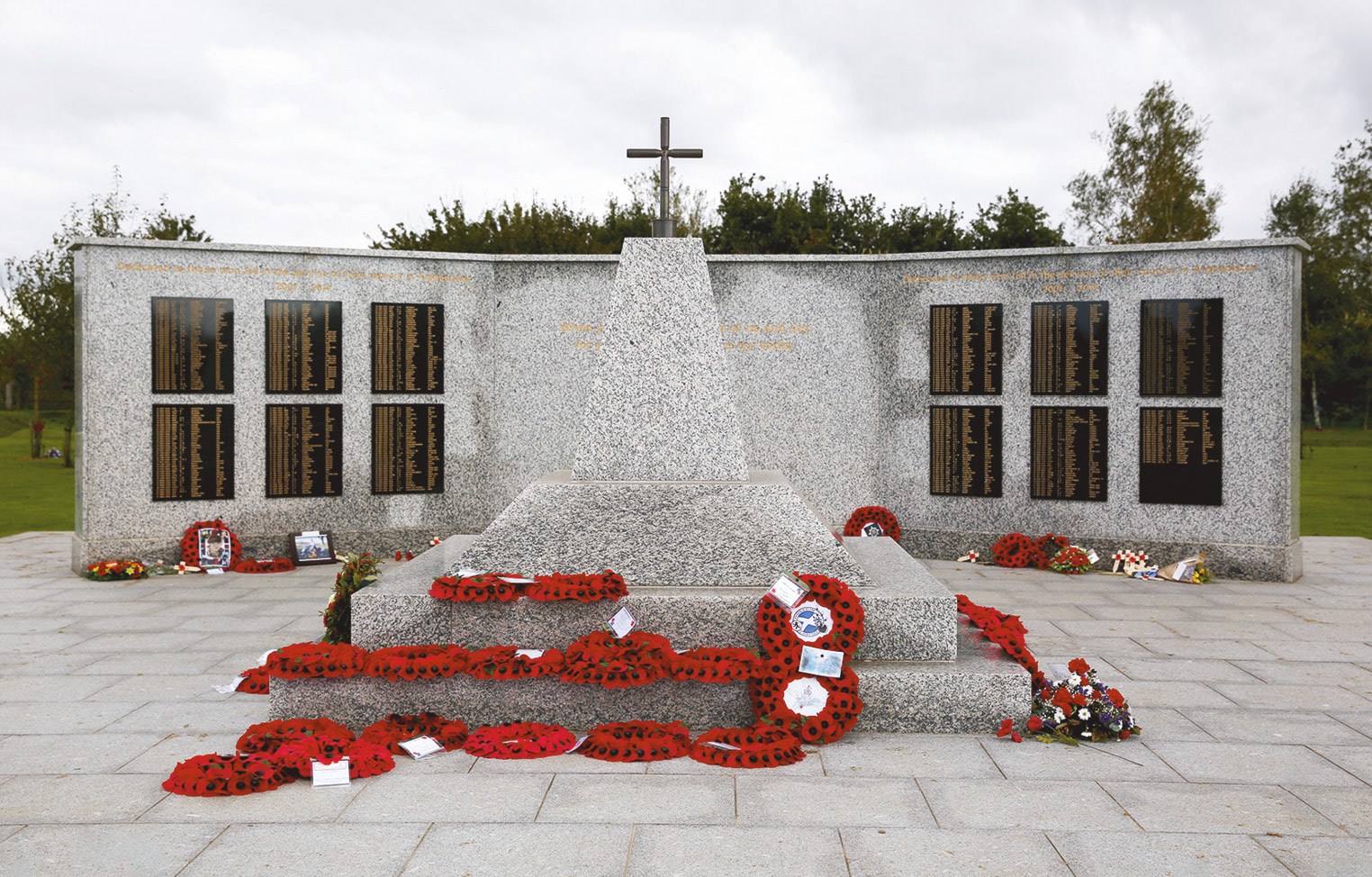
Camp Bastion Wall National Memorial Arboretum, Alrewas, Staffordshire, 2015
Aaron Lewis’s mother had been feeling out of sorts all day. ‘I did my shopping all wrong,’ she tells me. ‘I just wasn’t feeling right.’ Later, I consult a map, and mark out the distance between Essex and Afghanistan’s Helmand Province: 6,000km. It is hard not to ponder the power of maternal instinct. The gravest violation against Helen’s natural order occurred on the other side of the world, and she was already feeling unwell long before two men in dark suits arrived on her doorstep.
As a student, Aaron had decided to join the army ‘to make a difference’ in the wake of 9/11. Seven years later, he was deployed to Afghanistan with 29 Commando regiment; it was his first overseas tour, and his last. Aaron had taken the army’s advice and written letters before his departure, in case the worst happened. ‘I am so glad he did,’ explains Helen. ‘He told me not to blame the Government or Afghanistan or the army.’
Aaron Lewis is one of 454 British service personnel who died fighting in Afghanistan remembered on the National Memorial Arboretum’s Camp Bastion Wall – a monument inspired by a wall at the former British base of Camp Bastion, in Helmand Province, which was constructed by service personnel to remember their comrades. Aaron’s extraordinary mother, Helen Lewis, has since dedicated her life to the Aaron Lewis Foundation, which transforms lives for ex-service personnel. It’s a brave reminder of the undimmed constant behind every frontline: a mother’s love.
Dr Tessa Dunlop is an award-winning historian and broadcaster, whose previous books include The Century Girls, The Bletchley Girls, Army Girls, and Elizabeth and Philip.This is an extract adapted by the author from her new book Lest We Forget: war and peace in 100 British monuments (Harper North, £22 hbk).
Further information: For details of this year’s Royal British Legion Poppy Appeal, see http://www.britishlegion.org.uk.
All images: courtesy of Tessa Dunlop, unless otherwise stated