Subscribe now for full access and no adverts

Humans throughout history have demonstrated the need for social gatherings to celebrate significant occasions. In Egypt, where the calendar was based on the rise and fall of the Nile, which was so crucial to the agricultural economy, annual events such as the start of the inundation and the harvest were celebrated throughout the country. Over the centuries, the calendar became increasingly filled with the festivals of national or local deities, each celebrated over several days. Some yearly festivals commemorated divine marriages and births, such as the union of Horus and Hathor at Edfu, and the birth of their son Ihy at Dendera. While these public festivals are well-recorded, there is little evidence of the way in which similar private events were marked, if they were acknowledged at all. Whatever the occasion, however, the Egyptians knew how to celebrate.


Communal feasting, which was often accompanied by some form of musical entertainment, was an important element of public religious festivals, as well as private funerary and memorial rituals, with alcoholic drink featuring prominently. Images of funeral banquets depict tomb-owners and their guests surrounded by racks of jars containing wine and beer. In the tomb of Paheri at Elkab, attentive servants keep cups filled, saying that it is the duty of the guests to drink to the spirit of the deceased. When one guest raises a hand to refuse the refill, the waiter encourages her to ‘drink to drunkenness, make holiday’. One of her companions tells her to ‘drink, do not spoil the party’, and another guest takes the servant’s advice, demanding no fewer than 18 cups of wine because ‘my inside is as dry as straw!’. The appearance of wine in depictions of the funerary feast is likely to be a matter of aspiration rather than reality, since wine was an expensive luxury rarely affordable for most private celebrations.


Beer made from barley and flavoured with various botanical additives was the everyday drink of all Egyptians, and was available in a range of strengths. At the workmen’s village of Deir el-Medina, brewing beer for a festival was often cited in the attendance records as a reason for absence from work. For the major local festival of Amenhotep I, the royal patron of the village, a particular favourite was a potent brew known as ‘beer of Qode’, which was thickened and sweetened with dates. One of the biggest parties was the Festival of Drunkenness, held at Dendera in the first month of the year. Huge quantities of beer were brewed for distribution to the assembled pilgrims to commemorate the occasion when the annihilation of humankind by the rampaging leonine Sekhmet-Hathor was averted by means of a lake of beer.

A party was an excuse to dress up in one’s best clothes, possibly a new outfit purchased specially for the occasion. Isis, a woman of Deir el-Medina, wrote urging her sister Nubemnu to finish the weaving of her new wrap-around sash or shawl, because otherwise she would have nothing to wear to the upcoming Festival of Amenhotep I. Most clothing was made in the home, and linen was a valuable commodity, with lengths of cloth and worked garments being gifted, for example, as dowry goods, or as bonuses for state employees on significant royal occasions. In the paintings from Nebamun’s tomb, now in the British Museum, seated guests wear fine pleated linen gowns and kilts, with fringed edges, woven belts and ruffled sashes. Their outfits are complemented by finely dressed wigs topped with festal perfume cones.


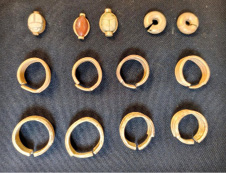
Few Egyptian partygoers could hope to own expensive jewellery of the sort deposited as burial goods and represented in paintings in elite tombs. The best most could hope to own was a few strings of stone or faience beads, simple wire bangles, and shell or bone earrings. For special occasions, plain white linen clothing was enlivened by collars and headbands made from leaves and petals, woven or sewn on to a papyrus or linen backing. Several such collars, thought to have been worn by guests at Tutankhamun’s funerary feast, were found in a cache of surplus burial materials in the Valley of the Kings. Elaborate floral arrangements created by specialist florists from the produce of temple gardens were included in the extensive lists of festival supplies. At Nebamun’s funeral feast, the wine amphorae and food tables are decorated with floral wreaths and trails of vine leaves, and servants hand out party collars. A Nineteenth Dynasty text warning schoolboys of the dangers of alcohol suggests that, even in disreputable drinking dens, flower garlands were standard party wear.

Entertainment and excess
Some festivals were marked by dramatic presentations, similar to mediaeval mystery plays, or carnival- like parades including acrobatic dancers and temple singers. Private parties often included a public element, with participants taking their noisy celebrations into the streets with drums, tambourines, and clappers. Music was the most common form of party entertainment and was provided by singers and dancers performing to the accompaniment of harps, lutes, pipes, and various percussion instruments. Nebamun’s guests enjoyed songs accompanied by a band of female musicians clad in full party attire, while scantily dressed girls danced. Though rarely shown eating, partygoers are always surrounded by lavish quantities of food. The inscriptions listing supplies for the greatest celebrations are extensive and comprehensive, with individual foods like specific types of bread requested by the tens of thousands. Such quantities suggest that, having first been offered to the gods, much of the food was to be distributed to the celebrating crowds. Many jars containing foods for the jubilee of Amenhotep III, found at Malkata and the recently rediscovered ‘Golden City’, were labelled as donations from individual courtiers. These illustrate the tradition of reciprocal gift-giving, whereby invited guests contributed goods for consumption at the party. At Deir el-Medina, party foods included luxury items such as festive cakes purchased from temple bakeries. Notes written on ostraca record the food and drink items that guests promised to provide for a celebration, proving that the principle of ‘bring a bottle’ is nothing new. Party time, in ancient Egypt, was an excuse to dress up, to be entertained, and to eat and drink to excess.


All images: Hilary Wilson, unless otherwise stated