Subscribe now for full access and no adverts
Say to Napkhureya, the King of Egypt, my brother, my son-in-law, whom I love and who loves me: Message of Tushratta, Great King, the King of Mitanni, your brother, your father-in-law, who loves you. For me all goes well. For you may all go well. For Tiye may all go well. For Tadukheba, my daughter, may all go well. For the rest of your wives may all go well. For your sons, for your magnates, for your chariots, for your horses, for your troops, for your country, and for whatever else belongs to you, may all go very, very well.
From the beginning of my kingship on, as long as Nimmureya [i.e. Amenhotep III – Nebmaatra], your father, went on writing to me, he wrote over and over about peace. …Tiye, the principal and favourite wife of Nimmureya, your father, knows all the words of Nimmureya… that he would write to me… it is Tiye, your mother, whom you must ask about all of them…
From the Amarna letters (AE 29)

A statuette head of Queen Tiye in her later years. Neues Museum, Berlin. Image: J Peter Phillips (JPP)
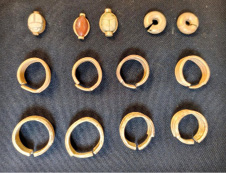
This remarkable letter, from Tushratta, the King of Mitanni, was written shortly after the accession of Amenhotep IV (Akhenaten). It is unique in giving some insight into the way in which a ‘king’s great wife’ may have had knowledge of, and influence on, international affairs at the height of Egypt’s empire. It reveals the regard that the foreign ruler – so far away in north Syria – had for Tiye: she is not dismissed as a person of no consequence. Indeed, the opposite: she is regarded by Tushratta as her husband’s confidante, the one to whom he talks, the one who knows. The letter ends with detail of the greeting gifts sent from Napkhureya-Neferkheperura (Amenhotep IV-Akhenaten) to Tiye (bracelets, earrings, clothes); and for Tushratta’s daughter, Tadukhipa, who had arrived at the Egyptian court shortly before Amenhotep III’s death.

Tiye is certainly one of the most prominent of the Eighteenth Dynasty king’s wives. She is depicted more frequently than any other, and appears alongside her husband in numerous temple scenes and statues. She is the precursor of Nefertiti, both in the frequency of her image, and in the religious role that she played.

Royal marriage
Although we lack clear evidence, we assume that a prince of this period was married and ‘set up house’ in his teenage years. There is no indication of the role of the designated heir or crown prince in the Eighteenth Dynasty: both Amenhotep II and Amenhotep IV-Akhenaten had elder brothers who predeceased their fathers. In both instances, the princes must have been married with children at the time of their accession.
The choice of Tiye as the wife for prince Amenhotep has been the subject of speculation and raises the issues of how a royal wife was selected. Earlier Egyptologists thought that a line of descendants of Queen Ahmose Nefertari were the ‘heiresses’ who legitimised the male succession. This was disproved by Gay Robins, who demonstrated that most ‘great wives’ were non-royal. She suggested that Tiye was a ‘compromise’ candidate agreeable to competing elite families. By the time of Amenhotep III, the ruling family was well established and must have negotiated a working relationship with the elite. But there was potential for competition, particularly between the family of the king’s mother and families who wished their daughters to become a (potential) ‘king’s great wife’.


The so-called ‘Marriage Scarab’, which exists in many examples, is a record of Amenhotep III’s accession, in that it gives his full titulary and gives the northern and southern limits of his rule: Naharin (Mitanni) and Karoy (a location in Nubia). It is also unique in giving the name of his wife and of her parents: her father Yuya and mother Thuya (or Tuyu). This couple was buried in the Valley of the Kings, and their funerary equipment survived substantially intact. Many objects give their titles, which are frequently said to be ‘modest’. Various claims that Yuya was of foreign, Asiatic, origin were based on his name (which has many different spellings), his mummy’s features, and the title designating him as a charioteer. He was therefore supposed to be a member of the mariyannu – considered by earlier Egyptologists to be the horse-owning aristocracy of Mitanni. This idea was discredited, and the term mariyannu is now recognised as a term applied to those who were trained as chariot warriors. By the time of Thutmose IV and Amenhotep III, chariots and horses had been used in Egypt for around 200 years – and chariots had been built and adapted, and horses bred there, for almost as long. Whether Yuya had any foreign ancestry remains very unclear. His title ‘god’s father’ has been interpreted as indicating a king’s father-in-law, but it is a relatively common priestly title.
Although Thuya has religious titles associating her with Min and Amun, she was also a hekeret nesut: ‘royal ornament’. The precise meaning and implications of this term are uncertain and debated, but it was significant: many high officials, particularly those closely associated with the palace, were sons of women who carried this title. It is therefore likely that Thuya’s father was an official of some consequence and had palace connections.


Thuya’s coffin carries a text calling her mother of Tiye, and also of the priest Anen. The inscription on a magnificent grano-diorite statue of Anen from the Luxor region, now in Turin, gives him many titles, including ‘greatest of seers in the House of the Benben’ and ‘second prophet of Amun’. Anen’s own tomb at Qurna contained a spectacular (although now very badly damaged) painting showing him in front of an elaborately attired Amenhotep III and Tiye, who are seated on the dais with a triple canopy over them. It was inappropriate for an official to state a direct family relationship to the king or a royal wife, but allusion such as this could serve as an indicator of the connection.
Jubilee and colossi
The titles held by Yuya and Thuya suggest that they originated from, or were influential in, the region of Akhmim. Another of the large scarabs that were issued during the reign informs us:
Regnal Year 11 under the Majesty of… Amenhotep (III), ruler of Thebes, given life, and the Great Royal Wife Tiye; may she live; her father’s name was Yuya, her mother’s name Tuyu. His Majesty commanded the making of a lake for the King’s Great Wife, Tiye – may she live – in her town of Djarouka. Its length is 3,700 [cubits] and its width is 700 [cubits]. [His Majesty] celebrated the Festival of Opening the Lake in the third month of Inundation, day 16. His Majesty was rowed on it in the royal barge ‘The Dazzling Sun Disc’.
When drained, following the breaking of the boundary dykes, this ‘lake’ was about 190 acres of land and would have been given over to agriculture. Djarouka is to be identified as the modern Tahta, on the West Bank of the Nile north of Akhmim. The name Tahta is derived from the ancient name Ta-hut-Ty, ‘the house/temple of Tiye’. Linked to Year 11 of the king’s reign, this indicates that religious changes elevating Tiye in status were already under way. These culminated in the events surrounding the spectacular heb-sed (‘jubilee’) of Year 30, and its two following festivals. Building works had already begun throughout Egypt and Kush in anticipation of the festival.

The phenomenal quantity of sculpture for the heb-sed is well known, and results in more images of Tiye than of any other royal wife. She is frequently shown on the same scale as the king, and with elaborate hair and regalia associating her with the goddess Hathor. Sometimes the royal couple are accompanied by smaller-scale daughters, as on the colossal dyad from Thebes now in the Egyptian Museum in Cairo. Tiye also appears on a smaller (but still colossal) scale on one flank of the many seated colossi of Amenhotep III (such as the Colossi of Memnon) with an image of his mother Mutemwia on the other side. In these colossi, the king appears as the sun god, and the queens as Hathor the mother and Hathor the wife. This statue form was followed by Ramesses II, notably at Abu Simbel, but with the inclusion of both male and female children. Indeed, the Nineteenth Dynasty sees far more prominence given to princes: in the Eighteenth Dynasty, royal daughters are shown, but princes appear on their own monuments or in the tombs of their tutors, rather than in a royal or ritual context.
Statues of Tiye on her own are also known and are also depicted as products of the royal workshops on the walls of, for example, the Tomb of Surero at Thebes. In these cases, it is impossible to assess scale. The statues themselves could be large stone images, or the smaller wooden statues attested from sites such as Gurob.

One of the statues shown in the tomb of Surero depicts Tiye, with the modius and double plumes, carrying the flail and standing on a prostrate enemy. This type of image is known, usually on a small scale, for kings. This ‘violent’ aspect of queenship is reflected, too, in images of Tiye as a female sphinx, most remarkably on the side-panel of her throne in a scene in the Tomb of Kheruef. Tiye is seated with Amenhotep III, on the dais and beneath the triple canopy, at a presentation during the third heb-sed. Tiye wears the vulture headdress, modius with falcon plumes (but no Hathorian horns and sun disc), and a fillet with two uraei, one wearing the Upper, the other the Lower Egyptian crown. She carries the flabellum and an ankh, and wears the broad wesekh-collar and the shebyu-collar of gold rings or discs. This is the first time that an Egyptian queen is shown with the shebyu. Amenhotep III wears it in this scene as well, and it indicates an elevation in status.


The whole throne is a feminised version of that used by kings, a direct parallel appearing in the scene in the Tomb of Anen. An Asiatic and a Kushite woman are bound to the sema-tawy motif, Tiye is called Mistress of all Lands, and the text states (as for kings) ‘trampling the foreign lands’. Tiye, as a sphinx, has the falcon wings folded on her back, and the modius with an uraeus wearing the Hathor horns and sun disc. The sphinx has the open, semi-circular shoot-fan over her: this indicates that the divine ‘shadow’ is present. The associated deity is Tefnut, the manifestation of the Solar Eye as a lioness sent by Ra-Horakhty to destroy humankind. She tramples two female enemies, Asiatic and Kushite, underfoot. The accompanying column of text describes Tiye as ‘Mistress of all Lands, united with the King Khaemmaat’.

The titles are significant. Khaemmaat was Amenhotep III’s usual Horus-name (although, in the accompanying titulary here, he uses a variant) and was particularly associated with the royal ka and his manifestation as a lunar god in the temple at Soleb (itself called Khaemmaat) in northern Sudan. The title ‘Mistress of all Lands’ is given to Tiye in her own temple, to the north of Soleb, at Sedeinga.
Tiye as a sphinx
In the same way as the temple in Middle Egypt, the temple at Sedeinga was called Ta-hut-Ty ‘the house or mansion of Tiye’. This later became Atiye, and Adey, in Meroitic and early modern times. The Meroitic temple in the town was dedicated to Isis, reflecting its origin in a temple dedicated to Hathorian goddesses. The ruins of the temple were dismantled by the French team who have been working at the site for many years, and the blocks are therefore easily accessible. The early travellers who visited the site could record only a few elements and the standing Hathor-headed column. The team led by Richard Lepsius published one significant image: the lintel with Tiye as a sphinx, wearing the flat-topped crown generally associated with Nefertiti, and certainly identifying Tiye with Tefnut. The other imagery on the panel is Hathorian: rearing uraei and the full face of Hathor on the sign for gold. Tefnut is the violent aspect of Hathor in the form of the burning Solar Eye, sent out to destroy humankind. A dedicatory inscription on a column states that the king made the temple for the ‘Great of Dread and Mistress of all Lands’. The word neret means a vulture, but by extension also ‘fear’ and ‘dread’, and here clearly relates to the awe and dread inspired by Tiye as the manifestation of the Solar Eye.

One of the most notable features of both the lintels and the sides of the abaci of the Hathor capitals is the centrally placed cartouche of Tiye, with those of Amenhotep III flanking it and with hieroglyphs oriented toward it: a unique instance. The surviving images on the blocks are otherwise conventional, and all depict Tiye in association with her husband.


Tiye appears elsewhere as a sphinx. A wooden panel published by Ludwig Borchardt depicts Tiye as a couchant sphinx with falcon markings, facing three cartouches with her name and those of her husband. A female sphinx with open wings, wearing the red crown, and with human arms raised in adoration, is shown on a broken clay sealing from the palace complex at Malkata. A sphinx, with raised wings and a headdress similar to that at Sedeinga, but with foliage emerging, is carved on a plaque made of sard now in the Metropolitan Museum of Art. The sphinx has human arms supporting a cartouche of Nebmaatra: its authenticity (along with two companion plaques) has been questioned. A direct parallel appears on the throne of a dyad with the names of Horemheb and Mutnodjmet: the sphinx raises its arms in adoration of a cartouche of Mutnodjmet. This type, with a large annular earring, certainly has Western Asiatic associations, and ivory plaques from Megiddo have identical images.

Nefertiti’s association with Tefnut has long been recognised, paralleling Akhenaten as Shu. The violent images that begin with Tiye’s depiction as a sphinx continue, but only for a short period. In addition to her manifestation as a sphinx, Nefertiti is shown in human form, wielding the khepesh, or a mace, over female enemies. The surviving examples are all on the prow and stern cabins of ships depicted on reliefs. By contrast, Ankhesenamun is never shown actively smiting enemies, but she does accompany Tutankhamun when he performs the action. In the reign of Ramesses II, Nefertari is shown in the same way, accompanying her husband as he performs the act of slaying enemies. But Nefertari does have a prominence that is more typical of Tiye, and she did receive a temple that is a direct parallel to that of Sedeinga, at Abu Simbel. The Abu Simbel temples are directly modelled in their concept, but not their architecture, on those of Amenhotep III at Soleb and Tiye at Sedeinga. Ramesses II appears as both a solar and lunar deity, and Nefertari is a manifestation of Hathor and related goddesses. The Nefertari temple does have engaged Hathor-headed sistra attached to the square piers. Nefertari is shown, too, being crowned by the goddesses Hathor and Isis, which, so far, is not attested for Tiye.

The influence of the iconography and divine associations of Tiye continue through later Egyptian history. At the end of the Twentieth Dynasty, in the Khonsu temple at Karnak, Nodjmet appears as a female sphinx with elaborate headdress, again on the prow and stern cabins of the boat that tows the Barque of Mut. The iconography of the god’s wives of Amun of the Kushite and Saite Periods also follows that of Ahmose-Nefertari and Tiye, and their titles closely associate them with Tefnut. The same iconography is revived again for Ptolemaic queens, some of whom could also be said to have ‘filled the foreign lands with dread’.
Robert G Morkot studied Ancient History, Egyptology and Meroitic at University College London and the Humboldt-University Berlin, and for many years was a university Senior Lecturer in Archaeology. He has worked in Libya, and travelled extensively around the Near East, but specialises in Nubia and Sudan and their relationship with Egypt.
Further reading
• My original thoughts on this subject first appeared in: R G Morkot (1986) ‘Violent images of queenship and the royal cult’, Wepwawet 2: 1-9 (available at https://ore.exeter.ac.uk).
• This book gives a useful discussion of the earlier ideas of Cyril Aldred and others: A Dodson (2016) Amarna Sunrise (Cairo: AUC Press).