Subscribe now for full access and no adverts
Casting an Egyptological eye over the varied information given by A O Lamplough in the 1911-1912 edition of his tourist guide Egypt and How to See It (see AE 144), what stands out are his impressions of and comments on the archaeological sites themselves. Apart from Auguste Mariette ‘the famous French Egyptologist who discovered the Apis tombs in 1851…’, Lamplough does not credit any archaeologist by name, not even Gaston Maspero, who was the Director General of Antiquities at the time. He makes no mention of any digs in progress, possibly because the book had to go to print before the season’s concessions had been allocated, although it may also be because most Egyptologists resented interrupting their work to entertain casual sightseers.
Deir El-Medina
Lamplough’s descriptions of what his readers could expect to see are sometimes difficult to reconcile with the monuments familiar to us today. For instance, Deir el-Medina is merely ‘a Ptolemaic temple’, with no reference to tombs such as those excavated by the Italian Egyptologist Ernesto Schiaparelli, 1905-1909. Excavation of the Worker’s Village itself by the French archaeologist Bernard Bruyère only began in 1922, with his report not published until 1959.


The Valley of the Queens
Lamplough declares the principal tomb in the Valley of the Queens to be that of ‘Queen Thi or Titi: the paintings are excellent and in admirable preservation’. This refers to QV52, the Tomb of Tyti, a wife of Ramesses III. The surprising omission of QV66, discovered by Schiaparelli in 1904, suggests that Nefertari’s tomb was not accessible to tourists when Lamplough was writing his guide. Today’s visitors would find the same situation, since QV66 has been permanently closed to tourists since March 2024, because of conservation concerns.
The Labyrinth
Flinders Petrie had been working in Egypt for decades by the time Lamplough’s book was published. His 1910-1911 season included work at the Hawara Temple of Amenemhat III, known to Classical authors as the Labyrinth. Petrie describes this as ‘so completely ravaged that only a great bed of chips showed’, yet Lamplough states it was ‘dilapidated enough now, but it must have been a mighty monument in its time, if we may believe Herodotus (and it is singular how often we can), and it must have eclipsed all other Egyptian buildings in size and magnificence’. Petrie’s finds, including statue fragments, and two granite shrines containing images of Amenemhat III with the regional deities Sobek and Hathor, were published later in 1912. By that time, one shrine was in the Egyptian Museum in Cairo, and the other had been gifted to the Carlsberg collection in Copenhagen. During his research, Lamplough may well have seen Petrie’s dig for himself, but his readers – expecting to see what he describes as the ‘many wonderful sculptures describing the history, religion and interests of the province to which each [chamber] was assigned’ – would have been disappointed.


Memphis
In March 1912, Petrie returned to Mit Rahina, the site of ancient Memphis, which Lamplough says was ‘covered each year by the inundation [so that] little remains of its former greatness’. He mentions the colossal statues of Ramesses II, found in the early 19th century, and the scattered mounds that marked the foundations of the Temple of Ptah. His omission of the large alabaster sphinx, now a prominent feature of the Open-Air Museum at Memphis, is explained by its being discovered at the very end of Petrie’s 1912 season. The 90-tonne sphinx was only fully uncovered the following year. Found lying on its side, it lay in waterlogged ground until it was set upright after the First World War.


Giza
At Giza, Lamplough says, ‘the Sphinx is more wonderful, more mysterious still… No one can tell when the Sphinx came into being. There is a legend that it was [already] in existence at the time when Chephren built his Pyramid’. His authority for this ‘legend’ is the so-called Inventory Stela, discovered by Mariette in 1858.
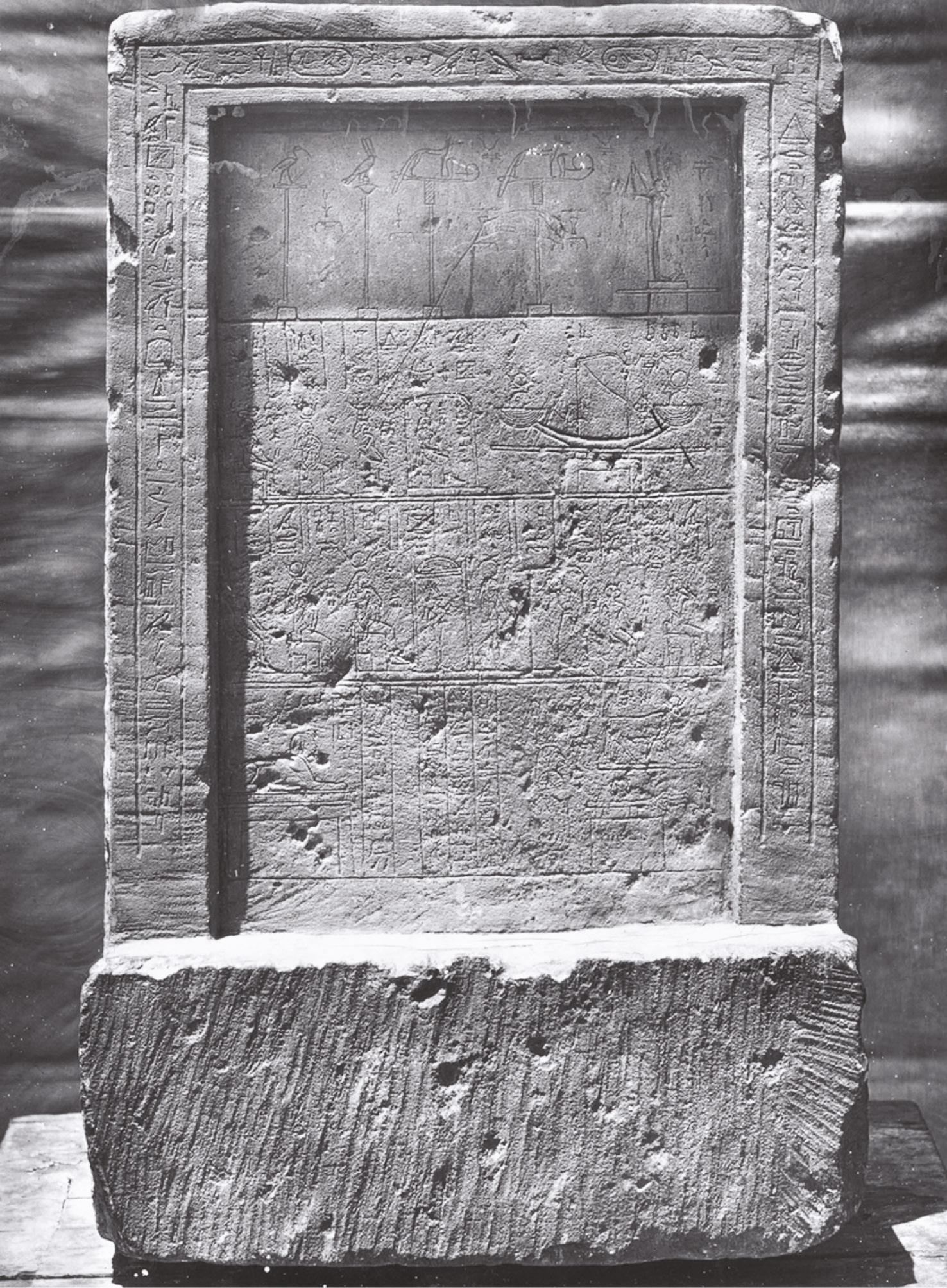
This retrospective text was composed some 1,900 years after Khafra, to provide an ancient pedigree for the cult of Isis at Giza. It lists the statues in the Temple of Isis, which was said to have existed beside the Sphinx since before Khufu’s time. On many occasions the Sphinx had been cleared of the sand that had engulfed it up to its neck, only to become buried again, as shown by drawings and photographs over the years. The front part had been cleared by Maspero in 1886, but just how much of the figure remained visible by 1912 is unclear. In pointing out the ‘Dream Stela’, which describes the first recorded clearance by Thutmose IV, Lamplough’s account suggests that the Sphinx was uncovered to at least the top of the stela, which stood between its paws. Lamplough theorises that, ‘the Sphinx now defaced and mutilated… is perhaps the sole survivor of a more ancient civilization still, far beyond our ken’. The ‘Age of the Sphinx’ controversy is clearly nothing new.
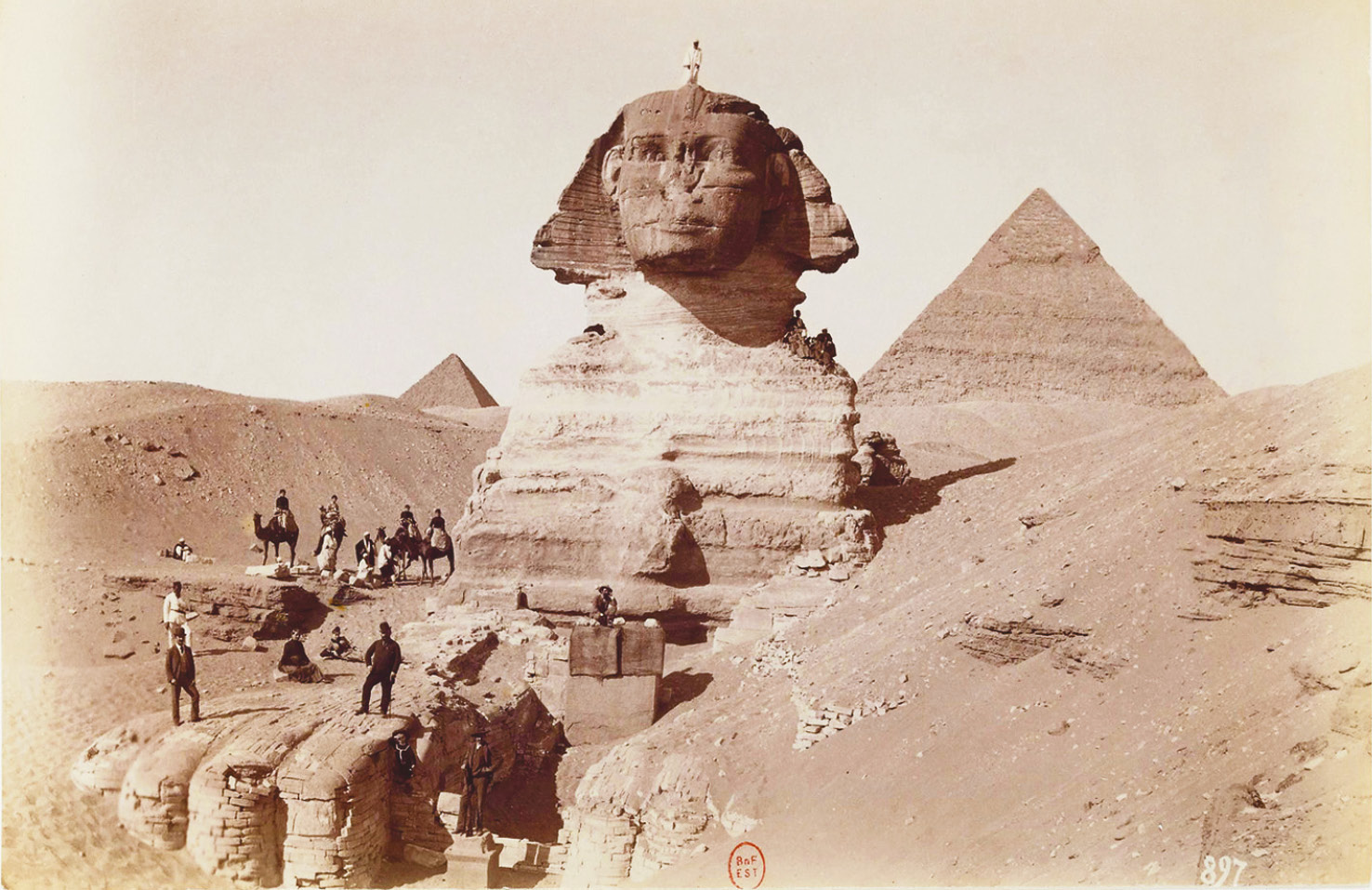
The Great Sphinx during excavations conducted by Gaston Maspero and Émile Brugsch, 1886-1887. Note the ‘Dream Stela’ between its paws. Image: B Facchinelli (1873-1895) Sfinge e le Piramidi di Ghiza, Bibliothèque nationale de France (public domain)
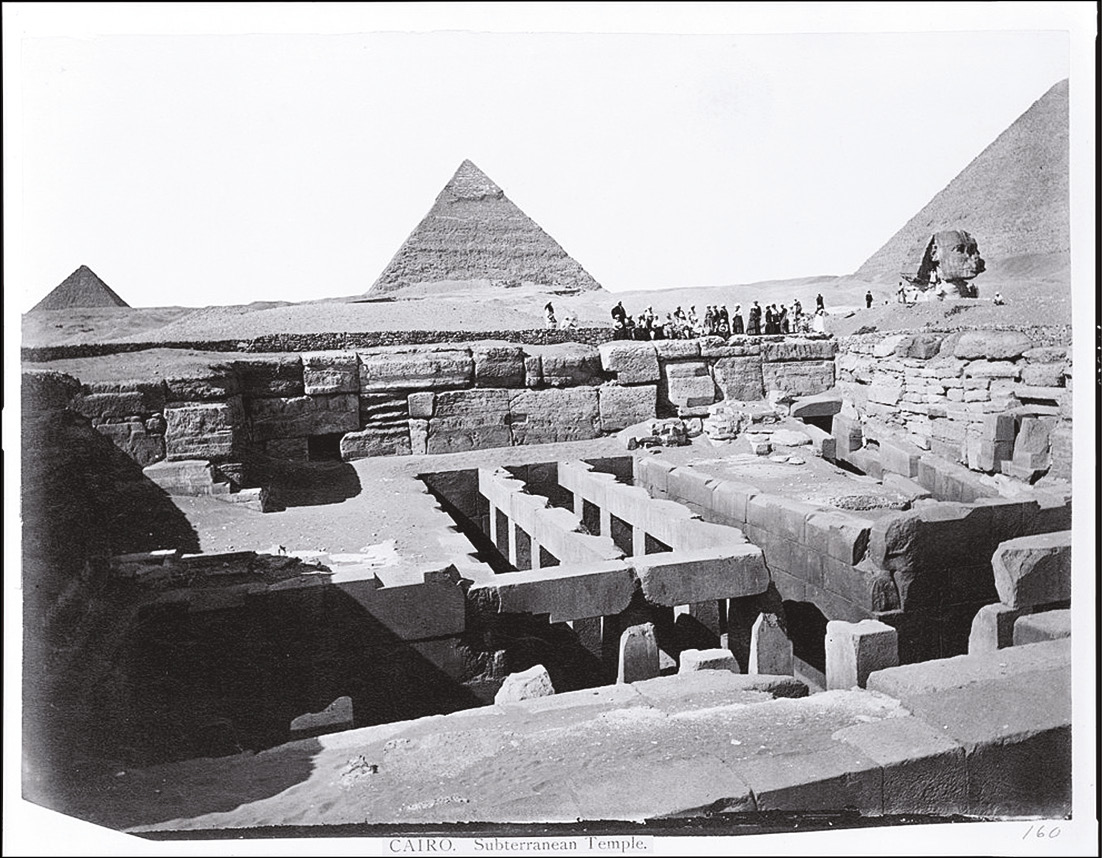
The monument he calls the ‘Temple of the Sphinx’, with its ‘huge slabs of granite… so beautifully surfaced and fitted that many of the joints even today are hardly perceptible’, is Khafra’s Valley Temple rather than the Old Kingdom Sphinx Temple. The two buildings were similarly constructed over a core of local limestone, but excavations by Baraize and Hassan, 1925-1936, showed that the Sphinx Temple had been stripped of much of its granite wall-facings and alabaster floors in antiquity.
Amarna
At Tell el-Amarna, Lamplough recommends visitors should see the ‘beautiful stucco pavements which were part of the king’s palace’. News of Petrie’s sensational discovery of the painted floors in 1891 attracted tourists by the boatload, necessitating the construction of raised wooden walkways, viewing platforms, and eventually a roofed building for their protection.
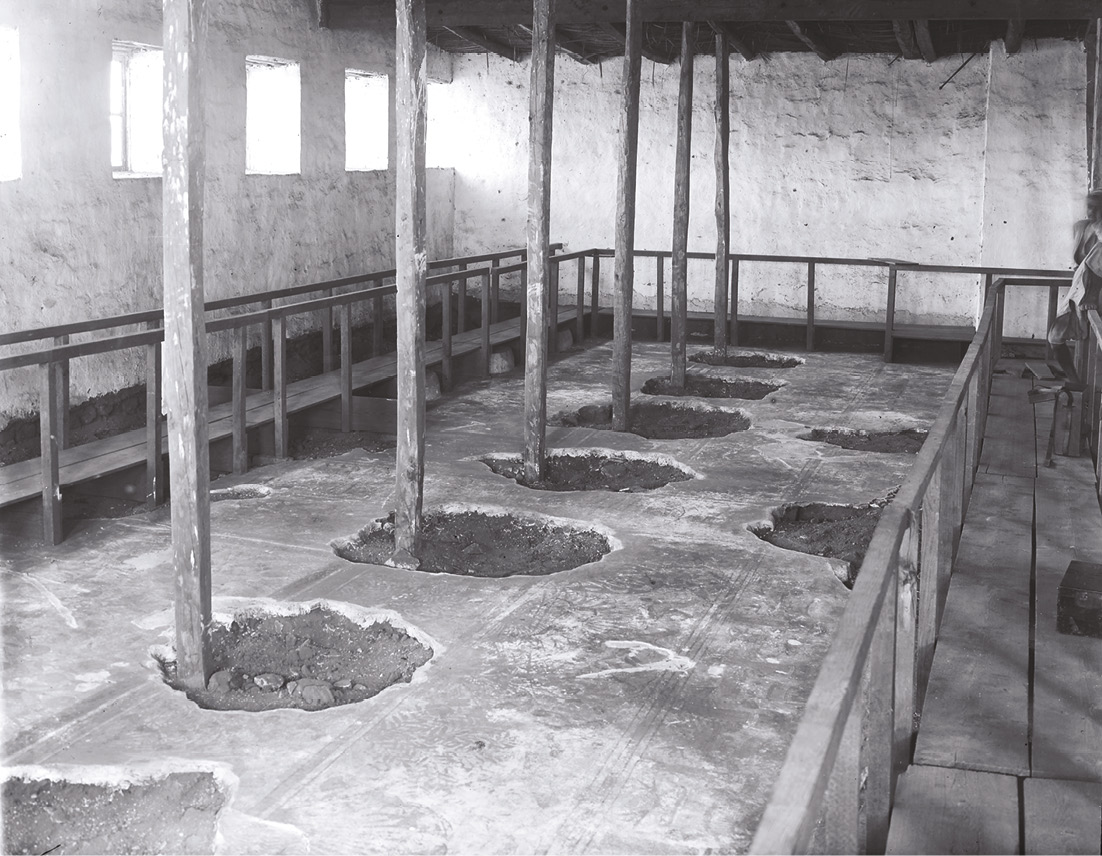
Those following Lamplough’s guide at the start of 1912 would have been among the last visitors to see the painted floors in situ, as local resentment towards tourists turned to vandalism. In February of that year, the building was broken into, and the pavement was hacked to pieces. Apart from those sections that were recovered and reconstructed in the Cairo Museum, Petrie’s drawings and photographs are the only record of a remarkable discovery.
Meanwhile, the German Archaeological Institute, led by Ludwig Borchardt, commenced its first season at Amarna over the winter of 1911-1912. Borchardt’s primary interest in the city’s architectural remains led to the excavation of the villa/workshop of the sculptor Thutmose where, in December 1912, he recovered that true masterpiece of Egyptian art: the painted limestone bust of Nefertiti. It is hard to imagine now that souvenirs bought in 1912 would not have included images of Nefertiti or that other Egyptian icon: Tutankhamun’s mask.

W M F Petrie (1894) Tell el Amarna, pl.II