

Subscribe now for full access and no adverts
It is so easy to think of it as purely a Stone Age. When we imagine early humans – both before and after the advent of Homo sapiens – wielding tools, it is implements fashioned from rocks that spring to mind. The origins of this stone technology lie over 3 million years in the past (see CWA 98), with the sophistication of the kit available to hominins reaching a milestone when Acheulean tools were first developed about 1.76 million years ago. These implements continued to be used for well over a million years, and include hand axes, cleavers, and picks that were crafted by skilled artisans capable of holding an image of the desired end product in their mind and working methodically towards that goal. As these people belonged to an itinerant world of hunter-gatherers, where communities were always on the move, the apparent absence of similarly ingenious structures has never occasioned any surprise. Instead, archaeologists have focused on the distances that groups travelled, and the ability to plan that implies, as a measure of their intelligence. Such lifestyles famously prevailed for the majority of human existence, with a settled existence and more prominent architecture only becoming relatively commonplace around the beginning of the Neolithic, starting a mere 12,000 or so years ago. It is against this backdrop that the discovery of substantial wooden structural elements at a site associated with Acheulean tools at Kalambo Falls in Zambia comes as something of a shock.
Compared to stone, wood has always seemed like a comparatively late addition to humanity’s technological repertoire. The earliest known timber object is a portion of a plank, dating back over 780,000 years, from Israel. Most early wooden artefacts, though, were small and portable, such as sticks modified for hunting or digging, which appear in Europe, for example, about 400,000 years ago. Even then, it has always seemed to be much later in the archaeological record that early humans – including Homo sapiens – set about tackling sizable pieces of timber and, by association, felling large trees. The finds from Kalambo Falls paint a very different picture. There, the combination of cutting-edge dating technology with excavations examining deposits ideally suited for the long-term preservation of wood have revealed a familiarity with woodworking that is simply stunning for the era. When it comes to understanding the lifestyles of the early humans responsible, and the way they viewed trees as a resource, the implications are nothing short of revolutionary.

A matter of time
‘The site was discovered in 1953 by the archaeologist Desmond Clark,’ says Professor Larry Barham, at the University of Liverpool. ‘He excavated a very large area of Kalambo Falls in the 1960s, and discovered a sequence of occupation running from the Early to the Middle Stone Age. There was evidence for the use of fire, and he also found what he thought were wooden tools. But a real problem was that there were only limited scientific dating techniques available, so they struggled to develop a chronology. Another complication is that the site had been disturbed by the Kalambo River, raising questions about whether the wooden objects found by Clark had been shaped by the river rather than humans. So, the big questions of whether or not there was early woodworking at the site, and how old it really was, ended up in limbo. It was that uncertainty that led me to visit Kalambo in 2006 with Geoff Duller, who had been working on dating some other African sites. We wanted to see what was there, and whether we could find sediments containing that Early to Middle Stone Age record. Most importantly, we wanted to look at whether there was a way we could date it.’


When it comes to understanding why the archaeology at the site is so special, it is crucial to appreciate its relationship with the Kalambo River. ‘In many ways the setting is peculiar,’ says Professor Geoff Duller, at Aberystwyth University. ‘The river is quite small, it’s only about 10m across, and there’s a complex pattern of meander bends, before the river cuts through a rock ridge and then plunges 230m or so in a single drop over the Kalambo Falls. The site itself is a couple of hundred metres upstream from the waterfall. The sediments that built up there were described by Ian Candy, the sedimentologist in our group, as being related to fluvial activity. Essentially, we’re looking at overbank flood deposits that have built up over time. So, we think it was a floodplain environment and a wet place for hundreds of thousands of years. Wood was able to survive alongside stone tools because these deposits have always been waterlogged. It is rather unusual to have that kind of stability in a fluvial environment. I still find it hard to fathom.’
The trip by Larry and Geoff duly led to excavations in 2006. This work did not produce any wooden artefacts – and had not been expected to – but a major breakthrough came when broad dates were established for some of the archaeological deposits. ‘A major reason why the site hadn’t been seen as more significant is because people didn’t know where to put it in the chronological framework that was built up for East and Southern Africa,’ says Geoff. ‘Back in the 1960s, radiocarbon dating had been applied to the wood that Clark found, but the technique only works until up to 50,000 years ago, so the dates just came back as infinite. Clark realised that the objects were older than 50,000 years, so they tried everything that was available at the time. One example is uranium series dating, which gave an age of about 180,000 years, but the team could see that wasn’t right either. They also tried some really experimental methods, but again it didn’t tell them much.’
‘The technique that finally opened this up for us is one that hadn’t been available to Clark: luminescence dating, which reveals when certain minerals were last exposed to sunlight. Back in 2006 this still posed a challenge, though, because Kalambo Falls really was at the very limit of what we could do with luminescence. Work had been undertaken in Southern Africa in the 2000s, based on the signal from the mineral quartz, and that worked beautifully, but just like radiocarbon it has a limit. That limit varies from site to site, but at Kalambo Falls it only reaches back about 60,000-70,000 years. Just like Clark, we realised that there were older materials present, including a really interesting assemblage of Acheulian stone tools.’
‘Because of that, we did quite a lot of developmental work after the 2006 excavations and went on to try another method, which also looks at quartz, but uses a different signal that is able to go back further in time. It goes by the name of ‘Thermally Transferred Optically Stimulated Luminescence’ – a right mouthful! This was really successful, in that it demonstrated that the lower part of the sequence, with these stone tools, dated to the period of 500,000-300,000 years ago. That was a big advance on what could be said before, but obviously a possible age range spanning 200,000 years is still not perfect. After we published those results in 2015, more developments were made in luminescence dating methods. In particular, it was realised that a different mineral – feldspar – could be used to go further back in time with more precision. This created an interest to return to the site and secure some new samples, which was one reason why we went back for more excavations in 2019.’

Folk engineering
The 2019 work was part of an ongoing project called ‘The deep roots of humanity’, which is focused on the period from 500,000-300,000 years ago. This era falls just before the evolution of Homo sapiens, and seems to have been a time of active technological change. As the Kalambo Falls dates lay squarely within this period, the plan was to return to the 2006 site and do some more digging, with the hope of securing additional stone artefacts and also to obtain the material needed for the cutting-edge feldspar dating technique.
Initially, it seemed that the team’s luck was against them. Scouting revealed that the 2006 site had disappeared, because it had either been obliterated by the river, or had become filled with sediment and completely overgrown. The only option was to try digging elsewhere along the river.
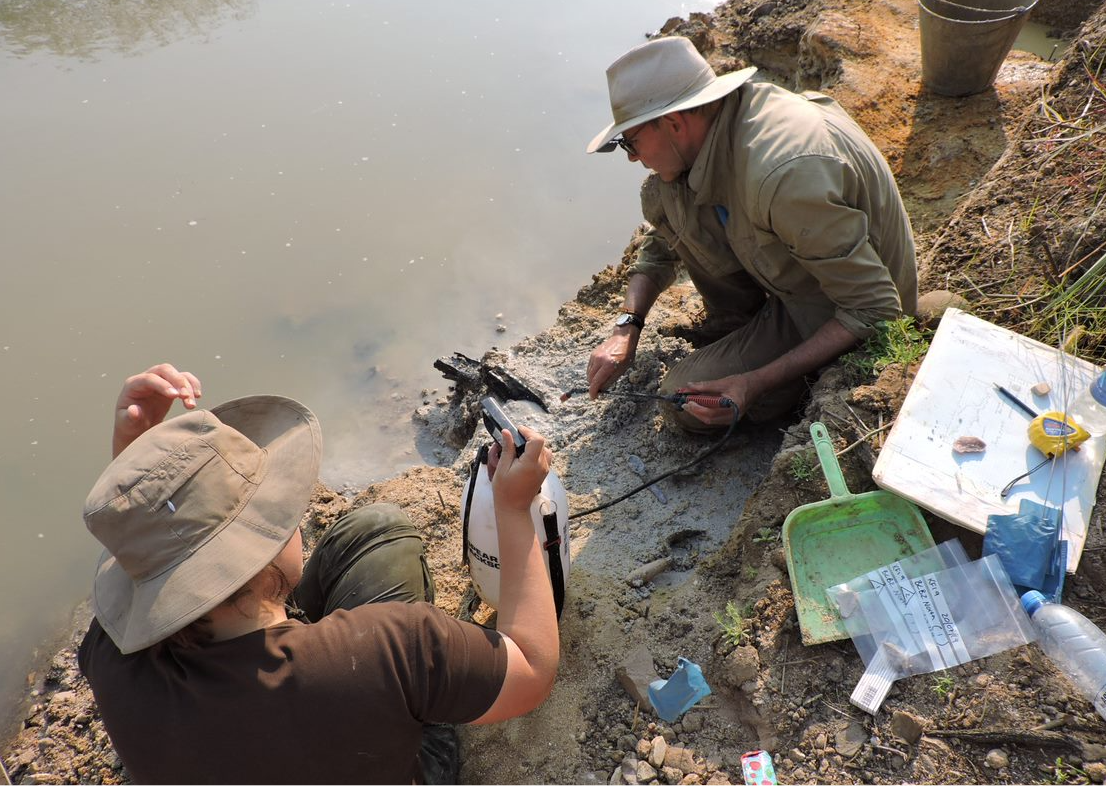
‘It was very much a plan B,’ says Larry. ‘We picked somewhere about midway between our 2006 site and Clark’s 1960s excavations. On the very first day we arrived, there just happened to be a piece of wood sticking out of this little patch of sediment exposed by the river. I remember looking into the river, which was quite clear, and seeing another piece of wood that had broken off and fallen into the water. When those two pieces were put together, we could see they were from a wooden tool: a digging stick. And we could also see from marks visible on the wood that it had been deliberately shaped – which was something that Clark hadn’t been able to prove – so we knew that we were on to something. That set the scene for a month of excavation, with five small trenches.’
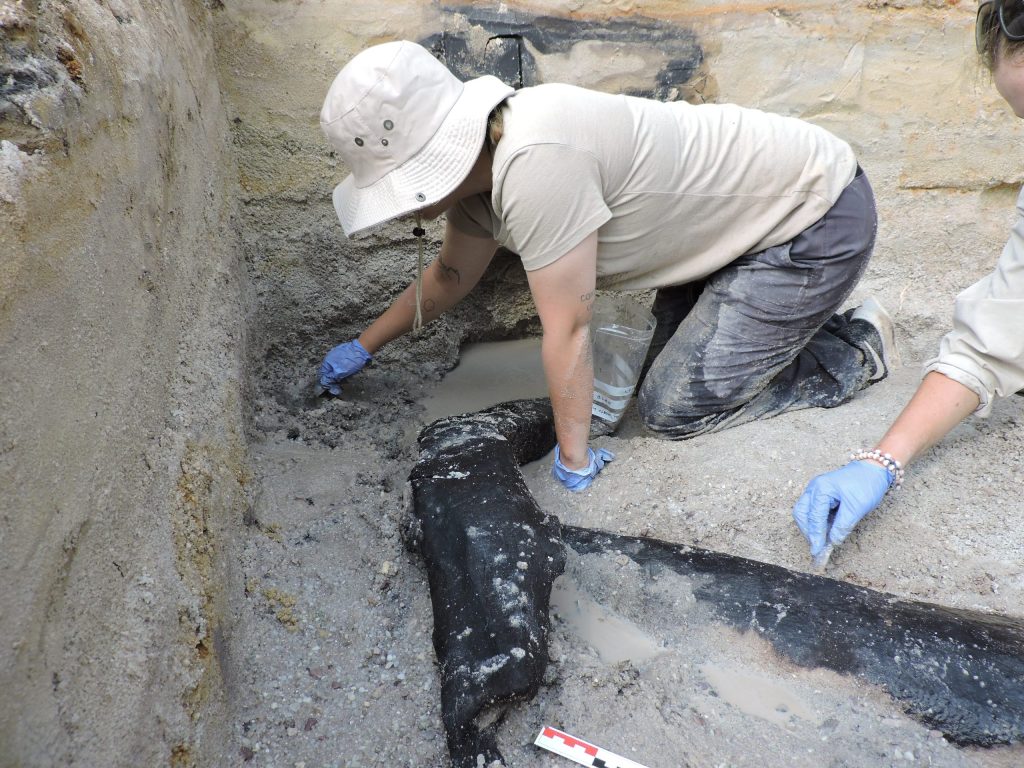
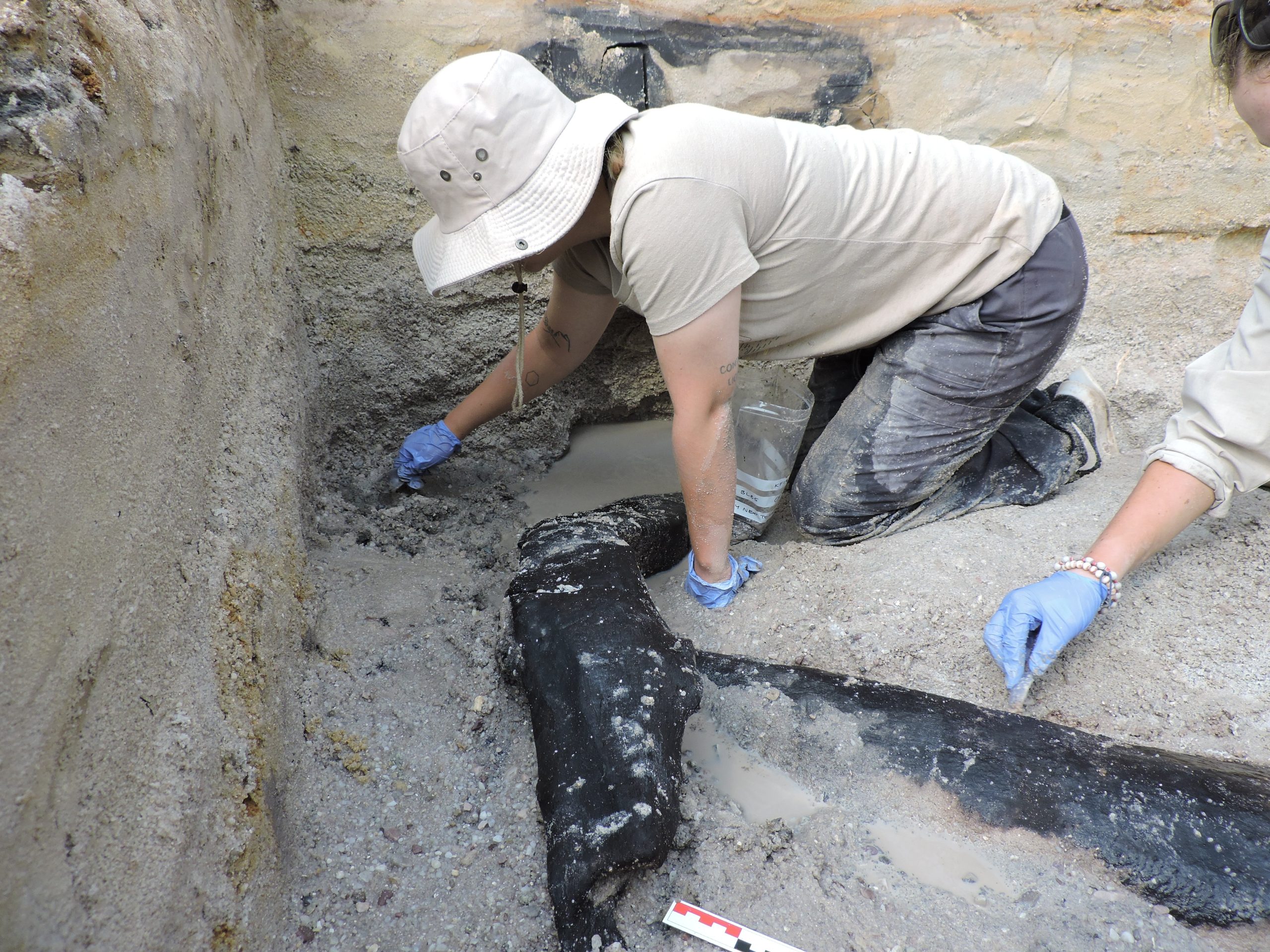
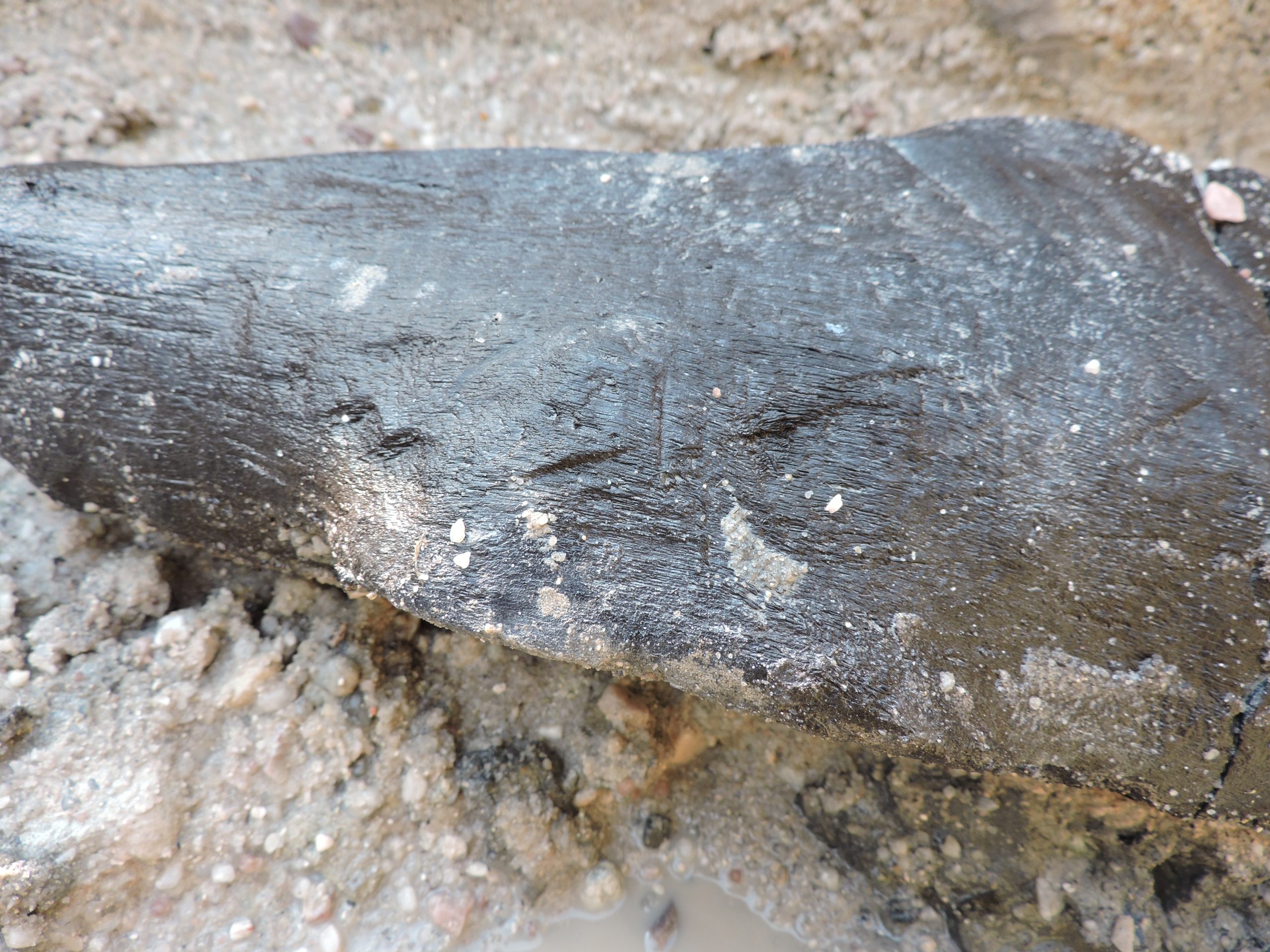
‘There were only ten days still to go when we found what has become known as “the structure”. As we removed the sediment in one of our trenches, the upper of what would turn out to be two logs appeared. We could see the light reflecting off the surface of the timber; we could see the grain of the wood and its bark – it was exceptionally well preserved. And cutting into this wood were chop marks that must have been made with a stone tool. When we lifted this overlying log, turned it, and looked underneath, there was a deliberate notch. You could see more marks and scraping where the notch had been shaped. That was when I realised we were looking at something unusual. It also reminded me that Clark had found one piece of wood that he thought was definitely not shaped by the river: a log with tapered ends and a notch. It was just like what we’d got. Back in the ’60s, Clark had thought his find was part of a structure, and now we had a log that was slotted into the notch underneath our example. The initial reaction as we uncovered this was that we were going to be very cautious – maybe the river had accidently brought the two logs together. But the lower log had also been shaped – there are chop marks and scrape marks on it, and these ensured that it passed snuggly through the notch in the upper log. That then locked the two logs into place.’

What, then, was this ingenious piece of carpentry intended to achieve? As we have seen, Kalambo Falls seems to have been a fairly wet environment. Perhaps it is no coincidence, then, that the two logs would work as part of a framework, while placing a third piece of wood on top would produce a raised platform well suited to keeping people or things dry. Similar structures are known from the Mesolithic, as at Star Carr, in Britain, which dates to roughly 9000 BC. Alternatively, combining multiple examples could create raised walkways crisscrossing the damp ground, just like the Sweet Track, also in Britain, which was constructed in around 3800 BC. Both possibilities seem plausible enough from a structural point of view, but the difference in timescale at Kalambo Falls is simply staggering. The results of the latest round of luminescence dating using feldspar places these struts 476,000 years ago, give or take 23,000 years. As well as confirming and refining the dates of 500,000-300,000 years ago determined after the 2006 excavations, the 476,000-years-ago result places this structure in a period when even small, portable wooden artefacts would be pretty surprising finds. It is astounding to think that durable wooden structures were being built so early.
Wood Age
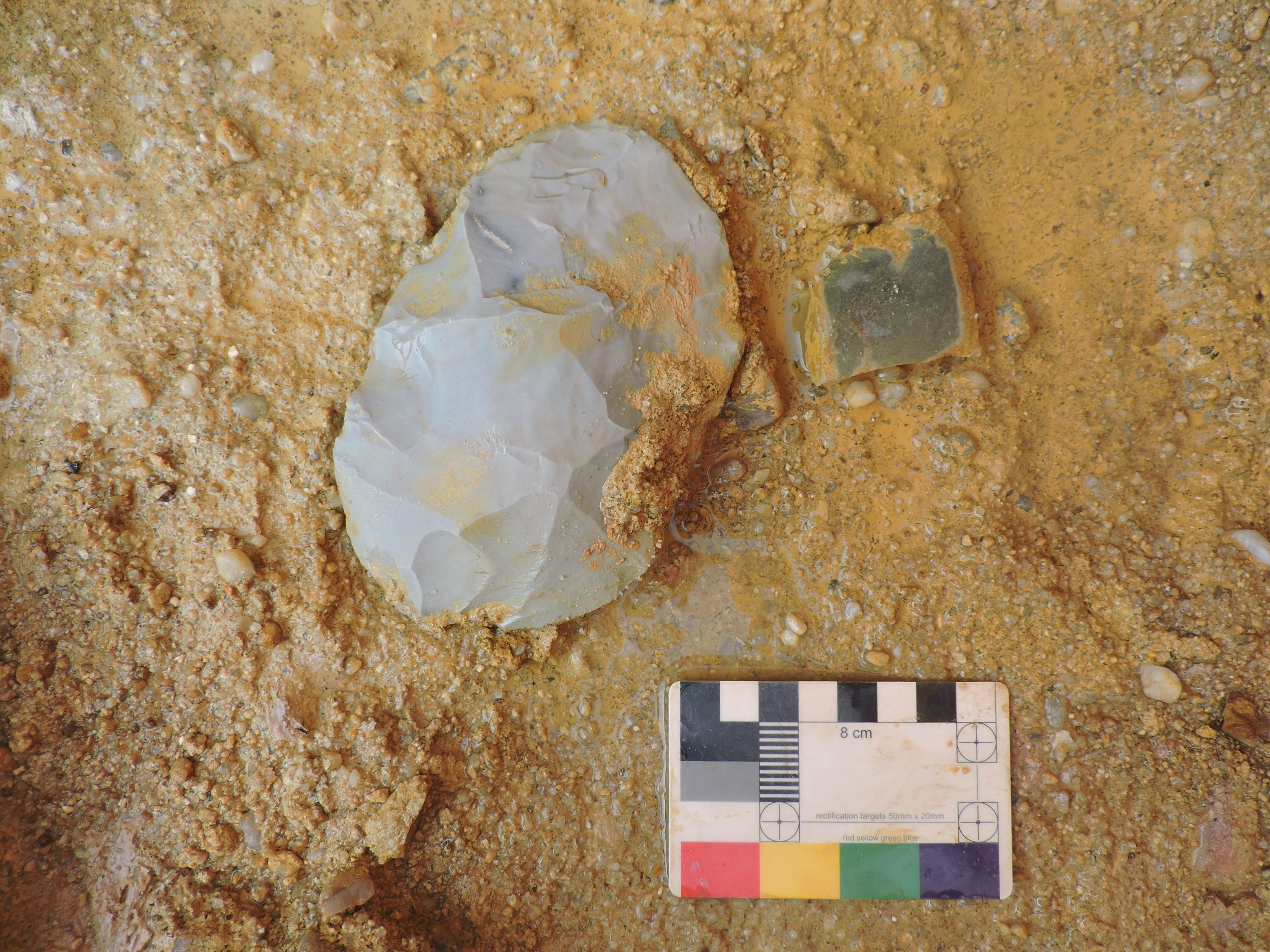
‘It is a challenge to my mindset, in terms of what I expected of humans at this time, and I think it is also a challenge to the discipline,’ says Larry. ‘Nearly 500,000 years ago at Kalambo, people were cutting down large trees, they were investing time into making something lasting. That suggests they must have been spending a significant amount of time in the area. These were not the usual foragers on the move. But then if everything they needed was at Kalambo Falls, maybe they didn’t need to travel constantly. There is water there, food, rocks, and wood, so why not just settle in and make the most of the landscape? Another interesting thing is that there is a real diversity of stone implements in the toolkit at Kalambo – a dozen different types of hand axes and cleavers, as well as adzes – you don’t see that range at other Acheulean sites. I’m just wondering if adopting a settled community life gave them an opportunity to specialise, perhaps specifically in the woodworking element, with some of the stone tolls being developed for that.’
‘Language is also likely to have been a factor. It’s not enough to watch people making these tools to learn how to do it, you also need a few nouns and a few verbs to be able to say “do it this way”. These are skills that had to be taught. The notched log certainly shows a familiarity with the technique – whoever made it, this wasn’t their first attempt. I have a suspicion that there was a lot more to the structure – especially the tapered ends. Did they fit into something else? Whatever the answer, this is early evidence for a built environment. And what we’re seeing is just a glimpse. It’s a very stark reminder that we’re missing a really large part of the material repertoire that early humans used. If you play a mind game where you imagine a good deal of the wood from this period still survived, I think you’d be surprised by what you saw. We’d probably be talking about renaming the Stone Age as the Organic Age or the Wood Age!’
Geoff agrees. ‘When you think about what is known of the capability and capacity of these people to shape and plan at that time, you suddenly realise, “Gosh, we know that wood is an incredibly flexible material that has all sorts of valuable properties. We also know that these people were making sophisticated stone tools. The opportunity they had to make different wooden objects was enormous.” After all, it wasn’t just the interlocking logs that were found at Kalambo Falls in 2019. Even though the area excavated wasn’t massive, the richness of the finds was extraordinary. Of the five trenches that were opened, one was geological, and the other four all produced some form of modified wood, with similar methods of working it observable over a span of about 150,000 years, from 476,000 to 324,000 years ago.’


Who, then, is the prime suspect for masterminding the extraordinary wooden world at Kalambo Falls? ‘So far as we know at the moment, the timing isn’t right for Homo sapiens,’ says Larry. ‘But there’s a fossil from Zambia that was found in the 1920s and is a very nicely preserved cranium plus some long bones from a Homo heidelbergensis. This particular specimen has been dated to about 300,000 years ago, which falls neatly within the late Acheulean timeframe we see at Kalambo Falls. Doesn’t mean it was definitely the hominin responsible, but whoever it was would need that capacity to plan, innovate, and think in abstract ways. So, it would probably be a big-brained descendent of Homo erectus, and heidelbergensis fits the bill.’
Given the extraordinary past of Kalambo Falls, thoughts naturally turn to the question of its future. ‘We know there is more to find at the site,’ Larry points out. ‘There is a temptation to put together a massive project on the back of the interest that this discovery has created, strip back the landscape, and find the village or whatever it is that’s down there. But before we do that it is important to think hard about the area. There are a lot more people living there now than there were in the 1960s. Demand on the local woodland means that the tree cover is thinning, and we’re wondering if increased rain runoff is what has made the river more active. But we need to model that. At the moment I’m talking to agencies in the Zambian government about putting Kalambo Falls forward for World Heritage status, given its unique nature. That has to be the priority at the moment, to look after this place.
FURTHER READING:
The wooden objects found in 2019 have been published open-access as L Barham et al. (2023) ‘Evidence for the earliest structural use of wood at least 476,000 years ago’, Nature (https://doi.org/10.1038/s41586-023-06557-9).
All Images: courtesy of Professor Larry Barham, unless otherwise stated.