
Subscribe now for full access and no adverts
The 18 June 1815 was a very special day in the history of Europe. Napoleon, fresh from his escape from exile on Elba, had gathered an army and was advancing across Belgium towards Brussels. Very little stood in his way except for the Allied army commanded by the Duke of Wellington. Historical accounts of the Battle of Waterloo have described events of that savage encounter, and many include details of the stubborn defence by Allied troops at Hougoumont Farm. Wellington selected his battlefield with care, assembling his army along the crest of a ridge overlooking and blocking Napoleon’s advance. This location incorporated four walled farms: Hougoumont on the right flank, in the west; La Haye Sainte in the centre; and Papelotte, further east; with Frichermont on the extreme left flank – forming forward bastions of defence against the French. Of these, Hougoumont was by far the most impressive in layout. It was constructed around two courtyards, with a smaller upper one to the south, serving the residential quarters which comprised a chateau complete with its own chapel, and a larger, lower-walled farmyard to the north. Around this enclosed yard stood barns, stables, and outbuildings, their brick-and-stone walls providing a largely impenetrable fortress-like façade against any attacking force. The French assault on Hougoumont Farm opened proceedings at Waterloo and continued largely uninterrupted throughout the day, a battle within a battle.

Following the Allied victory, the ruinous farm soon drew tourists and artists, including J M W Turner, who came to record its remains. A more detailed report was commissioned for Captain William Siborne, a soldier and qualified surveyor, in order to create a scale model of the entire battlefield and to compile a written account of the battle, published under his son’s name in 1848. Despite this impressive record, archaeological excavations on the site have been limited. Although investigations were undertaken by the local archaeological authority (SPW) in advance of restoration of the farm for the 2015 bicentennial celebrations, these were concentrated on the upper courtyard, defining the residential buildings – principally the chateau – and did not deal with the farm buildings in the northern courtyard. There was therefore very little to show what the north part of Hougoumont Farm may have looked like at the time of its construction, what evidence of the battle survived, or how the site may have altered in the aftermath of the conflict. This situation was set to change, however.
In 2015, Waterloo Uncovered – a charity designed to assist physically and mentally traumatised service personnel and veterans in their recovery – started archaeological investigations on the battlefield. Directed by Tony Pollard and Stuart Eve, and run in collaboration with the Belgian authorities (SPW/AWAP), this major project has included work to examine largely unexplored building foundations on the east and north sides of Hougoumont Farm’s lower courtyard. Siborne’s 19th-century account indicates that cow sheds and stables were apparently arranged along the east side, with additional stables on the north. These buildings were all destroyed by French artillery-fire, when incendiary howitzer shells set the buildings alight soon after 2.30 in the afternoon. Ensign Thomas Wedgewood of the Scots Guards, who witnessed the destruction, described in a letter to his mother how ‘They then sent fire balls upon the house and set a barn and all the out houses on fire’ (Glover, 2010; see ‘Further reading’ on p.43). Allied troops, many of whom had been wounded in the early stages of the battle, were sheltering inside and were unable to escape. Siborne described the carnage: ‘not a man could be spared to assist in extricating the sufferers from their perilous situation’ – a fact confirmed by Ensign Wedgewood, who noted the loss of ‘nearly one hundred men having now been consumed in the flames’.
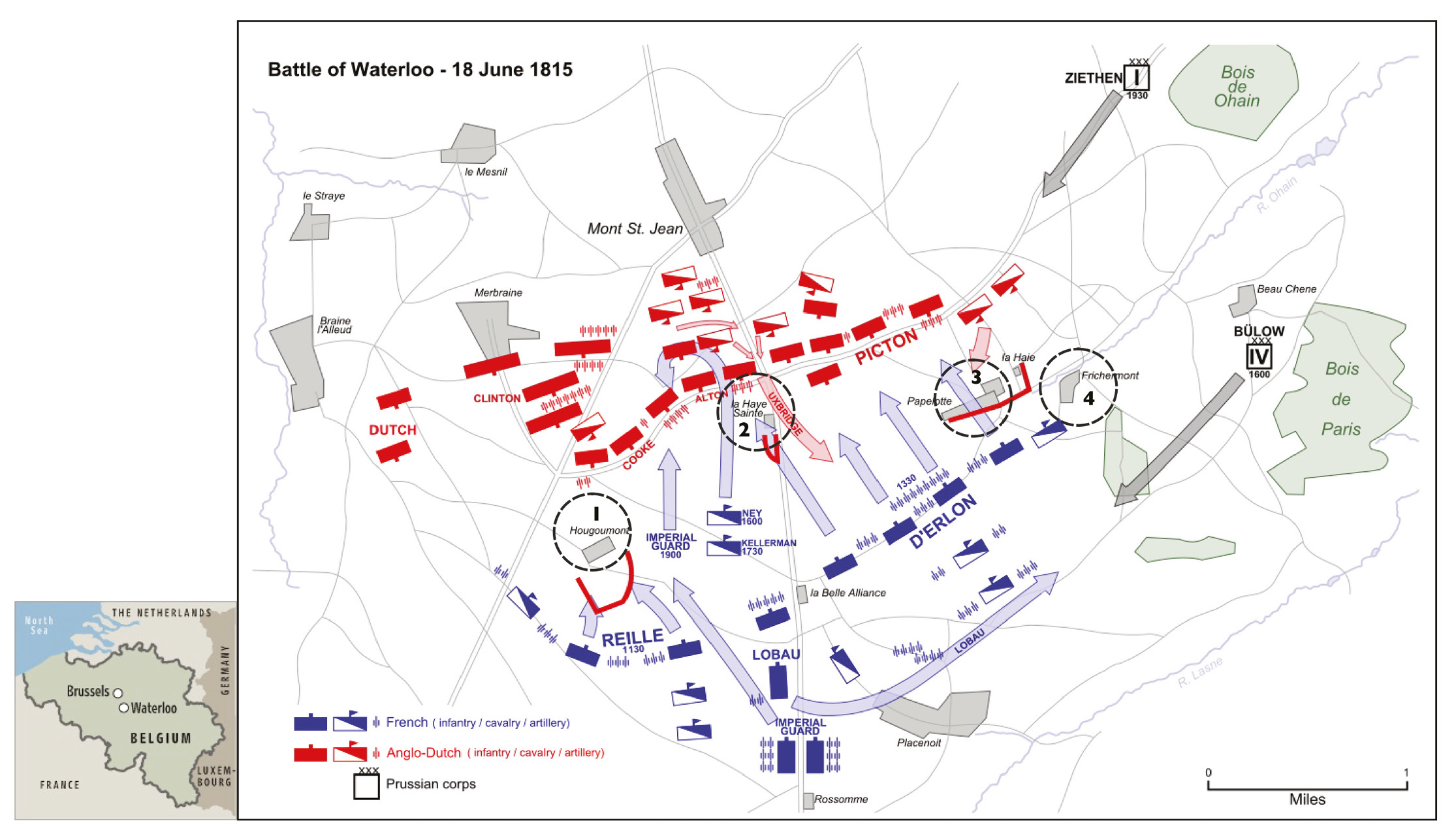
Another area of interest in this part of the site is the North Gate, which lies in the angle between the former building on the north side of the courtyard and a large barn (now part of the visitor centre) on the west side. This access point remains of special significance to the Coldstream Guards, who famously repulsed an incursion of French infantry there and closed the gates, preventing the fall of the farm and Wellington’s right flank.
The stable block and the barn
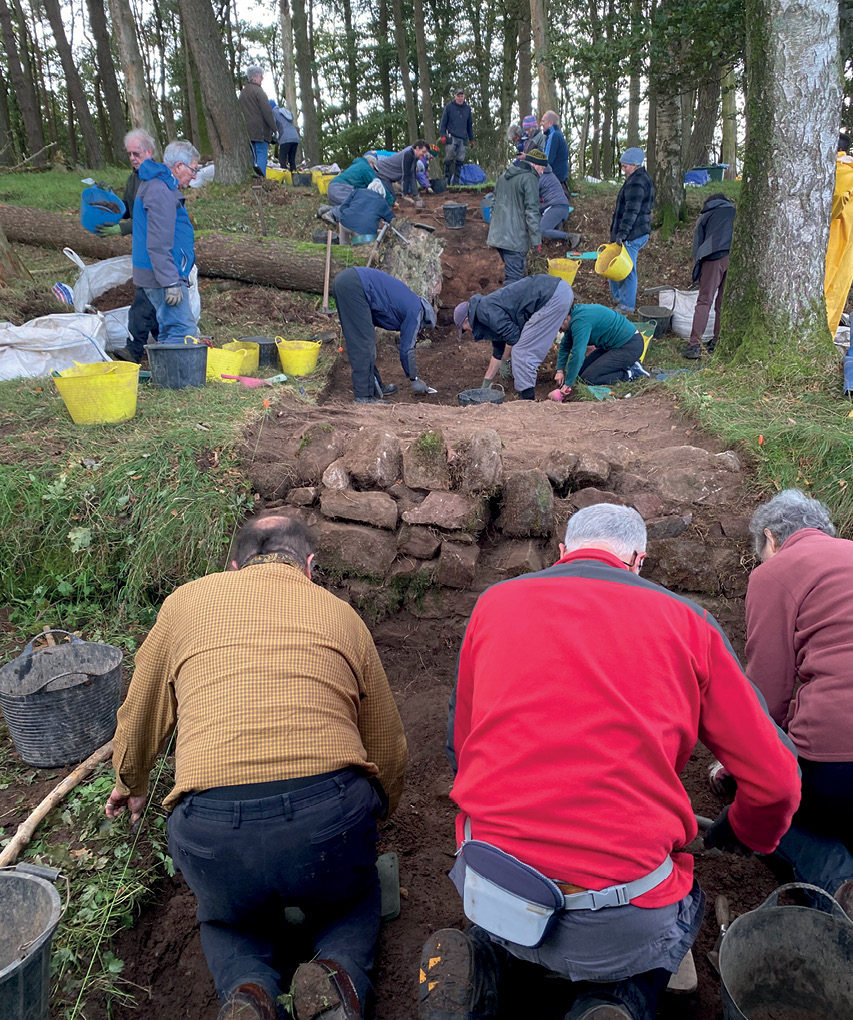
Waterloo Uncovered opened its first trench within Hougoumont Farm in 2016: lying along the east side of the courtyard, it aimed to locate traces of the cow sheds and stable block. This range, as befits its purpose, was probably built with an upper hay loft, making it potentially highly flammable. Buildings of similar design still line the upper courtyard, providing some hint of their probable appearance. Our first trench uncovered traces of the stone foundations, showing the building to be approximately 7m wide, but, totally unexpectedly, also located a superbly engineered drain that ran across the width of the building. The drain included a carefully constructed silt trap designed to winnow out sediment, an admirable embellishment to this utilitarian building that indicated the wealth of the original owners. Fortuitously, the silt trap also contained fragments of slate, which shed light on the construction of the roof.
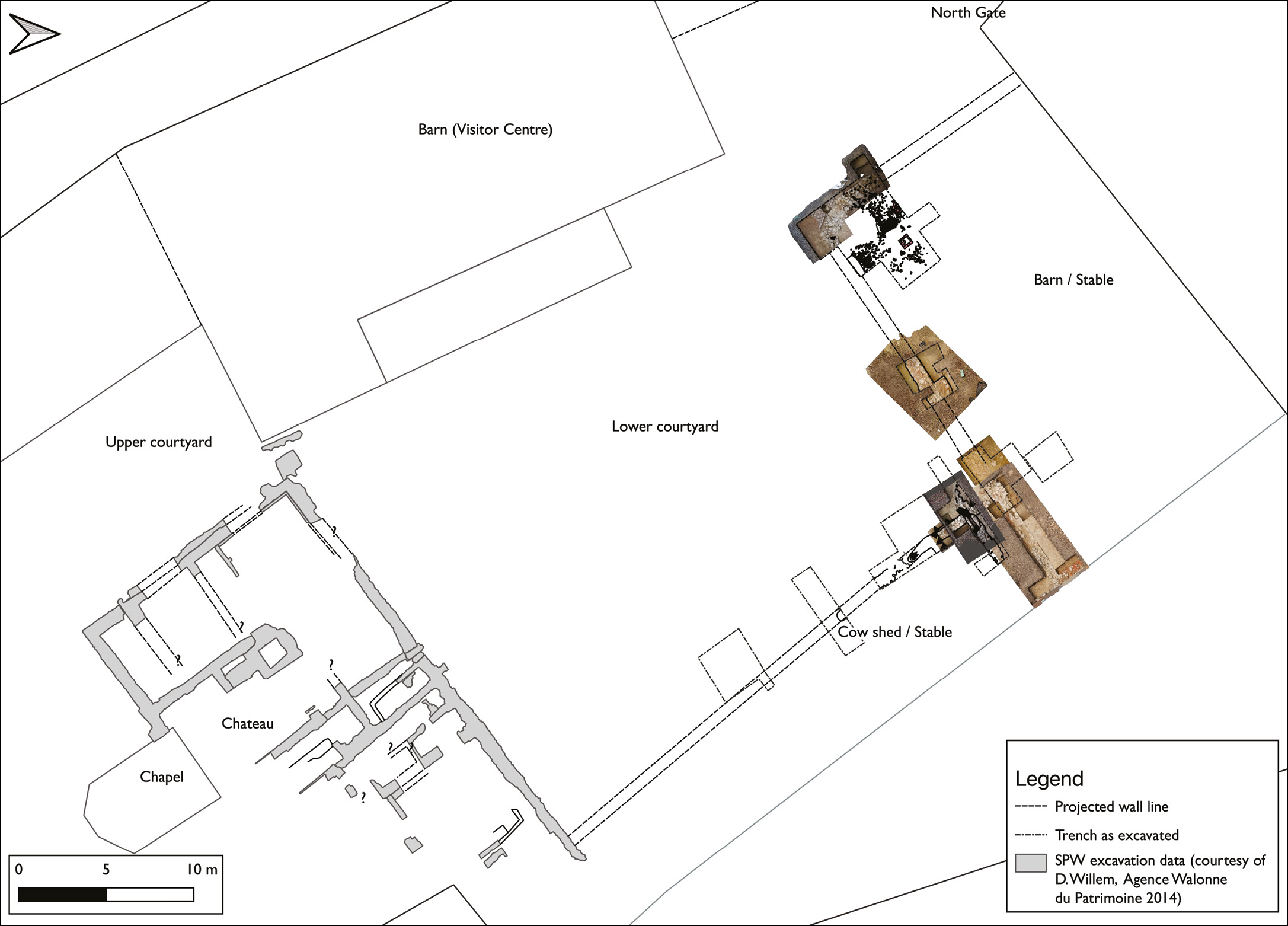
Subsequent excavations to expose more of the foundations to the south have shown that the building containing the drain was constructed with deeper foundations than those elsewhere along the east side of the yard and may have been a later addition, infilling a gap between a shorter, earlier version of the eastern range and the barn to the north. The floor of this stable block had long- since been lifted but was undoubtedly formed by stone cobbles, which Siborne’s model confirms extended beyond the building to provide a paved border around the fringes of the courtyard. The model also shows a series of other drains across the courtyard, features which may have been overworked following the extensive deluge on the day preceding the battle.