
Subscribe now for full access and no adverts
Recently published research focused on a late Roman sarcophagus found in Westminster Abbey’s grounds more than 150 years ago has shed new light on the coffin’s history, as well as the possible identity of the person buried within it.
First excavated in the Abbey’s northern precinct in 1869, the limestone sarcophagus has an inscription naming Valerius Amandinus, a wealthy Briton who is believed to have lived in Roman London during the 4th century AD. Its lid is also sculpted with a Latin cross dating to the 10th-11th century, however, suggesting reuse in the medieval period.
In the century and a half since its discovery, during which time the sarcophagus has been on display in the Abbey, most research on the coffin has focused on its Roman story. It was assumed that the remains of any later occupant had been lost, but conservation work in 2016 unexpectedly revealed that human bones were indeed still present inside the sarcophagus. James Young Langthorne from Pre-Construct Archaeology (PCA) analysed the remains, revealing that they belonged to a man who was probably aged between 35 and 49 when he died, and round 5ft 9in (1.75m) tall. His body had first been placed in a timber coffin and covered with lime before being placed in the Roman sarcophagus – and radiocarbon dating confirmed he had died in AD 987-1052.
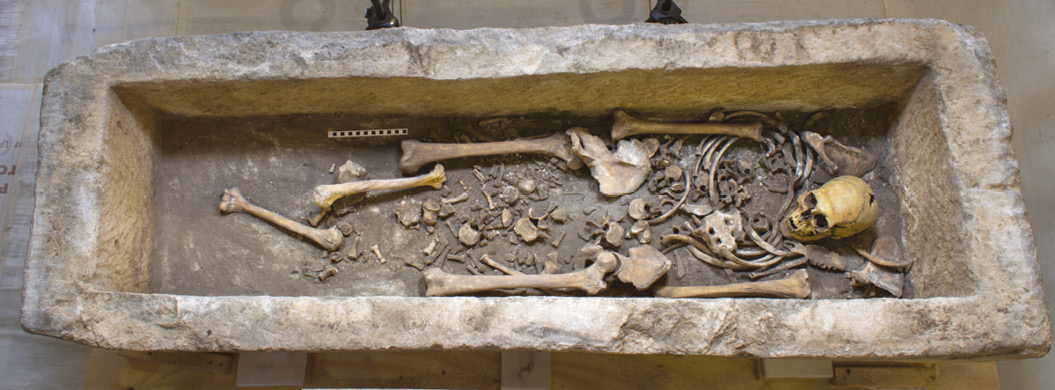
During a recent re-examination of these findings, Professor Warwick Rodwell, Consultant Archaeologist at Westminster Abbey, argued that the bones probably belong to a high-ranking medieval monk, the most likely candidate being Abbot Ælfwig (993-c.1020), who is known to have been initially interred in the Anglo-Saxon abbey’s eastern arm. A second candidate is Ælfwig’s successor Wulfnoth, who died in 1049 and who is also presumed to have been laid to rest at Westminster. Warwick suggests that the sarcophagus would probably have been embedded in the floor of the 11th-century church, with its recut lid serving as a cross-slab. When the abbey was rebuilt at the direction of Henry III in the 1240s important burials were exhumed and relocated in the new church. The sarcophagus and its contents were interred in the courtyard of the Great Sacristy as part of these changes.
Warwick’s full report was recently published in the Journal of the British Archaeological Association (https://doi.org/10.1080/00681288.2026.2675788). The sarcophagus can be seen at Westminster Abbey in the Queen’s Diamond Jubilee Galleries (see CA 345).
Text: Kathryn Krakowka / Image: Pre-Construct Archaeology Ltd, CC BY-ND 4.0