
Subscribe now for full access and no adverts
The Nene Valley is renowned for the pottery industry that thrived in the Peterborough area during the Roman period. Evidence for this activity is particularly concentrated around Durobrivae (Water Newton), with another cluster located a short distance to the west near modern Stibbington. At this latter site, numerous Roman kilns were excavated by Edmund Artis in the 19th century (see CA 416 for more about his work in the Nene Valley) and further examples have been uncovered during modern investigations. Two kilns excavated there in the 1960s have now inspired the latest experimental archaeology initiative at Stanwick Lakes in Northamptonshire.
Today Stanwick Lakes is a country park and nature reserve managed by the Rockingham Forest Trust, but between 1985 and 2004 this landscape underwent extensive gravel quarrying, prompting one of the largest archaeological excavations of the time. These works uncovered Neolithic and Bronze Age burial mounds, Iron Age and Anglo-Saxon settlements, a Roman villa with mosaics, and a deserted medieval village (CA 75, 97, and 106). Many of the excavated sites now lie beneath the lakes that give the park its name, but Stanwick Lakes’ heritage team are striving to help the public engage with the area’s rich archaeological story. The park is already home to a museum, Heritage Trail, Traditional Crafts Barn, reconstructed Iron Age roundhouses, and a Heritage Garden, and its team are busily engaged in experimental archaeological research.
In 2024, this included the construction and launch of a trio of Bronze Age logboats based on excavated evidence from Must Farm (see CA 416 for more on the project, and CA 263, 312, and 319 for the archaeology that it drew on), and the current project, a two-year initiative called From Iron to Empire, focuses on the Nene Valley’s Roman past. A key part of this work (which is supported by the National Lottery Heritage Fund) has been the construction of a full-scale Roman pottery kiln, led by Derek Roberts through his community archaeology company Udig, working with Stanwick Lakes volunteers.
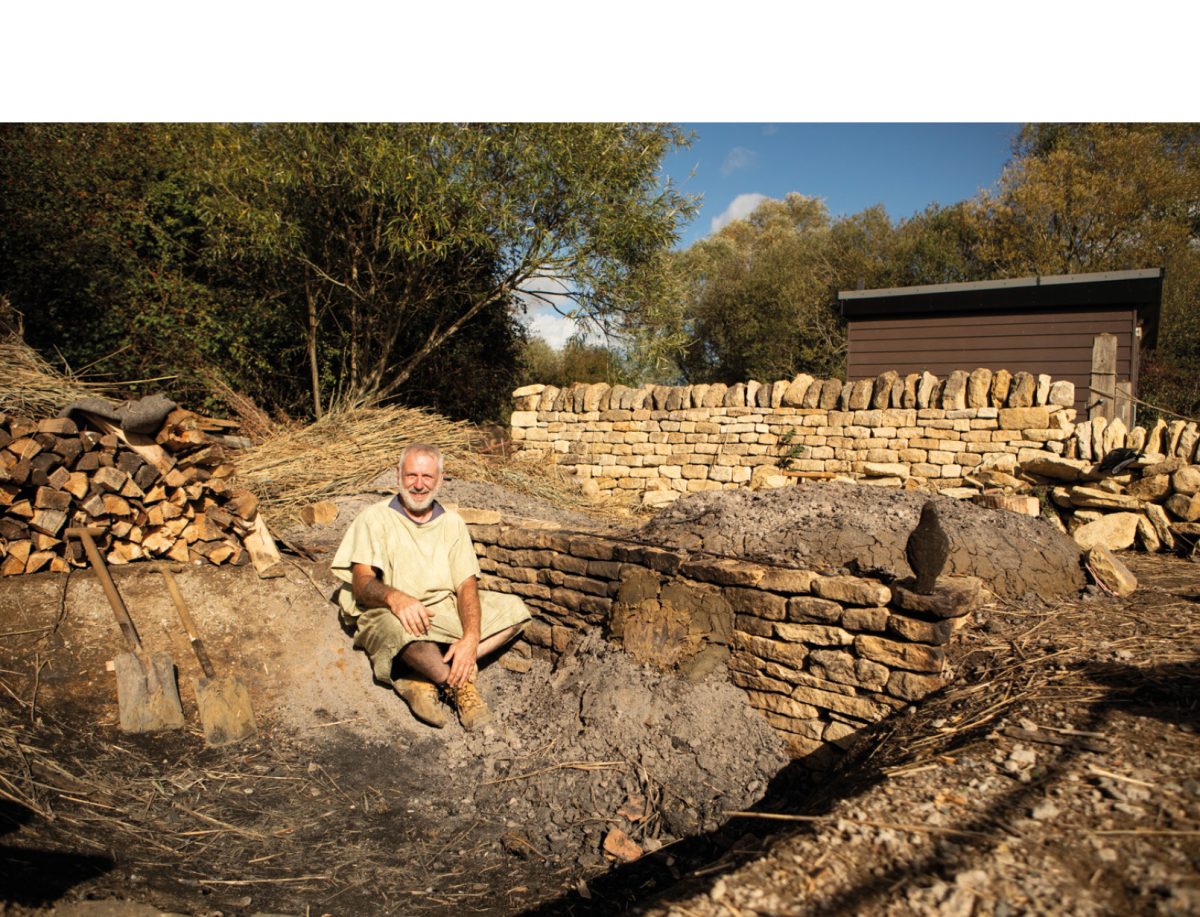
Its design was based on two kilns excavated at Stibbington in 1969: Kiln W, which had a well-preserved façade, and Kiln G, which had a well-preserved chamber. Together, these features offered invaluable information about all of their below-ground elements, and surviving jars and bowls, including greywares and colour- coated vessels, shed light on what they had been producing. The reconstruction’s roof, however, is truly experimental, as no trace of this aspect had survived. While the build team incorporated four modern thermocouples into the reconstructed kiln, to enable them to keep an eye on internal temperatures, they otherwise aimed to recreate the technology as closely as possible to what is suggested by available archaeological evidence.
Trials and triumphs
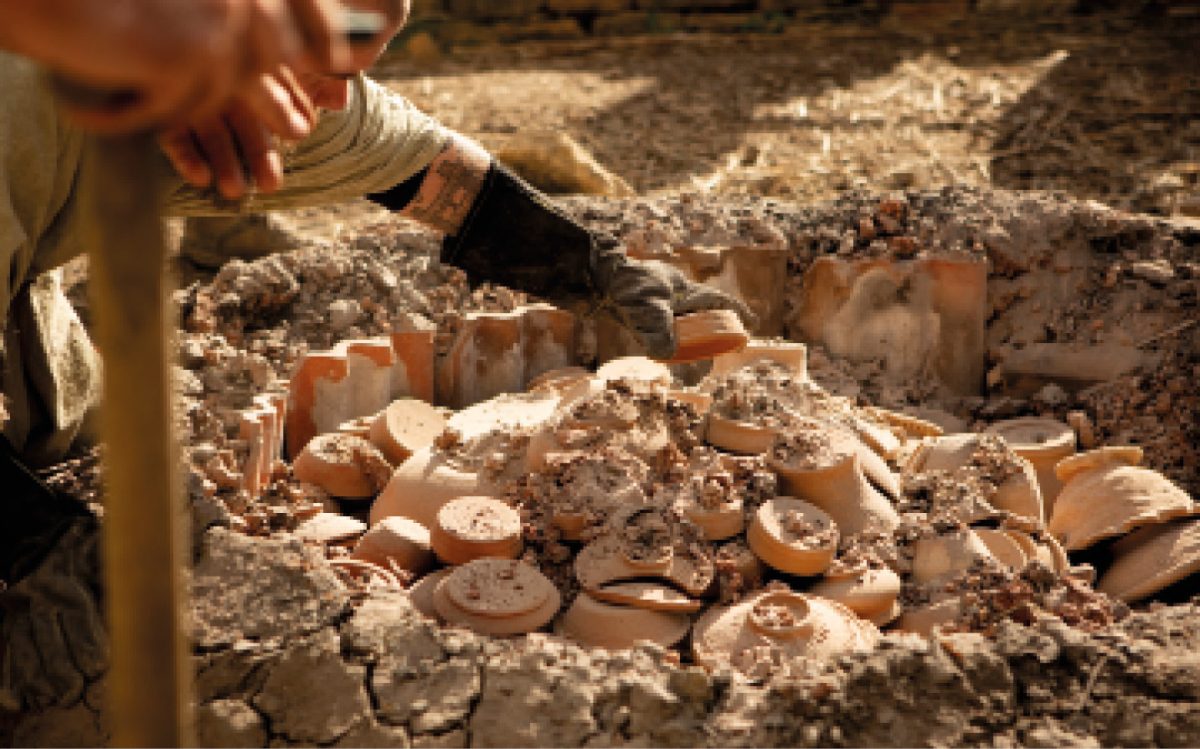
The project was not without its challenges: the gravel-thick local clays were laborious to dig to create a large pit to house the potter’s yard and allow the firing chamber and stoke pit to be as deep as those of the Stibbington kilns. The team also had to contend with both heavy rain and the extremely dry conditions of this summer’s heatwave, which caused clay linings first to slip and then to crack, but by the autumn the reconstruction was complete and, over the course of a heritage weekend in mid-October, the kiln was fired for the first time. In its chamber the team placed pots made by volunteers in workshops led by Liam Moorhead, who runs a pottery studio at nearby Woodnewton. Liam also took part in the firing, along with Wendy Gamble, another local professional potter with a keen interest in history. Some of the pots were replicas of examples excavated at Stibbington, and some were stamped with the letters FERIMP as a Latinised reference to the From Iron to Empire project.
Commenting on the initiative’s outcome, Derek Roberts said: ‘The first firing of the replica Roman kiln was successful and informative on many aspects of the process. Temperatures of 720°C to 850°C were achieved, leaving us with a good but mixed bag of fired pots with a range of colours. Only a small percentage of pots didn’t make it, and although some pots did not reach the minimum biscuit firing temperatures, the kiln worked well and informed enough to show us what we need to do for firings in 2027.’
Nadia Norman, Heritage Coordinator at Stanwick Lakes, added: ‘We are, as you can imagine, absolutely thrilled that this first firing has given us these results. Our aim is to use the data and these results to try another firing in 2027, adjusting our methodology to see what we can achieve next time. It has been absolutely brilliant, especially for the volunteers who helped build the kiln, that despite the challenges with the wet and then super-dry weather this year, their creation was so successful.’
The kiln will remain a permanent feature at Stanwick Lakes, supporting workshops, demonstrations, school sessions, and ongoing experimental archaeology programmes testing construction methods, firing behaviour, fuel use, temperature control, structural performance, and the impact of weather.
Designs and dyes
This is not the only Roman-themed initiative taking place at Stanwick Lakes: the team are planning a new ‘villa viewpoint’, too, overlooking where a grand Roman residence was excavated decades ago. They plan to build a folly-like ‘ruined villa’ to help visitors engage with the now-submerged remains and to enhance their schools programme. Like the original villa, the new structure will contain mosaic floors, and during the heritage weekend visitors were invited to help add ‘tesserae’ (made from reclaimed quarry stone) to one of a planned eight designs being created by artist Lisa Lovett. One of these mosaics will be installed in the site’s newly expanded Heritage Garden, where a space focusing specifically on the Roman period has been added. This courtyard garden is filled with raised beds planted with diverse species that were used for cooking, cosmetics, medicine, and perfume; some are native to Britain, some introduced to these shores by the Romans, and some known from the wider Empire. This area will also ultimately be adorned by a fresco inspired by a fragmentary female face preserved on painted wall plaster that was excavated at the nearby Hunsbury Roman villa.
As well as other drop-in craft activities and living history demonstrations from the Longthorpe Legion Roman re-enactment group, the Northants Guild of Spinners, Weavers, and Dyers were on hand during the heritage weekend, demonstrating traditional techniques linked to textile production in Iron Age and Roman Britain. They were showcasing their ongoing research into the durability of dyes used in Roman Britain and the wider empire, using wool, silk, cotton, and linen, and a wide range of natural dyes including woad, madder, weld, and walnuts. The finished fabrics had been strung like colourful bunting – with various shades of yellow, red, brown, and blue – along the front of the Traditional Crafts Barn, where they will remain to see how quickly they fade when exposed to the elements. Other samples have been placed in a light-excluded box for comparison.
There were also updates from Stanwick Lakes’ Bronze Age projects: a new, larger logboat is currently being constructed, led by Dr James Dilley and again using a fallen lime tree from the Boughton House Estate (although this time the team are hollowing out a whole trunk rather than a branch). Close-by, visitors could see a newly completed Bronze Age jetty based on archaeological remains from Must Farm and Flag Fen; James Dilley marked its official opening with a ‘votive sacrifice’, throwing a freshly cast bronze axehead into the lake.
Images: © Ancient Craft/Emma Jones