
Subscribe now for full access and no adverts
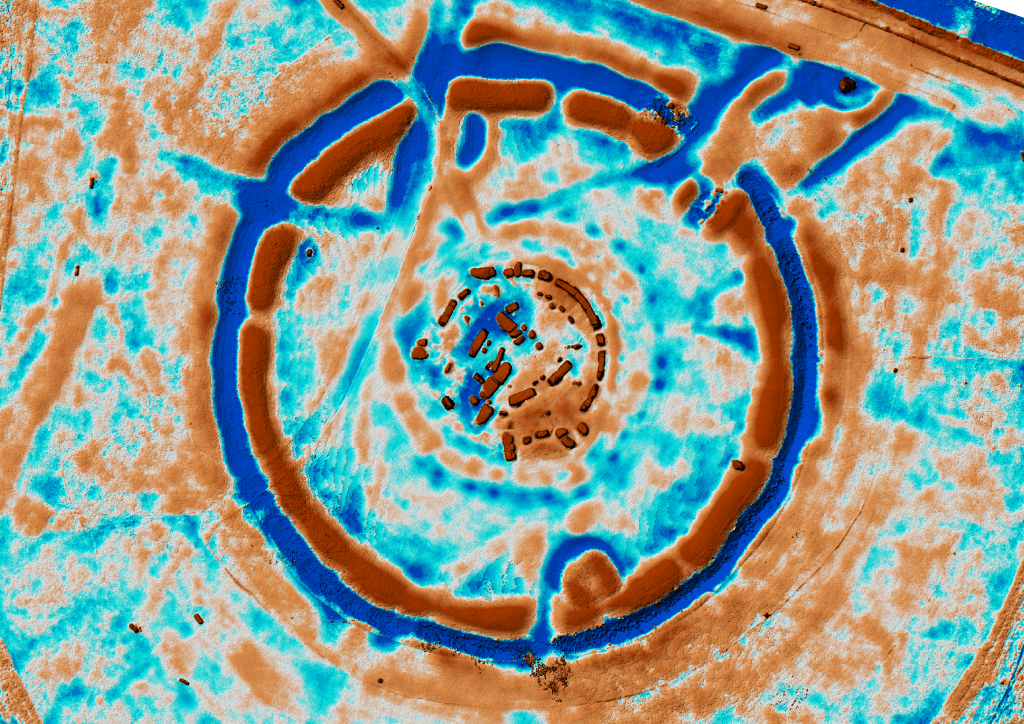
For more than a decade, Adam Stanford and English Heritage have periodically recorded the parch marks that appear at Stonehenge in the summer, when conditions are right. Until recently this involved oblique low-level aerial photography via mast, kite, or drone. However, our team have now utilised new UAS (drone) RGB, multispectral, and thermographic survey methods – with illuminating results. Applying vegetation indices to the multispectral data has afforded new possibilities for identifying hitherto unknown features within the monument, in both the visible and invisible spectrums.
This image shows a terrain-flattened Digital Elevation Model of Stonehenge derived from UAS survey. This technique is used to enhance micro-topographic features expressed at surface level that might otherwise be invisible to the naked eye. Orange and red colours represent positive expressions above the surface, while light- and dark-blue colours represent depressions.
Analysis and interpretation of the results with Heather Sebire and Mark Bowden are ongoing.
Text: Adam Stanford / Image: Survey data: Adam Stanford, GIS Analysis: Dr Scott Williams, SUMO GeoSurveys