Subscribe now for full access and no adverts
What is it?
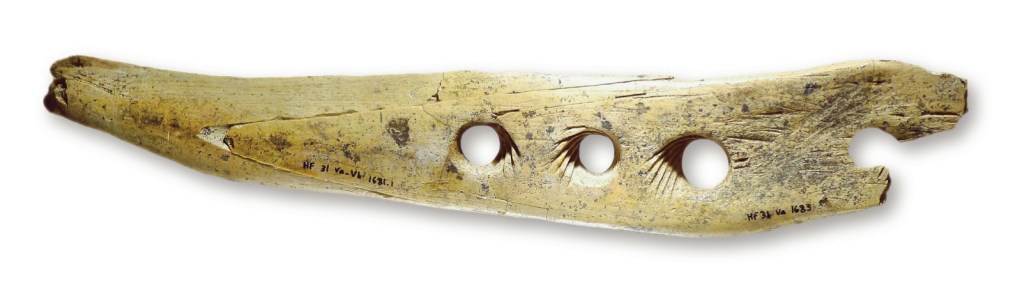
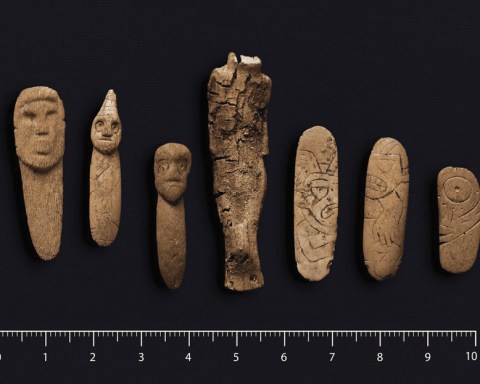
This perforated baton made of mammoth ivory is believed to be a Palaeolithic tool used to make rope. The baton is 20.4cm long, 3.6cm wide, and 1.5cm thick. Four holes of slightly different sizes have been drilled through the object, each containing carefully carved spiral grooves. The well-preserved surface of the tool and the sharp edges of the grooves suggest that it has not experienced heavy use, perhaps because it was broken during or shortly after having been manufactured. Radiocarbon dating of animal bones with signs of human working found in the same context as the baton reveal that it dates to between 40,000 and 35,000 years ago, in the Aurignacian period.
Where was it found, and when?
The fragmented object was found in Hohle Fels cave, in the Swabian Jura of south-west Germany, in 2015. A total of 13 pieces of ivory were recovered during excavations, and a further two were identified during sediment screening. These fragments were refitted to form the nearly complete object. Now a recent study has shed new light on the artefact’s function: microscopic analysis identified plant fibres adhering to the area around the baton’s holes and grooves, while experimental archaeology carried out with replicas of the object tested its potential for fibre-processing. The results strongly support the interpretation of the baton as a tool used for making rope or twine.
Why does it matter?
Perforated batons are found throughout the Upper Palaeolithic, but four-holed examples like this are very unusual. Its early Aurignacian age also places this object among the earliest known perforated batons. There has long been debate about the function of such artefacts: suggestions include ritual or artistic objects, spear-shaft straighteners, and tools for leather-working. However, the interpretation of the Hohle Fels baton as a rope-making tool – supported by the recent research – is an avenue that has not been explored before.
It is widely accepted that rope was in regular use in the Palaeolithic, as seen in imprints in clay, traces of fibres, and images in art, but direct evidence associated with its production is almost entirely absent. Experiments with the replicas of the Hohle Fels baton have revealed that plant-fibre bundles pulled through the grooved holes can indeed be twisted into a single piece of strong, flexible rope. The researchers determined, too, that the process would have involved between three and five people: one to twist and maintain tension on each of the strands, and one to operate the baton. The Hohle Fels perforated baton therefore represents a valuable source of information about an important activity that is not usually visible in the archaeological record, as well as providing further evidence for communal activities involving complex communication and planning among early Aurignacian hunter-gatherer communities in central Europe.
FIND OUT MORE: The recent research has been published in Science Advances (http://www.science.org/doi/10.1126/sciadv.adh5217).
Text: Amy Brunskill / Photo: Hilde Jensen, © Tübingen University