Subscribe now for full access and no adverts
The Altar Stone Engravings
I was recently researching the Historic England archive of Richard Atkinson’s 1958 excavations at Stonehenge, and two photographs (P50106, https://historicengland.org.uk/images-books/photos/item/P50106; and P50107, https://historicengland.org.uk/images-books/photos/item/P50107) revealed an astonishing feature of the Altar Stone.
The photographs partially show the excavated south-eastern end of the stone, which has otherwise always been buried, and there are what appear to be prehistoric engravings in it. Atkinson merely notes it was ‘deliberately worked’ in the 1979 revision of his Stonehenge book. With the benefit of recent knowledge of prehistoric engraved stones and ceramics, from all parts of the British Isles, the diagonal lines can be clearly identified as belonging to that tradition, and are more than functional working of the stone.
This preliminary identification of the alternating diagonal lines, their form indicating they were inscribed by stone tools, is merely the start of a debate as to their connection to the builders of Stonehenge, their meaning, and where they came from.
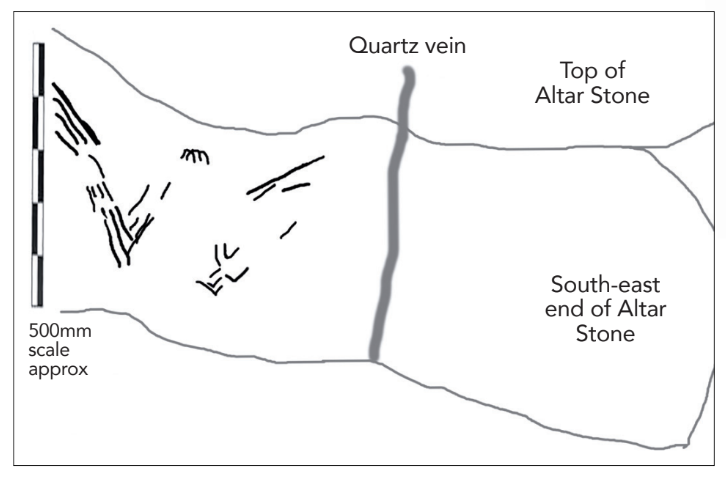
The previous excavation could, and should, be reopened to allow a modern detailed examination so the speculation this discovery will engender can be constrained by realism. I have sketched the engravings (above), and have written about them on my blog at http://www.sarsen.org/2024/10/prehistoric-engravings-discovered-on.html.
Tim Daw, All Cannings, Wiltshire
Wild gamers
I was interested to see the ‘Sherds’ piece about the (re)wilding of Knepp in CA 414, which has a surprising intersection with another hobby of mine: boardgaming. The talented game designer Mark Tuck has developed a delightful small solitaire PnP (Print & Play) game based on the Knepp project. Called Rewild, it’s available via his website www.tuckgames.com, and best of all it’s free! Fellow boardgamers among CA subscribers should check it out.
David Francis, Ivanhoe East, Australia
Fruitful memories
Chris Catling’s article about orchards (in CA 414) was a delight to me. It stirred many happy memories of my childhood in the Weald of Kent in the 1930s and 1940s.
We lived in a medieval house adjoining an apple orchard of the same name. A footpath wended through the long grass, where hens scratched happily.
The trees were large and gnarled but productive. The apples were ‘eaters’: Worcester Pearmain, among others.
There were a number of traditional large orchards on my grandfather’s land – apple, plum, pear, and cherry.
I particularly remember the tall cherry trees requiring very long ladders for picking, and the sweet scent of their blossom, especially at night.
These orchards were so very different from those of today, with their small bush-like trees, straight rows, and base earth.
I look forward to reading Terry Barnes’ and Tom Williamson’s book – so engagingly touched on in Chris’ article.
Mary Fox, Blean, Canterbury
Sheffield Castle
Sheffield Castle resurfaces at last! I was born and raised in Sheffield during the War and I always knew that if there was a castle market there must be a castle, but the adults around me said no one had ever seen one, so it must be long gone. I minded, so now [with the article in CA 414] you and the Wessex Archaeology team have made an old lady very happy.
Thank you.
Julie Tew, Harrow
P.S. A strange thing about Sheffield: until I was nine or ten years old, I thought that all rivers were orange like the Don.
Edible Archaeology
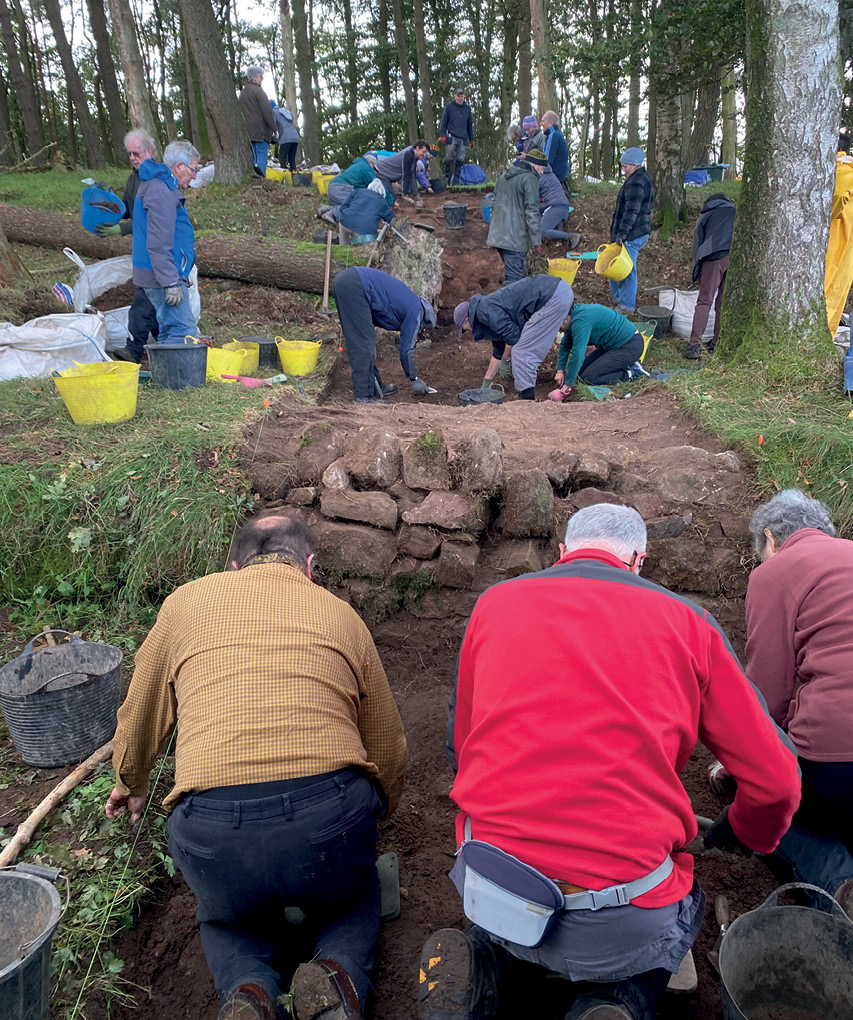
The Archaeology and Education teams at the Museum of Archaeology and Anthropology worked together to render Must Farm in chocolate cake for the University of Cambridge museum’s annual summer gathering. We were inspired by the publication of the Must Farm site earlier this year, and by the objects we were kindly lent by Peterborough Museum for our Beneath Our Feet exhibition. We took the bold decision to capture the scene ‘mid-burn’, complete with hastily discarded bronze tools, authentic cherry flames, and fleeing fenland jelly people in their log boat. The Must Farm site is so amazing because it really has the feeling of a moment frozen in time; we wanted to put some of that feeling into the cake.
Lily Pencliffe, Senior Teaching and Collections Assistant for Archaeology at Cambridge Museum of Archaeology and Anthropology

CA ONLINE: What you shared with us this month
Dr Isabella Rosner @IsabellaRosner
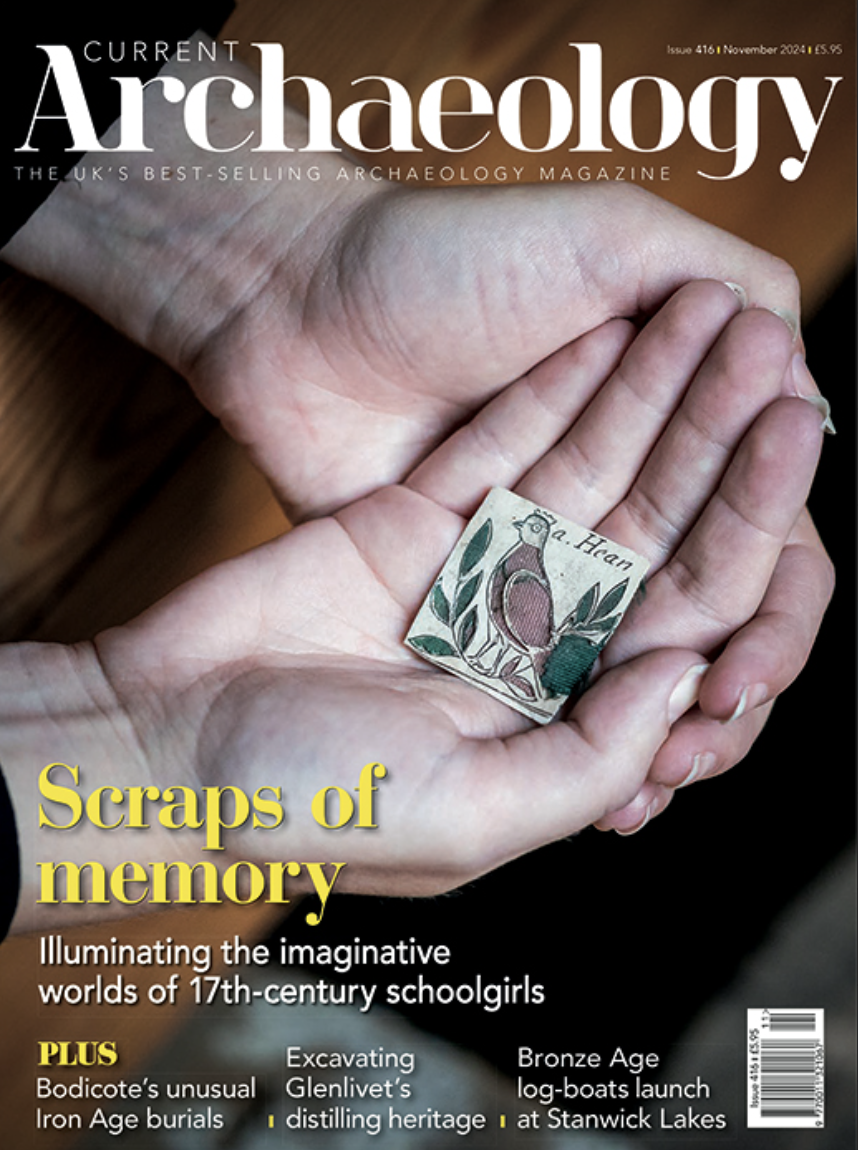
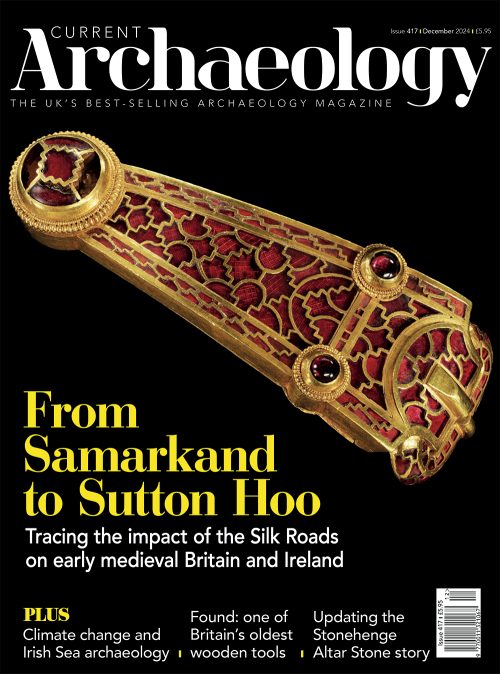
This article from @CurrentArchaeo is one of my favourite stories written about the @SuttonHouseNT papercuts. And the story of the rediscovery is on the cover of this month’s issue! How cool is that? Read the article here: https://archaeology.co.uk/articles/features/illuminating-the-imaginative-worlds-of-sutton-houses-17th-century-schoolgirls.htm
Nadia Norman @NadiaHeritageSL
It’s not every day you get an article in @CurrentArchaeo! A brilliant piece about the #BigBronzeAgeBoatBuild @StanwickLakes & our heritage projects. Huge thanks to @ancientcraftUK & @CambridgeUnit, weavers guild & our fab volunteers! @HeritageFundUK @HeritageFundM_E #heritage
NTS Archaeologist @NTS_archaeology
Sitting down tonight with a wee dram of @TheGlenlivet to review the new edition of @CurrentArchaeo magazine with our Upper Drumin distillery article in it. @N_T_S #PioneeringSpirit

STOP PRESS
We have just heard that our binder and slip case supplier will be closing their business shortly. They have supplied us for over 50 years, and we believe they are the only one of their kind in the country. We will be making one last order, and after that these products may not be available to purchase any more. If we do find a new supplier, we may not be able to match materials/colours.
If you would like to be part of this final order, please reserve your products online at http://currentpublishing.com/shop, or you can email subs@currentpublishing.com or leave a message on 020 8819 5580. Orders must be placed by 20 November.
Write to us at: CA Letters, Current Publishing, Office 120, 295 Chiswick High Road, London, W4 4HH, or by email to: letters@archaeology.co.uk. For publication: 300 words max; letters may be edited.