Subscribe now for full access and no adverts
Medical memories
The article on Temperance (CA 434) was very interesting, but one important establishment was missed: the National Temperance Hospital on Hampstead Road, purpose-built in the late 19th century. When I was nursing there in the early 1970s, we still had to record in a large ledger details of patients who received alcohol during their stay. The details included the reason for giving alcohol, how much and what sort, and the outcome for the patient. It would be interesting to know if University College Hospital, which then governed the NTH, still has the ledgers.
Mary Crockett, Cumbria
Consent and love
Sherds comments in CA 434 on chromosomal evidence of higher levels of sex between Neanderthal men and anatomically modern women (or, as he puts it, males and females) than vice versa, suggesting that calling such sexual ‘encounters, unions, pairing events, interbreeding’ and the like has a distinctly hippy tone. Rape, he implies, would be a better word.
Neanderthal men may sometimes have raped Homo sapiens women, but is it plausible to suggest that rape occurred frequently enough to leave such a strong imprint on the genome? And yes, the question of rape raises fascinating issues of consent – including whether sex was necessarily consensual between early Homo sapiens women and men. But, turning this around, could we imagine two male-dominant societies in which Homo sapiens men provided women to Neanderthal societies as an offering or item of trade? I am simply saying let us not assume: let us be curious and consider many options.
Beyond this, though, the key hippy word is ‘love’. None of the terms listed include this concept. And that points to a blindness, I think, in how we think about ancient lives. Should we exclude the possibility that Neanderthals and Homo sapiens experienced feelings of love, affection, and likings within their species – and potentially between the species?
It is time to contest essentialist readings of Homo sapiens and Neanderthals. Neanderthals made music (and, if they did, they must have sung) and art. Rather than thinking of them as lesser, defective humans, it would open more cognitive doors to think of them as expressing different ways of being human.
Cathy Rozel Farnworth, Warleggan, Cornwall
Woven Archaeology
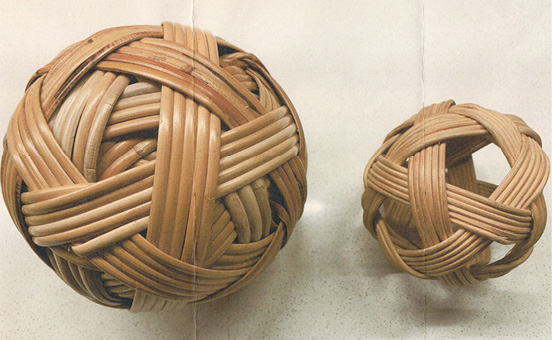
I used to be in Maths education and spent many happy hours hunting pentagons and their relationship to the golden section, in various locations where there is a lot of Islamic tessellation. Given that Haroun al-Rashid and company did not have a photocopier, there is some useful literature on how to draw pentagons and golden sections, if you have a straight edge and something to write with. Before I went to Sarawak, Malaysia, with my exhibition Common Threads, I put myself on a hurried weaving course, knowing that the people who live there have an astonishing range of woven goods, used for carrying things in their very steep, jungly, and wet part of the world. One of the works I studied was Occasional Paper 4, published by the Sarawak Museum, which showed me how to weave a Sepak Raga ball (though I used willow instead of the rattan used locally); the paper dates the earliest weaving yet found nearby as Neolithic.
These photos show the Sepak Raga ball I bought there, and my own bit of very amateur weaving. The pentagons are obvious and so are the triangles, but one further thing is clear: people in south-east Asia have been kicking woven pentagons and triangles about in very athletic ball games, long before people who were brilliant at metalwork came and put knobs on.
Mary Harris, London
CA ONLINE: What you shared with us this month
Dr Francis Young @drfrancisyoung.bsky.social
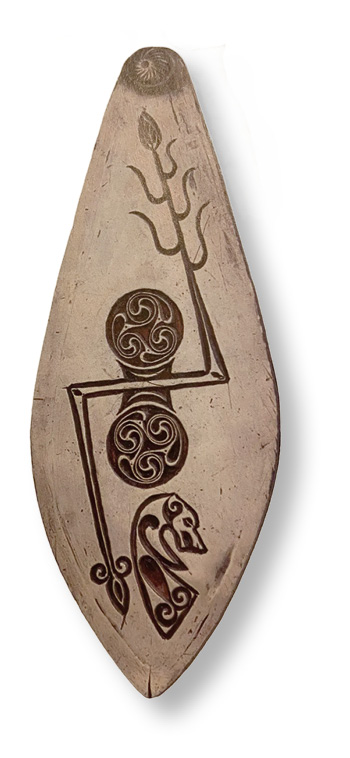
The design of this c.5th century picture plaque from Norrie’s Law [CA 433] goes pretty hard @currentarchaeology.bsky.social
Manau Miniatures @manauwargames.bsky.social
I love to see Pictish art being talked about, such an underrated part of history.
Stephen @sputniksteve.bsky.social
That is stunning.
Dave Fortin @davidwfortin.bsky.social
I translate that as ‘Romani ite domum’.
Royal Archaeological Institute @royalarchinst.bsky.social
We’ve had a wonderful day at the ArchaeoFair – thank you to everyone who came to chat to us! Looking forward to the Awards Ceremony coming up shortly! #CALive 26