
Subscribe now for full access and no adverts
When you think of ancient Egypt, you might imagine towering pyramids, or grand sculptures and vibrant wall paintings depicting powerful people and animal-headed deities. But what do we know about the lives of the people who created these masterpieces, or those who produced the everyday items that allowed this remarkable civilisation to function and flourish? Made in Ancient Egypt, a new exhibition at the Fitzwilliam Museum in Cambridge, turns the spotlight from famous pharaohs to their skilled subjects: the stonemasons, potters, weavers, smiths, jewellers, painters, and carpenters whose creations are still admired in museums across the world.
The Fitzwilliam Museum is a natural setting for this theme: for over 40 years its staff have been deeply involved in studying how ancient Egyptian artefacts were made (including, since 2014, the immediately recognisable coffins of this period; see http://www.egyptiancoffins.org), and the exhibition draws on its own extensive collections, as well as loans from across Britain and Europe. In ancient Egypt, the skilled workers that we encounter through these displays were collectively known as hemut (singular: hemu), a word whose meaning combines ideas of craftspeople and artists. They evidently felt great pride in (and had the opportunity to make a tidy income from) their work, as some of these individuals commissioned elaborately carved commemorative stones that preserve their names, boast of their abilities, and reveal that multiple generations of the same family sometimes followed the same career path.
Complementing these epigraphic echoes, hemut spring to vivid life in the reproductions of tomb paintings that appear throughout the exhibition. These colourful images show groups of people at work, among them jewellers using a band drill to perforate beads and stringing them on to ornamental collars; sculptors working on a limestone sphinx; and metalworkers pouring molten material into a mould – in a pleasingly realistic touch, one is holding up his hand to shield his face from the heat. These scenes suggest that many crafts were the domain of male workers, but women’s stories can be found in a section dedicated to textile production. There, we find images and clay models of women and girls spinning and weaving, and, while men again seem to have been in overall charge of their workshops, female workers could rise to supervisory roles. The same space includes a letter from a woman called Ir, complaining to her boss in c.1976-1793 BC about the competence of the team she is leading (the text’s uneven lettering and unusual spacing hints that she may have written it herself rather than employing a scribe). Close-by, one of the highlights of the exhibition represents a finished product from this industry: a fringed linen dress – 4,500 years old, but amazingly well-preserved – which was found in a woman’s coffin alongside eight other garments.
Encountering individuals
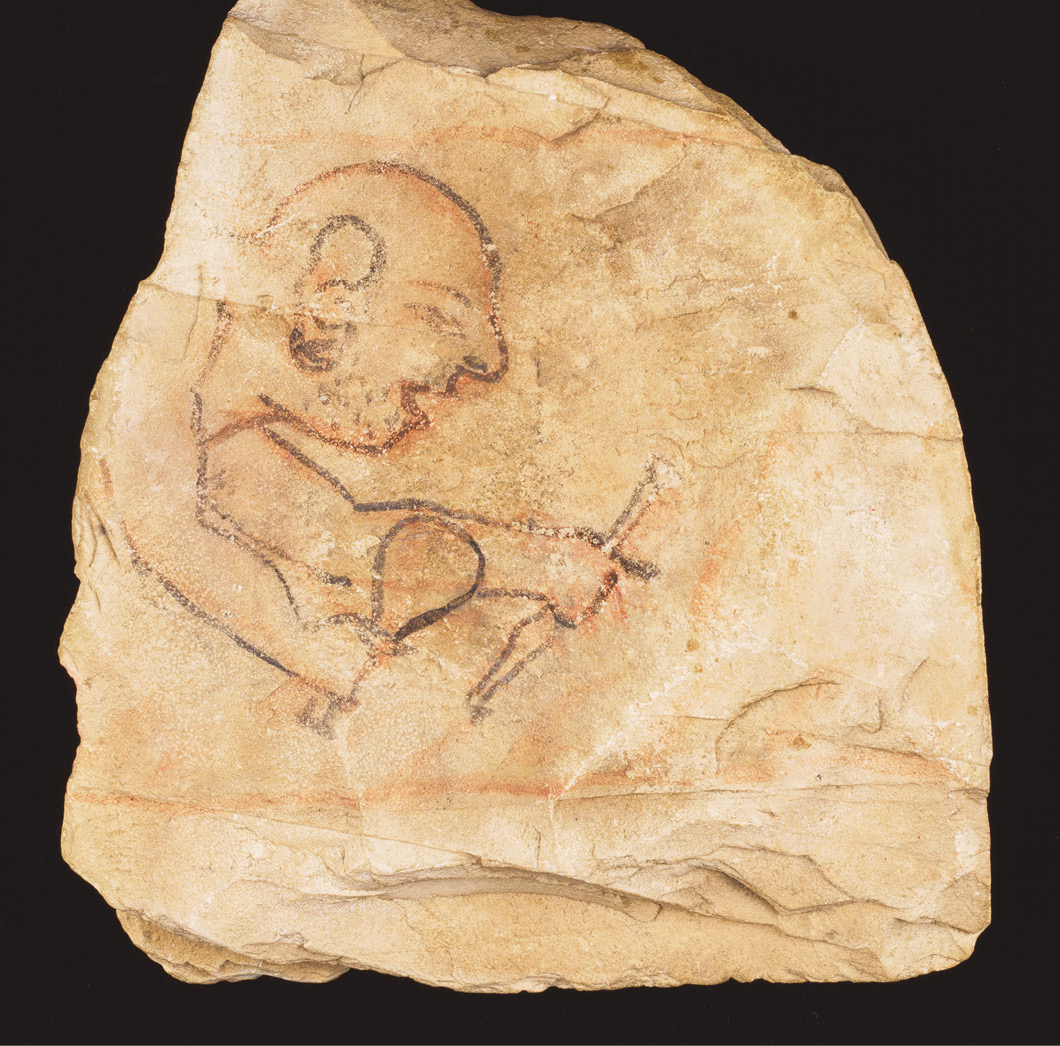
More casual – and therefore intimate – glimpses of individual workers can also be found in the displays. Particularly characterful is a sketch on a flake of limestone (above; it is probably from the Valley of the Kings and dates to 1295-1186 BC) capturing the profile of a large-nosed stonemason with a bald head, a stubbly chin, and a cheerful expression. In contrast to the lively but formally composed tomb paintings mentioned above, suddenly a recognisably real person stands before us. Even more tactile and tangible are the marks that some workers made by accident: a small handprint preserved in the clay underside of a soul house (a model building used for food offerings in tombs) and a partial fingerprint left by someone applying varnish to a coffin lid. The names of these people have long been lost to us, but traces of their touch reach out across millennia with powerfully relatable effect. Equally humanising are the notes that give us glimpses into the working day of ancient Egyptian labourers. One fragment documents absences from work on the royal tombs in the Valley of the Kings c.1150-1069 BC; from this we learn that the whole workforce was off for two days to attend a funeral; on another occasion, a labourer called Panebu was absent because he had been bitten by something; and, on a different day, the foreman Ramery was off sick.
While some classes of hemut appear to have been particularly admired (the most common word for sculptor, sankh, means ‘the one who gives life to’), not all crafts were equally esteemed. Scattered through the exhibition we find extracts from The Teaching of Khety, also known as The Satire of the Trades, whose catty comments single out craftspeople including potters (‘He gets more covered in mud than a pig in order to fire his pots’) and smiths (‘His fingers are like the skin of a crocodile, and he stinks more than fish eggs’.
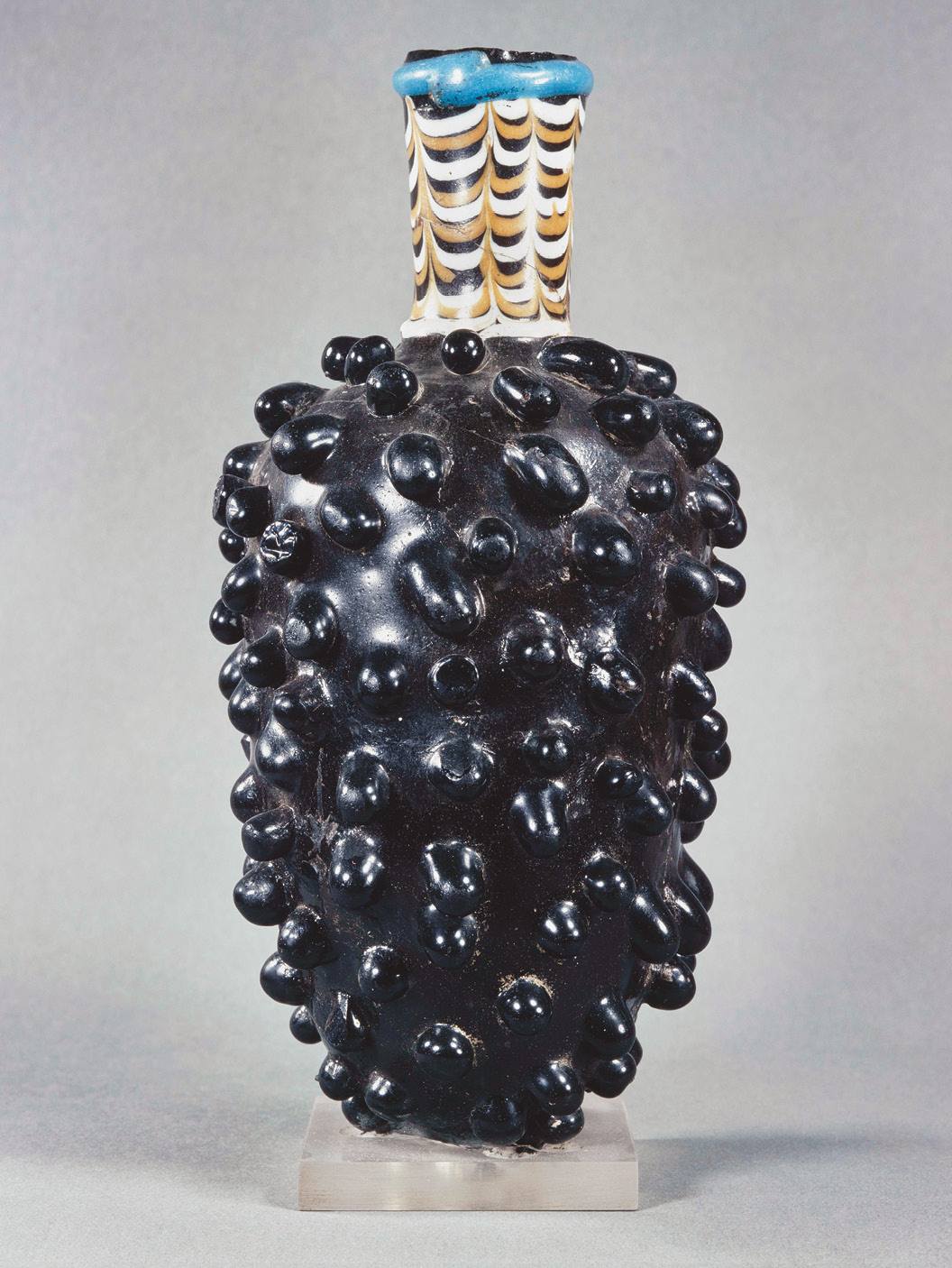
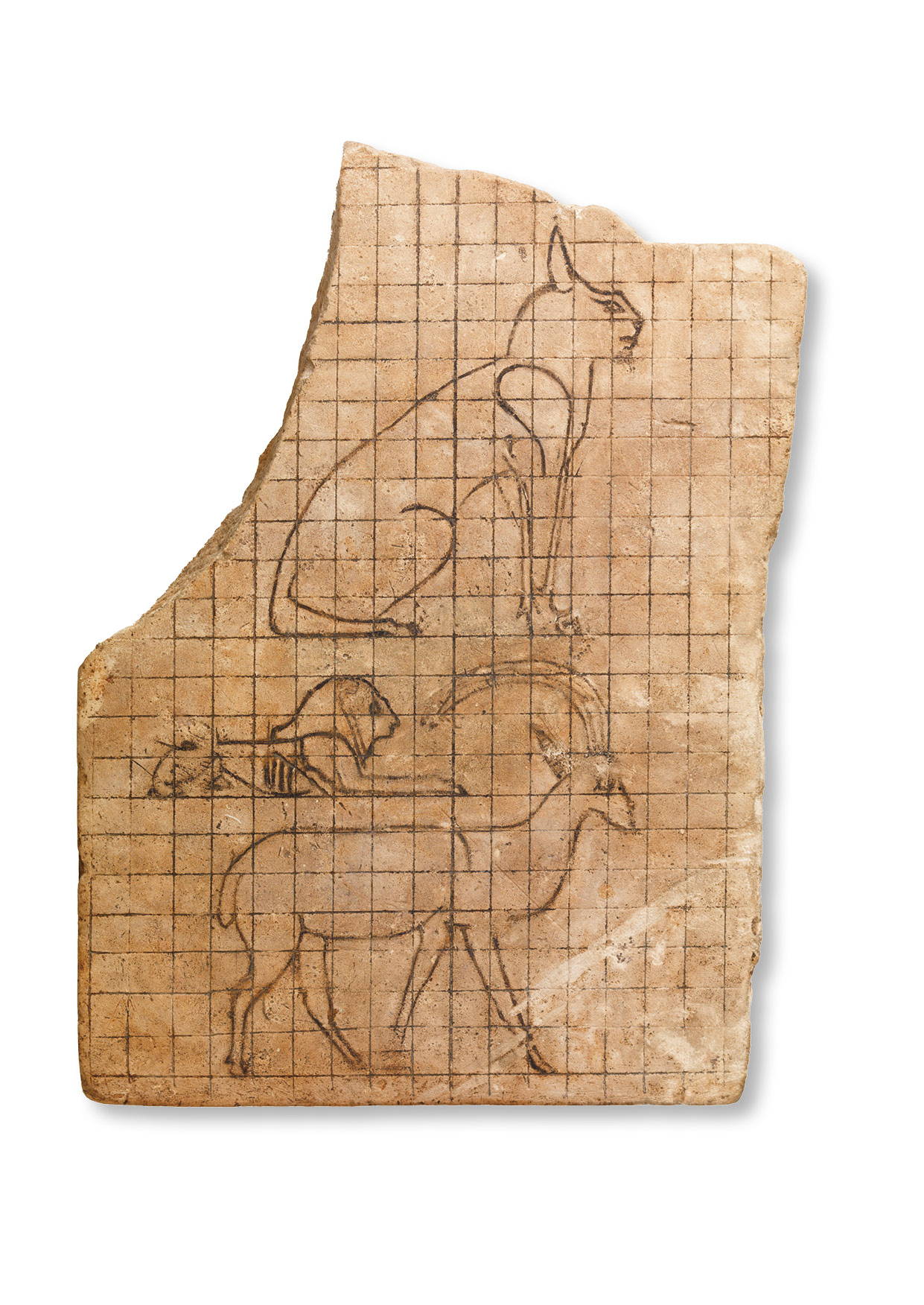
Visitors can learn, too, about how materials were sourced (whether from dangerous expeditions to desert quarries, or via long-distance trade routes; lapis lazuli, for example, was mined in Afghanistan) and about manufacturing methods. Intriguing insights into these processes emerge from an array of unfinished objects preserving tool-marks, guidelines, and evidence of midway modifications and mistakes. Some of the neatly gridded design sketches look remarkably modern, including ink drawings giving front and side views for a wooden shrine, and a piece of limestone setting out the correct proportions of various animals to be added to a carved relief (below). There are also objects that would not look out of place in a modern art shop, including an intricate glass bottle shaped like a bunch of grapes (above), tiny faience frog amulets, and beads depicting strikingly realistic flies.
Not every creation on show is expertly done, however. Towards the end of the exhibition is the shoddily painted coffin of Pakepu, dating to c.680-664 BC. In many places its pigments have run, the hieroglyphs are poorly executed, and the painter seems to have done most of the work standing on one side of the coffin and stretching across it, creating clumsy overlaps in the design. To err, however, is human – and it is this human touch which makes the exhibition as engaging as it is illuminating.
Further information: Made in Ancient Egypt is at the Fitzwilliam Museum until 12 April 2026. See http://www.fitzmuseum.cam.ac.uk/plan-your-visit/exhibitions/made-in-ancient-egypt for details.