Subscribe now for full access and no adverts
In 1824, a small group of visitors to the British Museum caused a sensation. Among their number were the King and Queen of Hawai‘i, and ten members of their court. This party had spent five months at sea, crossing two oceans to make Hawai‘i’s first state visit to Britain, seeking an audience – and an alliance – with George IV. While awaiting this meeting, they attended horse races, theatres, and the aforementioned museum – where today a thought-provoking new exhibition draws together around 150 objects to highlight the history and culture of the Hawai‘ian archipelago, and its complex 200-year relationship with Britain.
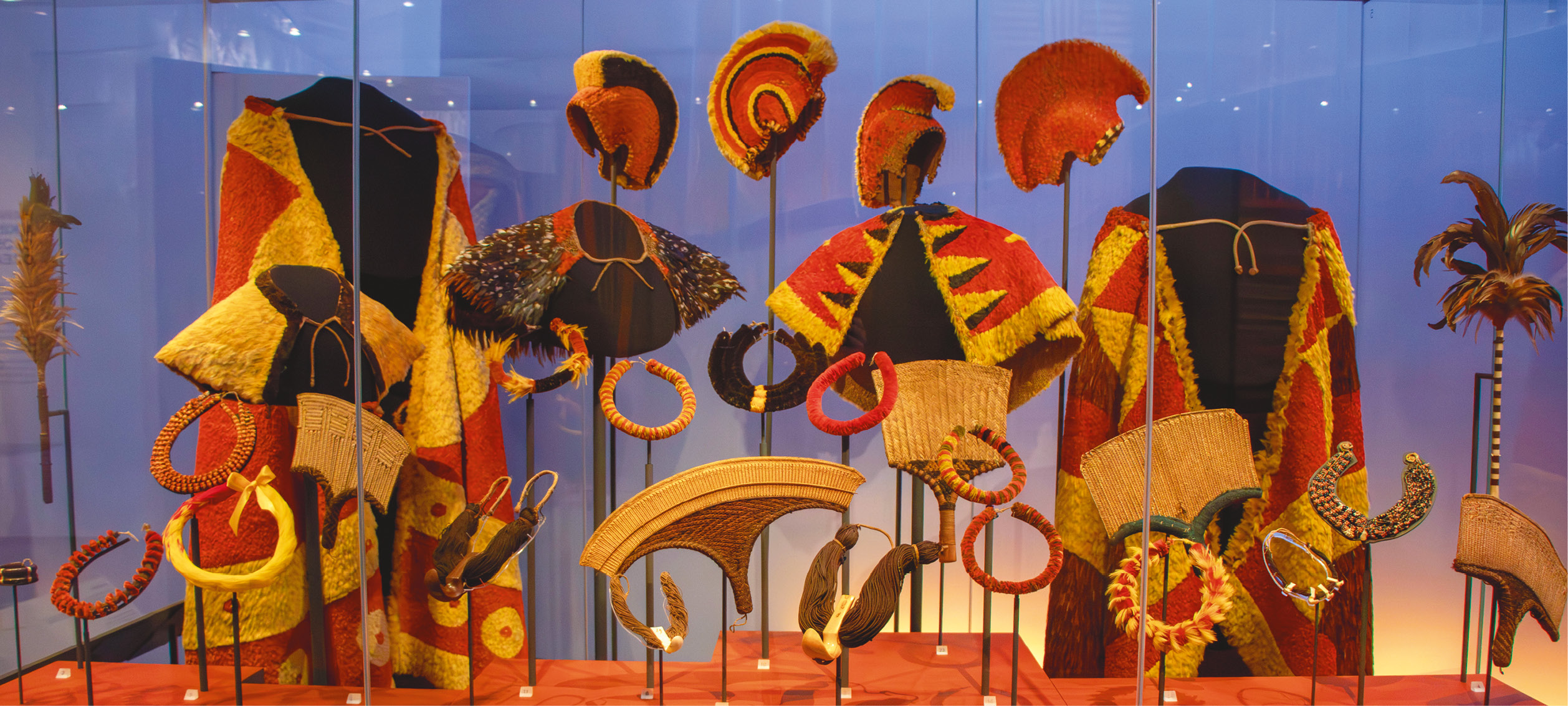
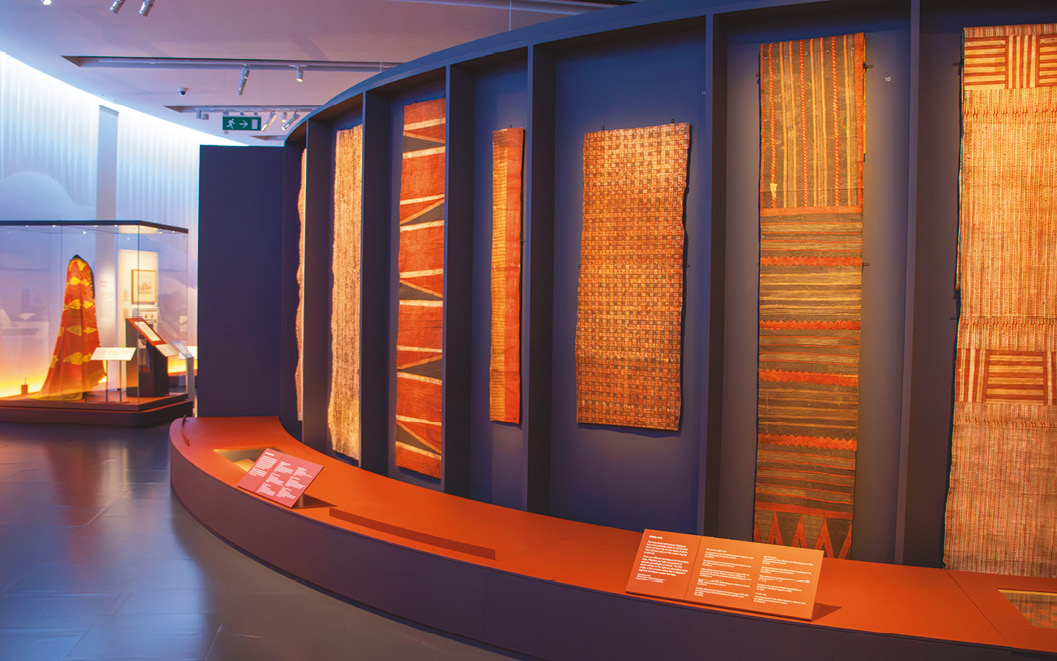
The themes of the exhibition – developed with Native Hawai‘ian knowledge-bearers – begin long before the royal visit described above, however, and well before Hawai‘i’s first recorded contact with Europeans (during Captain Cook’s fateful third voyage in 1778). As the initial displays attest, the archipelago was first settled around 1,000 years ago, by pioneering Polynesian ancestors who paddled their canoes vast distances, navigating using the stars and the movement of migratory birds. As you enter the exhibition, you are met by vibrantly patterened sheets of bark cloth (pictured below), expressively carved figures of gods, and a colourful cluster of cloaks (pictured above; they are known as ʻahuʻula, and were reserved for high chiefs), helmets, and garlands. These gorgeous garments are all adorned with countless tiny red and yellow feathers (which, accompanying text reveals, were sustainably harvested by specialist catchers without killing the birds), and are arranged as if being worn, giving the sense of a gathering of chiefs. These early displays, which are accompanied by the sound of traditional chants and drumming, and reflect deep relationships between gods, chiefs, people, and the natural environment, have a strong feel of an ancestral presence – but these are not the relics of a lost kingdom. The exhibition emphasises a very much still-living culture, interspersing video interviews with modern hula teachers, weavers, and bark-cloth producers among the displays, and incorporating the Hawai‘ian language in accompanying captions.
Hawai‘i’s inhabited islands were initially governed by different chiefs, but when Kamehameha I came to power in 1782 he set about uniting the archipelago into a single kingdom, a feat that he achieved through a mixture of diplomacy and warfare by 1810. As the exhibition illustrates, however, this was not only a period of internal change. The late 18th century saw a sharp increase in foreign contact with the islands – encounters that saw many Hawai‘ian artefacts transported to European collections, some freely given or traded, others with murkier provenances, but in many cases transforming revered mea kupuna, or ‘ancestral treasures’, into ‘specimens’ and ‘curiosities’ shorn of their original meaning. Kamehameha was evidently wise to the way that geopolitical winds were blowing, and in the same year that he founded the Kingdom of Hawai‘i, he wrote to a fellow-ruler of an island nation, George III, asking for support and protection. In the exhibition, this letter has been reunited for the first time with the magnificent gift that originally accompanied it to England: an exquisitely worked but unusually long feather cloak. Such garments were not meant to touch the ground, but this example, the largest in the world, would have trailed behind any wearer shorter than 7ft 4in (2.2m), prompting questions about its purpose. Perhaps it was a symbolic gesture, never intended to be worn, or perhaps its design drew on British royal fashions, which often featured long trains. Alternatively, it may have been meant as a compliment, implying that such a powerful king was surely of enormous stature.

The cloak and letter took two years to reach England, by which time the future George IV was ruling on his father’s behalf as regent, but he gladly accepted the gifts as well as Kamehameha’s request for protection, marking a turning point in a relationship between the monarchies that would endure for years to come. In the exhibition, a surcoat that George IV wore at his coronation in 1824 is displayed opposite the cloak, its red-and-gold ornaments mirroring the colours of the feathers, offering a cleverly realised parallel (pictured above). Paired in this way, the garments evoke ghostly representations of regal figures from each culture facing each other: two royal households, both alike in dignity.
A meeting of island nations
Kamehameha’s own son, Liholiho (Kamehameha II), took this relationship a step further when he and his delegation set out to visit George IV in person. Though their official reception was suitably dignified, their arrival prompted public fascination and prejudice in equal measure, and the displays contrast racist satirical prints that were in circulation at the time with a pair of dignified portraits that the king and queen sat for during their trip. You can also see a trio of impressive feathered god figures that the royal couple surely saw during their own visit to the British Museum, as they are recorded as being on public display from 1803.
Sadly, the intended royal audience never took place, as the Hawai‘ian delegation contracted measles and Liholiho and Queen Kama¯malu died of the disease. Their delegates still met George IV, however, and some of the lavish gifts that were exchanged – feathered cloaks and elegant silverware – are on show in the exhibition. Liholiho’s son, Kamemehama III, would continue to build on this relationship, and initially Britain held to its renewed promises of support. In 1842, the Royal Navy helped to restore Hawai‘ian sovereignty after a coup, and the following year Britain and France both signed a proclamation formally recognising the kingdom’s independence – a stark change from their rapacious colonial practices elsewhere – which is displayed alongside early drafts of the Hawai‘ian coat of arms. Gift exchanges and royal visits continued, but in 1893 an American-backed uprising overthrew the Hawai‘ian monarchy, and Queen Victoria rejected Queen Lili‘uokalani’s appeals for aid, preferring to leave the kingdom’s fate ‘in the hands of the Almighty’. It was a fateful decision that still resonates today. Lili‘uokalani was never restored to the throne, and Hawai‘i was ultimately annexed, becoming a US territory in 1898 and, in 1959, the 50th state.
The exhibition ends in the present day, highlighting modern issues affecting the islands, including overfishing, pollution, and habitat destruction. Collaborative research efforts are also striving to counteract the huge loss of cultural knowledge that occurred when artefacts were taken from their context without proper documentation during the 18th and 19th centuries, and an inspiring and uplifting final section focuses on this work. One of the illuminating insights shared in the displays came from a project to recreate an ancestral helmet: experimental attempts to replicate its woven design have revealed that its original maker was probably left-handed, providing a personal link with a now-anonymous individual.
Further information: Hawai‘i: a kingdom crossing oceans runs at the British Museum until 25 May 2026; see http://www.britishmuseum.org/exhibitions/hawaii-kingdom-crossing-oceans.
All images: © The Trustees of the British Museum, photo by MKH