Subscribe now for full access and no adverts
First announced in 1992, the long-awaited Grand Egyptian Museum (GEM) opened to the public in its entirety in November 2025, just as I had the fortune to be visiting Egypt. The downside to being one of the first to see inside was that I was not alone: thousands of locals and other tourists were also keen to explore the new galleries. However, my visit was spread across two days, and while the Sunday was very busy, the Monday was more pleasant.

A monumental museum
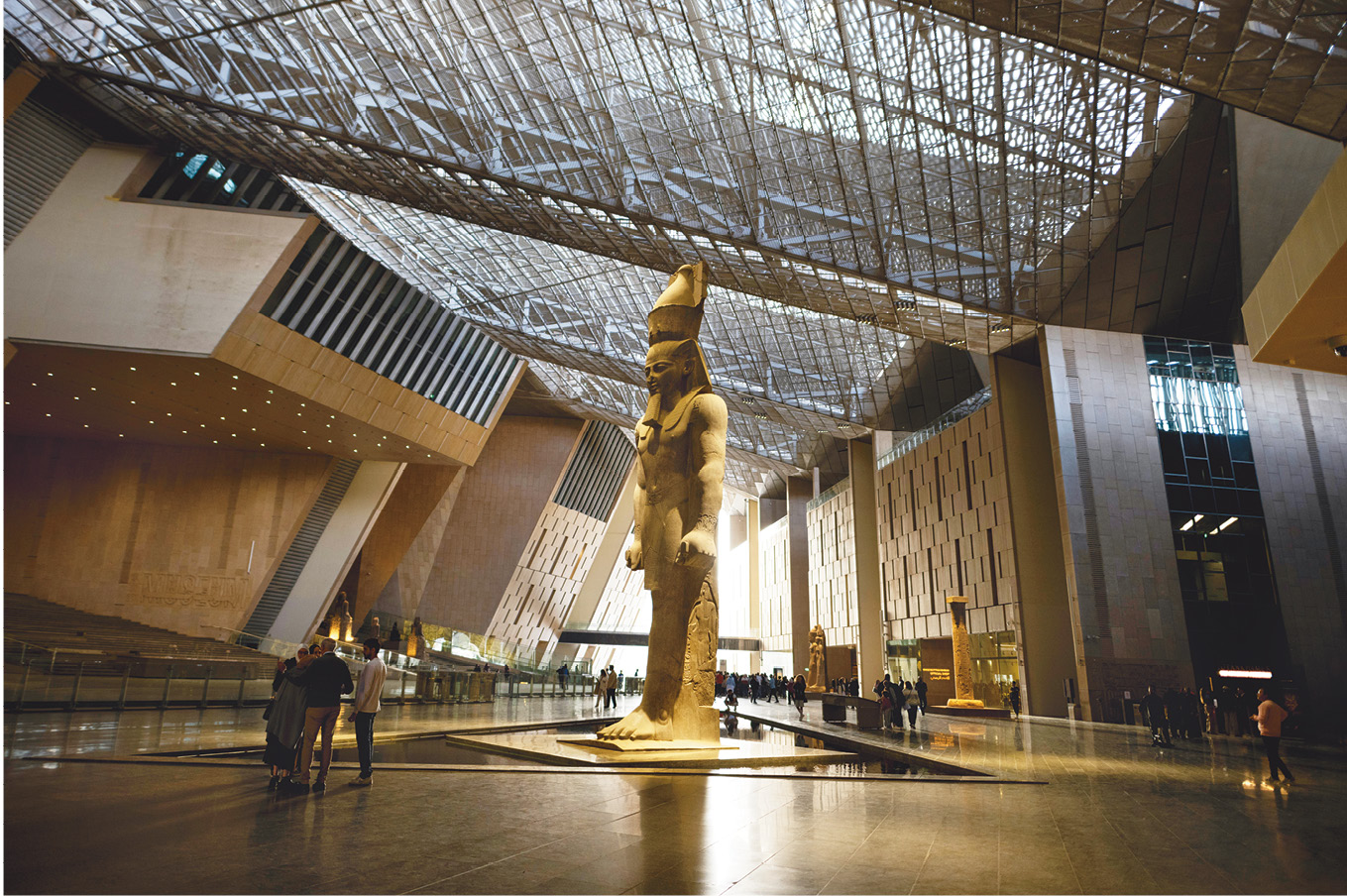
The building’s design is sympathetic to the ancient Egyptian artefacts it displays, with many shapes and angles invoking a sense of the Giza pyramid complex, which sits just 2km away and can be seen in stunning panoramic view from the top of the museum’s Grand Staircase. In fact, on the inside of the building there are no straight walls at all. Pictures do not really do it justice: you need two eyes to see all the angles.
I had read about the GEM before visiting and had assumed that I would head up the Grand Staircase looking at a few statues, and then go into the galleries to see the main exhibits. In reality, this vast staircase is one of the largest exhibition areas in the whole museum, spanning 6,000m2 and rising to a height equivalent to six floors. With around 90 statues, stelae, sarcophagi, and other objects on display, there is plenty to absorb you. Indeed, I did stumble a few times while concentrating on the artefacts in question and not the steps!
At the top of the stairs are the museum’s 12 main galleries. These are grouped chronologically into four sets of three, covering the periods from prehistory through to the Old Kingdom, the Middle Kingdom, the New Kingdom, and the Late and Graeco-Roman periods, respectively. Each set of three galleries covers the relevant era from three viewpoints: society, kingship, and beliefs. In between some of the galleries are ‘caves’ containing extra items, but these are slightly hidden away. The first one I could not find until I moved to the adjoining gallery and then the entrance became visible. So keep your plan of the museum with you to make sure you don’t miss out.
Extra experiences
The museum offers a virtual-reality display exploring the origins of the pyramids as well. The light displays are very well done, and for EGP200 (about £3) this was a nice break from looking at the items in glass cases. The ticket for this has to be bought from the ticket office on the ground floor.
The other optional extra is an audio guide. Again, this costs a little extra and, for anyone who knows the basics about ancient Egypt, is not worth having. Audio is not available for many points, and it does not go into much background detail, just generalities.
Out the back of the GEM (that is, the opposite side to where you enter) is the Khufu’s Boats Museum. This is included in your ticket price, so, if you have time, I suggest you do wander over. Inside, there is one completed ancient boat, and another that is just at the start of the process of being reassembled. Both of these vessels are approximately 5,000 years old, and were dismantled and buried within the Great Pyramid funerary complex. A walkway goes around the assembled boat, but also gradually ascends so that you get varying views of the vessel – which is clearly no longer quite watertight – from different heights.
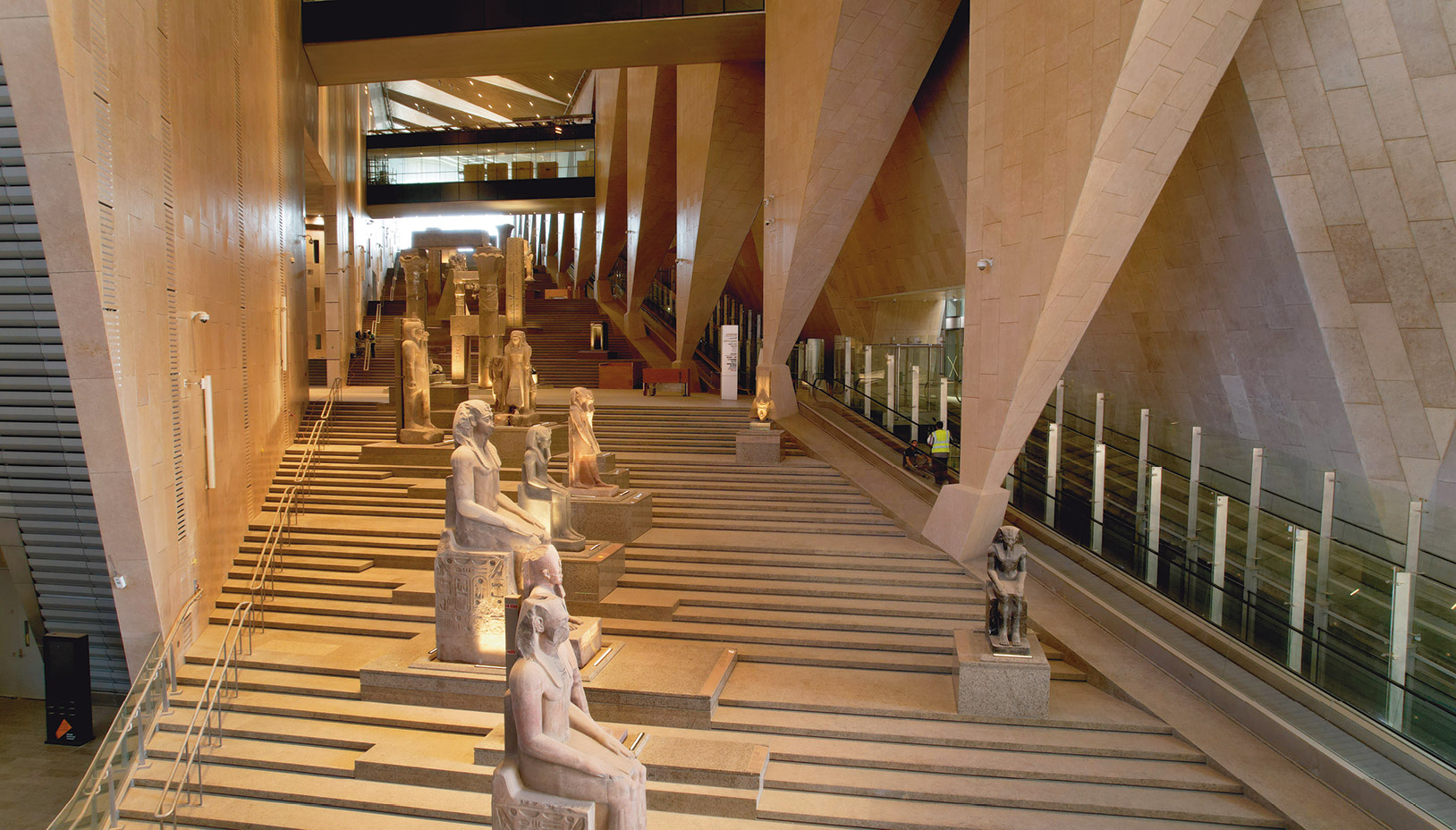
Accessibility issues have been carefully considered when it comes to the main galleries in the museum. On one side of the Grand Staircase is a moving walkway, which breaks at various points to enable you to gain access to the exhibits on the stairs. There is a lift, too, that can take around four wheelchairs at a time. However, I did see some wheelchair-users on the moving walkway: it’s not steep.
The cost of museum entry for foreign visitors is EGP1,450 (roughly £24), which I felt was great value given the gargantuan space this gives you access to. In two days, I only managed to cover the Grand Staircase and six of the twelve main galleries. I will have to go back – there is a lot in this museum!
TREASURES OF TUTANKHAMUN
The centrepiece of the GEM is the newly opened Tutankhamun Gallery, which contains more than 5,000 objects from Tutankhamun’s tomb, including several thousand that have never before been displayed to the public. Covering 7,500m2, this space comprises two parallel halls, each 180m long and up to 16m tall.
The gallery is organised around five key themes: the person of Tutankhamun himself, his day-to-day life, his burial, his journey to the afterlife, and the discovery of his tomb. The exhibit has been designed to allow multiple modes of exploration, with one path taking visitors on a chronological journey, starting with the young king’s ancestors, through his life, death, and mummification, while the reverse route begins with the opening of Tutankhamun’s tomb in 1922 and follows Howard Carter’s process of discovery.
A full-sized reconstruction of the tomb demonstrates how Tutankhamun’s extensive array of grave goods was once arranged within the 35m2 chamber in the Valley of the Kings, while the pharaoh’s famous funerary mask has its own display in the middle of the hall. Other highlights include the king’s inner, middle, and outer coffins and sarcophagus, and his ornate ceremonial throne. However, perhaps the most remarkable thing about this new gallery is the fact that it contains the full collection of objects recovered from Tutankhamun’s tomb, which are presented together for first time since their discovery more than a century ago.

DETAILS:
Grand Egyptian Museum
•Address: Cairo–Alexandria Desert Road, Kafr Nassar, Al Haram, Giza Governorate 3513204, Egypt
•Open: galleries and exhibition halls are open 9am-6pm daily, and until 9pm Wed and Sat.
•Website: https://gem.eg
Text: Amy Brunskill