
Subscribe now for full access and no adverts
On the evening of 29 November 1943, at a dinner at the Tehran Conference between ‘the Big Three’, the subject came up of how to deal with the leading Nazis after the war. Stalin provocatively proposed that there were just 50,000 who had led the Nazi war effort and that they should all be shot at the war’s end. Churchill was shocked and said that neither he nor the British public would tolerate mass executions. American President Franklin Roosevelt, trying to defuse the tension with humour, said maybe only 49,000 should be shot. His son Elliott, who was also present as military attaché, announced that the US Army would definitely support Stalin’s plan. Outraged, Churchill got up and left the table in a huff. A few minutes later, Stalin came up to him in jovial mood in an adjoining room, put his hand on his shoulder and said he had been joking all along. At this, Churchill returned to the dinner, the rest of which passed off without incident. But the whole issue of how to deal with the Nazi leaders after the war was left unresolved.
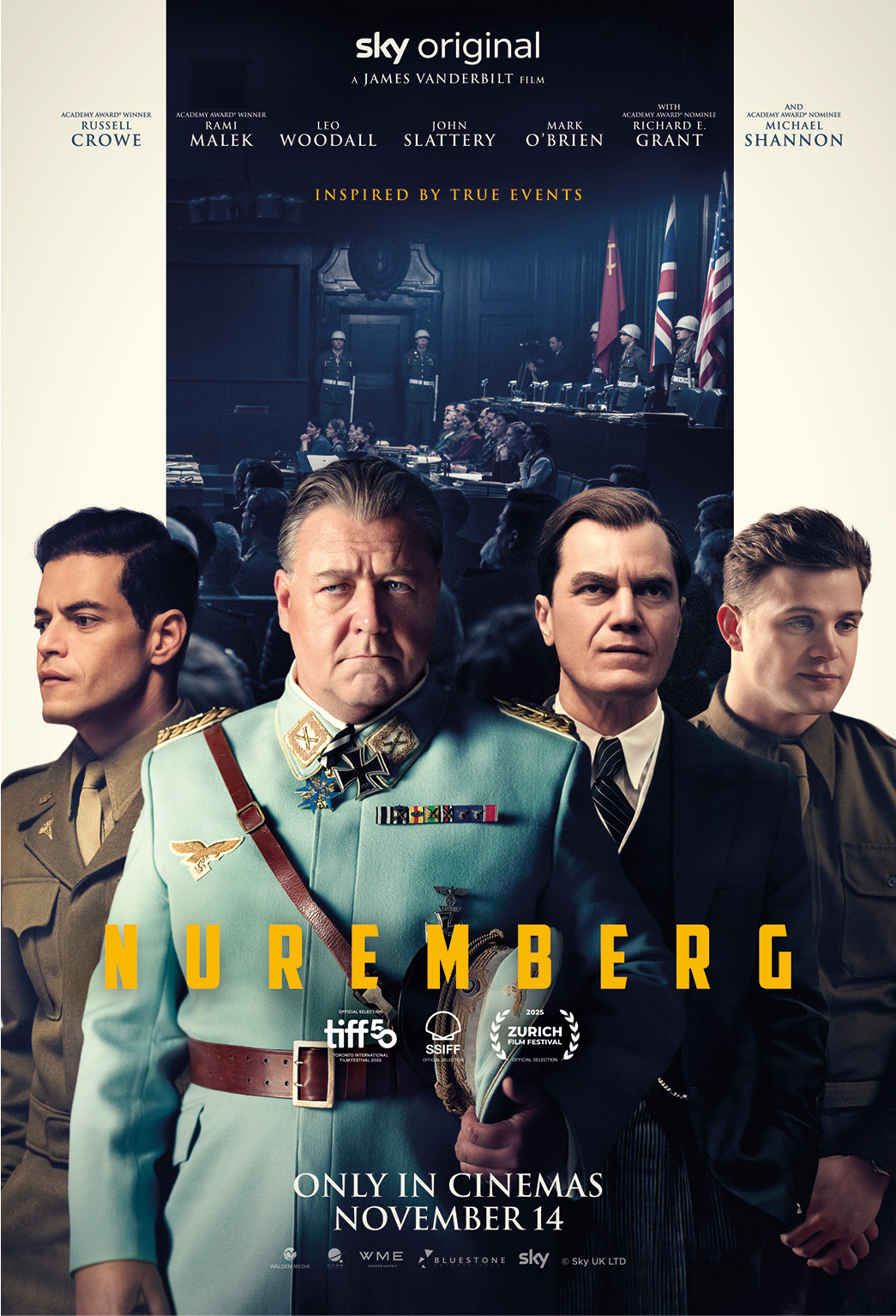
It is this debate that the new Sky Originals production Nuremberg picks up on. The war is over. In the opening scenes, Reichsmarschall Hermann Goering surrenders to an American patrol. In Washington, a Supreme Court judge, Justice Robert Jackson, argues that the Nazi leaders need to be brought to justice so the world can witness what evil they have done. But it is explained to him that the concept behind international law is that no nation has the right to try individuals of another nation in their own country, and there is no legal basis on which the Nazi leaders can be put on trial by the Allies. Jackson, however, persists, despite a widespread feeling in the US and Europe that the Nazi leaders should simply be executed and be done with. In the film, Jackson eventually comes up with the concepts of ‘waging an aggressive war’ and ‘crimes against humanity’, which become the legal basis for the trial of the Nazi leaders and of most criminal prosecutions for war crimes ever since. The Soviets agree to the trial. And the preparations for the trial and the drama of the courtroom confrontations are dramatised in epic scope in Nuremberg.
In fact, the story is rather more complex than this movie presents from its very American perspective. Philippe Sands has shown in his brilliant book East West Street that the legal concepts of both ‘crimes against humanity’ and ‘genocide’ came from two Polish Jewish lawyers, Hersch Lauterpacht and Raphael Lemkin, from Lviv. This legal framework was confirmed in the London Conference of the International Military Tribunal in the summer of 1945. Jackson argued that plotting and ‘waging an aggressive war’ should also be included. It is at this point that the narrative of Nuremberg begins.

Defining evil
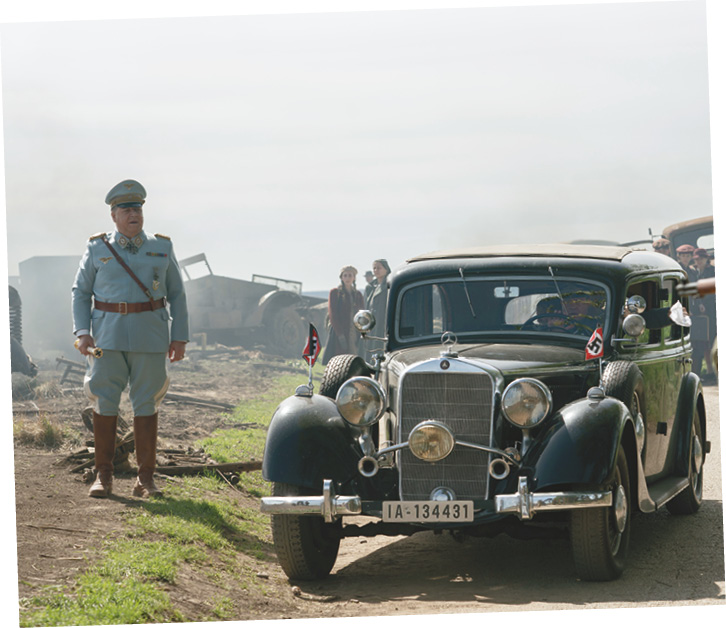
An American psychiatrist Lieutenant-Colonel Douglas Kelley (played by Rami Malek, who shot to fame as Freddie Mercury in the movie Bohemian Rhapsody) is en route to a prison where the leading Nazi figures are incarcerated. He doesn’t know why he is there, but it is explained to him by the prison commandant that his task is to assess the members of the Nazi leadership, to try to understand their psychology and see if they are fit for trial. The principal thread of the film is Kelley’s relationship with Hermann Goering (superbly played by Russell Crowe, who had to wear substantial padding for the part). Kelley interviews Goering repeatedly in his bare prison cell. After a few scenes in which an interpreter, Sergeant Howie Triest (Leo Woodall), translates for him, it turns out that Goering speaks excellent English. The dialogue of the core scenes of the movie continues in English.
Kelley meets some of the other leading Nazis in the prison, too, including Robert Ley, Karl Dönitz, and Julius Streicher. Ley and Streicher both display appalling anti-Semitism, believing Kelley to be a Jew – or, as Streicher says, ‘You work in a Jewish profession.’ They all adopt different attitudes towards their imprisonment and potential trial. ‘Do you think you can get these guys to open up to you?’ Kelley is asked. ‘Yes,’ he replies, ‘they all want to be listened to.’ What fascinates Kelley is the question of whether these men can be regarded as ‘evil’. ‘If we could psychologically define evil, we could make sure it would never happen again,’ he claims. This proposition is at the heart of the film that follows.

As Kelley gets to know Goering, he becomes increasingly fascinated by him. Goering talks about first hearing Hitler speak in Munich in 1922 and how he made him feel like a proud German once again. He denies any knowledge of the extermination camps, insisting that he only knew about work camps and did not know what Himmler and the SS were up to in the camps that they ran. He goes on to charge the Americans with running camps for interned Japanese residents during the war, so concluding that both sides ran work camps. After what in reality were hundreds of hours of meetings, Kelley finds he gets along well with the Reichsmarschall, in what appears to be a case of Stockholm syndrome, in which two men from opposite sides bond. Goering asks Kelley: ‘Are we friends, Doctor?’ After a long pause, Kelley replies: ‘Yes.’
Meanwhile, Justice Jackson (played urbanely by Michael Shannon) asks Kelley to tell him what Goering is going to argue in his defence. Effectively this is asking the psychiatrist to ‘spy’ on his patient for him. Reluctantly, Kelley goes along with this and tells Jackson and the British prosecutor Sir David Maxwell Fyfe (played with wonderful aplomb by Richard E Grant) part of what Goering has told him. But he insists that in the courtroom Goering will have them for breakfast.
Passing judgement
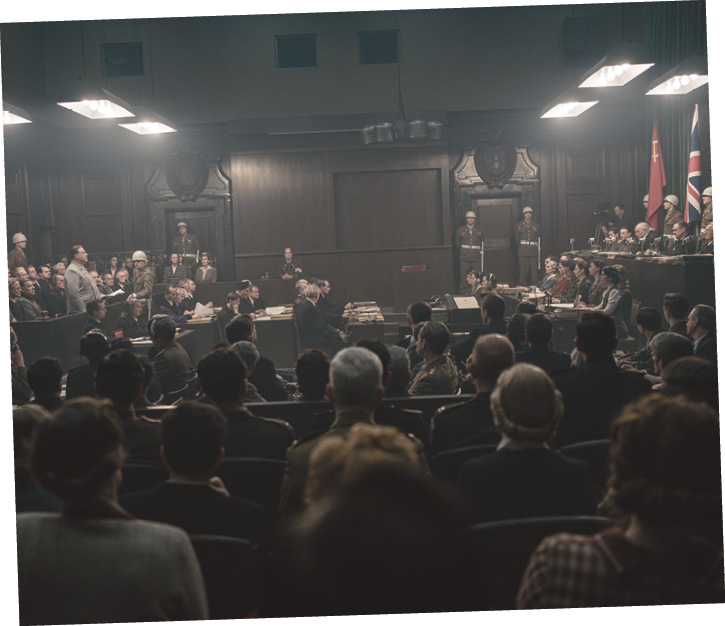
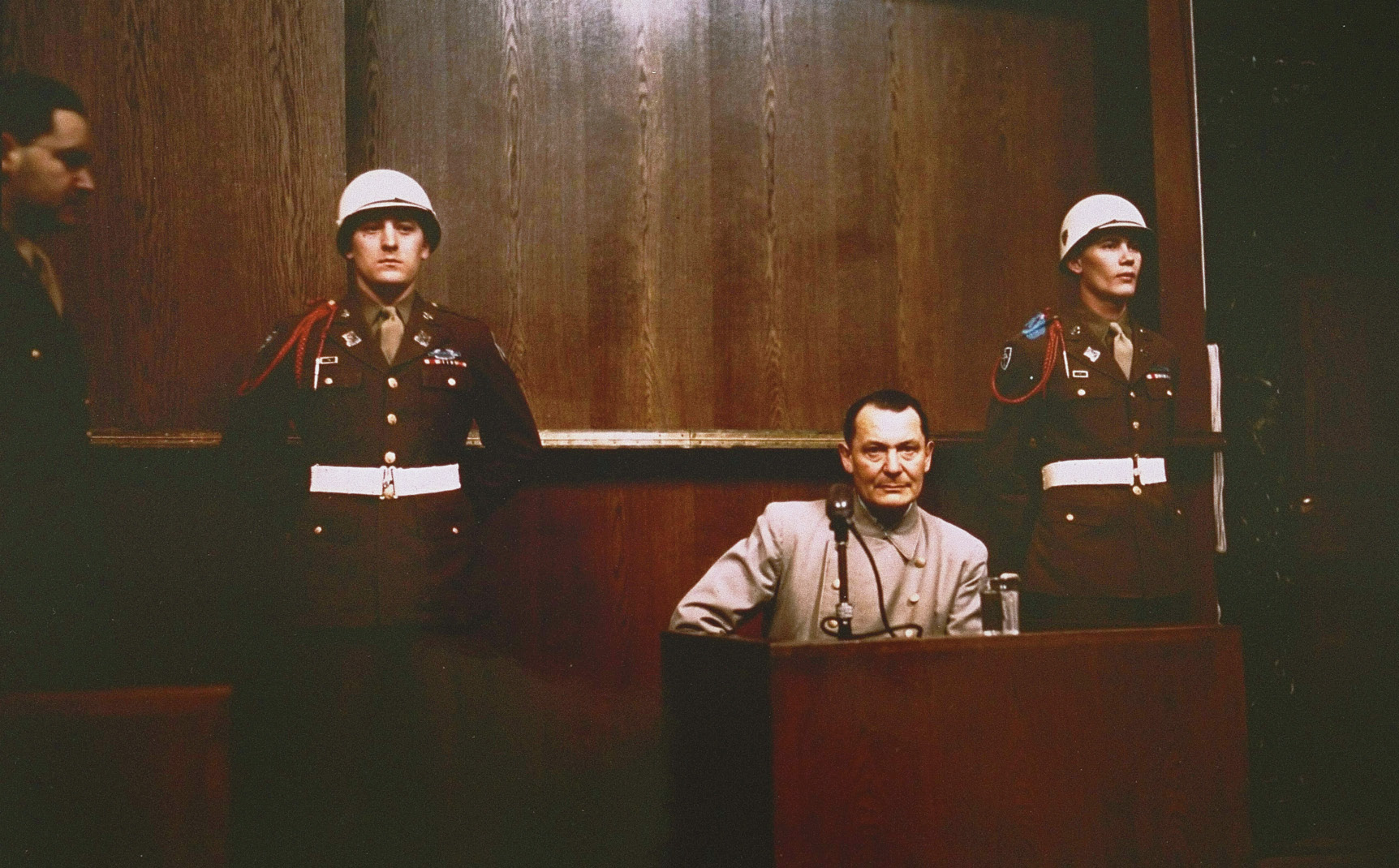
The trial opens and is filmed with impressive attention to authentic detail, informed by the thousands of photos and film of the courtroom. If you want to know what it felt like to be present in that court, Nuremberg will, without doubt, help you. Jackson opens the prosecution reading the opening of the actual speech that was delivered in November 1945.
Early in the trial, the court was shown a one-hour film called Nazi Concentration Camps. This was assembled by the American director George Stevens, who had led a team of cameramen across Europe from D-Day to VE Day. The footage projected in the courtroom at Nuremberg was extremely graphic, showing naked corpses piled high at extermination camps, the ovens at Buchenwald, and bodies being bulldozed into mass graves at Belsen. Many in the court, on all sides, were deeply shocked by this film, parts of which are shown in Nuremberg.
Kelley is so outraged by the footage that it prompts a central scene in the film, when he confronts Goering in his cell demanding to know: ‘How was this possible?’ ‘Do you think American bombs don’t kill civilians?’, Goering responds angrily. He goes on: ‘This is what happens in war. People die. There is no moral difference. The fact is that you won and we lost.’ This claim that the trials were simply a case of victor’s justice was central to his defence.
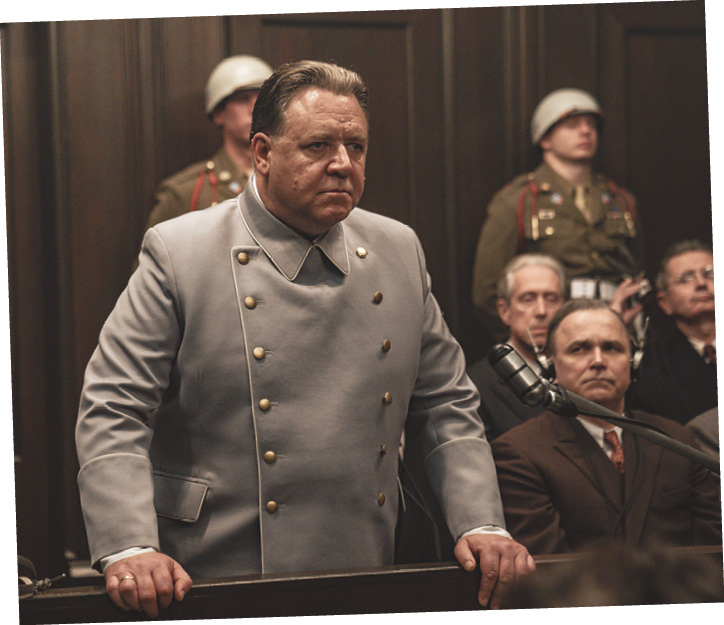
When Goering is called to the witness stand, the film again faithfully follows what actually happened in the courtroom – except that, in reality, Goering replied in German, whereas in the movie he replies in English. Jackson loses his temper with Goering’s cool and calculated replies. His prosecution falls apart. Kelley was right: there was no way he could outsmart the Reichsmarschall in court. But then Maxwell Fyfe takes over the questioning. He asks him about Hitler, prompted by Kelley’s revelations that he still admired his Führer. He says, ‘You contend you didn’t know anything about the murder of six million Jews, millions of Soviet prisoners and others?’ Goering nods his assent. Maxwell Fyfe then asks, ‘If you had known about this, would you still have followed Adolf Hitler?’ Goering comes back instantly, saying, ‘Yes I would. Heil Hitler.’ The court is aghast at this admission. Goering has condemned himself by answering Maxwell Fyfe’s questions.
There is no sense in the film of the months that pass in the courtroom. From March to July 1946, defence lawyers presented their arguments. Hundreds of witnesses were called and most of the defendants were questioned. Many tried to blame everything on Hitler and Himmler, who had both committed suicide and so were not there on trial. In September, the judges withdrew to consider their verdicts.
Crimes committed
After nearly 11 months, on 1 October 1946, the verdicts were read. Goering and 11 other leading Nazis were sentenced to death. Their hangings would be conducted in front of dozens of military and press representatives as witnesses, although, in reality, they were not actually filmed. Streicher’s execution is shown in the movie in some detail. He screams and blubs like a child. He pees himself as the noose goes around his neck. Goering, as is well known, escapes the hangman’s noose by taking a cyanide pill that he had secreted on him for all these months, on the night before he was due to be executed. From the beginning, he had told Kelley that he would never be executed. He was right.
After the trials, Kelley returns to America convinced that there was nothing evil about Goering and most other Nazi leaders. He argues that hatreds can grow up in any country at any time and lead to despicable acts. He argues that even in America the sort of atrocities committed by the Nazis would be possible if hatreds grew. This line naturally proves very unpopular in the US.
There are many things to admire about this film. Its attention to detail in the prison and courtroom scenes is superb. The courtroom scenes often cut from colour to black-and-white original archive film to give a newsreel and authentic feel to the proceedings. The performances of all the lead actors, especially Russell Crowe, Rami Malek, and Leo Woodall, are outstanding. Although Goering is repeatedly described as narcissistic, Russell Crowe makes him an appealing, often amusing, avuncular figure who regularly outsmarts his opponents.
On the other hand, the film is long at 2 hours 20 minutes and it often foregrounds personal dramas against the background of the majestic drama of the trial of the Nazi regime. It assumes the viewer knows little about Nazi war crimes, which readers of this magazine will find irritating.
There have been previous films about the trials. Judgement at Nuremberg was directed by Stanley Kramer in 1961 with an all-star cast that included Spencer Tracy, Burt Lancaster, Richard Widmark, and Marlene Dietrich. It concentrated on one of the later Nuremberg trials of the German judges who had endorsed atrocities committed by the Nazi regime. The Memory of Justice is a four-and-a-half-hour-long documentary made by Marcel Ophuls in 1976, which looks at collective and individual responsibility for crimes in Vietnam and in the Second World War.
Many films have marked the 80th anniversary of the end of the Second World War. Nuremberg marks another 80th anniversary: of the trial opening in November 1945 that set the precedent and the legal basis for the various war-crime tribunals of the past few decades. Like the Nuremberg trials themselves, these tribunals help not only by prosecuting the guilty, but also by gathering evidence as a permanent record of the crimes that have been committed. For that reason alone, Nuremberg is well worth watching.
Douglas Kelley (1912-1958)
Lieutenant-Colonel Douglas Kelley was a psychiatrist in the US Army who served in the European theatre treating US soldiers suffering from ‘combat stress’ (later diagnosed as post-traumatic stress disorder or PTSD). In August 1945, he was sent to Nuremberg prison, where his task was to assess the 22 leading Nazis to see if they were fit for trial. Over a five month period, he spent dozens of hours talking to all of the Nazi prisoners. He asked each of them to carry out the Rorschach test, in which the person has to look at a series of ten ink blots and describe what they see in them. The film shows some of the prisoners carrying out these tests. It was a form of psychometric testing that helped Kelley to understand the personality of the individual and their emotional functioning.
Kelley concluded that all 22 Nazis were fit for trial. He thought Rudolf Hess was perfectly sane, but had a juvenile personality and worshipped Hitler as a father figure. He accepted that Hess was suffering when in Nuremberg from amnesia, sometimes real and sometimes feigned. He found him to be paranoid, suspicious of everything and everyone around him. But this did not bar him from being tried. Robert Ley, the Chief of the German Labour Front, was the only prisoner whom Kelley identified as being mentally ill. He thought the parts of his brain that controlled judgement and emotion were impaired. But Ley committed suicide before the trial began.
Without doubt the man who most enthralled Kelley was Hermann Goering, and the film focuses on their increasingly close relationship. Kelley regarded Goering as ‘brilliant, brave, and ruthless’. He found the the most senior Nazi captured by the Allies to be fascinating, and belived him to be charming and of high intelligence.
Kelley found all the other Nazis to be unremarkable and mostly of poor intellect. This added to his belief that there was nothing obviously ‘evil’ about the Nazi leaders, but that the rise of the Nazis to power gave them overwhelming opportunities to carry out atrocities on a grand scale.
After the war, Kelley wrote a book entitled 22 Cells in Nuremberg, based on his interviews with the Nazi leaders. He became increasingly agitated that no one wanted to listen to his warnings that any society could produce individuals who could carry out evil acts. In 1958, he committed suicide by taking a cyanide pill – just as the one Nazi he had grown to admire, Hermann Goering, had done.
Nuremberg
Written and directed by James Vanderbilt.
Starring Russell Crowe, Rami Malek, Michael Shannon, and Richard E Grant.
Produced by Richard Saperstein.
Based on the book The Nazi and the Psychiatrist by Jack El-Hai.
A Bluestone Entertainment production for Sky Originals Cinema.
In the next issue of MHM: The true story of the Nuremberg trials: justice at the crossroads of history.