Subscribe now for full access and no adverts

Athribis is located seven kilometres south-west of the modern city of Sohag on the west bank of the Nile. Confusingly, there were two sites called Athribis in ancient Egypt, one in the southern Delta (capital of the tenth Lower Egyptian nome) and the other in Upper Egypt. It is the latter site that is the subject of this article.
Athribis, on the west bank, stood opposite the nome capital Akhmim, on the east bank. It is tempting to suggest that the temples of Athribis would have been joined by canal to the grand temples of Akhmim, so that on festival days the cult images could visit each other in a similar manner to the Beautiful Festival of the Valley at ancient Thebes (Luxor).

Excavations
The first archaeologist to examine Athribis was Flinders Petrie, who worked there for only six weeks in 1907. He published his findings in the 1908 report of the British School of Archaeology in Egypt. He found a heavily ruined temple begun by Ptolemy VIII Physkon, but substantially built by Ptolemy IX Soter. In his plan of the area he calls this the ‘Temple of Physkon’. Only the main gate in the temenos wall and a pylon were found, both aligned towards Akhmim. Slightly to the north is a less-ruined temple built by Ptolemy XII Auletes, who decorated the interior. The exterior was later decorated by Roman emperors Tiberius, Caligula, and Claudius. Curiously, this later temple is oriented at 90° to the main axis of the earlier temple.
The Egyptian authorities worked on the Ptolemy XII temple from 1981 to 1996. The most recent work has been a joint German and Egyptian initiative under way since 2003, entitled the ‘Athribis Project’. The temple has been made safe for visitors and is now open to the public.
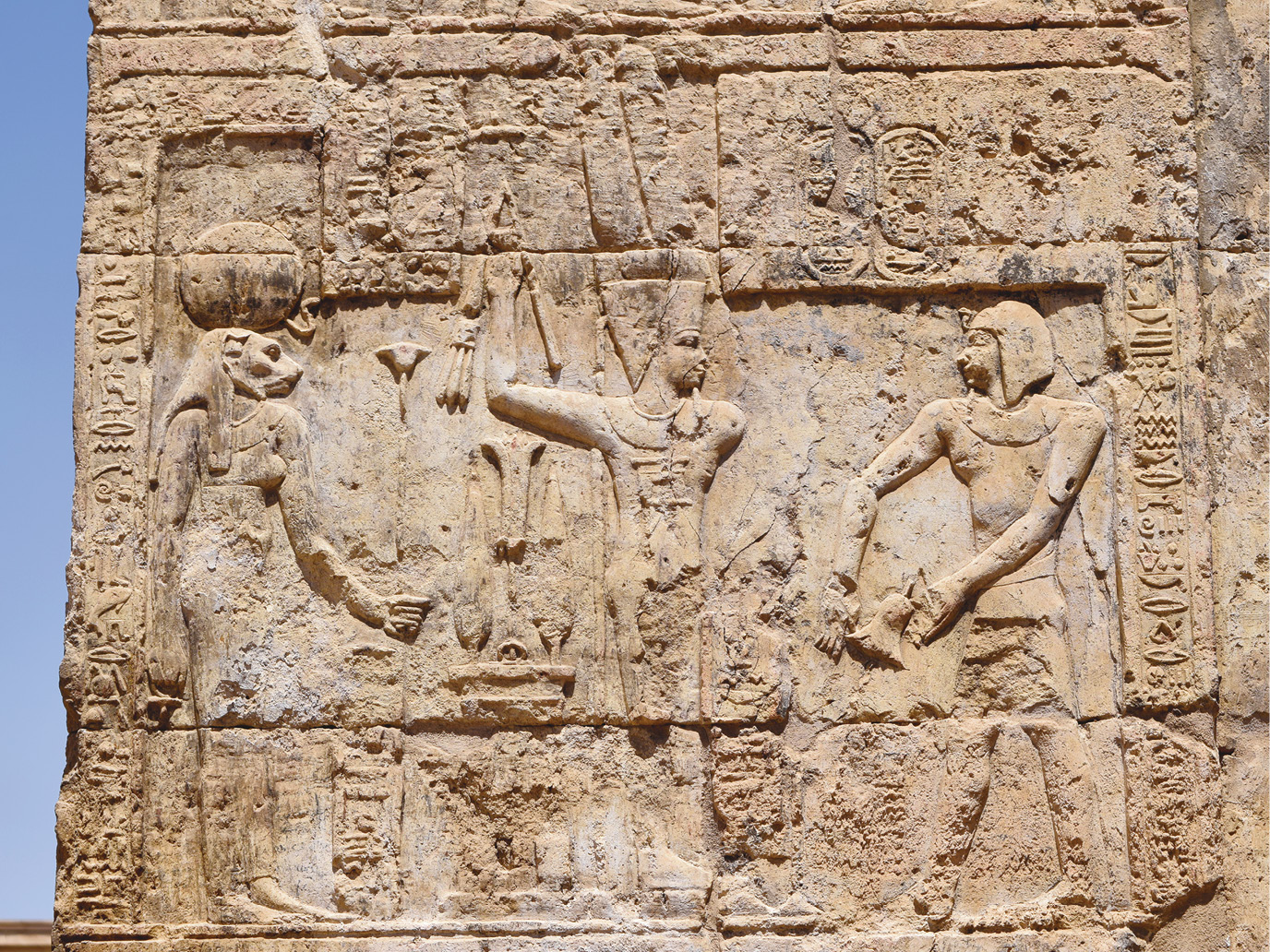
At Akhmim, the principal god worshipped was the ithyphallic Min. The temples at Athribis are dedicated to the local triad of Min (or Min-Ra), his consort Repyt (a lioness-headed goddess comparable to Sekhmet or Pakhet), and their son, the child Kolanthes (who appears as a human boy with the sidelock of youth). The name ‘Athribis’ is derived from the original Egyptian name of the site Hut-Repyt, meaning ‘Domain of Repyt’.

The Temple of Ptolemy XII
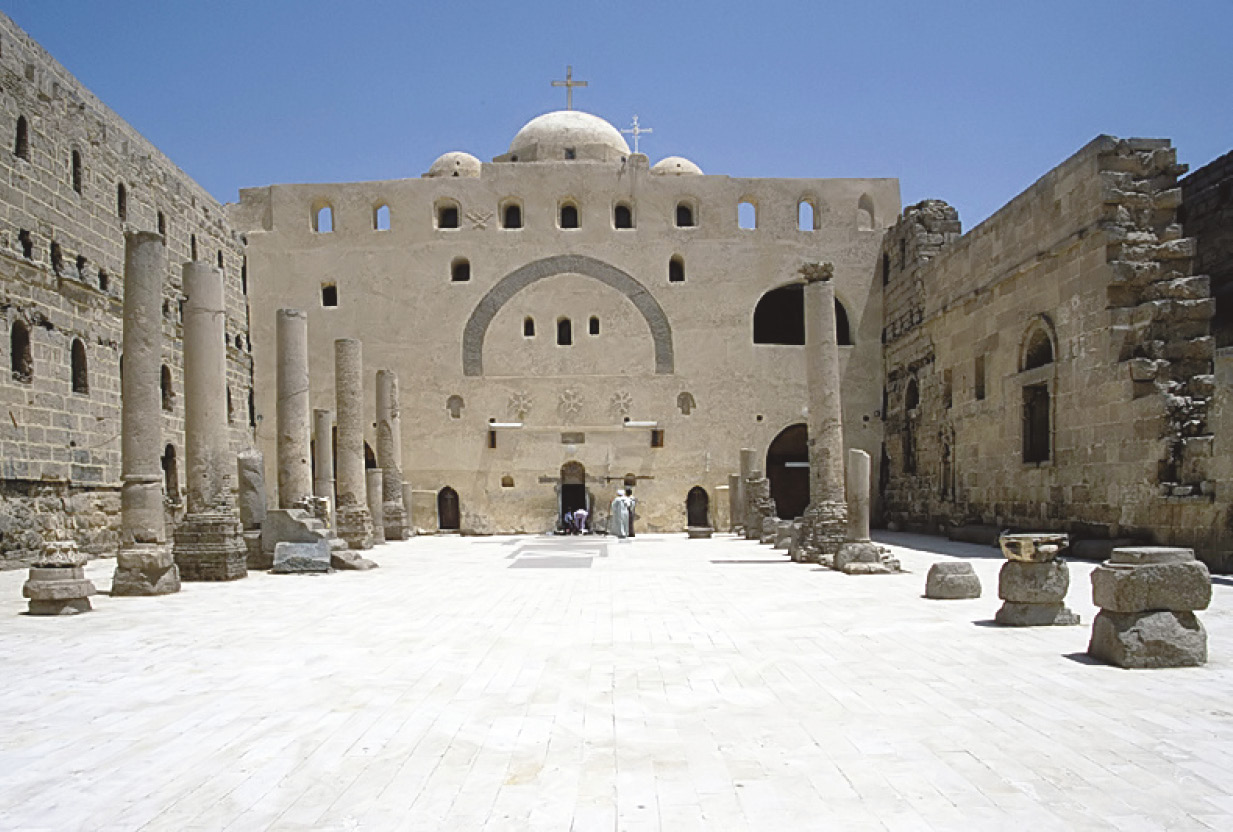
The site of Athribis stands at the foot of high cliffs that dominate the area. The Temple of Ptolemy XII is constructed from limestone blocks quarried from the summit of these cliffs. Most of the Graeco-Roman temples surviving today (Dendera, Edfu, and so on) are built of sandstone, so it is good to see a limestone temple of the period, as more intricate scenes could be carved into limestone than sandstone. Unfortunately these limestone blocks proved attractive to ‘recyclers’ over the years, either to be burnt in kilns to produce lime for construction purposes, or to build the White Monastery only three kilometres to the north. The White Monastery is so-called because of the limestone blocks used to build its walls – a visit today is interesting because many of these walls contain ancient blocks covered in hieroglyphs.

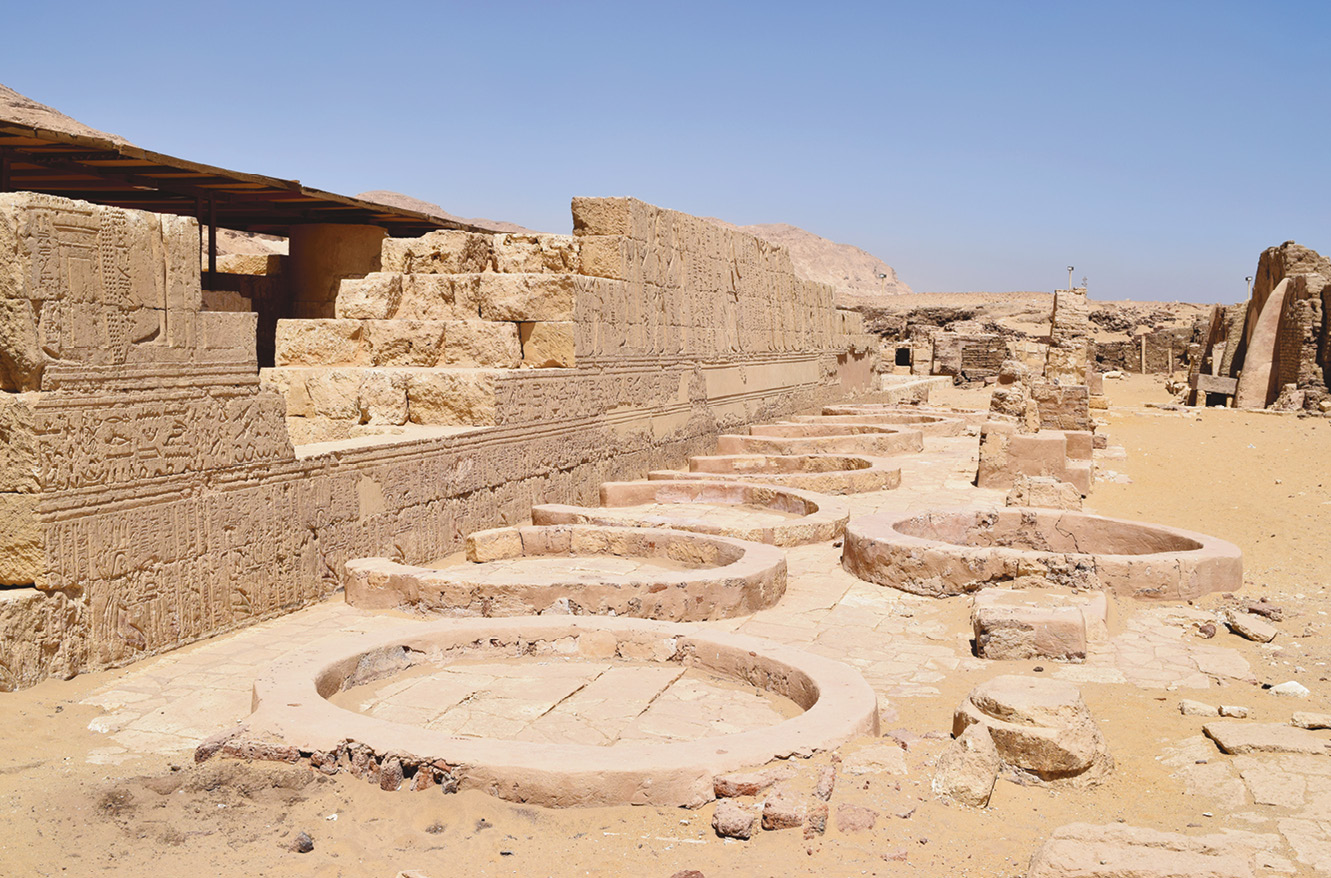
Today the temple area is in confusion, but four separate phases of development can be identified. The first of these was the intended use of the site as an Egyptian temple, ending around AD 350. Next, a stone pavement was built around the outside walls of the temple. Third, a church was built on the pavement in front of the temple, with the temple itself housing a monastery (including a large refectory on the eastern side of the temple). Finally, the church fell into disuse, and there are signs of general Islamic habitation until around AD 1000, after which the site was abandoned and became covered in sand.
Inside the temple
The floor plan of the temple was recorded by Petrie. Each of the rooms and architectural features has been given a letter and a number by the Athribis Project: for example, the sanctuary is room D3. If you are familiar with other Graeco-Roman temples such as Dendera, then it is helpful to bear these in mind when trying to interpret the more-ruined remains at Athribis.
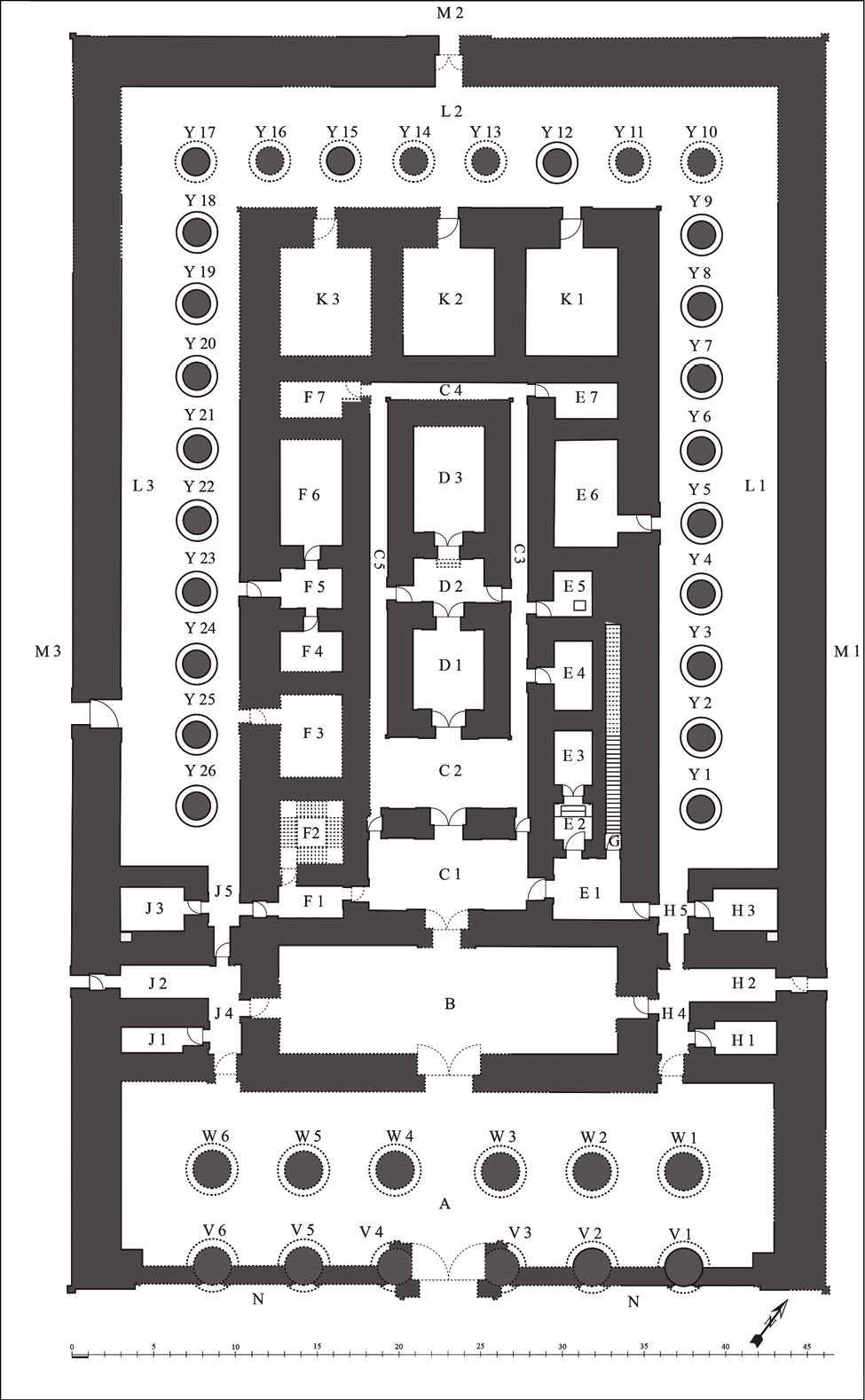
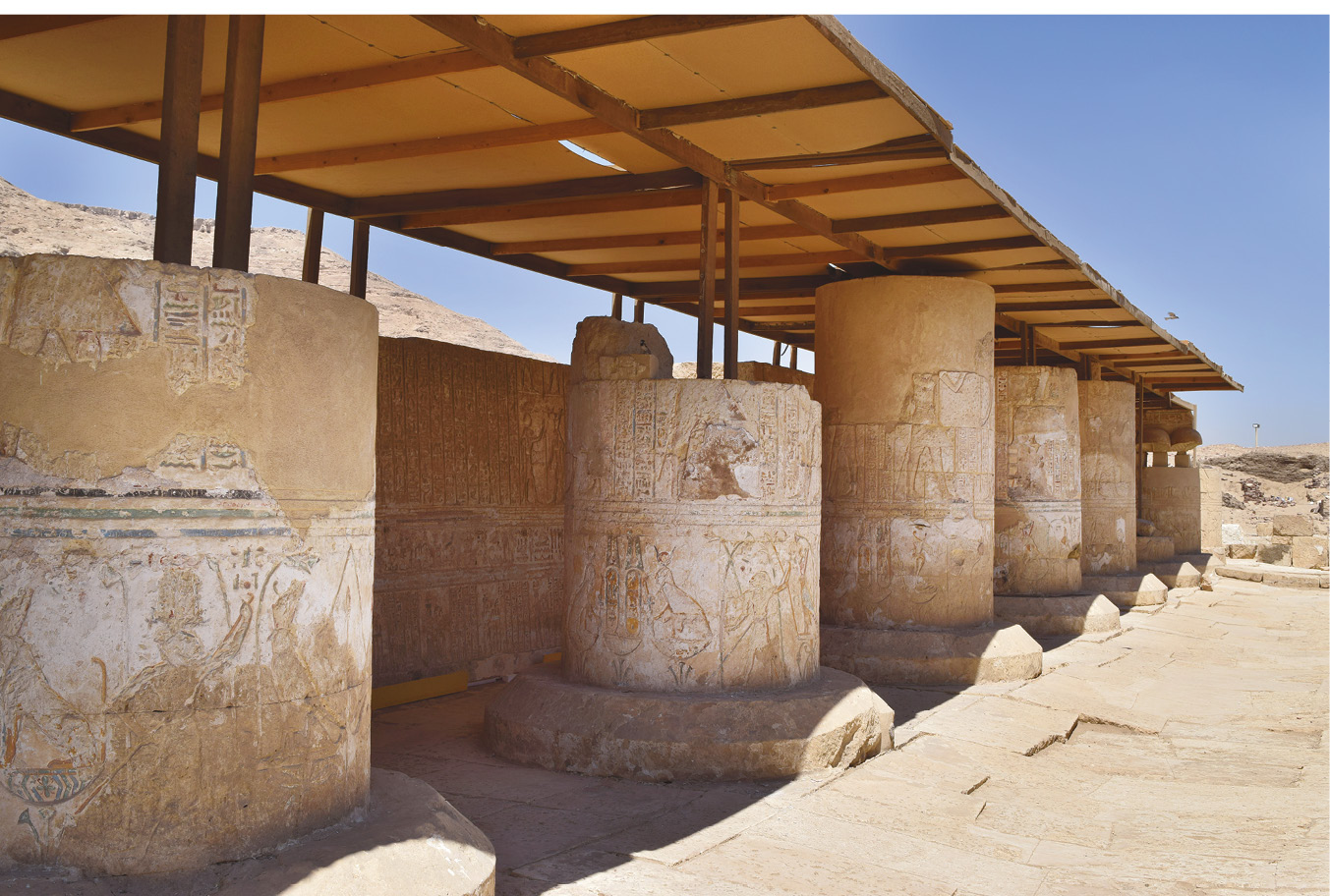
As at Dendera, the facade of the Athribis temple has six Hathor-headed columns (V1 to V6) rising from a screen. However, the Athribis pronaos (room A) is smaller than that at Dendera, having only two rows of six columns, rather than Dendera’s four rows of six columns. All the Athribis columns have collapsed, but two have been partly restored in an Open Air Museum in front of the temple.


From our knowledge of Dendera, we would expect Athribis room B to be a smaller hypostyle hall (the ‘Hall of Appearance’, where the resident deity would appear on festival occasions), but no evidence of columns there has yet been found. H1 to H3 and J1 to J3 are storerooms to each side of room B. Following the main axis of the temple, we pass into C1, the ‘Hall of Offerings’, and C2, the ‘Hall of the Ennead’. This leads into the sanctuary area, comprising rooms D1, D2 and D3. Possibly there was one sanctuary for each of the gods Min, Repyt, and Kolanthes, or alternatively D1 and D2 are lesser rooms approaching the single sanctuary at D3.
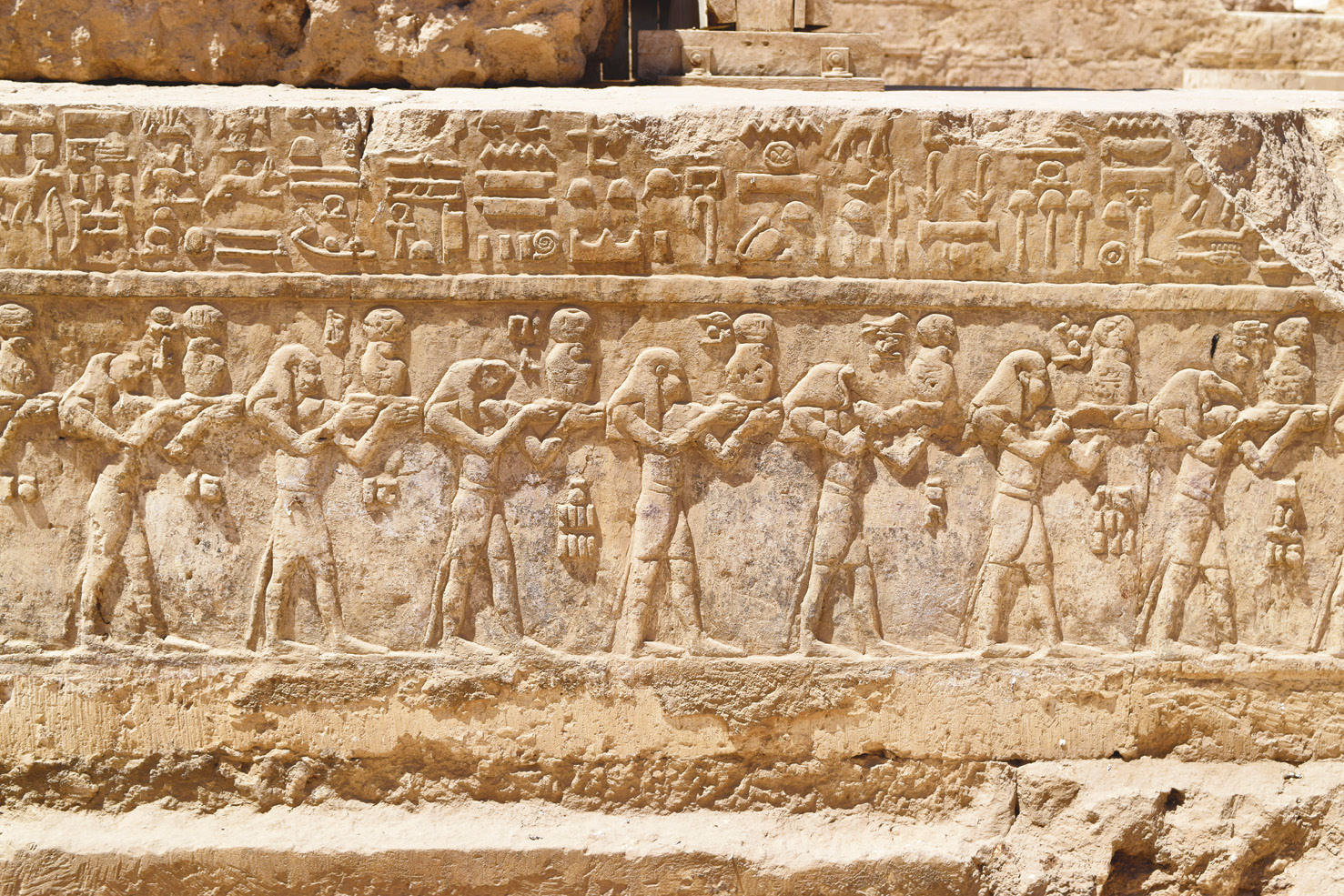
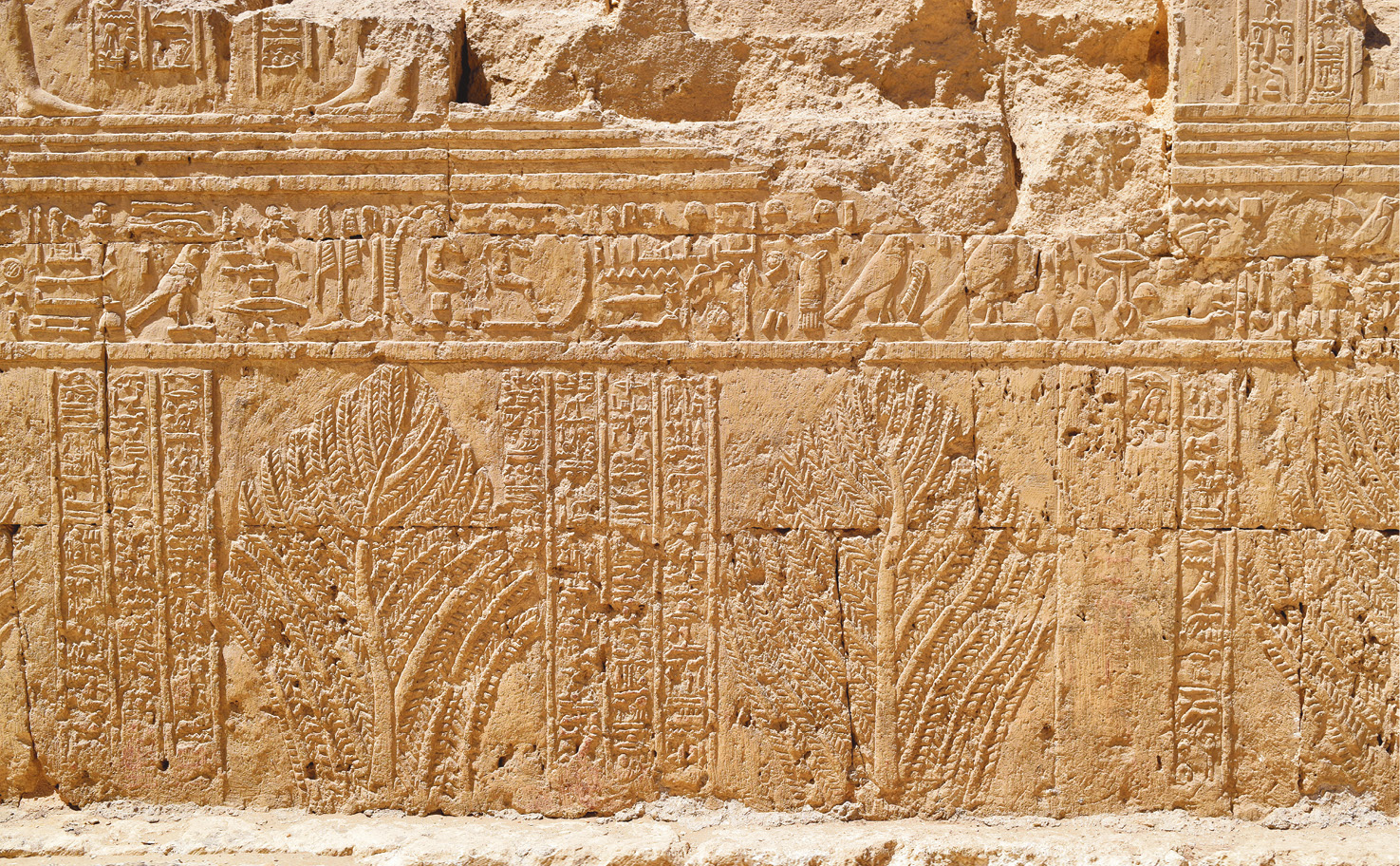
A corridor (C3, C4, C5) passes around the sanctuary, beside which lies a further series of storerooms (E3 to E7, K1 to K3, and F3 to F7). At Dendera, these storerooms are mostly accessed from the corridor, which makes sense if they held cloths or incense needed for activities within the sanctuary. However, at Athribis, most of these storerooms seem to be accessed from outside rather than from the inside corridor. From the surviving inscriptions, rooms F4, F5, and F6 form the usual ‘laboratory’ suite where incense and unguents were mixed and stored. Of particular interest is room F6, the ‘Punt Chamber’, where we can see actual depictions of aromatic trees brought from faraway Punt.

L1, L2, and L3 form an ambulatory around the sides and back of the temple, populated with columns. It is unusual to have such a colonnade around the sides of an Egyptian temple; it reminds me of the columns around the mammisi at Philae. Perhaps the Ptolemy XII temple was a large mammisi built for the earlier temple. As mentioned above, the later temple is oriented at 90° to the earlier temple’s axis, as is the mammisi at Dendera. It also has three sanctuary rooms in a row and surrounding columns, like the mammisi at Philae. However, the Ptolemy XII temple seems to have been a complete temple. Perhaps the surrounding columns were added as a decorative effect to recognise the role of that part of the temple as a place to worship a child-god.
After the temple fell into disuse, a monastery was built on its ruins. The refectory was in area M1, outside the eastern outer wall.
The Zodiac Tomb
Petrie recorded the decoration (in colour) inside a tomb in the cliffs above the temples of Athribis. It belongs to two brothers, Ibpemeny the Younger and Pemehyt, was dated to the mid-2nd century AD, and was of interest due to the two zodiacs (denoted A and B) painted on the tomb’s ceiling. The idea of the 12 signs of the zodiac was originally Babylonian, but was imported into Egypt in the Graeco-Roman period via Greece. In Egypt, it combines Egyptian ideas with the standard Greek/Babylonian signs of the zodiac that we still use today – for example, equating the twins of Gemini with Shu and Tefnut.
In the ‘Zodiac Tomb’, there are two scenes on the ceiling, side by side – presumably one zodiac for each of the brothers. Each contains images of the standard signs (such as Aries, Taurus, and Gemini) in a ring around the scene, but the signs are rotated around the ring. Perhaps each was drawn up specifically for a brother (according to his birthday)?

Visiting Athribis
The site of Athribis is open to the public and easy to reach from Sohag. Although the Temple of Ptolemy XII today lies in ruins, there is still plenty of interest, particularly if you are familiar with other temples of the period (such as Dendera or Edfu), which will help you to understand the floor plan. You can also enjoy a virtual tour of the ruins and find out more about the Tübingen Temple Project here: http://www.bit.ly/ProjectAthribis.
Geoffrey Lenox-Smith holds the Certificate in Egyptology from Birkbeck, University of London, and is a regular contributor to AE magazine.
Further reading
W M F Petrie (1908) Athribis (British School of Archaeology in Egypt).
R El-Sayed et al. (eds) (2012-2022) Athribis I to VII (Institut français d’archéologie orientale).
O Neugebauer and R A Parker (1969) Egyptian Astronomical Text III: decans, planets, constellations and zodiacs (Brown University Press).

All images: the author, unless otherwise stated