Subscribe now for full access and no adverts
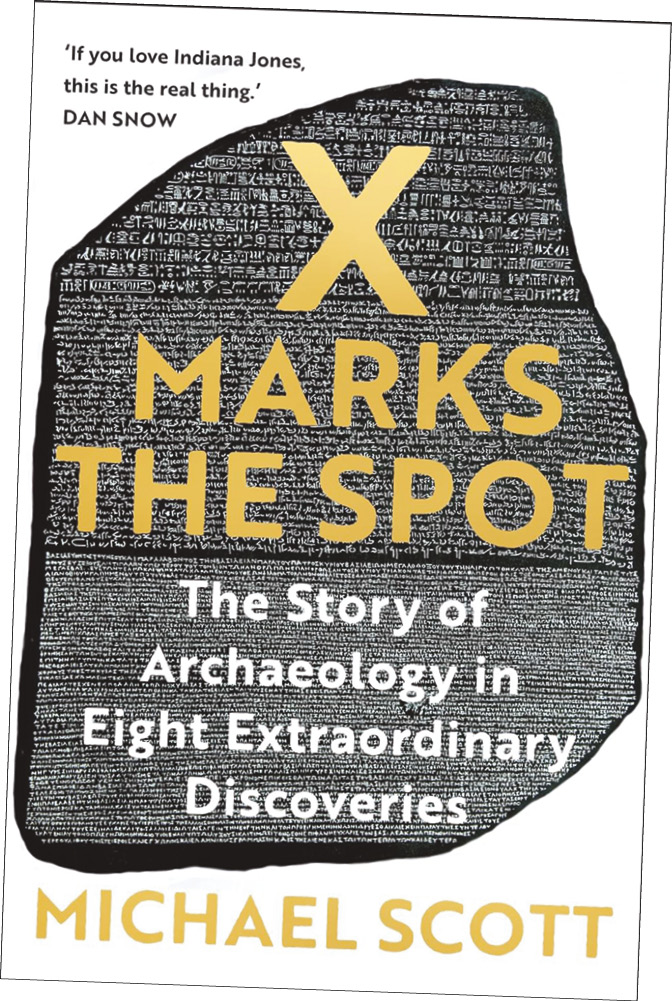
REVIEW BY AMARA THORNTON
Popular histories of archaeology have been published, in one form or another, for centuries. These narratives, at least those produced for European and American readers, frequently lean heavily on adventures and derring-do, thrilling revelations of ancient remains, often overseas. X Marks the Spot does not stray too far from that well-worn path.
In archaeology, context is everything. A discovery without context – location, stratigraphic layer, provenance – is a far less meaningful one. The same could be said for the history of archaeology and the history of archaeological discoveries, which are more complicated and more numerous than most popular narratives would have you believe. A history of archaeology without this complicated, populated context is really no history at all.
In his introduction, Scott outlines three main aims for his narrative of ‘the story of archaeology’: to highlight the decisions made on what to research/investigate; to reveal changes to how such investigations have been done; and to present the importance of the afterlives of discoveries. X Marks the Spot begins on familiar ground with the discovery of the ‘Rosetta Stone’ (p.11) during Napoleon’s Egypt campaigns, and the story of Champollion and the decipherment of its text which enabled scholars to gain access to written ancient Egyptian sources. One of the positive attributes of the book is that, apart from the Rosetta Stone and Machu Picchu (in Chapter 3), the discoveries and sites chosen are not what one might expect in a popular history of archaeology.
The first chapter is the only one set in Egypt, so if you’re looking for Howard Carter and Tutankhamun, you’ll be disappointed. Instead, we are taken to Peru, to the Silk Roads in Central Asia, to East Africa, to China, to Turkey, to Siberia, and to the Cyclades. Scott introduces some compelling support characters. We meet ‘half-Scottish and half-Chinese’ (p.54) diplomat and translator George Macartney and the monk Wang Yuanlu in Chapter 3. In Chapter 4, alongside unnamed ‘African excavators’ (p.129), it is an unnamed ‘part Maasai, part Kikuyu’ man who had reported to Louis and Mary Leakey the location of ‘bones like stone’ (p.131), which decades afterwards led Mary Leakey to a significant discovery. And in Chapter 6 there is Mehmed Çakir, a Turkish sponge diver whose profession – as Scott demonstrates – had a long association with underwater archaeological finds. But people like Macartney, Wang, the unnamed man, and Çakir are not the main focus. In part, the shape of the narrative is driven by sources available to the author; but it is also a choice.
X Marks the Spot promises that it ‘is dedicated to this quintessentially human itch to find out about, and relate ourselves to, the physical remnants of our pasts’ (p.3), delivering this through eight individual stories taking place ‘in a particular era of archaeology’s evolution’ (p.5) from the early 19th century to today. By the fifth story, we are already in the 1970s, so nearly half the book focuses on the latter half of the 20th century. The chronological leap that the book takes is explained by the dual themes Scott examines: the context and ethics of ‘discoveries’ on the one hand, and the technological and intellectual evolution that drives archaeological advances on the other. The attempt to explore these two somewhat separate themes makes X Marks the Spot a book in two halves; its narrative feels, as a consequence, slightly disjointed. It is a battle between context and technology, neither of which wins.
The story of archaeology is not just one of progress in technology or interpretation. It is a story of people, politics, empires, culture, society itself. In discussing the Terracotta Warriors (Chapter 5, pp.161-162), Scott makes an important point: that ‘discovery’ is a battleground too. X Marks the Spot would have been more compelling if this point had been evenly and adequately presented throughout.
X Marks the Spot: The story of archaeology in eight extraordinary discoveries
Michael Scott
Hodder & Stoughton, £25
ISBN 978-1529367768