Subscribe now for full access and no adverts
REVIEW BY HUGH CHEAPE
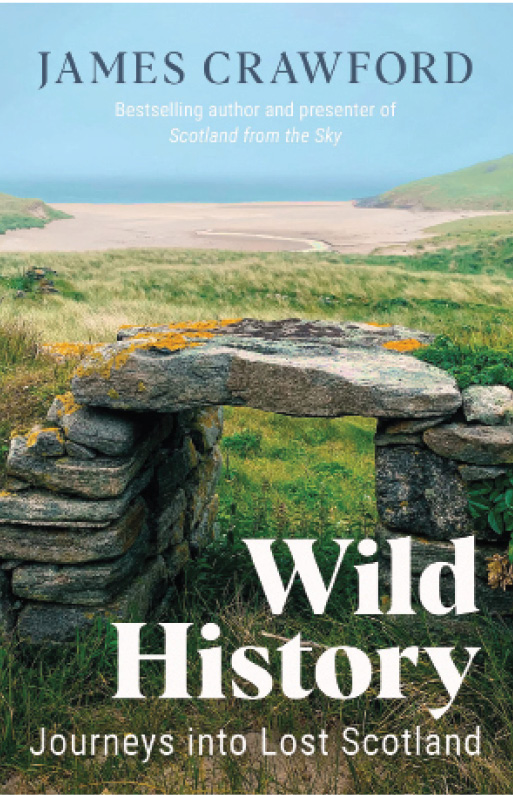
James Crawford, broadcaster and writer, has won plaudits for the cultural biographies in his Fallen Glory: the lives and deaths of history’s greatest buildings, and its tales of ‘hubris, power, violence and decay’. Now, he has turned his attention to more modest structures. ‘Wild history’ may play to the seductive appeal of ‘wild swimming’, ‘wild camping’, or even ‘re-wilding’, but it should firmly engage us with our past. This is a guidebook with a difference and a travelogue with an attractive personal underlay. This is the author’s own journey into a ‘lost Scotland’, and accounted for in an early career in the Royal Commission on the Ancient and Historical Monuments of Scotland. He worked with the archive established by A O Curle in 1908 and developed by his successor ‘commissioners’, who scoured the country for prehistoric and historical sites and recorded them as best they could in the RCAHMS inventory, now accessible on the Canmore website.
The author assumes that public awareness of what the landscape contains is low, and hopes to inspire us to explore this landscape for ourselves, and to reclaim history in a state of decay or swallowed up by nature. He guides us to a personal selection of 55 sites across the country, from Cove to Calanais, and Ailsa Craig to Fethaland on Shetland’s Mainland. Modern ‘heritage trails’ are bypassed in this glimpse into a world of ‘wild histories’, offering its crystal-clear notion that the same fulfilment is in reach of all of us with curiosity and a pair of feet. We are mentored to ‘read the landscape’ using a formulaic treatment of Ordnance Survey grid references and a personal expedition of discovery, description, and contemplation, offering us potential meanings for each site. Loving descriptions of the seasonal weather makes this our own experience.
Shape is given to this choice of ‘way-markers to our wild history’ by offering them in four categories: worked landscapes, sacred spaces, contested earth, and sheltered landscapes. Inclusion of a ‘cathedral of trees’, an outlying Calanais stone, Dùn Deardail, and two football grounds in the ‘sacred’ suggests that our own choices need not be too categorical.
James Crawford
Birlinn Ltd, £22
ISBN 978-1780277868