
Subscribe now for full access and no adverts
REVIEW BY JEFFREY JAMES
King Harald III of Norway’s sobriquet Hardrada conjures up an image of a resolute, ruthless, no-nonsense leader, yet may in fact be a corruption of the Norse word harfagri, meaning ‘the fine or fair haired’. Nevertheless, in his new book Thunderbolt of the North, the author W B Bartlett is undoubtedly right to portray his subject in the mould of other fierce, axe-wielding Scandinavians from history as a ‘hard ruler of granite-tough warriors’ – a man cast from the same rock face as earlier invaders of England, such as Erik Bloodaxe, Sven Forkbeard, and Cnut. Dominance in the far west of Europe was hotly disputed within close kinship networks of aspirant rulers in the 11th century. Competing loyalties and greed in the end tended to fracture otherwise close familial ties.
When aged 15, Harald fought alongside his elder half-brother King Olaf Haraldsson, the future patron saint of Norway, against men loyal to Cnut the Great at the Battle of Stiklestad. The 1030 battle was a pivotal moment in history, presaging a decline in paganism in Norway and the rise of Christianity. Olaf was killed at Stiklestad, and young Harald was forced eastward into exile in the lands of the Rus, where he completed his apprenticeship-in-arms, fighting as a mercenary in the employ of warlords disputing claims over emerging states like Latvia and Ukraine. He later travelled down pirate-infested waterways to Constantinople, capital of the Byzantine Empire, known as Miklagard (the Great City) in Norse. Here he joined and went on to command the famous Varangian Imperial Guard, seeing action throughout the empire’s domains.
The Varangian Guard was an elite, close-knit military unit, and baptism into the Christian faith was a prerequisite for guardsmen. The Byzantine Emperor followed best practice when imposing Christianity on his heathen conscripts. Alfred the Great had done much the same in 9th-century Wessex. Prior to conversion, the emperor’s daughter described the Scandinavian incomers dismissively as axe-wielding barbarians.
Interesting tactical observations turn up throughout the book. One, from a near-contemporary Persian writer, describes the Norse as always attacking together and never breaking ranks, forming a ‘single fist against the enemy until they overcome them’. Another speaks of the Vikings fighting ‘best on shipboard, not on horseback’. A quote from the Heimskringla, a collection of sagas about Norwegian and Swedish kings, describes the Northmen fighting ‘in phalanx taut’ against enemies similarly ‘pent-tight’. The mention of ‘storms of arrows’ raging around Olaf and Harald at Stiklestad highlights a tense moment before the onset of hand-to-hand fighting. The famous Battle of Maldon poem from the late 10th century also mentions bowmen being busy.
The second half of the book focuses on Harald’s imperial ambitions in making good his claim to rule Norway, as well as a failed attempt to conquer Denmark. Military campaigns spanning the best part of two decades between 1047 and 1066 are detailed, ending with our hero’s death in battle in Yorkshire at Stamford Bridge in the early autumn of 1066. Bartlett impressively sustains a narrative wide in geographic scope and political complexity, detailing all the major events, plus a host of others which, in truth, are more anecdotal, akin to folktales. They come courtesy of an impressive bibliography of skaldic and primary-source material that is well referenced by the author.
The book also features a vibrant cast of minor characters with nicknames such as ‘Einer the belly-shaker’ and ‘Thorkill the tall’. Harald has sometimes been referred to as the ‘last Viking’. It captures the sense of his death bringing an epic age to a close, but minor raids continued. As historian John Gillingham noted, ‘nobody had told the Vikings that the Viking Age was over’.
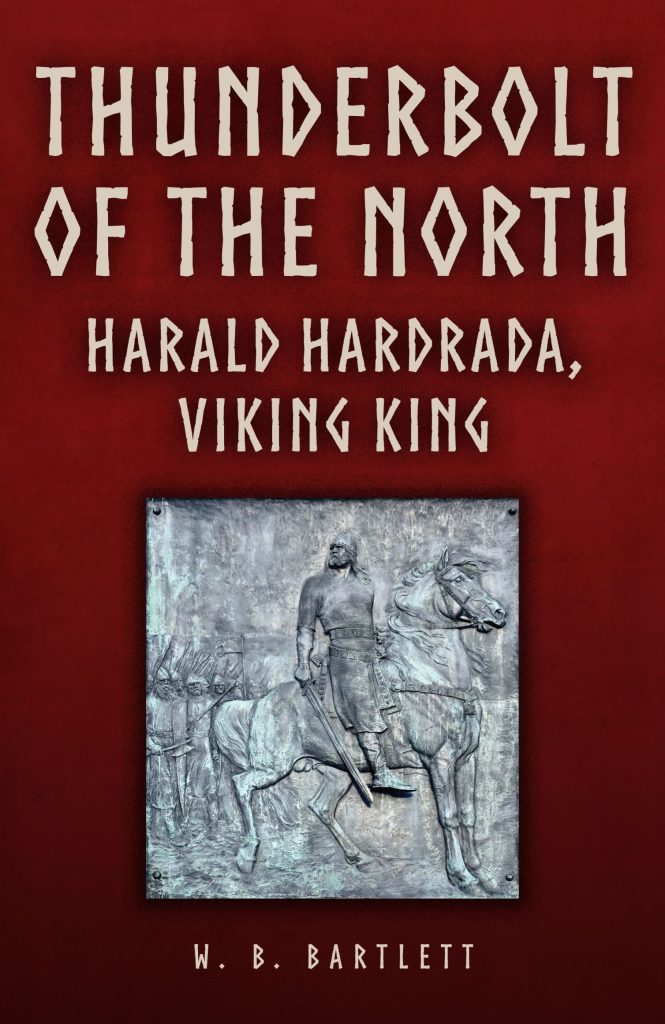
Thunderbolt of the North: Harald Hardrada, Viking King
W B Bartlett
Amberley Books, hbk, 336pp (£22)
ISBN 978-1398110458