
Subscribe now for full access and no adverts
REVIEW BY SOPHIE AMBLER
Battlefield commemoration has hitherto been the territory of historians of the modern age, leaning too heavily on the First World War and US Civil War, and linking battlefield memorialisation to the rise of nationalism. Atherton instead offers a longue durée exploration, across seven centuries starting from c.1300. The first investigation of its kind, Britons and their Battlefields will be essential reading not only for modern historians needing a lesson in chronological depth, but also for archaeologists and historians of medieval and early modern war.
Atherton’s findings justify his broad chronological scope. He argues persuasively that the memorialisation of battlefields was transformed by the Reformation. In the late Middle Ages, battlefields were carefully managed, with hedges and wooden crosses to demarcate graves (potentially allowing for later disinterment), and the building of chapels and tall crosses to highlight the battlefield landscape and encourage prayers for the dead. A case study of Neville’s Cross (an English victory over the Scots in 1346) demonstrates the richness of medieval commemorative landscapes. At nearby Durham Cathedral, English commanders presented their banners to the shrine of St Cuthbert. In the following decades, the Neville family sponsored building work to convert the cathedral church into a ‘battlefield victory chapel’. Durham’s clergy erected a six-foot wooden cross on the hillside where they had prayed during the battle. A cross of stone, ten-feet high, also stood on the battlefield itself. Such commemorations ended with the Reformation. Now came disapproval of prayers for the dead and distrust of sacred spaces, and the systematic destruction of battlefield shrines and crosses, such as those commemorating Neville’s Cross, Towton, and Barnet. The success of that destruction has perhaps deceived us into missing medieval commemorative programmes. Critically, Atherton argues for the commonalty of battlefield monuments in the late Middle Ages. He (conservatively) estimates that nine out of 17 registered battlefields of 1300-1542 were marked by crosses or chapels: we should look for monuments when tracing medieval battlefield landscapes.
Conflict archaeologists will also read with interest Atherton’s suggestion of changes to battlefield burial practice. As a 17th-century specialist, Atherton draws richly from textual evidence to suggest a fundamental transformation: in the Middle Ages, bodies were gathered for burial in mass graves, which could then be consecrated; after the Reformation (and especially during the Civil War), men were buried where they fell. We should not be fooled by local traditions of mass graves at Civil War battlefields, likely ‘folk memories’ shaped by medieval practice and the work of the War Graves Commission in the 20th century. Given the well-known challenges of locating and excavating pre-modern battlefields, Atherton’s suggestion cannot be tested – but it should be considered in future investigations. So, too, should his warning on the use of place-names in battle-field landscape investigation. Attending carefully to how antiquarians navigated earlier conflict landscapes, he suggests that the naming of fields and other local landmarks to suggest connections to battles are often 18th-, 19th- and 20th-century confections, awarded a ‘spurious authenticity’ by inclusion on Ordnance Survey maps.
Atherton’s broader findings on the cultural shifts in the memorialisation of battles and battlefields between the 17th and 20th centuries are richly rewarding. As an Early Modern specialist, I find that some of his generalisations regarding medieval military cultures do not bear scrutiny, nor does his berating of ‘military historians’ through a caricature of them as bumbling armchair generals – this characterisation has been contradicted for decades by the thriving and diverse field of military history. Still, these are minor grumbles when set against what is a richly rewarding read. Atherton’s book is thoroughly researched, cogently argued, and stuffed with important findings large and small.
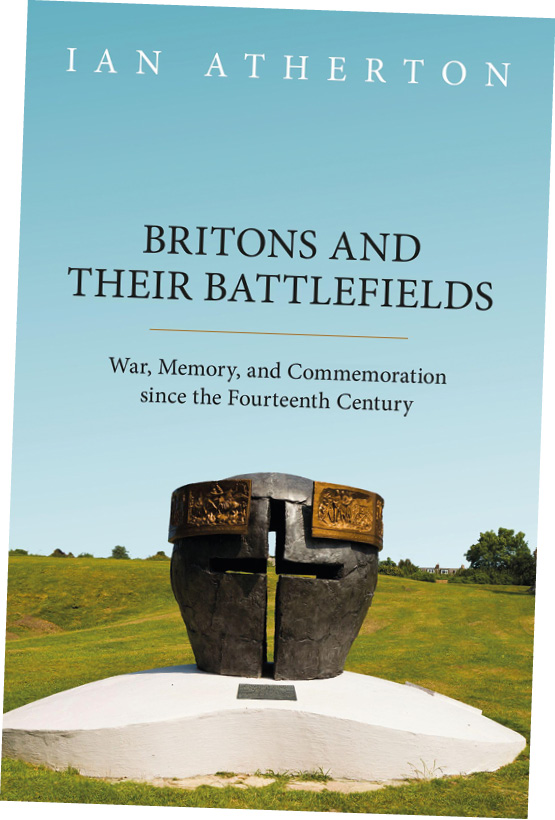
Britons and their Battlefields: War, Memory, and Commemoration since the 14th century
Ian Atherton
Oxford University Press, £35
ISBN 978-0198912859