
Subscribe now for full access and no adverts
A section of Watling Street – one of the most important roads in Roman Britain, running from Dover (Dubris) to Wroxeter (Viroconium Cornoviorum) via London and St Albans – has been uncovered during excavations in Southwark.
Traces of the route, which was established shortly after the Roman invasion of Britain in AD 43, had already been identified in the area in the 1990s, but its precise path through London was unclear. Now archaeologists from MOLA (Museum of London Archaeology) and Southwark Council have revealed a new stretch lying beneath Old Kent Road.
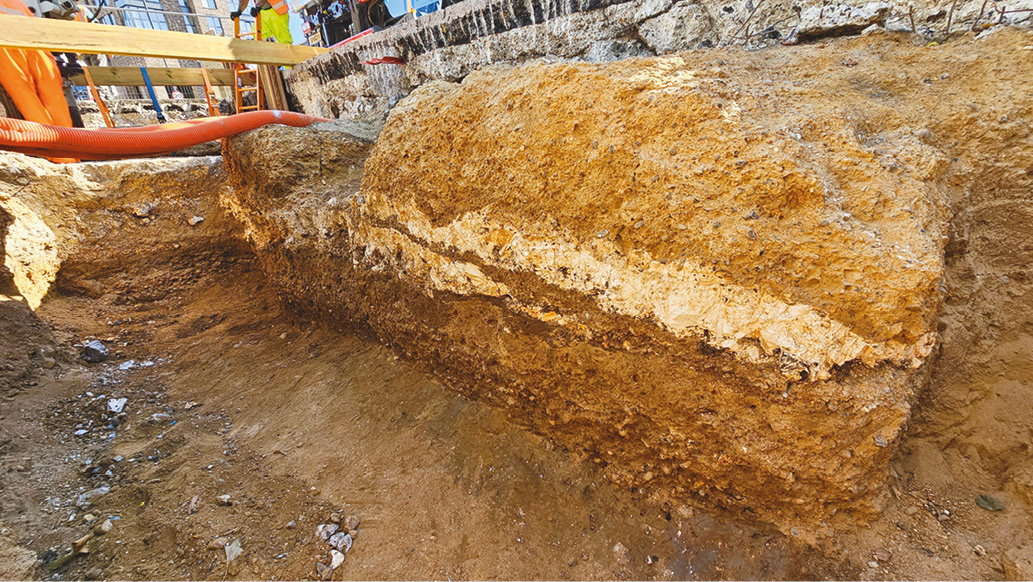
This portion of the road (which was uncovered during Southwark Council and Veolia’s expansion works on Southwark’s low carbon heat network) is relatively small, with the exposed section measuring less than 6m across (the entire surface is likely to be 12-14m wide). Nevertheless, the archaeologists have been able to use its location, and that of the previous discovery, to project Watling Street’s likely course – with unexpected results. ‘We are drawing straight lines between two points, so this may not be accurate if further finds of the road are made, but for some reason the modern alignment moves off the Roman alignment, probably about 500m north-west,’ Dr Chris Constable, Borough Archaeologist for Southwark Council, explained.
The newly excavated section of Watling Street shows remarkably clear layers, representing different construction stages of the road. A solid foundation of gravel is sealed by two layers of chalk – most likely taken from the nearby Camberwell hills – which was then topped with a further layer of gravel and compacted sand. It lies directly underneath the base of the modern road, and archaeologists believe there would have been another layer of sand and gravel that would have sat at a similar level to the present-day street.
‘The scale of survival is far greater than other Roman roads identified in Southwark, except for Road 2 on the north island, displayed at Southwark Cathedral,’ Chris said.
Archaeological investigations connected with the heat network expansion are set to continue, and with the works covering significant areas – including the course of a second Roman road, which runs from London to Lewes – this project may yet reveal further insights into infrastructure of the period.
‘It’s extraordinary to literally be peeling back the layers of Old Kent Road’s history as we work towards a greener future by expanding Southwark’s low carbon heat network,’ commented Councillor Helen Dennis, cabinet member for new homes and sustainable development.
Text: Rebecca Preedy / Photo: MOLA, 2024