
Subscribe now for full access and no adverts
In March 2025, the owners of a house in the Carrollton neighbourhood of New Orleans came across a flat marble slab while clearing undergrowth in their backyard. The unusual object bore an engraved Latin inscription, leading the couple to fear that their home may have been built on top of one of the city’s forgotten cemeteries. According to a report by the Preservation Resource Center of New Orleans, the homeowners reached out to researchers at the University of New Orleans who confirmed that that this was unlikely to be the case, and sent images of the stone to several other experts in order to decipher the Latin inscription and find out more.
This revealed that it was, in fact, a funerary inscription for a Roman sailor called Sextus Congenius Verus. He was a ‘soldier of the praetorian fleet Misenensis, from the tribe of the Bessi, [who] lived 42 years [and] served 22 in the military, on the trieme Asclepius.’ On further investigation, it was discovered that this inscription perfectly matched the description of a stone that had originally been found near Civitavecchia, Italy, and was recorded as missing from the city’s museum. The port town of Civitavecchia, originally known as Centumcellae, was an important base for the Roman navy in the 2nd and 3rd centuries AD, and a number of sailors are known to have been buried near the harbour.
Civitavecchia remained a major port into the 20th century, and was heavily targeted by Allied bombing raids between 1943 and 1944, resulting in the local museum being almost completely destroyed. At present, it remains uncertain how the Roman funerary stone ended up in New Orleans, but it is believed that it may have been picked up by an American soldier during World War II or sold by an antiquities dealer in the period after the war. The stone now been handed over to the FBI’s Art Crime Team, and plans are under way to return it to the museum in Civitavecchia.
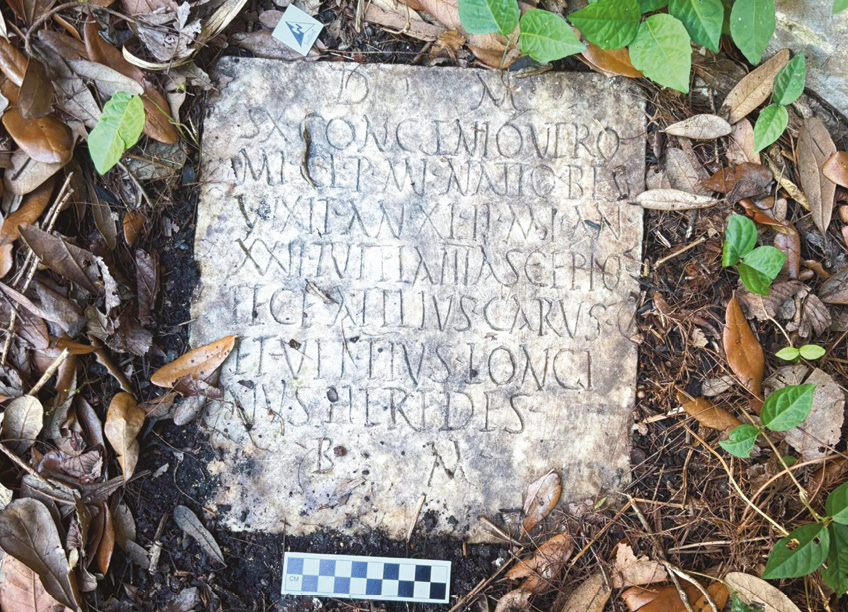
Text: Amy Brunskill / Image: courtesy D Ryan Gray and the Preservation Resource Center of New Orleans