Subscribe now for full access and no adverts
In CA 411, we carried a news story about the exciting implications of recent research into early medieval silver coinage; for this month’s column, we delve deeper into the science behind the study to reveal how these conclusions were reached.
In north-west Europe, c.AD 660 marked the onset of a transformative period for the early medieval economy. At the centre of this development was silver coinage, which supplanted the use of gold and stimulated the growth of trade networks and urban centres across England and north-west Europe. One of the main questions associated with this increased reliance on coined money is: where did the silver bullion come from? Three theories have been prominent: (1) the revival of mining silver in Europe – specifically at Melle in western France, a mine whose silver has a low gold content; (2) the recycling of Roman plate or scrap silver; and (3) importing Byzantine or Islamic silver. Now a new study by researchers from the Universities of Oxford and Cambridge, and Vrije Universiteit Amsterdam, has set out to address this conundrum, along with how the minting of silver coin was sustained over the ‘long 8th century’ from c.660-820.
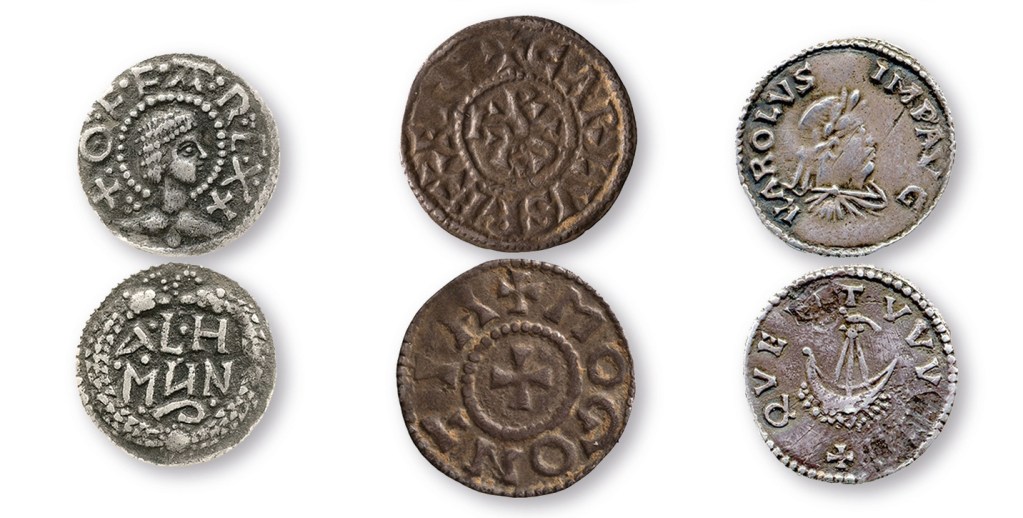
During the research, 49 silver coins – minted in England, the Netherlands, and eastern Francia, and now residing in the collections of the Fitzwilliam Museum in Cambridge, examples of which are shown (above right) – were analysed using a complementary combination of lead isotope and trace element analysis. Lead isotopes and concentrations of certain trace elements, namely gold and bismuth, can be used to characterise silver metal and identify its corresponding potential source. Using this approach, the team identified two major shifts in the source of silver in the widespread coins – denoted as the early period (c.660-750) and the late period (c.750-820).
In the early group are 29 coins, minted in England, Frisia, and Francia. These were homogenous in composition and not regionally distinct, with high levels of gold ranging from 0.6-2% and a consistent lead isotope range. The lead isotopic ranges and trace element profiles are distinct from any known European ore, including Britain and Melle in France, ruling out silver coming directly from nearby mining. Furthermore, there is no overlap with analyses of late Roman silver coins or objects. Neither is there strong overlap with contemporary Islamic silver, which has higher 208Pb/206Pb ratios. Instead, the geochemical profile of the coins matches Byzantine silver, with the higher levels of gold attributed to these objects being occasionally gilded.
The researchers therefore suggest that the melting down of Byzantine silver facilitated the rapid expansion of silver coinage. Byzantine silver had reached north-west Europe prior to its recycling, as evidenced by sites like Sutton Hoo, where 10kg of Byzantine silver objects were discovered, enough material to produce 10,000 pennies. If the silver in coins was coming from prestige objects, this indicates that elites had control over coin production, and the surge in minting indicates significant socio-economic changes. These could have been driven by a multitude of possible factors, including revived interregional trade and the emergence of production-focused urban and rural settlements, among others.
Byzantine silver was, however, a finite resource, and after c.AD 750 there was a shift towards silver coins of a different composition. Twenty coins among those studied by the researchers represented this later period (c.750-820): one coin of Pippin III (747-768), five of Offa of Mercia (757-796), two of Charlemagne (792-814), one Danish copy of an issue of Charlemagne, seven of Louis the Pious (814-823), and five of Coenwulf of Mercia (796-821). These coins are characterised by a lower gold content of 0.01-1.5%, and had geochemical compositions similar to the silver at the mine in Melle. Previous research indicates that this mine was particularly active in Charlamagne’s reign during the 8th and 9th centuries.
Between c.750-793, there was some regional variation in the coins, with a pattern of gold content increasing the further from Melle the coins were minted. It is proposed this occurred due to the remelting of the old coins made of Byzantine silver with silver bullion from Melle. After 793, however, there is a strong shift among all surveyed coins across the Carolingian state and England to a more standardised Melle-like silver coin with a consistently low gold content, including those of Offa of Mercia, which had higher gold levels during the earlier years of his reign. The significance of this date lies in Charlemagne’s coin reform of 793. The researchers indicate that this widespread shift in the coins’ geochemical profile to predominantly Melle silver reflects the Carolingian state’s firm currency control and a centralised silver distribution. Its spread to England illuminates political ties between Charlemagne and Offa, underscoring the vital trade networks across north-west Europe, and interdependencies crucial for these thriving economies.
The research was published in full in Antiquity (https://doi.org/10.15184/aqy.2024.33), where the paper’s authors summarise: ‘By the end of the 8th century, a substantial proportion of the bullion used across the Carolingian Empire – and in England – stemmed from the mines and workshops of Melle, and the speed and extent of this change are best accounted for by a conscious and far-reaching decision at the apex of the Frankish government.’
Text: Amber Johnson / Image: Kershaw et al. (2024) Antiquity (© The Fitzwilliam Museum, Cambridge)