Subscribe now for full access and no adverts
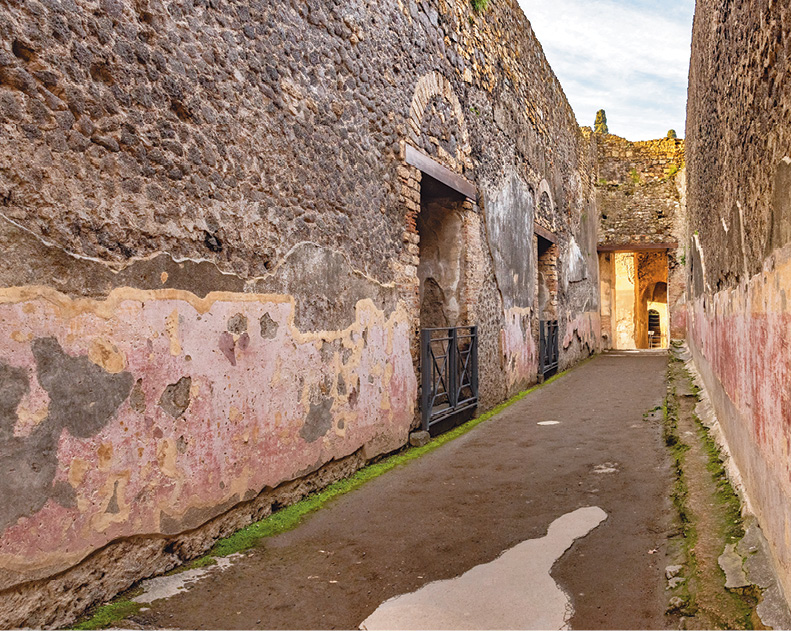
Between two of Pompeii’s ancient theatres runs an unassuming passageway. Measuring c.27m long and 3m wide, this space is believed to have been constructed in the 80s-70s BC to connect the city’s Large Theatre with its smaller, covered theatre, before opening on to the via Stabiana at the eastern end.
The corridor was initially discovered in 1794; in 1810, it was noted that the walls were covered with inscriptions and drawings. A variety of research into these engravings has taken place over the last two centuries, but records remain fragmentary, making it difficult to study the corpus as a whole.
The ‘Bruits de Couloir’ project (literally ‘corridor sounds’, which is a French term for gossip) set out to change this. Researchers from Sorbonne University, France, and the University of Québec in Montreal (UQAM), in collaboration with the Archaeological Park of Pompeii, carried out two field visits, in spring 2022 and September 2025, using a multidisciplinary approach to re-examine this space.
The team’s initial focus was recording the location of each graffito – which was done using virtual grids applied to both the north and south walls – as well as other standard epigraphic details. They were then able to document the spatial and thematic connections between inscriptions to see how they related to others in the space.

During the second stage, the project partnered with Mercurio Imaging to carry out Reflectance Transformation Imaging (RTI) coverage of both walls in their entirety. Researchers worked over five nights to take nearly 15,000 pictures of these surfaces under different angles of lighting. This is currently being processed to create an interactive model where variable light can be applied to every point on the walls, highlighting even the tiniest details of each graffito.
This approach has enabled the researchers to produce a comprehensive reinterpretation of the graffiti in this corridor, enhancing our understanding of the c.200 known examples, as well as uncovering 79 previously unidentified inscriptions and images.
The collection is remarkably varied, ranging from isolated letters to long messages, including references to political figures, sex workers, and gladiators, declarations of love, appeals to deities, and playful insults. Most of these are written in Latin, but some Greek inscriptions are also present, and there is even one example in a Proto-Semitic language currently not found anywhere else in the ancient West. Figurative images are equally varied, encompassing animals, people, boats, and geometric designs: some are extremely rudimentary, while others are highly detailed.
The new additions to the corpus reflect the miscellaneous activities, thoughts, and feelings of the ordinary people of Pompeii. One such inscription features a fragmentary declaration of love: ‘Erato amat…’. Erato is a name probably belonging to a female slave or freedwoman, and is known at other sites, but this is the first time it has been recorded in Pompeii. Unfortunately, damage to the inscription means that the name of her beloved remains elusive. Another recent discovery comprises an image of a pair of gladiators, c.10cm high, shown in fighting position. The artist behind this drawing was remarkably skilled, able to bring to life a dynamic event, presumably from memory, using just a few lines. Evidence of the artistic vision and capabilities of everyday people like this provides an interesting juxtaposition to the ancient images created by professional painters, mosaicists, and sculptors, with which we are more familiar.
The project’s findings confirm that this corridor was not just a through-passage, but a public space used for a wide range of activities: a place of conversation, waiting, and other social interactions, where numerous people recorded their most immediate thoughts and emotions.
As a direct result of this research, the Archaeological Park has scheduled the construction of permanent cover for the corridor to protect the fragile inscriptions. This will be combined with the technologies developed during the Bruits de Couloir project to preserve the graffiti for future visitors and research. The final goal is a 3D platform that will integrate photogrammetry, RTI data, and epigraphic metadata to create a new tool to aid in the study of these inscriptions. This will be available at https://bdc-pompei.com.
Using the latest technology, nearly 80 ancient voices at risk of being lost have been rescued from obscurity. The research has established a methodological precedent, too, that will be of enormous value for the thousands of other inscriptions across Pompeii, which represent an important, and vulnerable, element of the site’s heritage.
The research has been published in the E-journal of the Excavations of Pompeii (https://pompeiisites.org/e-journal-degli-scavi-di-pompei).
Text: Amy Brunskill / Images: courtesy of the Archaeological Park of Pompei; © ‘Bruits de couloir’ project, 2025