
Subscribe now for full access and no adverts
Re-examination of an early medieval burial found at Bull Wharf in the City of London suggests that the probably female individual may have been the victim of an execution, and that she had perhaps been placed on the Thames foreshore as a warning to other would-be malefactors.
The skeleton was one of two discovered in 1991 during rescue excavations on the site by MoLAS (now MOLA; see CA 158). While the second interment did not appear out of the ordinary apart from its location, the first was notable as this individual had been buried between two sheets of bark, which lay on a mat of reeds, and moss pads had been placed over their face, pelvis, and knees. Even more notably, the skeleton showed signs of several injuries that most likely occurred at or around the time of death.
The human remains were carefully lifted in two blocks and brought to London Museum – and now the more unusual skeleton has been re-examined by a team of researchers led by Dr Madeleine Mant from the University of Toronto, using modern methodologies. They found that the skeleton was probably that of a woman aged older than 40, and that there were a large number of injuries present throughout her body which were at various stages of healing. She had four fractures that had completely healed – one near to the left side of her jaw and the others on three different ribs – meaning that it was impossible to tell when they had occurred and whether they were the result of one incident or of cumulative trauma during her lifetime. She also had another series of wounds, all to the shoulder blades, that were in the process of healing at the time of her death (below). Based on the amount of woven bone found on this damage, the researchers suggest that these fractures occurred approximately 10-12 days before the woman’s death. Finally, she had almost 50 completely unhealed injuries that most likely happened at or around her time of death. These included more fractures to both shoulder blades, as well as several fractures to the spine and ribs, and a large blunt force trauma on the left side of her cranium.
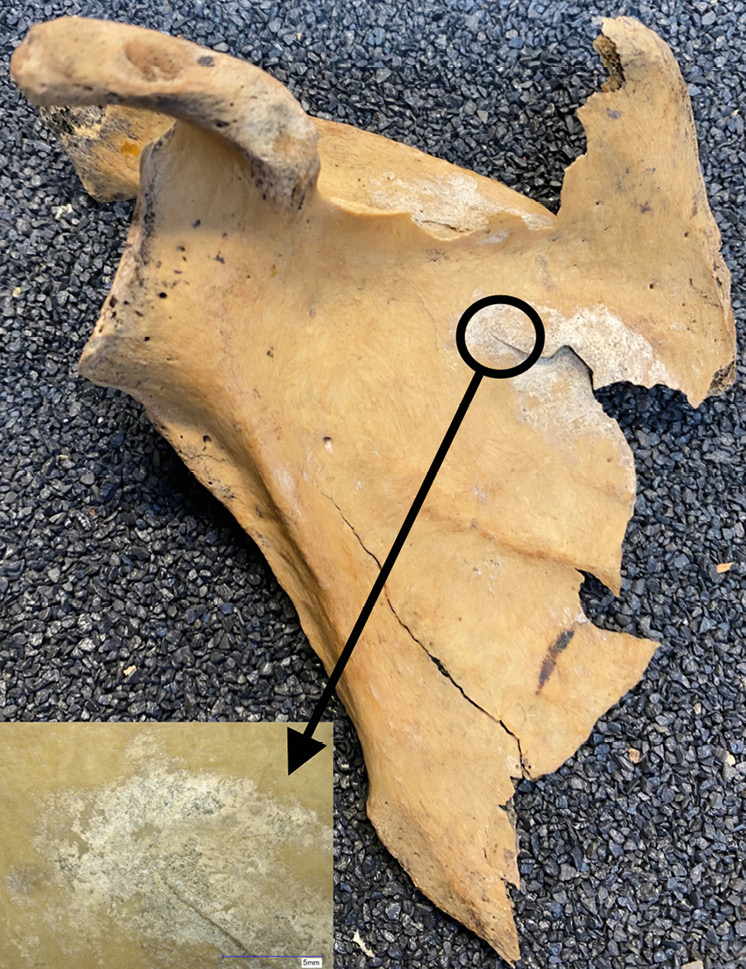
Analysis of the fracture pattern suggests that this woman suffered significant blunt force trauma to her upper back at least two weeks before her death. Then, when those injuries had just begun to heal, she suffered another series of catastrophic injuries to her head and torso – possibly from being beaten with a blunt weapon – which ultimately resulted in her death.
So, how did this woman come to be bludgeoned to death? The team looked at her burial context for clues. Radiocarbon dating of the bark sheets that she had lain between provided a date of AD 680-810, with the sequence of foreshore deposits indicating that the burial had probably occurred sometime between the mid-8th and early 9th centuries. Isotope analysis found that the woman was from London or another part of south-east England, making it unlikely that she would have been seen as an outsider – so why had she been treated in such a brutal way?
At the time that the burial took place,this site would have been at the edge of the Thames: a very prominent and symbolic location, which would have been easily seen by those living and trading in nearby Lundenwic, and was probably chosen for a specific purpose rather than convenience. The researchers therefore argue that this is unlikely to have been a case of murder or other clandestine violence and that, instead, it is most probably a case of judicially decreed or otherwise sanctioned violence. Their conclusions are strengthened by the fact that, in Anglo-Saxon England, it was common for execution victims to be buried in locations that were highly visible to the surrounding community, and most especially along territorial borders; at this time, the Thames provided a border between the kingdoms of Wessex and Mercia.
The full results of this research were recently published in the journal World Archaeology.
Text: Kathryn Krakowka / Photo: London Museum