Subscribe now for full access and no adverts
The Community Archaeology Radiocarbon Dating (CARD) Fund – sponsored by Archaeological Research Services Ltd and Scottish Universities Environmental Research Centre (SUERC) Radiocarbon Laboratory – was established to help projects in the volunteer sector gain access to radiocarbon-dating. In the last year, ten community projects in England, north-east Wales, and south-west Scotland benefited from this support, and their results took the total number of radiocarbon dates obtained since the Fund was launched past the 100 mark.
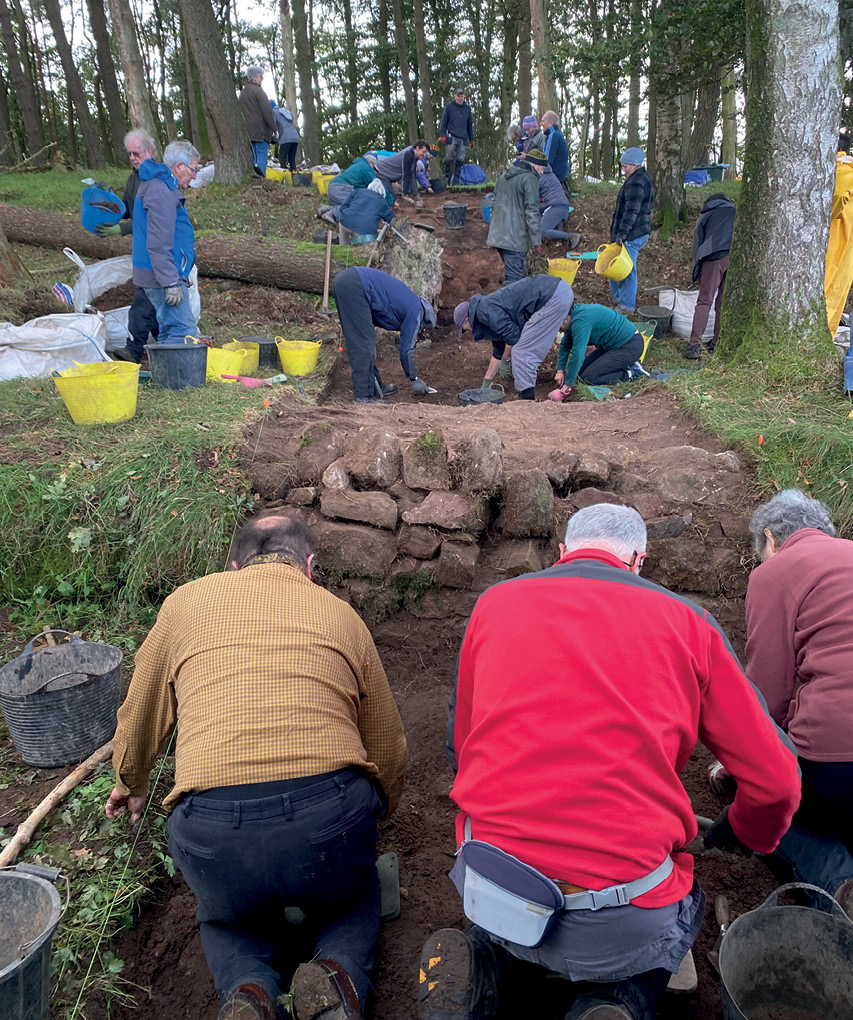
The latest round of results from 2023, starting with the earliest-dated discoveries, included Archaeology Scotland’s Adopt-a-Monument which, working with volunteers from the Stronafian Heritage Project, uncovered evidence of Neolithic occupation during excavations at Creag Liath in Glendaruel’s Stronafian Community Forest, Argyll and Bute (see CA 406). The site lay just 400m from Auchategan, where investigations in the 1970s had found Neolithic pottery, much of which was carinated. In order to date the finds from Auchategan more precisely, charred residue from a fragment of Carinated Bowl pottery was radiocarbon dated, yielding a result of 3766-3534 cal BC.
Shifting our focus to the south, in 2021 the West Kent Community Diggers opened a series of small test-pits across an area of Rusthall Common known locally as ‘the Bumps’. Two years earlier, a resistivity survey and analysis of aerial images had suggested that this site preserved a possible outline of the ‘scar’ of a large earthen mound, and potentially the remains of a prehistoric ‘chambered tomb’. West Kent Community Diggers’ test-pits recovered lithic artefacts with a broad Neolithic to Bronze Age date, and a sample from a carbonised oak stake was radiocarbon dated to 2455-2147 BC, during the ‘Beaker’ period. This result fits with the general dating of much of the lithic material as well as a time of ‘mound builders’. As such, the discovery of a previously unknown prehistoric barrow in an area of Kent where no such monuments are known is highly significant.
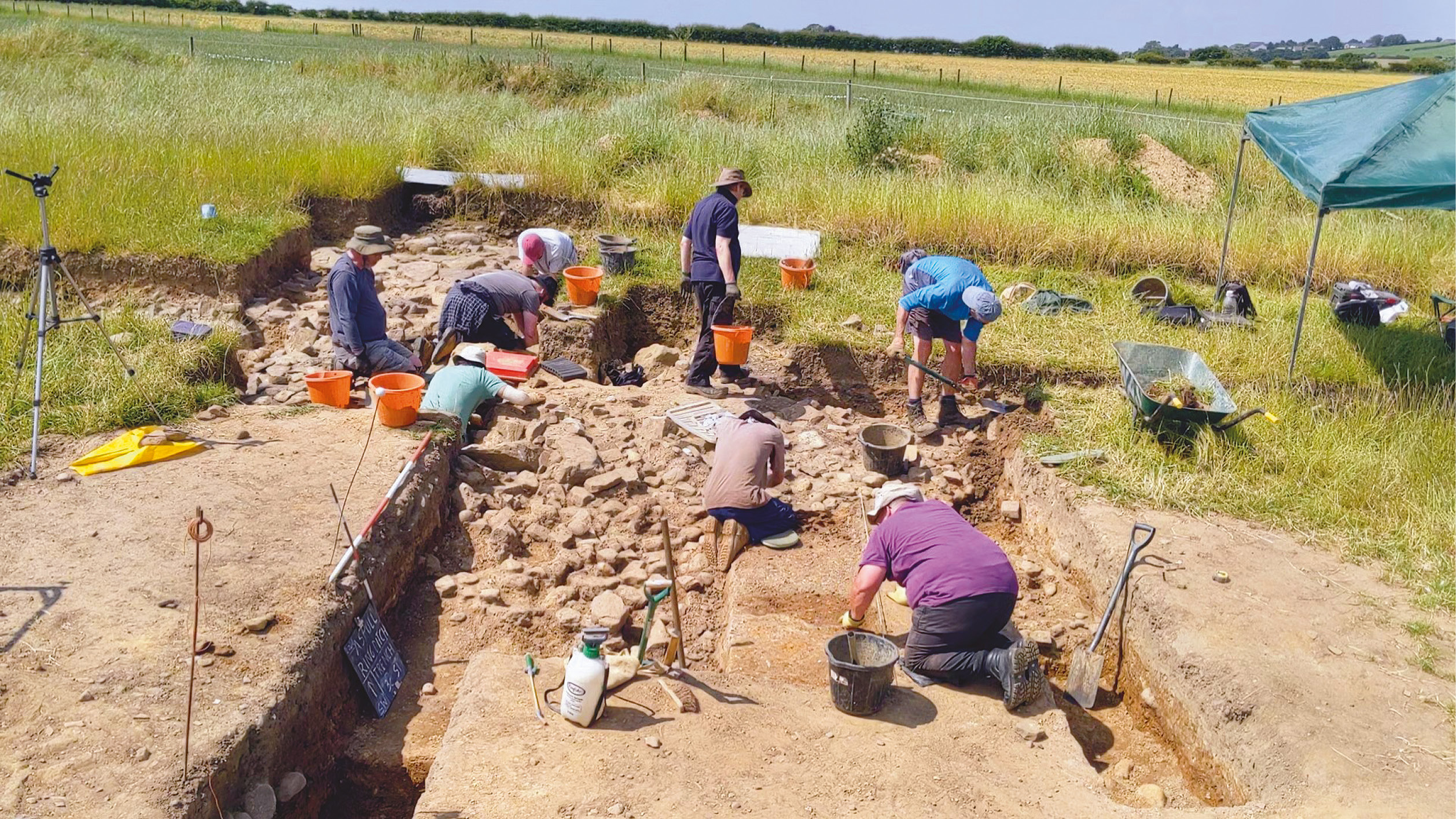
Moving further into the Bronze Age, since 2022 the Clwydian Range Archaeology Group have been investigating the Bryneglwys ring cairn in Clwyd, north-east Wales, uncovering pottery and cremation deposits both inside and outside the cairn bank. Samples of cremated human bone from in and around the cairn produced consistent radiocarbon dates of 2020-1769 BC and 2026-1774 BC.
Another ring-like monument was explored by the Wigan Archaeological Society, who in 2022 began excavation of a slightly oval feature on the outskirts of Aspull near Wigan, Lancashire (see CA 405 and CA 411). The first year’s work revealed a ring ditch up to 47m in diameter with an entrance on the west side, and in 2023 and 2024 the team focused on the slight mound that covers almost the whole of the interior, which proved to be a Bronze Age burial site containing at least three cremation urns. A stony layer covers the central area, but the urns were found in patches devoid of stone, and cremated bone from one of them produced an Early Bronze Age radiocarbon date of 1891-1688 BC. The site is thought to have originated as a henge, but was later repurposed as a cemetery.
Forts, churches, and hunting lodges
Turning to the Roman period, Petuaria ReVisited is a community-led project working to rediscover an important Roman centre at Brough on Humber in East Yorkshire (see CA 385). They undertook a fourth season of excavation in 2023, and one of the trenches investigated what may be the top of one of the main ditches of the Roman fort that was founded in AD 70, during the invasion of what is now Yorkshire. It proved to be waterlogged: intermingled with rough limestone blocks in an upper layer was brushwood, which produced a radiocarbon date of AD 421-572, while a red-deer antler from under the main stone and brushwood layer was radiocarbon dated to AD 420-567. These results potentially throw intriguing light on post-Roman activity within Petuaria.
The Southwell Community Archaeology Group has been very active for some years in furthering understanding of the growth of the eponymous Nottinghamshire town, particularly in the medieval period. One project took place recently in the Vicars’ Court precinct, where there are buildings that stand as part of the Southwell Minster assemblage. Its aim was to understand more about the development of the early Vicars’ Choral, which had supported the Minster canons, and the Anglo-Saxon church believed to have pre-dated the extant Norman Minster. Excavation of a trench traced out the foundations of walls and post-holes close to Southwell Minster, and animal bones (butchered cow remains) were found in contexts below or adjacent to the walls, which produced mid- to-late Saxon radiocarbon dates of AD 677-883 and AD 658-947, far earlier than anticipated. The pottery finds indicated late Saxon and Saxo-Norman activity in the area above, establishing a longer period of possible ecclesiastical settlement on the site than was originally thought.

Another church to feature in funded projects can be found in Ashwell, Hertfordshire. In 2020, planned building work in the north-west corner of St Mary’s Church revealed a completely unexpected brick-built burial vault. Its construction had sunk a large pit through earlier burials, displacing the remains of at least 12 individuals whose jumbled bones had been placed along the long sides of the vault. There was no ledger stone or record of burials in the vault, but two individuals represented by the displaced bones were radiocarbon-dated to AD 677-881 and AD 677-882 on behalf of Ashwell Archaeology. They are thought to represent part of a (probably sizable) population in middle-Saxon Ashwell, buried close to an Anglo-Saxon church that would have been located near to the extant building.
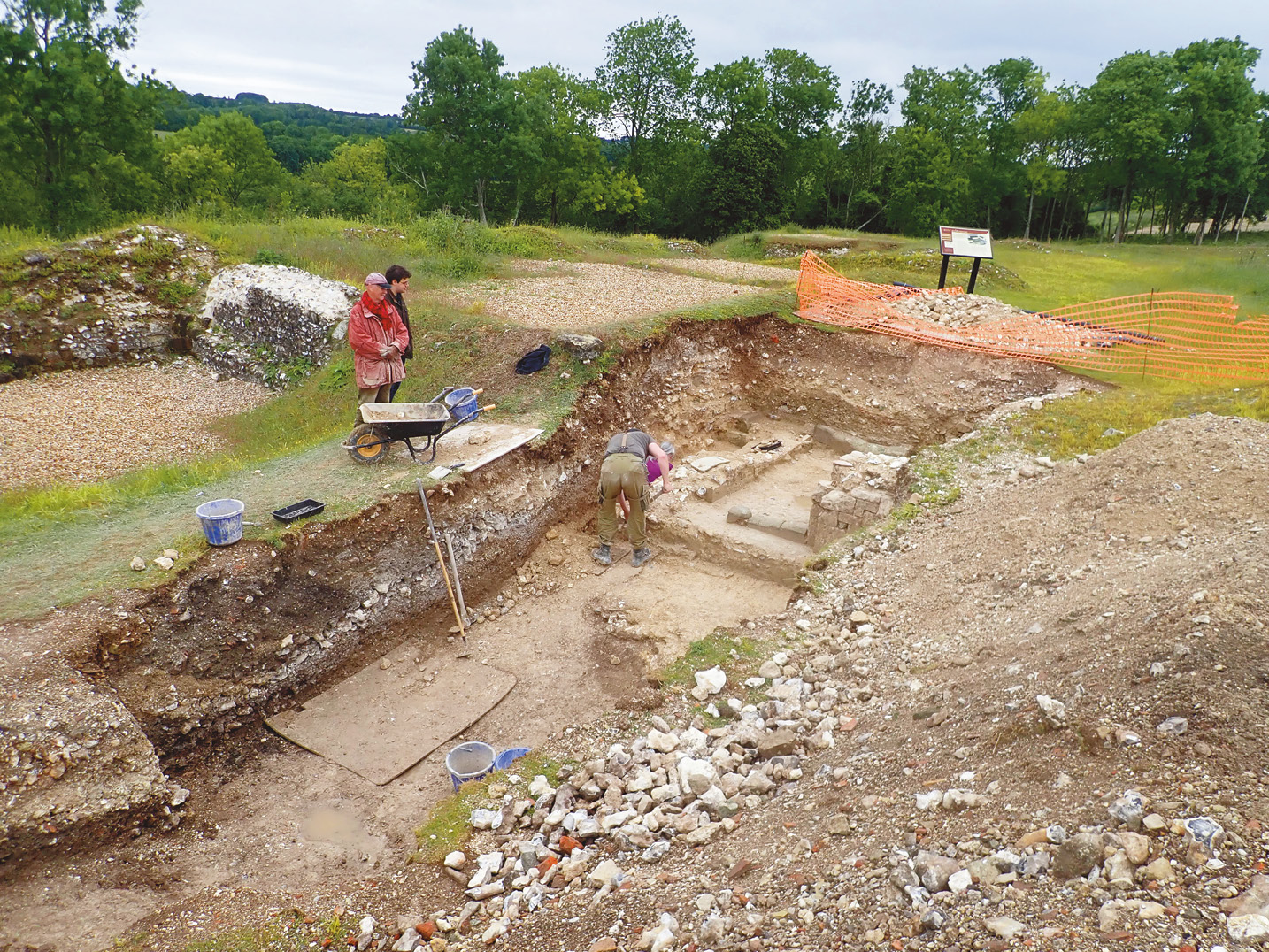
Moving from sacred sites to more worldly pursuits, Clarendon Palace, near Salisbury in Wiltshire, was one of the most important secular buildings in medieval southern England, used as a major hunting residence from at least the 12th to 15th century. In 2019, the Friends of Clarendon Palace undertook the first modern excavations on the site, funded by the National Lottery Heritage Fund. Their investigations yielded a wealth of dating evidence, including the site’s first environmental evidence and securely recorded stratigraphic sequences. Charred hazelnut shell taken from the earliest excavated context on the site – at the base of a succession of building and demolition layers found alongside the edge of the 12th-century Great Hall – yielded a date of AD 988-1162, which places it firmly in the first phases of work at the site. Meanwhile, charcoal from a layer underneath a covered walkway linking the corner of the Great Hall to another building to the south-east produced a date of AD 1282-1397, suggesting that the walkway had been created reasonably late in the sequence of major work at the Palace.

Human remains, human stories
The CARD Fund has also helped to support the Wendens Ambo Society, who are carrying out an ongoing programme of osteoarchaeological examination of human skeletal remains, and selected isotope analysis, for its ‘Lost Church of Wenden Parva Project’ (see CA 405). Their grant was used to obtain a radiocarbon date for a sample of human bone from a grave within the church, located near to the altar; this produced a result of of AD 1485-1655.

The final initiative helped during the 2023 funding cycle was the Friargate Community Archaeology Project (FCAP), which since 2012 has been investigating the grounds of a Quaker Meeting House that was built on the site of a medieval Franciscan Friary close to the River Ouse in central York. In 1983, during modernisation of the Meeting House, builders found and rapidly reburied a modest assemblage of human bones. FCAP volunteers re-excavated this charnel deposit in 2012, and have been studying the bones and other evidence from the site ever since. The influential early Quaker George Fox was expelled from York Minster in 1651, and a small Quaker community was established in the city soon after, with their first Meeting House and burial ground created by the Nightingale family, who owned property and lived on the street now known as Friargate. The use of the site as a cemetery was short-lived (1661-1667), but burial records at the Brotherton Library in Leeds indicate that several Nightingale family-members were interred in the garden; there is also reference to a ‘planter’. Many of the bones studied by the project come from an adult female, but some have been identified as those of an Afro-Caribbean adult male, and a sample was radiocarbon dated to AD 1495-1797. It is therefore thought that the remains could be from members of the Nightingale household.
To mark the CARD Fund reaching its recent milestone, a seminar on ‘The Archaeology of Britain in 100 (Radiocarbon) Dates’ will be taking place on Saturday 16 November at the University of York. The event is open to the public and will discuss current developments in radiocarbon dating and celebrate the achievements of the Fund. Contributors include Dr Clive Waddington (Archaeological Research Services Ltd), Professor Derek Hamilton (Professor of Archaeological Science at SUERC), and Dr Alex Bayliss (Head of Scientific Dating at Historic England). For more information about the seminar, and how to apply to the 2024 funding round, see http://www.cardfund.org – volunteer and community groups are warmly invited to apply for grants before the closing date of 30 November.
Source: Emma Aitken is Senior Palaeoenvironmental Officer at Archaeological Research Services Ltd.
All images: courtesy of Archaeological Research Services Ltd