
Subscribe now for full access and no adverts
A collection of large cannons from the American Revolutionary War has returned to Savannah, Georgia, after several years of conservation work, as part of a project led by the US Army Corps of Engineers and the Coastal Heritage Society.
The cannons were discovered at the bottom of the Savannah River in 2021 during an Army Corps project to deepen Savannah’s shipping channel (see MHM 127, April/May 2022). Over the following year, a total of 19 cannons were recovered from this location. Researchers suspect that they were sunk in the days leading up to the Siege of Savannah in autumn 1779, when the British – who controlled the city at the time – scuttled at least six ships in the river downstream of the city to block the path of French vessels aiding the colonists’ planned attack on Savannah.
After being lifted from the river 240 years later, two of the cannons were immediately placed on public display, while the remaining 17 were sent to Texas A&M University for cleaning and preservation in a specialist conservation lab. On examination, most of the cannons were packed with cannonballs and gunpowder charges, with the plugs sealing their bores still in place. These wooden plugs have been radiocarbon-dated to the 1700s.
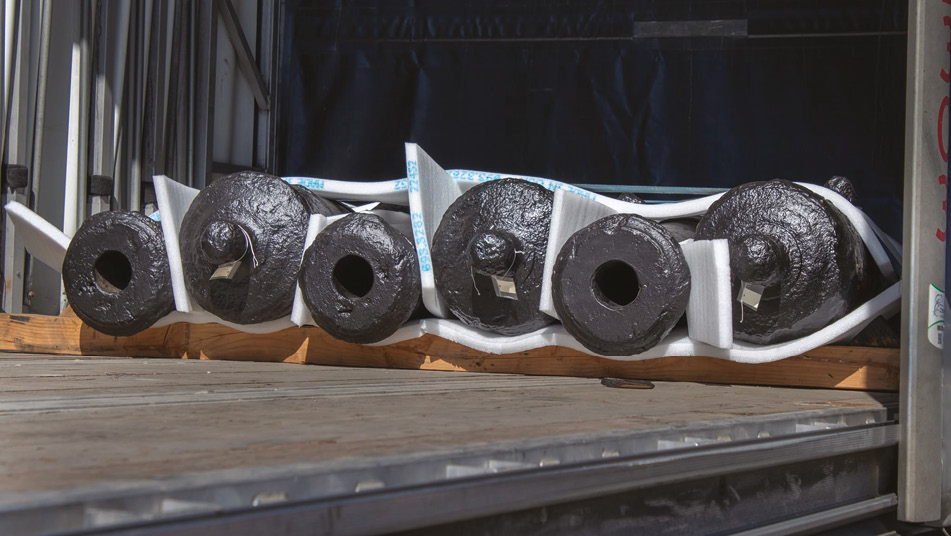
Research indicates that three of the guns were probably made by the British military, while the others appear to be of French design, and may have been cast in America around the time of the conflict.
Following painstaking cleaning, the cannons were coated in wax and paint to protect them for the future and leave them looking ‘brand new’. Then they were driven back to the Savannah History Museum, where custom mounts had been created, described as resembling ‘giant wine racks’, to display the cannons, each of which weighs up to 1,500lbs. They will form part of the museum’s new exhibition Loyalists and Liberty: Savannah in the American Revolution.
Text: Amy Brunskill / Image: Coastal Heritage Society Georgia