The last charge: The Battle of Mars-la-Tour and Von Bredow’s ‘Death Ride’, 16 August 1870

One of the crucial battles of the Franco-Prussian War was also the scene of perhaps the last successful cavalry charge in Western European warfare, as William E Welsh explains.
Start
This article is from Military History Matters issue 138


Subscribe now for full access and no adverts

On the morning of 16 August 1870, hundreds of French cuirassiers were eating breakfast and grooming their horses when Prussian artillery shells slammed into the midst of their camp on the escarpment west of the city of Metz. Four batteries of Prussian six-pounders had unlimbered at mid-morning on the heights south of Vionville, three miles east of the village of Mars-la-Tour, and began a furious fire on the French horsemen.

The Prussian gunners had sighted their cannon by aiming at the reflection of the sun on the French cavalry’s silver cutlery and goblets, as well as at the colourful tablecloths of their mess. The percussion-fused shells exploded on contact, and with deadly accuracy.

The startled cuirassiers mounted up and rode east to escape the crashing shells. Having reached the safety of the French II Infantry Corps, their officers rallied them, and the heavy cavalrymen formed up in their respective squadrons to await the enemy’s imminent advance.
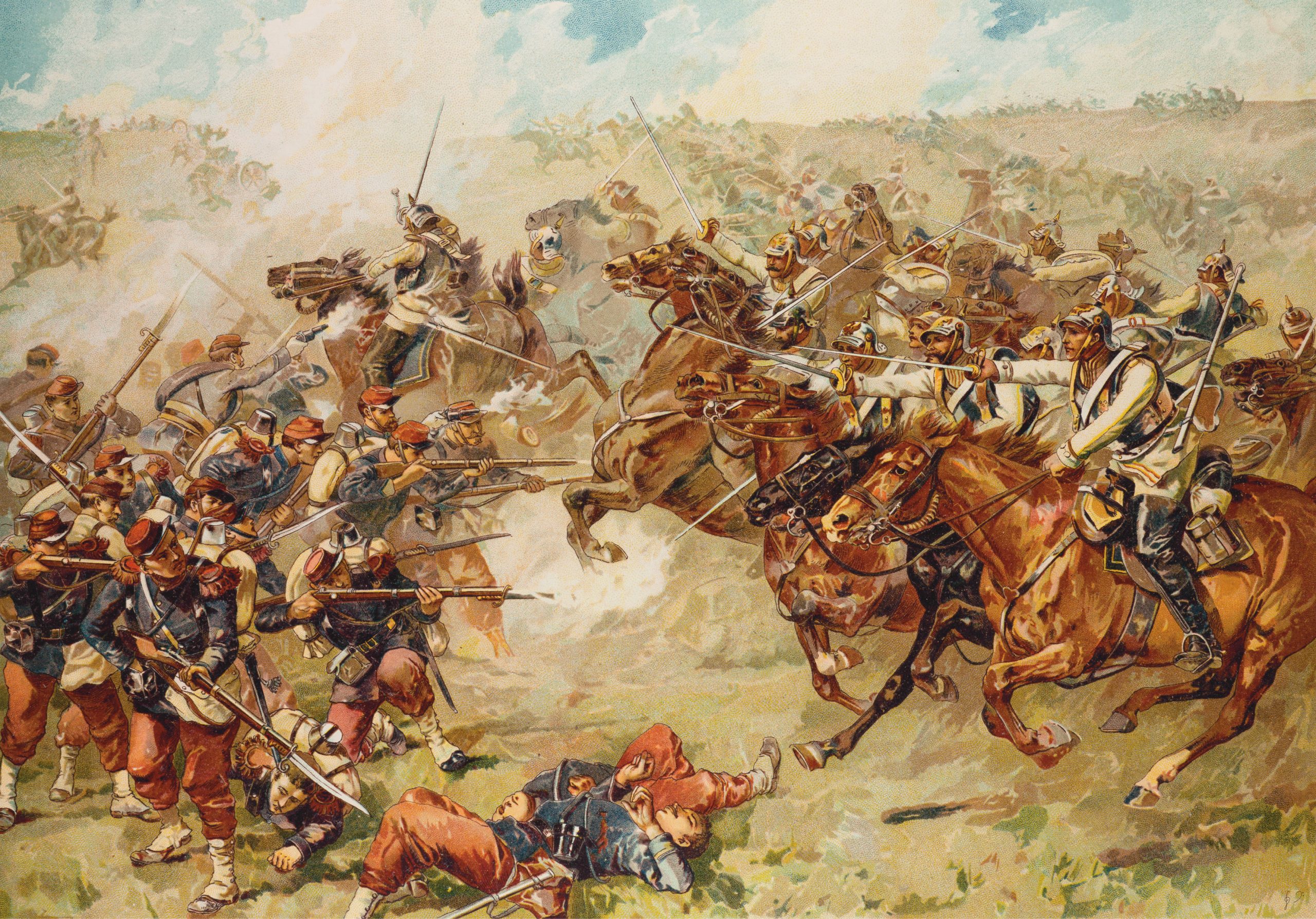
Von Bredow’s ‘Death Ride’: taking advantage of a depression in the rolling terrain, General Adalbert von Bredow led his white-coated Prussian cuirassiers in a successful headlong charge against massed French artillery. Image: Alamy

Prussian victories

After Prussia had defeated Austria in seven weeks in 1866, Prussian Minister-President Otto von Bismarck established a new confederation of North German states – but Bismarck needed a war with France to bring the more independent South German states into a united Germany.

The French emperor Napoleon III duly played into Bismarck’s hands by declaring war on Prussia on 19 July 1870. The nephew of Napoleon Bonaparte, he had solidified French supremacy on the Continent through France’s successful participation with Great Britain in the Crimean War (1853-1856), as well as by achieving victory over Habsburg Austria in northern Italy in 1859. Acutely aware of the threat that Prussia posed to French hegemony, he set about modernising French weaponry in the 1860s – overseeing the development of the breech-loading Chassepot rifle, which had twice the range of the Prussian Dreyse ‘needle-gun’ (so-called because of the shape of its firing pin), and the production of the mitrailleuse multi-barrelled volley gun (an early form of machine-gun).

Though he lacked formal military training, the 62-year-old emperor decided to lead France’s newly created Army of the Rhine in defending the north-eastern frontier of Alsace-Lorraine against the Prussians. In a series of small, but sharp battles, fought during the first week of August 1870, the Prussians defeated the French at Spicheren, Wörth, and Wissembourg.

Afterwards, the eight French corps that made up the Army of the Rhine retreated west in two different directions. Napoleon III and his subordinate Marshal François Bazaine fell back with the II, III, IV, VI, and Imperial Guard to the fortress of Metz, on the Moselle River, while Marshal Patrice de MacMahon led the I, V, and VII, stationed in Alsace, on a much longer retreat to the city of Châlons-sur-Marne, 100 miles east of Paris. Napoleon III intended to reassemble the five northernmost corps in Metz, from where they would march to Châlons-sur-Marne via the fortified city of Verdun.
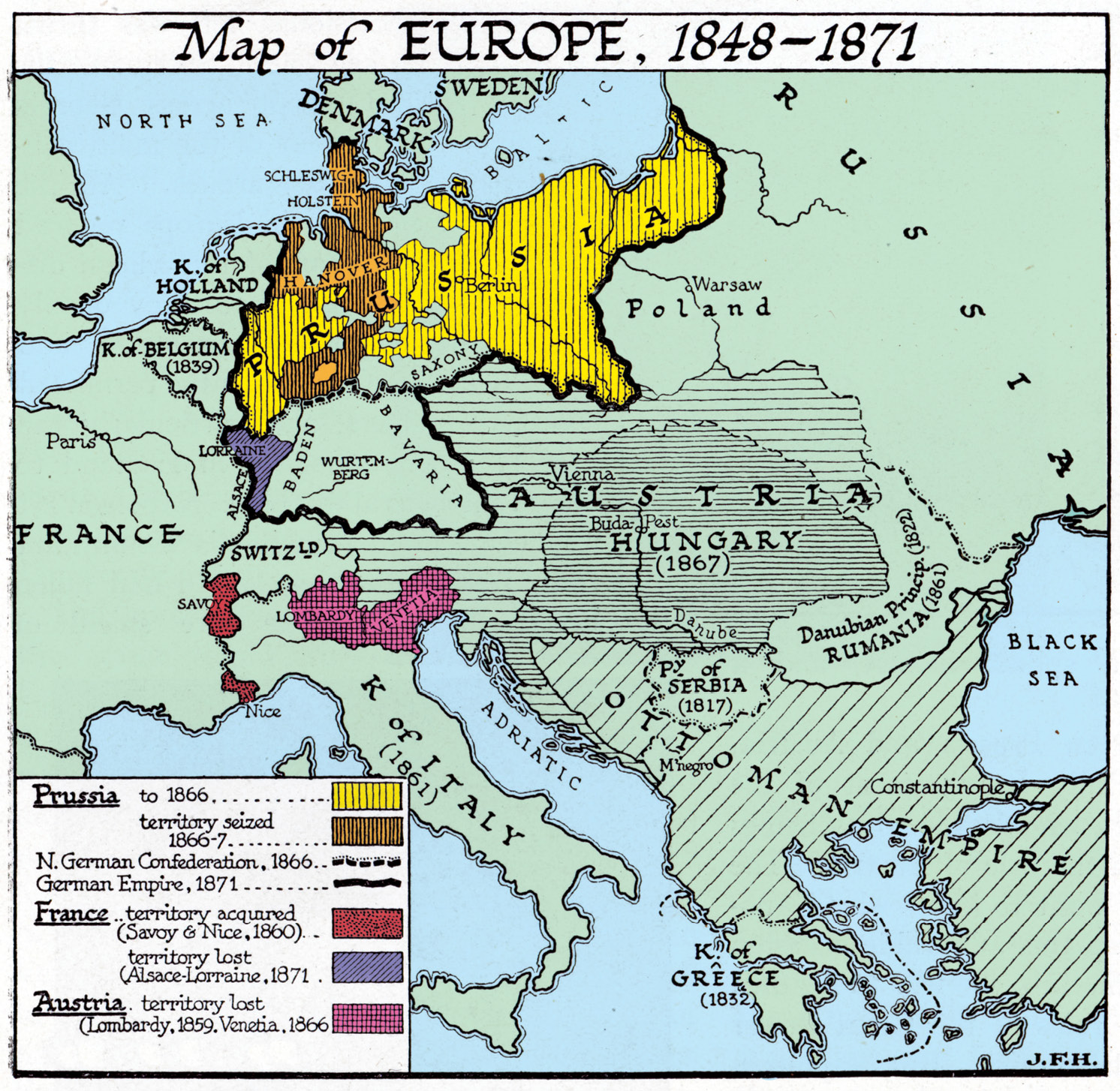
Europe was remade between 1864 and 1871 as Prussia’s leading minister, Otto von Bismarck, welded the 39 separate states of Germany into a single nation-state under Prussian hegemony.

Changing command

For more than a decade, Prussian chief of staff Helmuth von Moltke had laboured over plans for an invasion of France. As war drew ever closer in the late 1860s, he sought first-hand intelligence of enemy defences, sending officers clad in civilian clothing into France to study frontier forts and to map Alsace and Lorraine. Using this intelligence, Moltke completed his invasion plan in 1869. Having drawn up timetables for Prussia’s mobilisation, he intended next personally to oversee the daily operations of the three Prussian armies once the invasion began.

After their victories in the war’s opening battles on the frontier, Moltke directed the commanders of the three Prussian armies to swing south around Metz, thereby bypassing the city’s ring of forts. The largest of the three armies, the 134,000-strong Second Army under Prussia’s Prince Frederick Charles, posed the greatest threat to Bazaine. It comprised six infantry corps (III, IV, IX, X, XII, and Guards) and three divisions of cavalry, and the Prussian royal headquarters marched with it. Moltke learned from mounted patrols that the French Army of the Rhine had split into two wings, and he intended to intercept the left wing withdrawing to Metz.

Realising that he lacked the skill and stamina to direct his forces in person following the debacle on the French frontier, Napoleon III gave command of the five corps converging on Metz to Bazaine on 12 August. The French marshal, however, had never commanded a field army. The emperor also did Bazaine a disservice by lingering in the area for four more days, during which time he undermined his commander’s authority by continuing to issue orders to some units.

François Achille Bazaine (1811-1888), commander-in-chief of France’s Army of the Rhine. Like that of most French generals during the Franco-Prussian War, his performance was lacklustre
Helmuth von Moltke (1800-1891), chief of the Prussian General Staff.  He was, with Prussian premier Otto von Bismarck,  the joint architect of German unification. 

Slow retreat

On 14 August, Prussia’s 5th Cavalry Division, composed of three brigades totalling 5,145 horsemen, began crossing the Moselle at Point-à-Mousson, 30 kilometres south of Metz. Its commander, General Albert von Rheinbaben, had orders to scout north-west towards Mars-la-Tour in search of the French army.

The vanguard of the Second Army – General Constantin von Alvensleben’s III Corps, General Albrecht Gustav von Manstein’s IX Corps, and General Konstantin von Voigts-Rhetz’s X Corps – began crossing the wide river the following afternoon. Alvensleben’s corps, which crossed at Novéant, anchored the Second Army’s extreme right flank. His north-westerly march would put him in contact the following day with Bazaine’s vanguard, bivouacked just a few miles away at Gravelotte.

On 15 August, the rearguard of Bazaine’s army was still making its way through Metz. It was an agonisingly slow passage, given that the French had to move 160,000 troops, 350 cannon and mitrailleuse, and 40,000 supply wagons through the narrow streets of the old city.

At the head of the French army, General Marquis de Forton’s 3rd Reserve Cavalry Division had advanced four miles beyond Gravelotte to Vionville. Lacking much guidance from Bazaine, Forton did not send patrols south of the Verdun road in search of the Prussians. Bivouacked behind his cuirassiers and dragoons were General Charles Frossard’s II Corps and General François Certain de Canrobert’s VI Corps.

That morning, Prussian hussars and French dragoons clashed briefly near the village of Mars-la-Tour, a few miles west of Vionville. The hussars belonged to General Hermann von Redern’s 13th Cavalry Brigade. Redern reported up the chain of command that the road east of Vionville was packed with French troops.

French infantry firing the superb Chassepot breech-loading rifle, which had twice the effective range of the outmoded Prussian Dreyse ‘needle-gun’.

Bloody repulse

Napoleon III departed from Gravelotte for Verdun at dawn on 16 August. As he climbed into his carriage, the French emperor instructed Bazaine to set out with his army for Verdun as quickly as possible. Bazaine had planned to set out that very day, but when he learned that the French IV Corps at the rear of the army was still in Metz, and needed another day to catch up, he suspended the marching orders he had issued the previous night.

Prussian batteries unlimbered at mid-morning and began shelling the French cavalry. A short time later, General Ferdinand von Stülpnagel’s 5th Division, consisting of the 9th and 10th Infantry Brigades from Brandenburg, of Alvensleben’s III Corps, arrived on the high ground south of the Verdun road. The Brandenburgers, who possessed an esprit de corps second only to the Prussian Guard, streamed north across the open ground to engage the French. The soldiers of General Charles Verge’s 1st Division of the French II Corps, which was positioned along the Verdun Road between Vionville and Rezonville, shattered the attack of the Prussian 10th Brigade with their Chassepot rifles. General Gustav von Buddenbrock’s 6th Division went into action on Stülpnagel’s left. Undaunted by the tempest of French rifle-fire, these Brandenburgers captured Vionville.

Meanwhile, Alvensleben continued to strengthen his line of artillery on the ridge south-west of the nearby settlement of Flavigny. The Prussian III Corps had 90 guns hurling explosive shells with great accuracy at the French by midday. Although the guns of the French II and VI Corps attempted to counter the Prussian guns, many of the French shells failed to explode owing to defective fuses. Alvensleben believed that he had engaged the French rearguard – because the Prussian high command had incorrectly assumed that the majority of Bazaine’s troops were already well on their way to Verdun.

Forced march

Frossard, finding that the Prussians had turned his right flank, resorted to a desperate measure. At 12.30pm, he ordered the Cuirassiers of the Guard and the 3rd Lancers to charge the Prussian infantry near Flavigny. The lancers turned away before reaching the Prussian line, but the cuirassiers charged home. Prussian rifle- and artillery-fire left the ground carpeted with dead and dying horses and men. The costly charge had accomplished nothing.

Meanwhile, the 19th and 20th Divisions of General Konstantin von Voigts-Rhetz’s X Corps, which in accordance with their original orders were bound for points west of Mars-la-Tour, received new orders to turn east. These divisions were composed of so-called ‘new Prussians’ from Brunswick, Frisia, Hanover, and Westphalia.

The French began extending their line west in the early afternoon. Canrobert’s VI Corps deployed to the west of Frossard’s corps. By marching north-west along the Doncourt road from Gravelotte, the French III and IV Corps both deployed for battle north-east of Mars-la-Tour at mid-afternoon.

Bazaine had no idea of the extent of the Prussian threat – because his cavalry had failed to reconnoitre south of the Verdun road the previous day. Although he might have committed two infantry divisions of the Imperial Guard corps in a counter-attack earlier that day against Alvensleben’s Brandenburgers to reopen the Verdun road, he held them back to protect the strategic crossroads at Gravelotte.

The crank-operated early machine-gun known as the mitrailleuse (from the French for ‘grapeshot’), which also helped give the French infantry a marked advantage over their Prussian opponents.

Von Bredow’s ‘Death Ride’

His infantry corps having suffered heavy casualties, Alvensleben looked around for a Prussian cavalry unit that could disrupt Canrobert’s VI Corps artillery, which was pummelling his left flank. Having located the 12th Cavalry Brigade, he ordered its commander, General Adalbert von Bredow, to charge the enemy.

Knowing that his heavy cavalry would most likely suffer grievous losses in such an attack, Bredow delayed his advance for as long as possible, hoping for the arrival of the Prussian X Corps. But when it had still not arrived at 2pm, he decided to proceed with the attack. ‘It will cost what it will,’ he said to his officers, as he ordered forward six squadrons of the 7th Cuirassiers and 16th Uhlans.

Advancing from a position behind Vionville, Bredow’s horsemen thundered north across the Verdun road, and then turned east towards Canrobert’s gun line. With a keen eye for terrain, Bredow led his troopers through a depression in the landscape that partially shielded them from the storm of enemy canister- and mitrailleuse-fire that raked them as they raced towards their objective.

On reaching the guns, the Prussian cuirassiers and uhlans (light cavalry) butchered many of their crews. Once through the line, the Prussian horsemen continued deep into the rear of the VI Corps, sowing panic among the sea of supply wagons before eventually returning to their own lines. Bredow lost 420 of his 800 troopers in an event that became known to history as Von Bredow’s ‘Death Ride’ – described by the historian Michael Howard as ‘perhaps the last successful cavalry charge in Western European warfare’ (see ‘Shock Tactics’ box opposite). ‘All our battery horses were dead, and we were about to be overrun when Bredow’s cavalry flashed by,’ a Hanoverian gunner later said. ‘They saved the day because our brigade was beaten.’

A vintage map showing the position of the two armies at around 4pm on the battlefield of Mars-la-Tour, about 20 miles east of Metz, in north-eastern France.

Charge of the Guard Dragoons

The 19th and 20th Divisions of Voigts-Retz’s X Corps arrived on the field at 3.30pm after a 12-hour forced march over chalky roads under the blazing August sun. General Alexander von Kraatz-Koschlau’s 20th Division deployed for battle at Tronville, south-east of Mars-la-Tour, while General Emil Schwartzkoppen’s 19th Division deployed in company column a short distance to their west.

General Georg von Wedell’s 4,600 Westphalians of the 38th Brigade, one of the two brigades in Schwartzkoppen’s Division, launched a headlong assault against General Louis René Paul de Ladmirault’s position, but their attack floundered in a ravine in the face of withering fire from General François Grenier’s 2nd Division of Ladmirault’s Corps. As with many Prussian infantry assaults that day, the French Chassepots decimated them before they could bring their inferior Dreyse guns to bear on the enemy. The 20th Division, which advanced across the Verdun Road to the Tronville woods, escaped the slaughter.

At that point, Voigts-Retz experienced the same feelings of dread that had gripped Alvensleben when his infantry had suffered heavy casualties earlier that afternoon. At 5.30pm, fearing that Schwartzkoppen’s division would not be able to keep the French from capturing Mars-la-Tour, he ordered the 1st and 2nd Regiments of the Dragoon Guards to counter-attack the French infantry cautiously advancing toward Mars-la-Tour. The dragoons belonged to the 3rd Guards Cavalry Brigade that had been sent ahead of the infantry of the Guards Corps.

The Brandenburg dragoons, large men on sturdy mounts, caught the French soldiers at a disadvantage in the same ravine where Wedell’s riflemen had been shot to pieces a short time before. The 600 dragoons barrelled into the front ranks of Grenier’s hesitant infantry, slashing right and left with their razor-sharp sabres. Although they lost half their number, the valiant cavalrymen halted Ladmirault’s troops short of Mars-la-Tour.

Artillery superiority

General Albrecht von Manstein, who also was hurrying his IX Corps to the battlefield as fast as possible, had sent his artillery batteries ahead to reinforce the two Prussian corps already engaged. This enabled the Prussians to have as many as 210 guns in action by late afternoon.

By that point, Bazaine’s troops were running low on ammunition. The only way to replenish their supplies the following day would be to tap the magazines in Metz. Bazaine feared that the Prussians might actually turn his left flank at Gravelotte, and cut him off from Metz. For this reason, he ordered Edmond Leboeuf’s III Corps to counter-march to Gravelotte.

A painting by the 19th-century German artist Emil Hünten depicts Prussian Dragoon Guards stampeding French infantry to the north-east of the village of Mars-la-Tour in the late afternoon.

At 6.30pm, the fighting flared up again at opposite ends of the battlefield. At the western end, General Paul von Rheinbaben led his hussars, uhlans, dragoons, and cuirassiers in a fresh attack against Ladmirault’s IV Corps. But before they could reach the French infantry, the chasseurs, cuirassiers, and dragoons of General François du Barail’s 6th Cavalry Division intercepted them. A swirling cavalry melee unfolded over the next half-hour on the grassland between the Yron and Cuve streams north of Mars-la-Tour that involved 40 squadrons of cavalry. The cavalry clash, however, changed nothing.

Meanwhile, Manstein’s IX Corps from the Second Army arrived from the south and deployed against Bazaine’s left flank between Rezonville and Gravelotte, as did the VIII Corps from General Karl Steinmetz’s Prussian First Army. Prince Frederick Charles, who had arrived on the field in the late afternoon, sent Manstein’s troops into action shortly after 7pm. Although they launched a determined attack in the gloaming, they failed to dent the French line; and by 9pm, the battle was finally over, after 12 hours of bloody fighting.

Napoleon III surrendering to Prussia’s King William I in September 1870, following the Battle of Sedan. 

French hesitancy leads to final defeat

Bazaine’s excessive caution at Mars-la-Tour allowed the Prussians to retain the initiative for most of the day, despite being heavily outnumbered. Alvensleben’s bold attack, combined with spoiling attacks by the Prussian cavalry, succeeded not only in cutting the Verdun Road, but also holding it in the face of piecemeal French counter-attacks until substantial reinforcements arrived at the end of the day.

Owing to technological advances in rifled artillery and breech-loading rifles, both sides suffered heavy casualties. The Prussians suffered 16,000 killed and wounded compared to 17,000 French casualties. The Prussians, though, could more easily absorb such losses in this and the battles that followed that autumn, because they received a steady stream of reinforcements from Germany that replenished their ranks.

A Prussian military parade in Paris after the capitulation of France.

Though both sides claimed success, Mars-la-Tour was a significant tactical victory for the Prussians. Two days later, they followed it up 10 kilometres to the east with a major strategic victory at Gravelotte- St Privat (see MHM 119), the largest battle of the Franco-Prussian War. In its aftermath, Bazaine gave up all hope of fighting his way out of Metz and retreating west to Verdun.

In the weeks that followed, one disaster followed another for the French. Napoleon III and more than 100,000 men of the Army of Châlons surrendered to the Prussians following the Battle of Sedan on 2 September, and Bazaine himself finally surrendered on 27 October. In a little over five months, the Prussians had destroyed France’s field armies. A new government, the Third Republic, defended Paris for as long as possible – but, after a four-month siege of the French capital, the war ended in January 1871 in a Prussian victory that would pave the way for German unification and the creation of the German Empire. As such, the Franco-Prussian War would have terrible repercussions that would reshape the world in the century to come.


Shock tactics: cavalry charges that shook the world

From the 7th century AD, European horsemen began using the iron stirrup, which melded horse and rider into a true shock weapon by putting their combined weight at a gallop behind their lance or sword. For more than a thousand years, the cavalry charge would remain a potent weapon of war – until 16 August 1870, when Von Bredow’s ‘Death Ride’ and the charge of the Prussian Guards Dragoon at the Battle of Mars-la-Tour (see accompanying feature) became perhaps the last in the long line of successful shock charges by medium and heavy cavalry. In the decades after the battle, military theorists would argue that Mars-la-Tour proved cavalry charges could still win battles – but advances in weaponry would reveal ever more conclusively that such tactics had finally had their day.

Here, William E Welsh selects four actions down the centuries that reveal how shock cavalry attacks could successfully reverse the tide of battle.

One of the key engagements of the Crusades, the Battle of Montgisard is also one of the best examples of a successful shock charge. It took place just inside the Kingdom of Jerusalem in 1177, when King Baldwin IV’s Frankish host caught Ayyubid Sultan Saladin’s rampaging army by surprise near the city of Ramla. Charging in two ranks, 600 mounted knights and sergeants smashed through a hastily organised defence to engage the sultan’s Mamluk guard, who fought to the death to buy time as Saladin fled the battlefield. According to chronicler William of Tyre, ‘Saladin’s lines were broken and, after a terrible slaughter, were forced to flee’.

European states employed various types of cavalry – cuirassiers, dragoons, lancers, uhlans, and hussars – in the dynastic wars of the 17th and 18th centuries. Dragoons, functioning as line cavalry by Napoleonic times, often accompanied cuirassiers (named for the armoured ‘cuirass’ that covered their torsos) in all-out charges. Typically, the attacking cavalry squadrons advanced at a walk or trot before galloping when they closed to within 200 paces of the enemy. One of the boldest strokes by a cavalry force occurred during the Battle of Vienna, on 12 September 1683, when Polish King John Sobieski unleashed an attack to relieve the Austrian capital, which had been besieged by the Ottoman Empire for two months. Descending from the heights north of the city, 3,000 Polish winged hussars spearheaded a charge that struck Ottoman troops unprotected by field works. Fifteen thousand Polish, Austrian, and German troops exploited the initial attack. Having suffered grievous losses, the Turks withdrew.

An attack of similar scale occurred during the Battle of Eylau, as Emperor Napoleon sought to complete his conquest of Prussia on 7-8 February 1807. Marshal Joachim Murat led five cavalry divisions – 10,700 cuirassiers and dragoons – against the Russian centre at Eylau, south of Kaliningrad. Advancing through the snow, the French horsemen fought their way through two lines of infantry and turned back to carve up a 70-gun battery. The attack saved the French centre from collapse and bought time for the arrival of French reinforcements.

The charge of two brigades of British cavalry at the Battle of Waterloo on 18 June 1815 closely mirrors the tactics of the two successful Prussian cavalry charges at Mars-la-Tour. When Marshal Jean-Baptiste d’Erlon’s 19,000-strong French I Corps threatened the Allied left-centre in the early afternoon, the Earl of Uxbridge led 2,500 heavy cavalry of the 1st Household Cavalry Brigade and 2nd Union Cavalry Brigade in an attack that smashed Erlon’s corps. The British horsemen continued across the field, where they carved up a French artillery position. The attack bought time for Prussian reinforcements to draw closer to the battlefield.

Lady Butler’s iconic 1881 painting Scotland Forever! depicts the charge of the Royal Scots Greys  at the Battle of Waterloo, 18 June 1815. 

Further Reading:
• David Ascoli, A Day of Battle:  Mars-La-Tour, 16 August 1870  (Birlinn, 1987).
• Michael Howard, The Franco- Prussian War: the German  invasion of France, 1870-1871 (Routledge, 1961).
• Geoffrey Wawro, The Franco-Prussian War: the German conquest of  France in 1870-1871 (Cambridge University Press, 2003). 

All images: Wikimedia Commons, unless otherwise stated

By Country

Popular
UKItalyGreeceEgyptTurkeyFrance

Africa
BotswanaEgyptEthiopiaGhanaKenyaLibyaMadagascarMaliMoroccoNamibiaSomaliaSouth AfricaSudanTanzaniaTunisiaZimbabwe

Asia
IranIraqIsraelJapanJavaJordanKazakhstanKodiak IslandKoreaKyrgyzstan
LaosLebanonMalaysiaMongoliaOmanPakistanQatarRussiaPapua New GuineaSaudi ArabiaSingaporeSouth KoreaSumatraSyriaThailandTurkmenistanUAEUzbekistanVanuatuVietnamYemen

Australasia
AustraliaFijiMicronesiaPolynesiaTasmania

Europe
AlbaniaAndorraAustriaBulgariaCroatiaCyprusCzech RepublicDenmarkEnglandEstoniaFinlandFranceGermanyGibraltarGreeceHollandHungaryIcelandIrelandItalyMaltaNorwayPolandPortugalRomaniaScotlandSerbiaSlovakiaSloveniaSpainSwedenSwitzerlandTurkeySicilyUK

South America
ArgentinaBelizeBrazilChileColombiaEaster IslandMexicoPeru

North America
CanadaCaribbeanCarriacouDominican RepublicGreenlandGuatemalaHondurasUSA

Discover more from The Past

Subscribe now to keep reading and get access to the full archive.

Continue reading