
Subscribe now for full access and no adverts
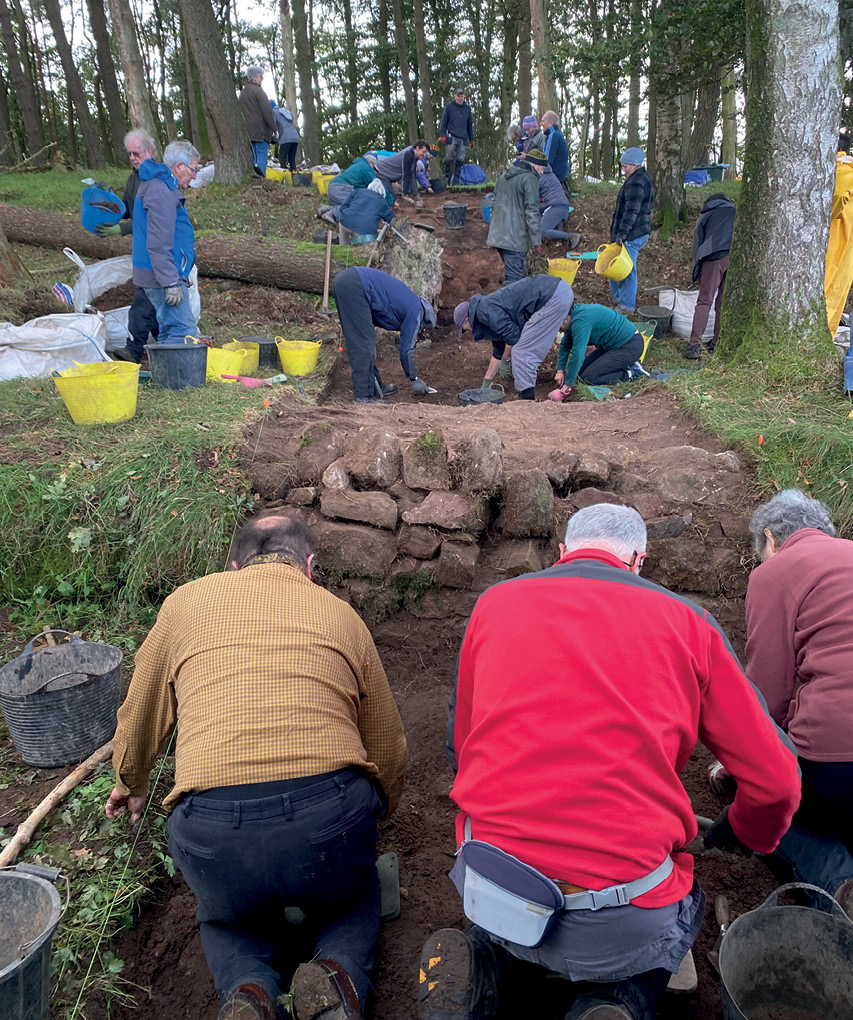
When Ken Wallace and other members of the Hallaton Fieldwork Group discovered Iron Age and Roman pottery in a field near the village of Hallaton, south-east Leicestershire, at the turn of the millennium, little did they realise that they had recovered the first pieces of what would become known as the Hallaton Treasure (see CA 188), an intriguing collection of finds that continues to captivate those who see it two decades later.
The group went on to investigate the hilltop site alongside archaeologists from University of Leicester Archaeological Services, and across three excavations the team uncovered more than 5,000 Iron Age and Roman gold and silver coins, a unique silver bowl, silver and bronze ingots, the remains of an Iron Age tankard, and animal bones representing hundreds of pigs. It was an amazing array, but the most intriguing find was a pit containing an ornately decorated Roman cavalry helmet and parts of at least three more (CA 202, 233, and 236).
In 2008, the Hallaton Treasure was acquired by Leicestershire County Council Museums (for which I am the Archaeology Curator), and an associated project was launched to learn more about its contents and to put some on public display. Grants from the National Lottery Heritage Fund, the Art Fund, the Museums and Art Galleries Improvement Fund, the MLA/V&A Purchase Grant Fund, the Headley Trust, and local funding bodies supported additional micro-excavation, conservation, and restoration work on the helmet assemblage itself, and also enabled the creation of the Hallaton Treasure Gallery at Harborough Museum in Market Harborough.
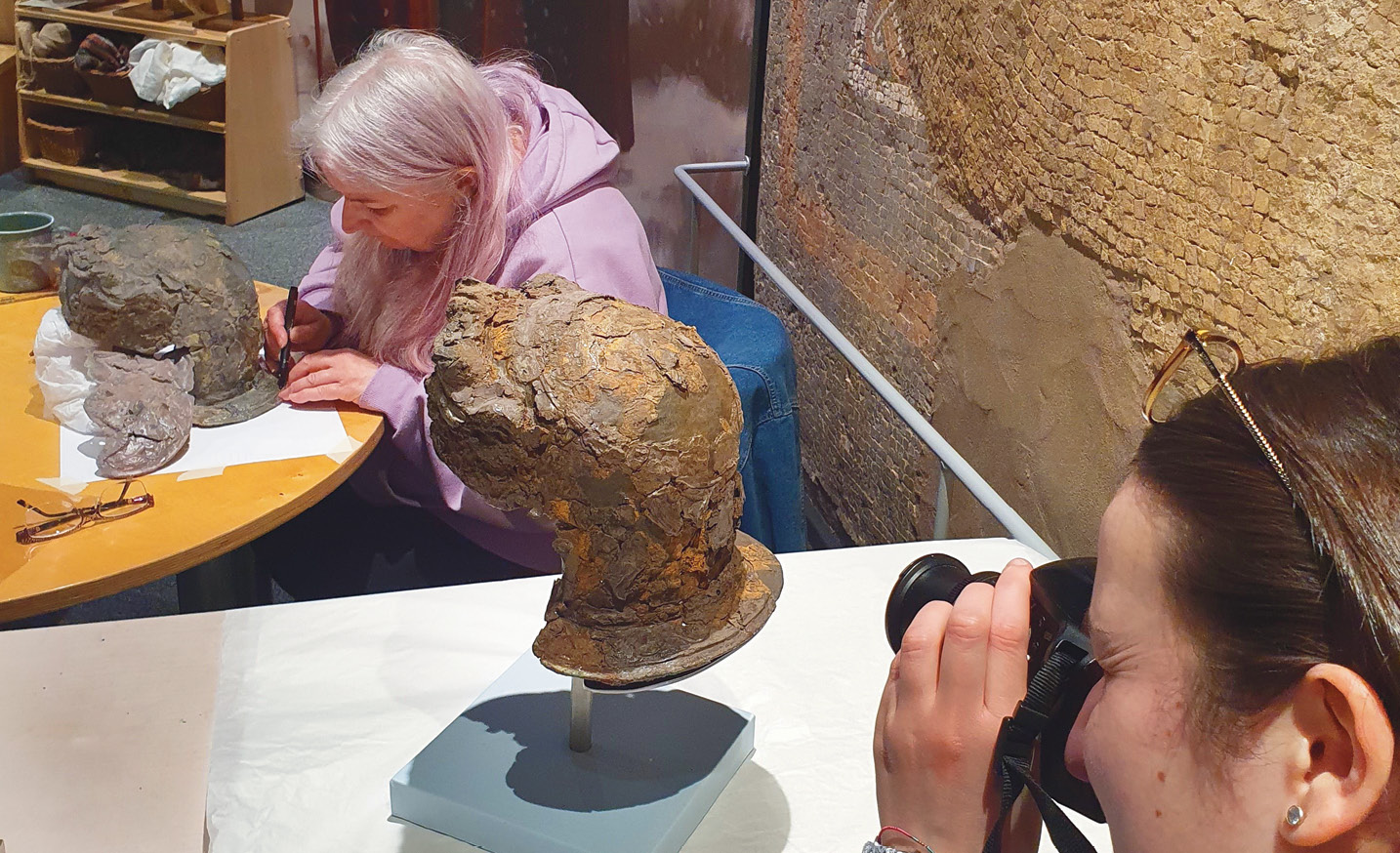
The gallery opened in 2009, and the Hallaton Helmet bowl and two cheekpieces were displayed there from January 2012 following completion of their restoration. Conservation of the remaining objects from the helmet pit was undertaken between 2017 and February 2020, allowing them to be fully analysed and prepared to join the artefacts already in the museum. Then, during the hiatus due to the COVID-19 pandemic, work began in earnest to plan how the displays at Harborough Museum could be updated.
As part of this initiative, we felt that a recreation of how we understand the helmet to have originally appeared would add greatly to public engagement with the find. While it is wonderful as an archaeological object and as an amazing example of what can be achieved through painstaking laboratory work and restoration by the conservation team, the original helmet is quite a tricky object to read for the average museum visitor, with its grey-brown coloration and tantalisingly fragmentary iconography. To allow full appreciation of the designs chosen to adorn the helmet’s surface centuries ago, and to understand what a high-status object this once was, a replica was required.
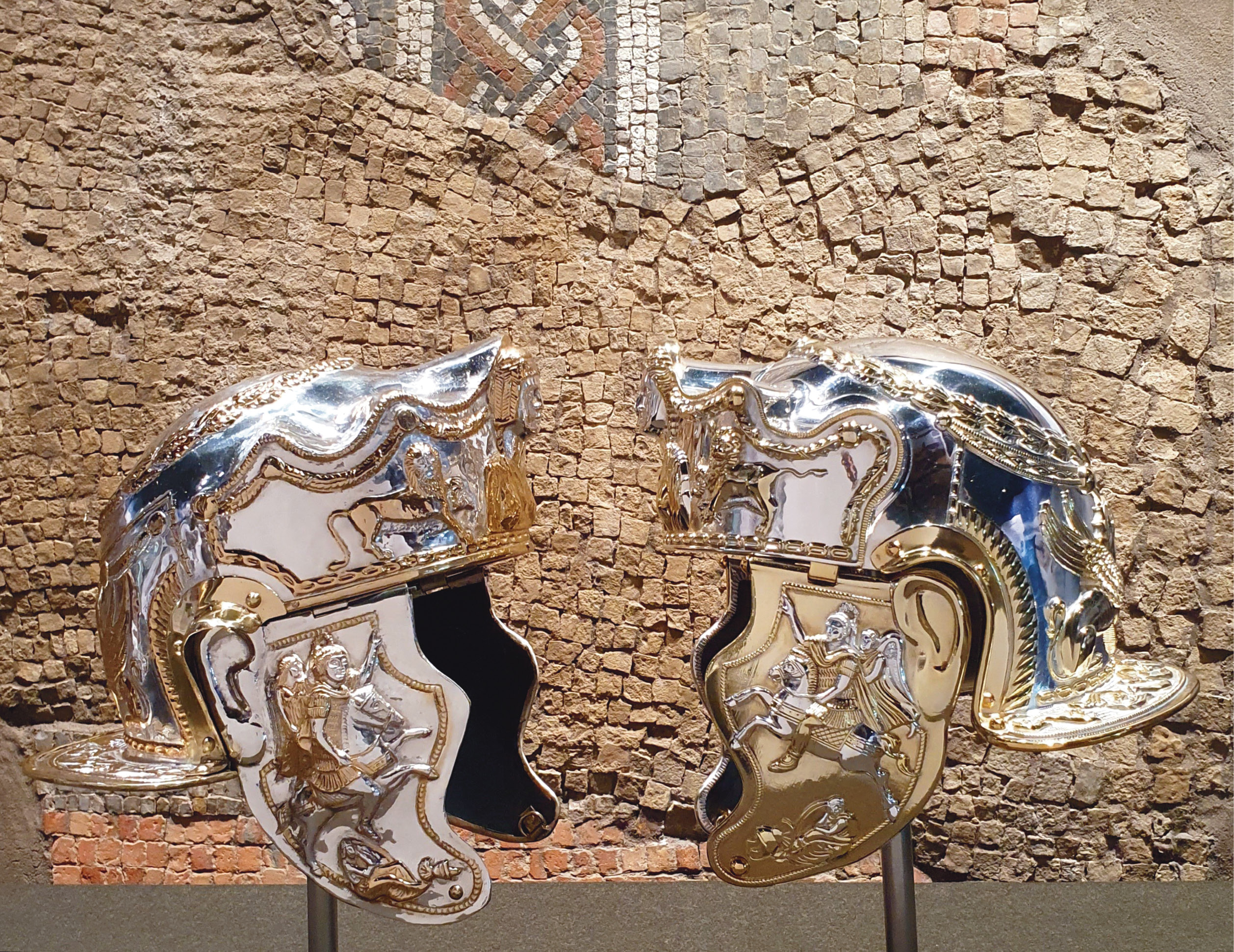
A brief was duly sent out, and a range of creative practitioners responded to the challenge. Following an interview process, two very different artists were commissioned to create their versions of the Hallaton Helmet, using modern and traditional techniques. Thanks to the extreme generosity of local organisations, there would actually be three replica helmets: one by each maker for Harborough Museum, and one for Hallaton Museum (a small, independent museum near to the findspot). The different recreations would allow variations of interpretation to be embodied in each object.
Investigating and illustrating the Hallaton Helmet
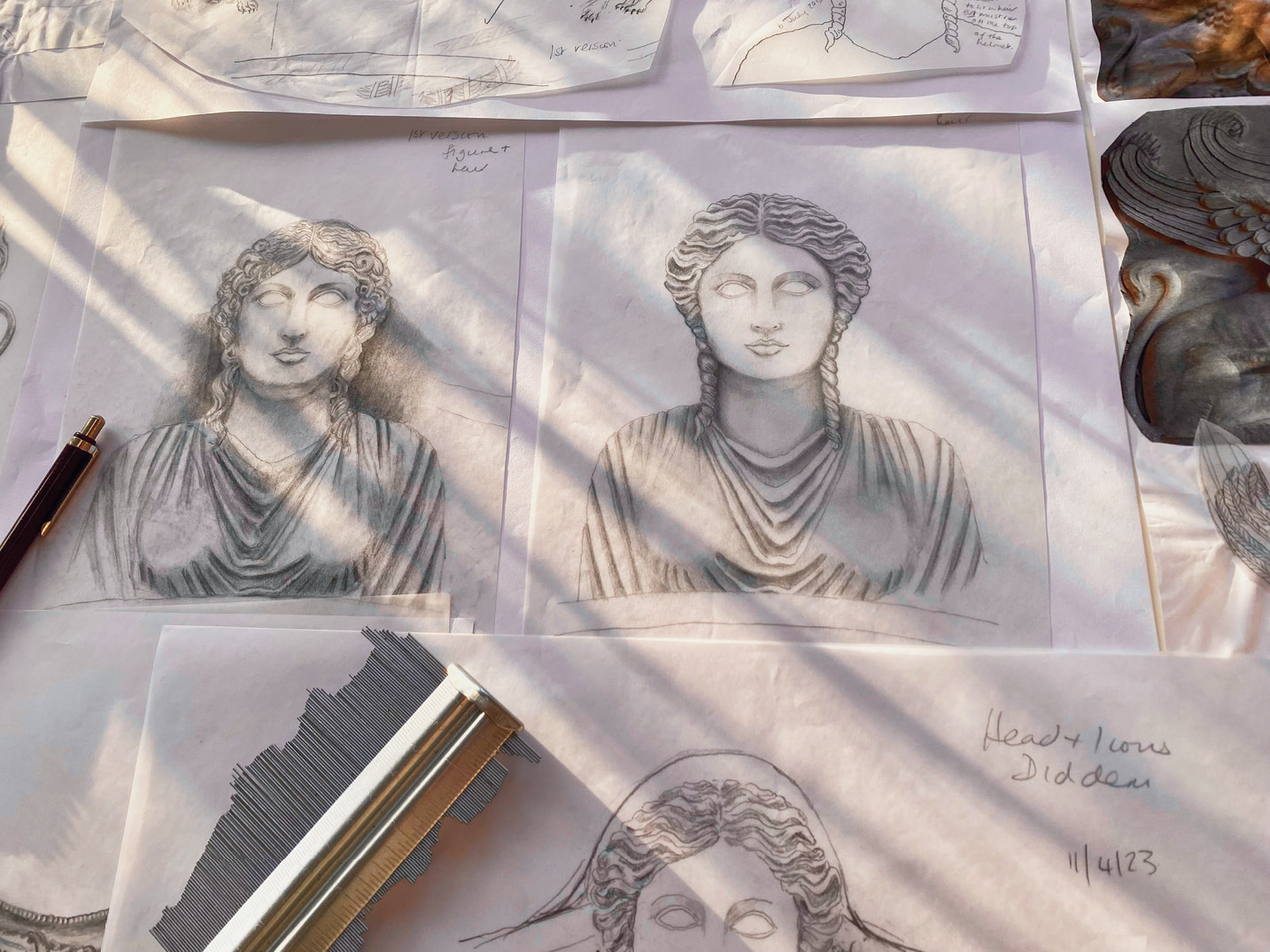
With funding in place and artists commissioned, the hard work began to complete the project within the very tight time-frame of one year. To help with this, the Leicestershire CC Museums project team commissioned new 3D scans of the helmet and associated cheekpieces by Design Futures Group, based at Sheffield Hallam University (these fully rotatable models can be seen at http://www.sketchfab.com/lcc). From these, a full-colour print was produced, which proved invaluable for the process, as it allowed close inspection and planning alongside the real helmet, but could also be taken off-site to wherever staff were working on the project – something that obviously could not be done with the original artefact. Measurements could easily be taken from the scan too, and Debbie Miles, the archaeological illustrator commissioned to assist with the project, was able to trace off the print to help with the positioning of iconography.
In order to interpret these motifs, we reanalysed the helmet’s surface using bright lights, and the artefact was also rephotographed. A fortuitous volunteer placement helped enormously with this part of the process: Teresa Porciani (now Dr Porciani), an Italian specialising in early medieval sculpture, was in the latter stages of her PhD at the University of Leicester. Her grounding in Roman art, her eye for iconographic detail, and her photography skills were perfect for the project. Meanwhile, Debbie Miles had previously produced technical drawings of the helmet cheekpieces, so she was already familiar with the collection – although producing reconstruction drawings estimating the object’s original appearance required a very different approach, which was a new challenge for her.
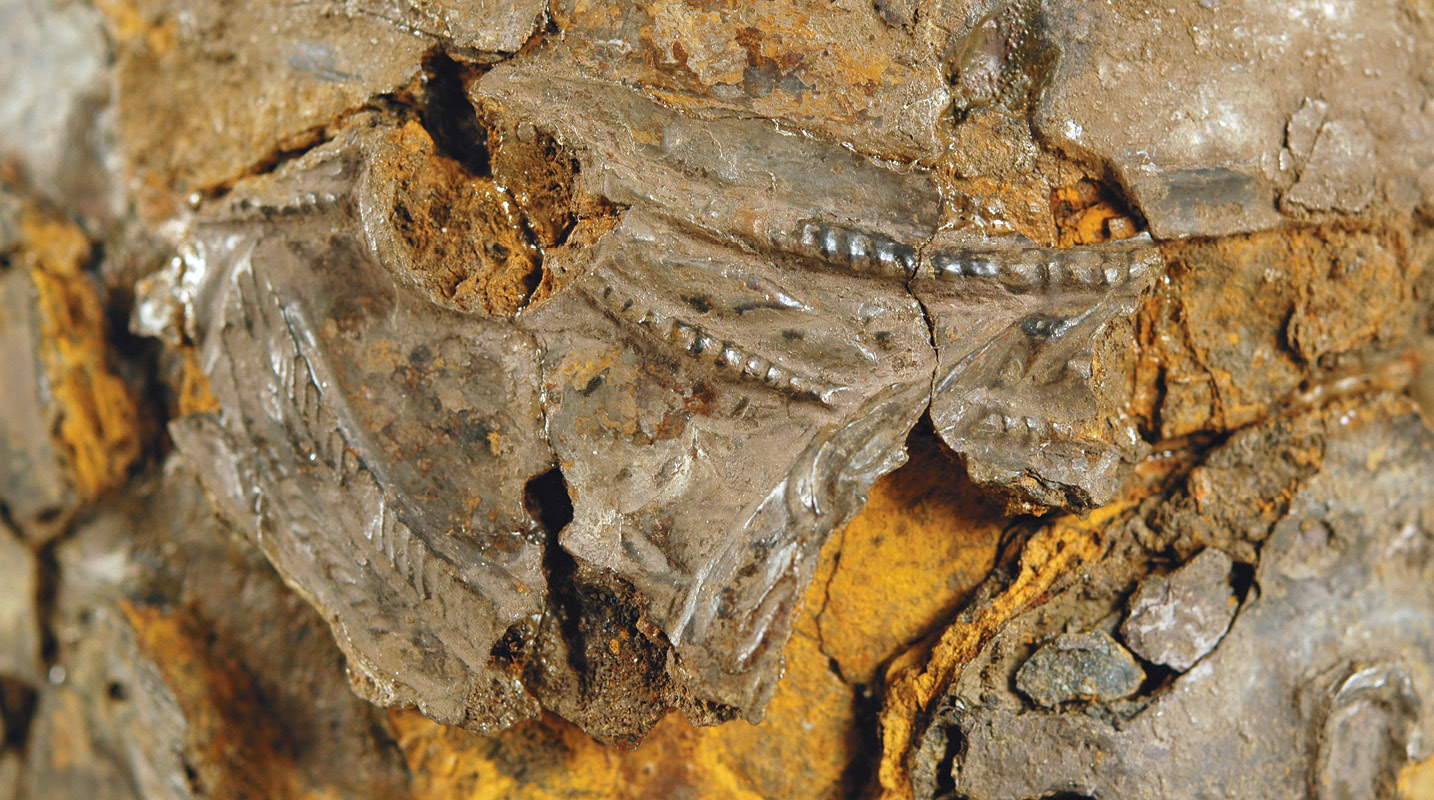
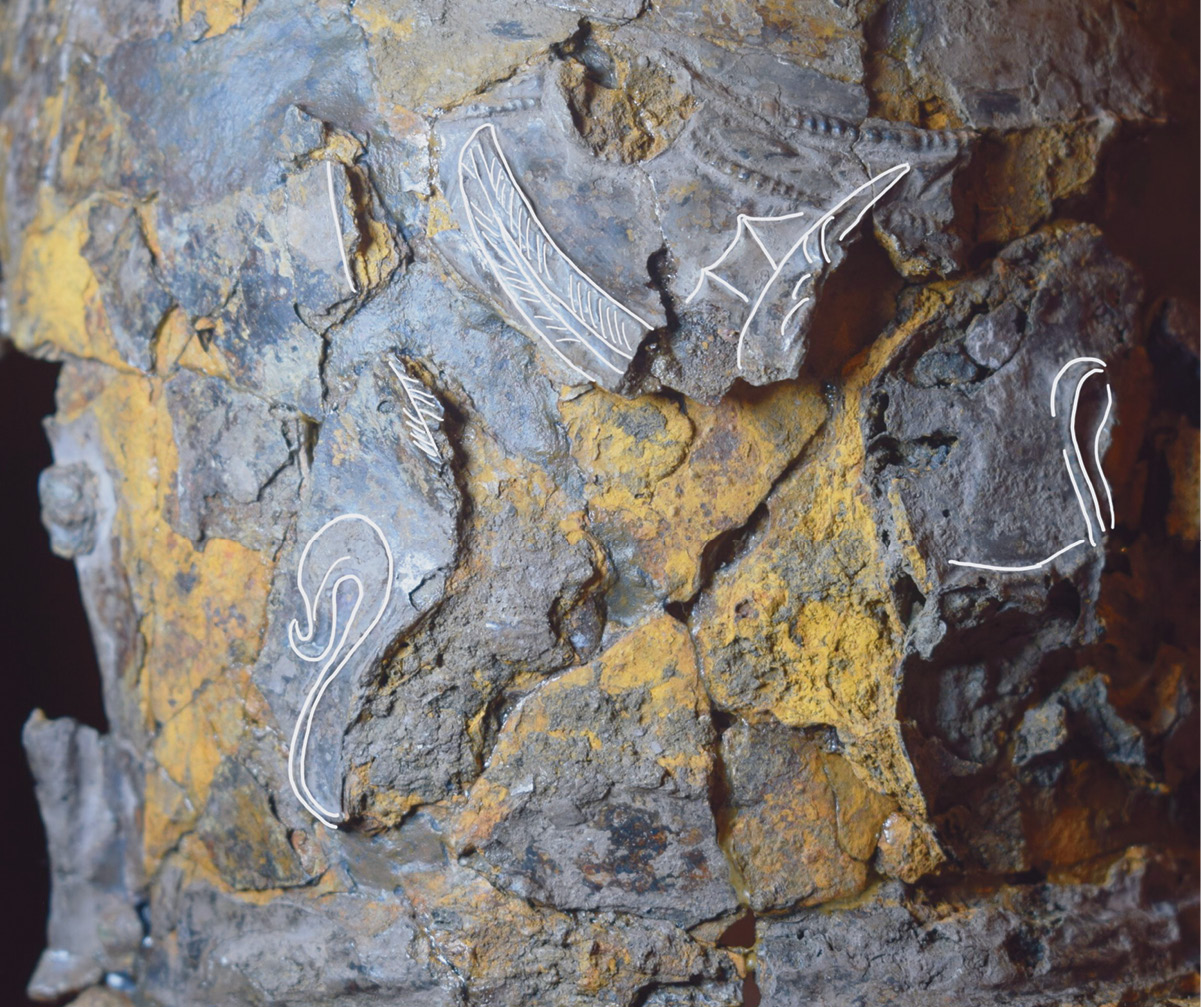
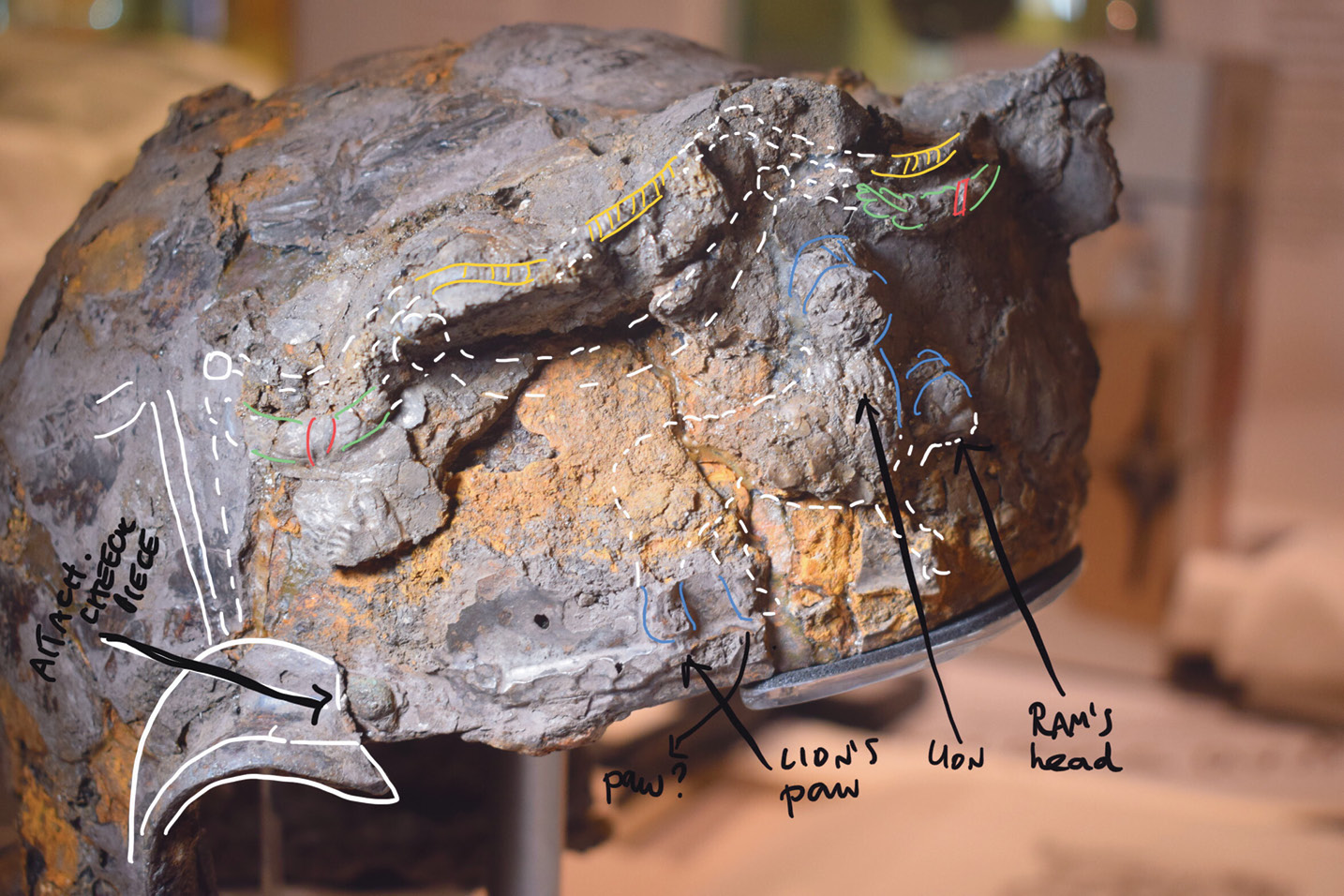
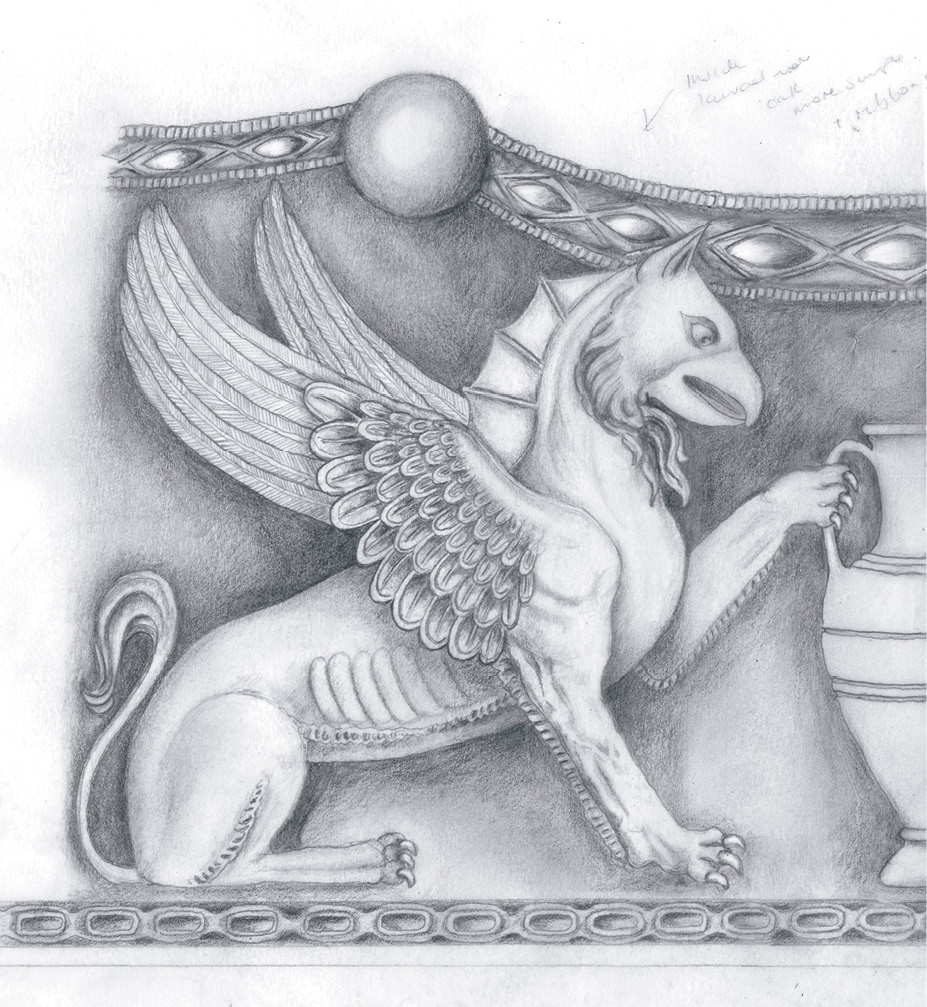
Top, above & below: Surviving motifs on the rear of the helmet bowl were sketched and annotated by Teresa Porciani, and reconstructed by Debbie Miles.
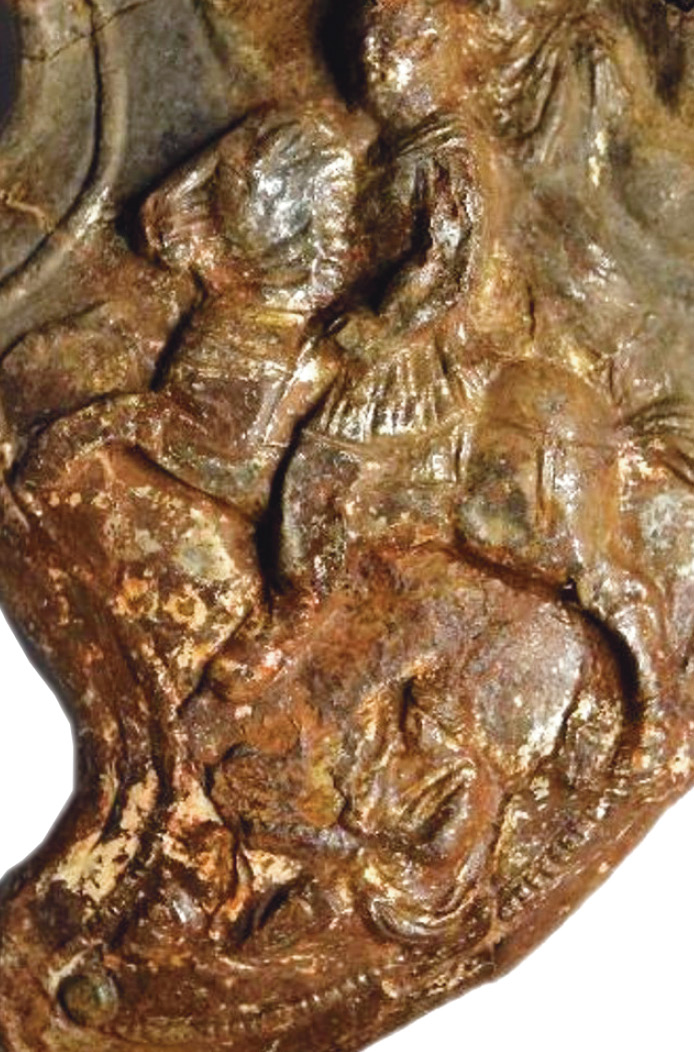
The team worked on the helmet a section at a time, with the first area to be tackled being the ornate brow-guard, featuring a striking female figure (possibly the goddess Cybele) flanked by lions and rams and bordered by an oak leaf garland. While the iconography was roughly visible, much of the design is missing, including the top of the female’s head and the outer portion of the brow-guard. The female’s hairstyle was particularly challenging, so we sought out parallels in 1st-century sculpture for comparison. The missing outer portion may have featured extra imagery, as there is a significant amount of space behind the lions, but this could not be estimated.

The most challenging area to recreate, however, was the rear of the helmet bowl, which at the start of the project was a total unknown. This section of the object is very fragmentary, but there are a few remaining pieces of the design which proved to be key. Teresa noticed depictions of a tail, wing, and ear, along with a possible vase handle, and on analysing the helmet once more, Debbie spotted a webbed feature too. Having consulted sculptural images from the same period, we believe the design to be a pair of opposed griffins holding a central amphora – a motif seen on other Roman helmets, with one example sitting atop the Crosby Garrett Helmet (CA 287). The legendary griffin was a fierce creature that guarded treasure, and therefore would have been a sensible choice for a piece of armour. Contemporary imagery of such creatures was consulted, and a composite design was carefully manipulated to fit the proportions of the fragments seen on the original helmet.
By contrast, the laurel wreath on the helmet’s crown was one of the easier elements to reconstruct, as a section survives well – although we cannot be certain whether this wreath once nestled in curls of hair, like on many other cavalry helmets of the period (such as Hallaton’s closest parallel, Xanten-Wardt, on display at the LVR-RömerMuseum in Xanten, Germany). During our analysis, the scrolling foliate pattern on the neck-guard was established and the intricacies of this design appreciated for the first time, with tiny tool marks covering its background. Some of the most difficult elements to interpret and reconstruct were the linking motifs that create zones of decoration on the helmet – parts that the casual viewer probably would not register, but that are integral to creating a cohesive design.
Once the basic design for the replicas was in place, it was time to decide on the surface finishes. The internal iron core of the original Hallaton Helmet was decorated with a thin outer layer of silver, into which the decoration was rendered using the repoussé technique. This silver was attached to the underlying iron helmet by a black pitch-like substance (which provided support for the relief elements of the design as well) and was also crimped over the edges – this can clearly be seen on the reverse of the cheekpieces, and we wanted this evidence of construction to be visible on the replicas.

The impressive brow-guard was constructed differently, with sandy filler added directly between the iron core and outer silver layer. Analysis at the British Museum suggested that the filler had been consolidated with beeswax containing traces of pine resin to create a solid, impact-resistant layer. While this element could not be seen on the replicas, it explains how the brow-guard achieved its very pronounced, front-heavy shape. Further design elements that would need to be reflected in the reconstructions were the original helmet’s copper- alloy attachments – the rivets that attached the ear-guards to the helmet bowl and the edging strip to the neck-guard, while further copper-alloy rivets and fastening loops on the cheekpieces would have fastened with cord under the wearer’s chin.
The decorative silver layer was also gilded in many places. X-ray fluorescence analysis by the British Museum showed an absence of mercury, which supports the use of leaf rather than mercury-amalgam gilding in this process. The extent of the gilding is difficult to assess, but traces can be seen on the moulded edging, possibly the female’s hair, and the lion’s mane and tail on the brow-guard. Other areas where gilding has been identified are the foliate scrolls on the neck-guard, the laurel wreath around the helmet’s crown, and areas on the back-central section of the bowl. The cheekpieces, however, present a more confusing picture. Seven such items were found buried with the helmet, and we only know for certain that Cheekpiece 6 belonged to it. Unfortunately, this object has not survived well, but the better-preserved Cheekpieces 1 and 2, which must be from different helmets, have more gilding surviving – and, on the latter, it also occurs in the background to the high repoussé, which shows that gilding was not reserved for the motifs.
A 21st-century reimagining
Thanks to generous funding by Leicestershire Archaeological and Historical Society and the Association for Roman Archaeology, Rajesh Gogna was commissioned to recreate two identical helmets – one for Leicestershire County Council’s Harborough Museum, and the other for Hallaton Museum – using 21st-century techniques. A leading figure in his craft, Rajesh is a Leicestershire-based silversmith, a senior lecturer and practice-based researcher at De Montfort University, and Chair of Contemporary British Silversmiths.
The first step for Rajesh and his team was to create a computer-aided design (CAD) model of the helmet’s basic shape, with the help of 3D scans of the bowl. Next, working closely with the Leicestershire CC Museum Collections team, they modelled Debbie Miles’ various reconstruction drawings of the iconography in 3D, before an SLA resin model of the completed design was printed, electroformed, silver-plated, and gilded. In this version of the helmet, certain separate elements of the original – such as the copper-alloy edging strip on the neck-guard, ear-guards, and ear-guard rivets – have been produced as part of the same one-piece 3D-printed bowl, but other aspects were hand-prepared by Rajesh, such as the brass elements like rivets and the pins which attach the cheekpieces. The interior of the helmet bowl and cheekpieces have also been tarnished to give the impression of the original’s iron core, on to which the intricate decoration was applied.

Hand-crafted in Rome
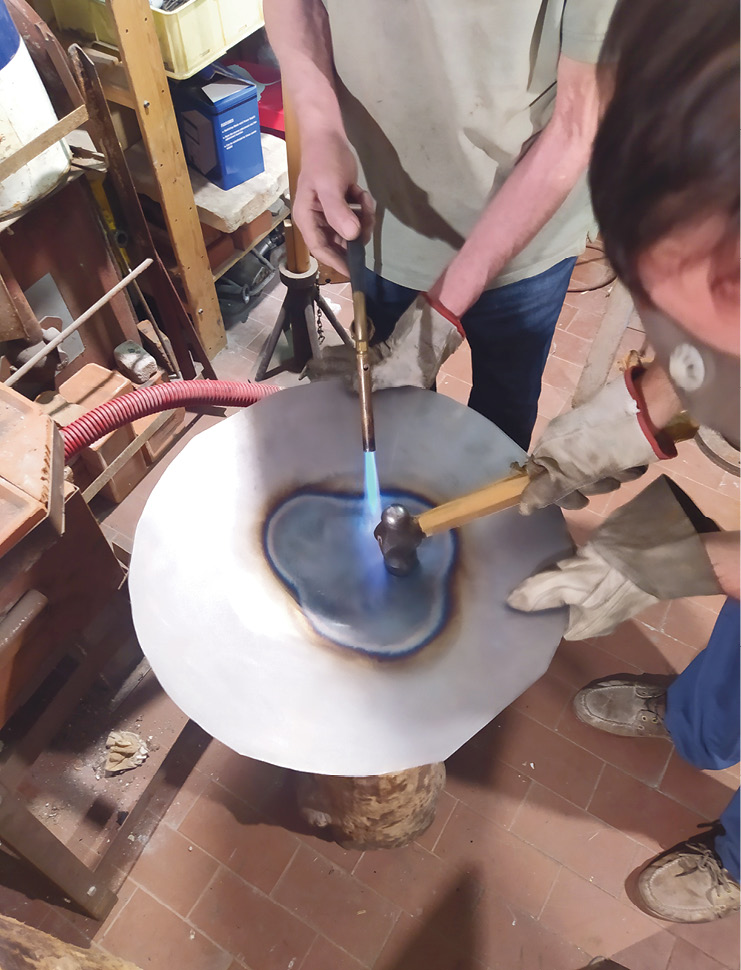
The technology available to Rajesh would have seemed utterly alien to the Roman artisan who produced the Hallaton Helmet – but the techniques employed by Francesco Galluccio to create the second replica would have been much more familiar. Francesco is a renowned Italian archaeologist and replica-maker whose authentic recreations are displayed in museums across Europe, including the Vatican and Capitoline Museums in Rome. His replica armour is much sought-after by Roman re-enactors due to the exceptional craftsmanship and research that goes into creating each piece, and it was one of these re-enactors who told Francesco about the replica helmet project – it was a surprise that the news reached Rome!
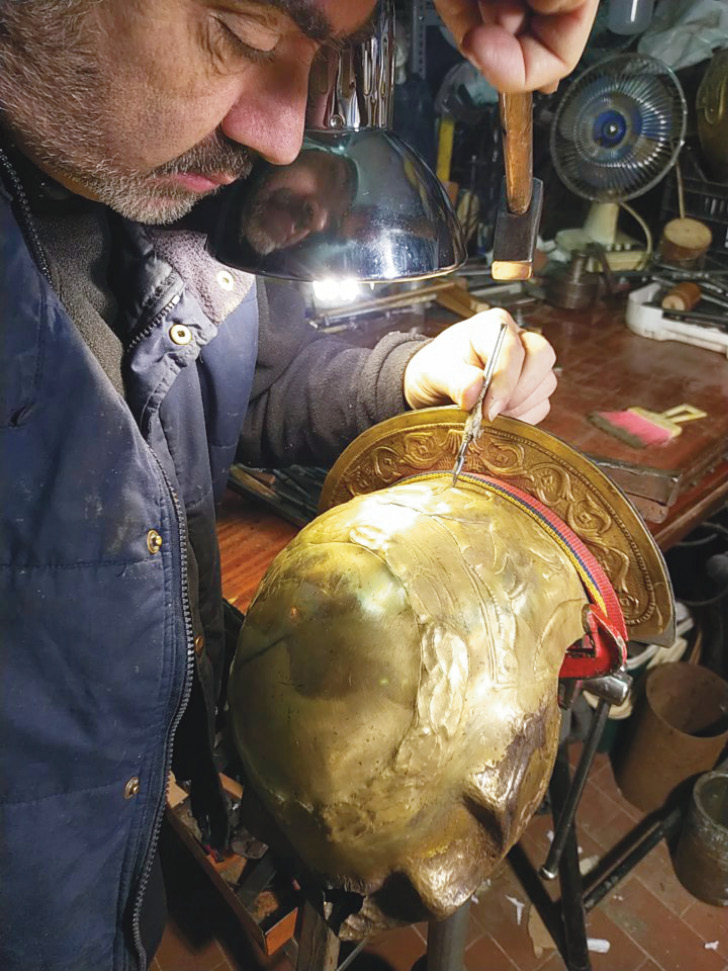
We were able to commission Francesco to produce his contrasting recreation thanks to grants from Leicestershire Fieldworkers, Market Harborough & the Bowdens Charity, Market Harborough Historical Society, and the Friends of Leicester and Leicestershire Museums. He began by forging an iron core for the helmet (as the original would have been made in a similar way), taking measurements from 3D scans of the original to enable accurate shaping and sizing. He then produced drawings of the decorative motifs, based on information supplied by the Leicestershire CC Museum Collections team – this was a crucial collaborative part of the process, as Francesco had never seen the original helmet in person. His designs differ slightly from the sketches produced by Debbie Miles for Rajesh’s version, as Francesco interpreted the fragmentary evidence in his own way – for example, the female figure’s hairstyle. All his variations were backed up with a wealth of parallels, however, so the museum team were happy to proceed with them: the view was taken that these replicas are an interpretation of sometimes scant evidence, and so there is no ‘right’ or ‘wrong’ design.
Another creative compromise came in the production of the decorative outer layer, which was worked in brass sheet – as noted above, this part of the process would have been undertaken in thin silver sheet on the original helmet, but the cost of replicating this was prohibitive – and overlaid on the iron core. In order to create the intricate motifs, designs were hammered into the reverse of the brass using the repoussé technique, and Francesco also worked the outer surface using punches and hammers.
Rajesh and Francesco’s replicas are now proudly displayed alongside the original objects from the Roman helmet assemblage (as well as other finds from the site) in our Hallaton Treasure Gallery – and we are delighted to report that visitors are much more engaged with the real artefacts now that they can easily see how they may once have looked. The new helmet exhibit (designed by RFA Design and manufactured by Glasshaus Displays) puts this incredible collection centre stage, and the Roman artefacts really hold their own next to the new shiny versions.
Further information:
To read more about the replicas and the wider research project behind them, see http://www.leicestershirecollections.org.uk/behind-the-scenes.
For details of how to visit the Hallaton Treasure Gallery at Harborough Museum, see http://www.harboroughmuseum.org.uk.
All images: © Leicestershire County Council Museums, unless otherwise stated