Subscribe now for full access and no adverts
Few manuals offering guidance for the long-term preservation of a library are likely to recommend burning its contents. That, though, was the fate of hundreds of scrolls stored in a palatial villa to the north of Herculaneum in the autumn of AD 79. As Vesuvius erupted, a plume of dust and poisonous gases rose at least 3km into the atmosphere. Portions of this cloud periodically collapsed, cascading down the flanks of the volcano as pyroclastic flows. The first of these superheated avalanches is believed to have enveloped both Herculaneum and the neighbouring villa during the evening of the initial day of the eruption. The result was a human tragedy on an almost unimaginable scale, as hundreds of sheltering inhabitants were exposed to temperatures that have been calculated at 500°C. This lethal heat also carbonised food, fabrics, and furniture, as well as the papyrus scrolls in the villa. Over the following hours, more and more pyroclastic flows careered into the town. Having devastated Herculaneum, this volcanic material then protected its ruins by burying them deep. The rapidity and heat of the gases had sucked much of the oxygen out of this shroud, too, allowing the fragile artefacts within to endure undisturbed for centuries, awaiting rediscovery.

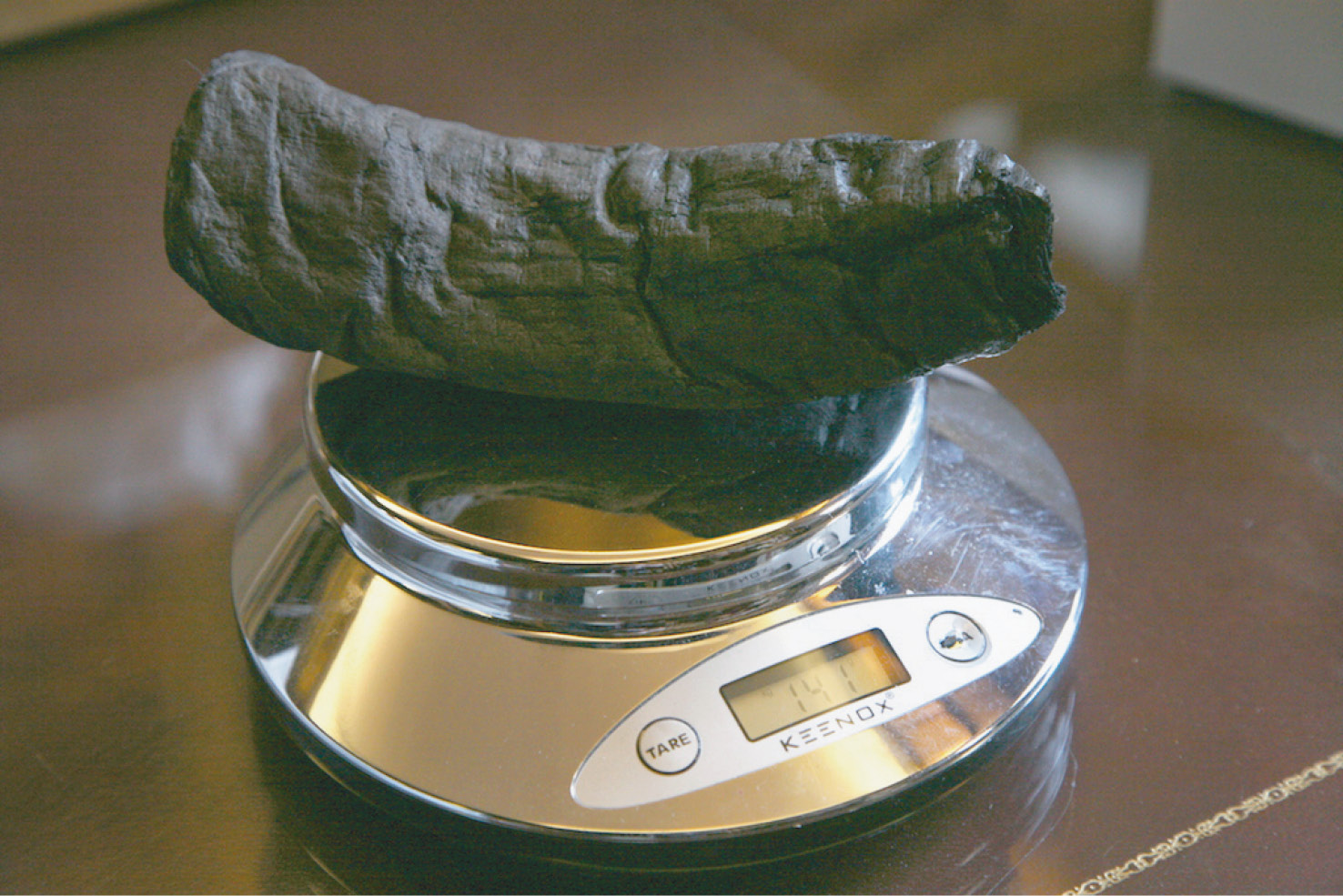
For the villa, that moment came in 1750, when well-digging operations struck not water, but a sumptuous marble pavement. The King of Naples, Charles VIII, was sufficiently enthused by the promise of buried marvels to order excavation of the site. This posed significant challenges, though, as the villa lay at a depth of 27m, meaning that investigations had to be conducted via subterranean tunnels. Karl Weber, a Swiss engineer, was engaged to lead the project, with a team of press-ganged convicts and labourers doing the digging. Although the king was eager for rapid results, Weber was not one to be rushed. The marble floor proved to belong to a belvedere set within a vineyard, and it was a full six months before the diggers reached the villa proper. Despite Weber’s brief, he was not interested in simply grabbing ancient masterpieces. Instead, he used the tunnels to compose a plan of the villa, marking the locations of key finds with such diligence that his work has been credited as the first true archaeological excavation. His investigations ultimately ran for 14 years, with the king’s patience rewarded by the recovery of treasures galore, including scores of bronze and marble sculptures, as well as frescoes and mosaics. Despite this abundance of wonders, the site owes its modern name to a collection of charred lumps that at first glance appeared distinctly underwhelming. These relics have been likened to coal and even, in more recent times, a burnt burrito. When first encountered in 1752, they were thought to be rolled up fabric or fishing nets. In reality, they were charred papyrus scrolls from the only library to survive intact from Classical antiquity.

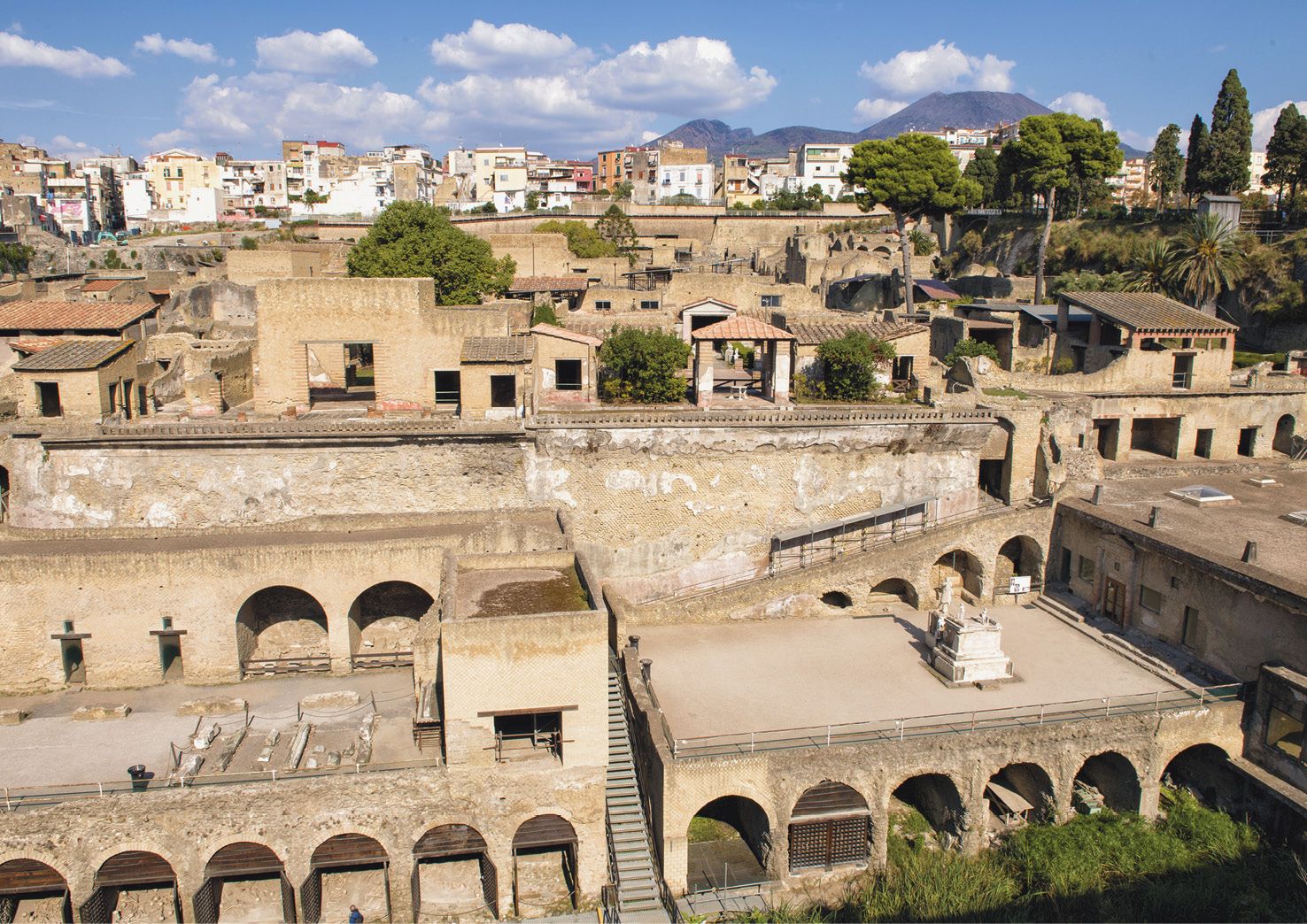

Villa dei Papiri
Camillo Paderni, who was in charge of conserving the villa finds, is often credited with appreciating the true nature of the scrolls. The possibility – indeed, probability – that they held lost texts from the ancient world occasioned considerable excitement. Such was their value that small numbers were even given away as diplomatic gifts, while the king established an august body, the Accademia Ercolanese, to tease out the priceless texts. This proved to be a task worthy of Hercules, as the burnt papyri were too brittle to unroll without fragmenting. How, then, could they be read? Early attempts to reveal their secrets veered from the disastrous to the destructive. Scrolls would often be cut open, with one approach relying on copying down any visible text, before scraping it away to reveal the next layer of papyrus below. Such transcription was often far from straightforward, as the blackened papyri were now the same hue as the ink on them, frequently rendering the text all-but invisible.
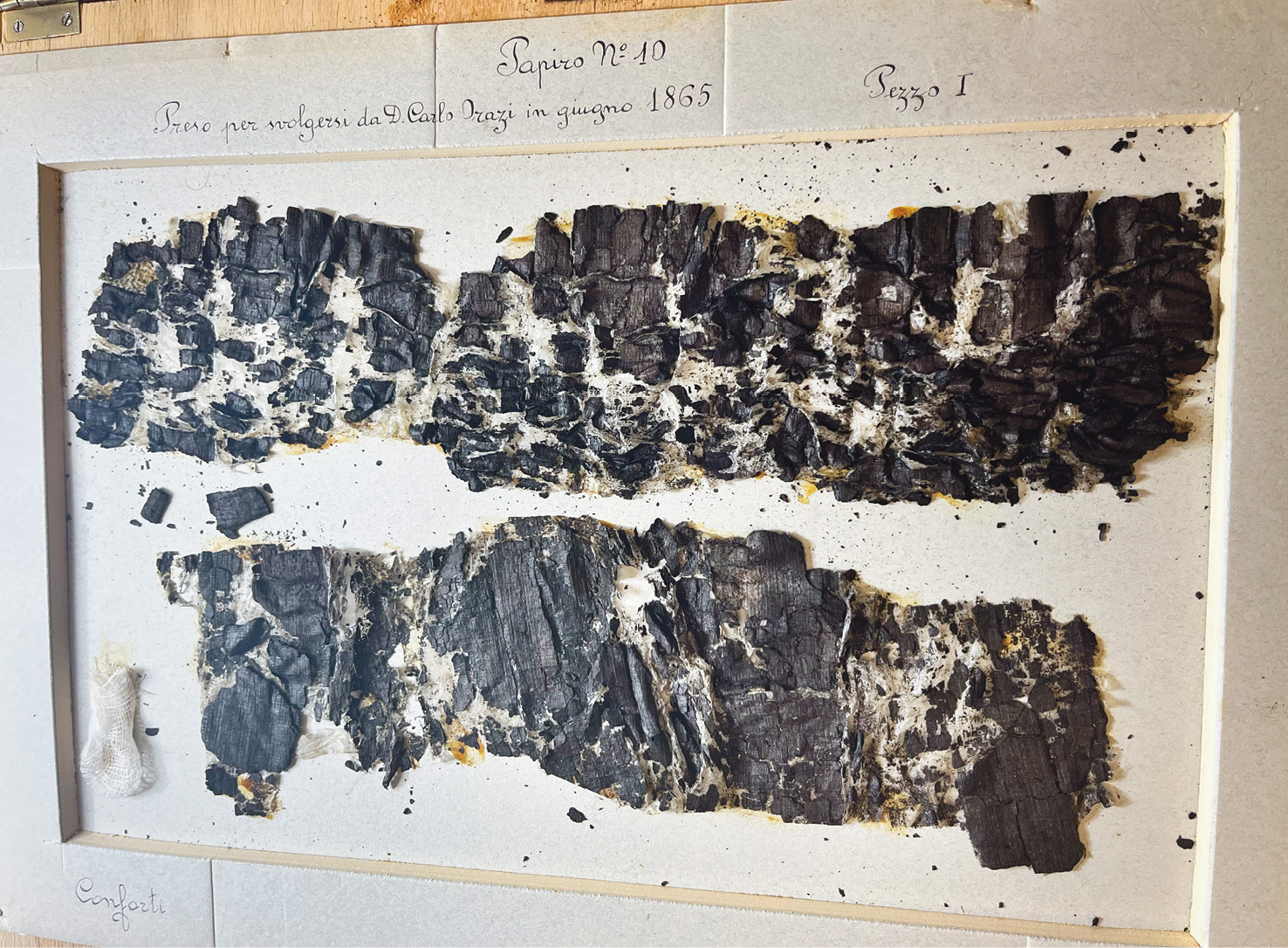
Despite these challenges, recoveries were made. One early achievement was reading part of a Latin poem featuring the death of Cleopatra. The first Herculaneum text to be printed, though, proved more representative of the wider collection. This emerged in 1793 and was a treatise in ancient Greek called On Music, which had been composed by Philodemus of Gadara. Philodemus was a poet and philosopher, who was already a known – if obscure – figure thanks to the existing ancient literature. As knowledge of the contents of the scrolls grew, so too it became more and more apparent that the nucleus of the library was a collection of works that must have belonged to a professional philosopher. The only plausible candidate was Philodemus himself, whose surviving body of work has been much expanded by the contents of the Villa dei Papiri. Indeed, one of his scrolls seems to contain the equivalent of final proof revisions to a text. This association also presents a strong candidate for the owner of the villa: the Roman aristocrat Lucius Calpurnius Piso Caesoninus. He was a friend and probable patron of Philodemus, as well as the father-in-law of Julius Caesar.
Neither Philodemus nor Piso were casualties of Vesuvius, as both were long dead when it erupted. Someone, then, must have preserved Philodemus’ library, with Piso’s son a plausible candidate. Whoever it was, we know that they continued adding to the collection in the 1st century AD. As such, it remains entirely possible that major lost historical or literary works from this period lie preserved among the unopened scrolls. Until recently, though, the question confronting modern scholars remained exactly the same one that had taxed the ingenuity of the Accademia Ercolanese from its inception over 250 years ago: how can they be read? An initial step towards finding a fresh solution was taken in the 1990s, when a team from Brigham Young University successfully produced clearer texts of previously opened papyri, by exposing them to infrared light and then creating digital images of them. This demonstrated that progress could be made by harnessing new technologies and non-destructive imaging processes, signposting the potential for future breakthroughs.
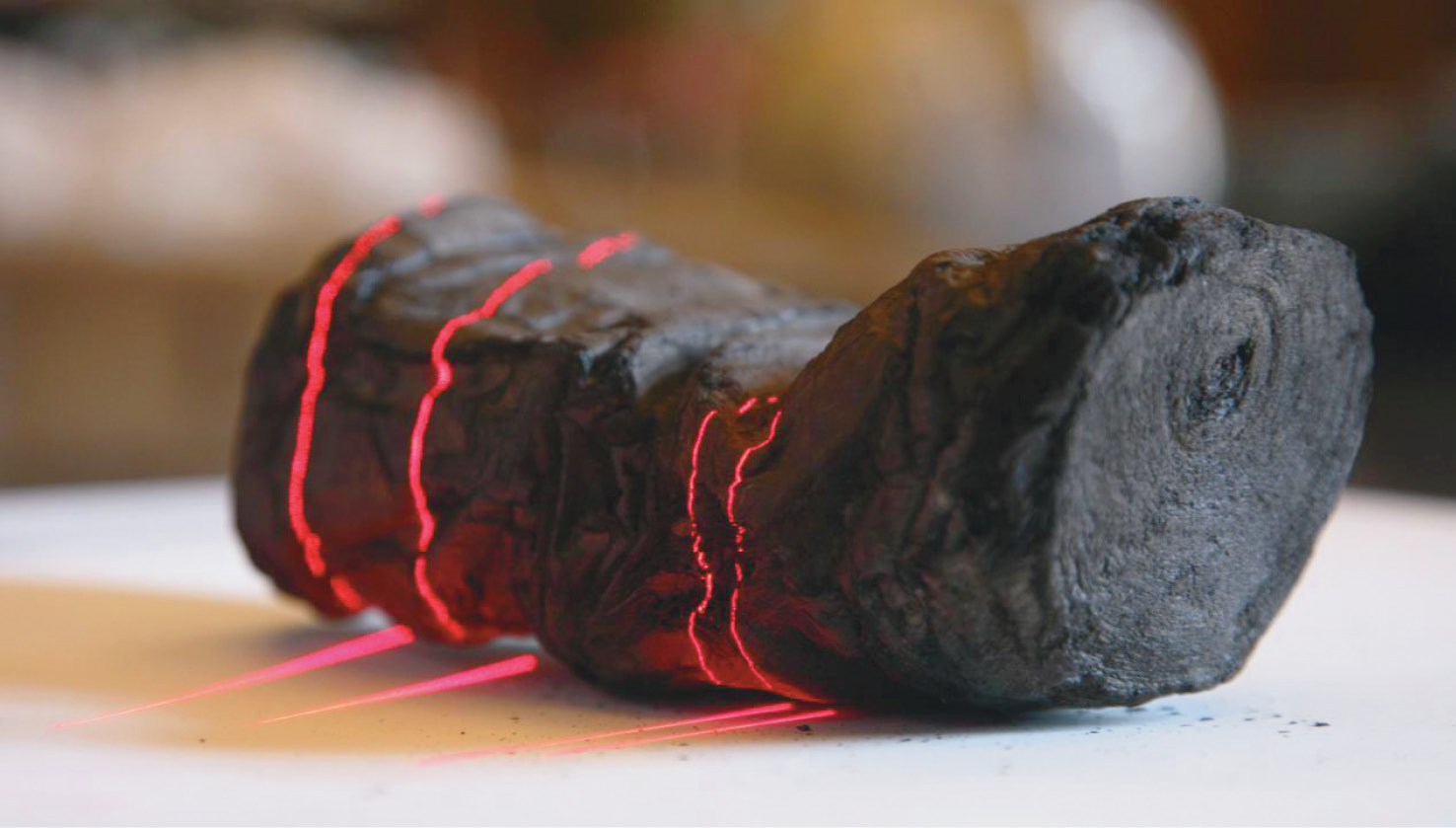
That potential is now being realised, thanks to an innovative process pioneered by Brent Seales at the University of Kentucky. In 2002, Brent and his team developed a digital technique that was capable of virtually unwrapping objects like scrolls. ‘We created the method purely as a technical one,’ says Brent, ‘before we knew exactly which materials were candidates. It’s funny to say that, because people always imagine it was the other way around. I did have the Dead Sea Scrolls at the back of my mind, because they were something that I knew more about. But I didn’t know that the Herculaneum Scrolls existed in 2002. It wasn’t until I met Richard Janko at the University of Michigan that I understood fully the importance of that collection and how it might be suitable for virtual unwrapping.’

The charred scroll found at En Gedi (above) was successfully virtually unrolled in 2016, revealing text from the Book of Leviticus (below). Images: courtesy of EduceLab, University of Kentucky

Virtually legible
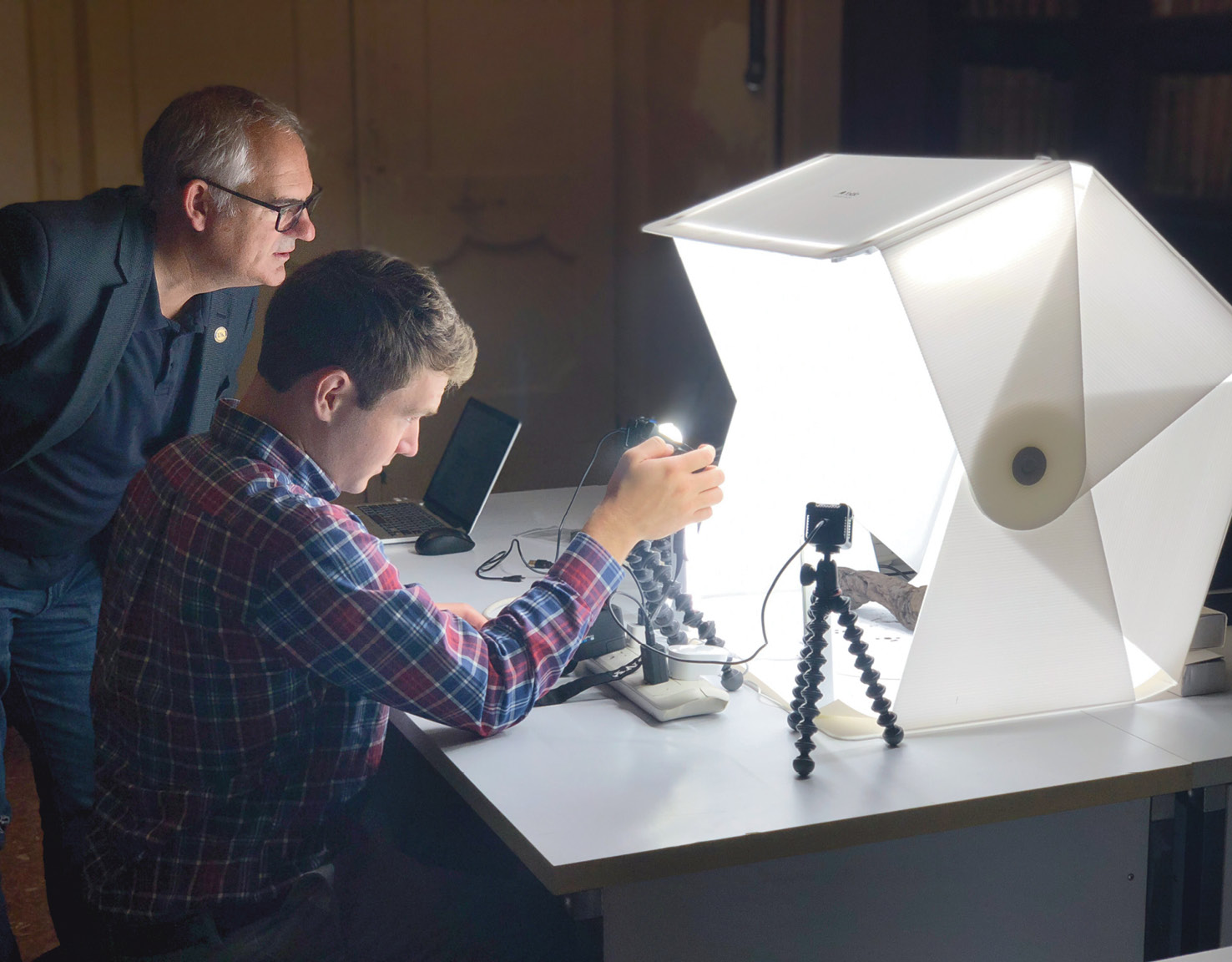
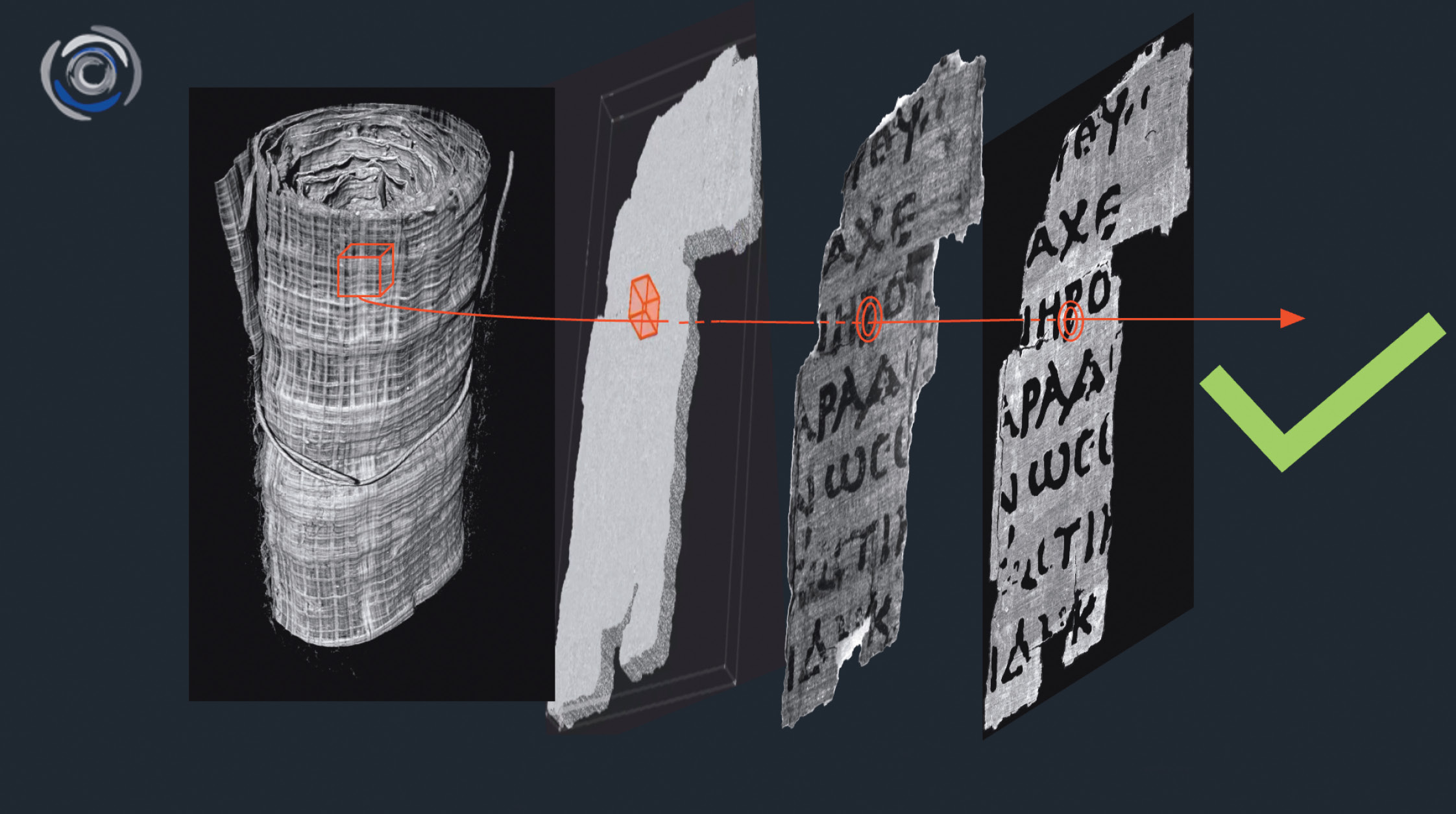
Brent’s process involves creating a detailed 3D image of both the interior and exterior of an object. This can be achieved using X-ray Computed Tomography, a technique that is comparable to a medical CT scan. ‘Because the papyrus layers and the gaps between them respond to the X-ray beam differently, this allows you to see, with the naked eye, the internal structure of a scroll,’ Brent explains. ‘We scan the scroll in small sections that together form a very high-resolution cross-sectional composite. And when you see those cross sections, they look fantastic because you can make out all of the rolled-up layers within the scroll. But they are also so complex that they show you the seriousness and gravity of what has to happen computationally in order to unwrap them virtually. To go from that image to unwrapping the layers visible on it, we have to start by identifying where the papyrus edges are. This is a process we call “localisation”, and for a long time it was a laborious process, because it involved manually tracing out the layers making up the scroll. This is then used to build a virtual model of the surface of the scroll. Once we have that, the information captured during the scanning should also reveal what was on that surface, such as ink. As a final step, we can virtually flatten the whole scroll and read it. For the technique to work, though, you have to get the localisation right, otherwise there’s no hope of seeing writing. Instead of looking at the surface of the scroll, you’d be looking at the air in the gaps between layers or something like that.’
The importance of gaining a pin-sharp view of the innards of the carbonised rolls was illustrated in 2009, when the team scanned a set held by the Institute de France. These had been a diplomatic gift from Ferdinand IV of Naples and included an example known to researchers as P.Herc.Paris 4. Scanning the scrolls at a resolution of 25 microns successfully captured the spiral of papyrus that lay coiled and concealed beneath the charred exterior, but its edges appeared fuzzy and individual surfaces could not always be distinguished. This level of detail was not enough to undertake all of the localisation work or capture faint traces of writing. Brent’s team had more luck in 2016, with a charred scroll that had been found not at Herculaneum, but in the remains of an ancient synagogue at En Gedi. This scroll has been radiocarbon dated to the 3rd or 4th century AD and, unlike the Herculaneum examples, was made of animal skin. Because this medium is thicker and there are fewer wraps, its internal structure proved less challenging to disentangle. Even better, just as the surfaces and gaps within the scroll responded differently to the X-ray beam, so too did the chemistry of the ink. Thanks to this, once the En Gedi scroll had been virtually unwrapped, the ink on its surface – with some teasing – became apparent as ghostly writing, which proved to be from the Book of Leviticus.
Sadly, the carbon-based ink used on the Herculaneum Scrolls responded to the X-ray in much the same way as the underlying papyrus. As a result, virtually modelling the surface essentially replicated the problem that had vexed 18th-century transcribers – to the naked eye, the ink was invisible. ‘For a long time, we didn’t have a solution to this,’ Brent says. ‘Other people had proposed that a different scanning method might resolve the problem, but it wasn’t true. Ultimately, we realised that machine learning – that is, AI – would be able to make the evidence of the ink visible, even though we couldn’t see it ourselves. That evidence is very subtle, but it is there. One way you can think about it is by imagining the papyrus as a grid; then, when the ink goes over the top, it covers some of the holes in that grid. The effect is a bit like a muddy puddle in a street – the mud will fill the cracks in that part of the street, making it appear slightly different to the rest. In the same way, the portions of papyrus with ink on top of them look subtly different to the sections that haven’t been written on. This difference won’t pop out at you as bright lettering in an X-ray, but it means that the letters are detectable on the papyrus as shapes where there are slight changes in texture. We figured that machine learning could be taught to recognise that.’
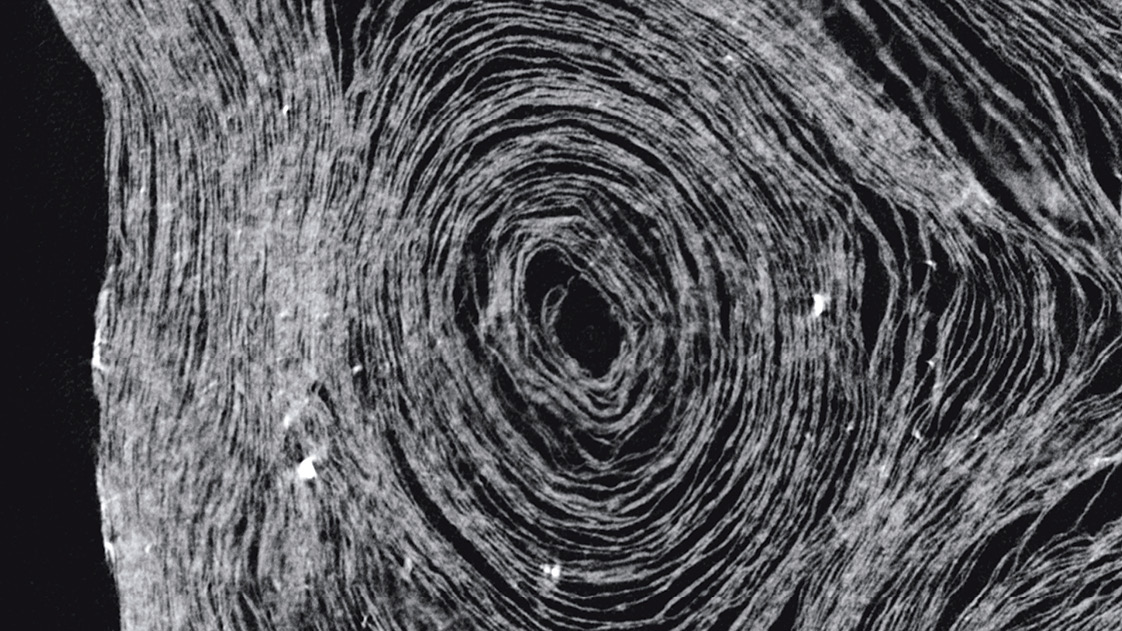
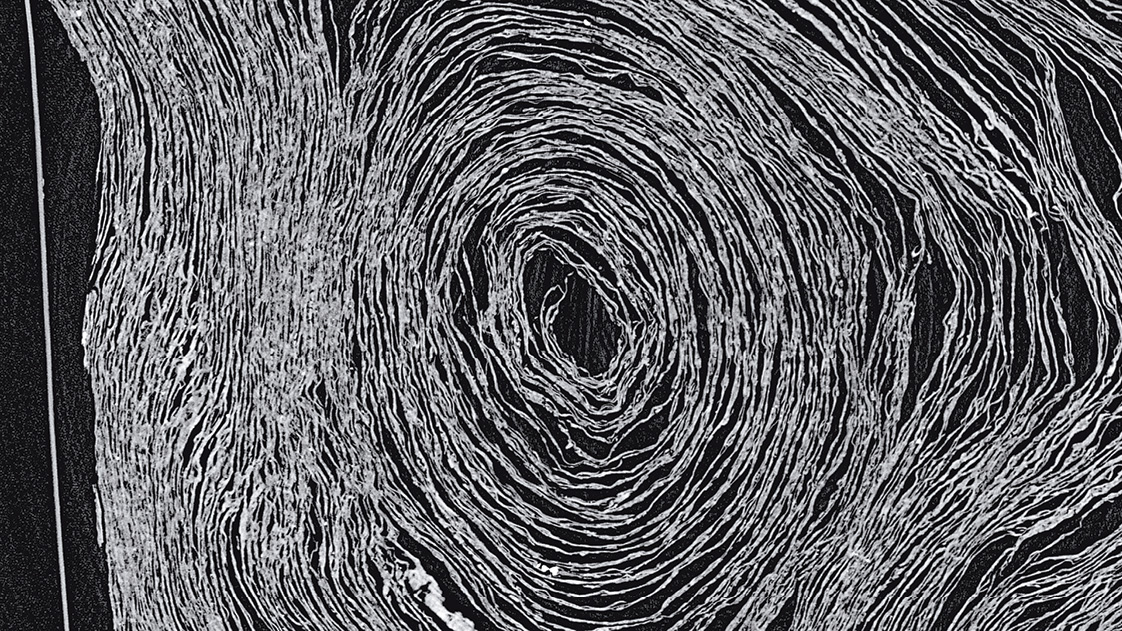
To try this approach, in 2019 Brent rescanned two of the scrolls held by the Institut de France, including P.Herc.Paris 4. This time a resolution of 8 microns was achieved at the Diamond Light Source particle accelerator in Oxford. The results were simply breathtaking, and revealed the structure of the scroll in exquisite and unprecedented detail. But would the resulting model of the internal papyrus surfaces successfully capture the faint residue of ancient ink? And, if so, how effectively would the AI be able to reveal the lost writing?
‘We intentionally built a method that didn’t need to know anything about language,’ says Brent. ‘It looks at a minute area of the scroll – much smaller than the size of a letter. It’s really the size of a speck, and the system asks whether this speck looks like inked fibres, or raw fibres. This is then repeated across the entire length of the page, and then all of the little points appear as either “yes” or “no”, with a little bit of probability used where there’s a “maybe”. So the end result is really a pointillist impression of the surface of the papyrus, and that is what creates the image that the human then interprets.’

A longitudinal CT slice through P.Herc.Paris 4. Image: courtesy of EduceLab, University of Kentucky
Ω marks the spot
‘The technique is what we call a “supervised learning approach”, which means that you have to teach the system what the ink looks like, and what the places without ink look like. A crucial step was to find a way to build a set of labels that could be used to provide this teaching. That presented another challenge, because, of course, the whole problem was that for the most part, we couldn’t see a difference either. This was where scrolls that had previously been physically opened provided the key. We found a small fragment where ink was visible on the top layer. So we could then X-ray that fragment, and it became our equivalent of a treasure map. We still couldn’t see the ink on the virtual model of the fragment created by the tomography, but, because it was visible on the physical fragment, we knew exactly where it must be on the digital version. Thanks to that, we could generate all of the labels that we needed to train the system, and off we went.’
Even with high-resolution scans of two of the scrolls, and an AI tool that knew how to spot subtle ink residues, coaxing out the text within still posed a formidable challenge. Initial attempts to use the system on fragments where the text was already known produced results that showed the AI was able to pick up some of the ink, but not enough to make the whole text legible. So, while the technique was working, it still needed more training, and perhaps some fine-tuning too. A novel way to tackle this came out of a conversation between Brent and Silicon Valley tech entrepreneur Nat Friedman, who suggested making the data freely available online, and offering an award for the first person who read 5% of one of the sealed scrolls. That achievement would earn the winner a cash prize, while numerous subsidiary sums could be claimed for reaching important milestones along the way, such as revealing the first word. Offering these extra prizes ensured that progress was shared with the wider community. The competition was named the Vesuvius Challenge and launched on the Ides of March in 2023, with the end of the year given as the deadline for claiming the grand prize.
‘The total prize pool came to a million dollars, which attracted a lot of attention,’ says Brent. ‘And that really amplified the community working on this. It generated a lot of discussion and good ideas, with participants voting with their feet by trying things out and then reporting whether it was working or not. My team is five people, so we can only try five sets of experiments at once. During the competition, we had about 3,000 people testing ideas and sharing what they had found. You can think of it as almost like a pharmaceutical lab, where they’ll have something like 50 billion different combinations of something and be able to test them all at once. That gets results.’
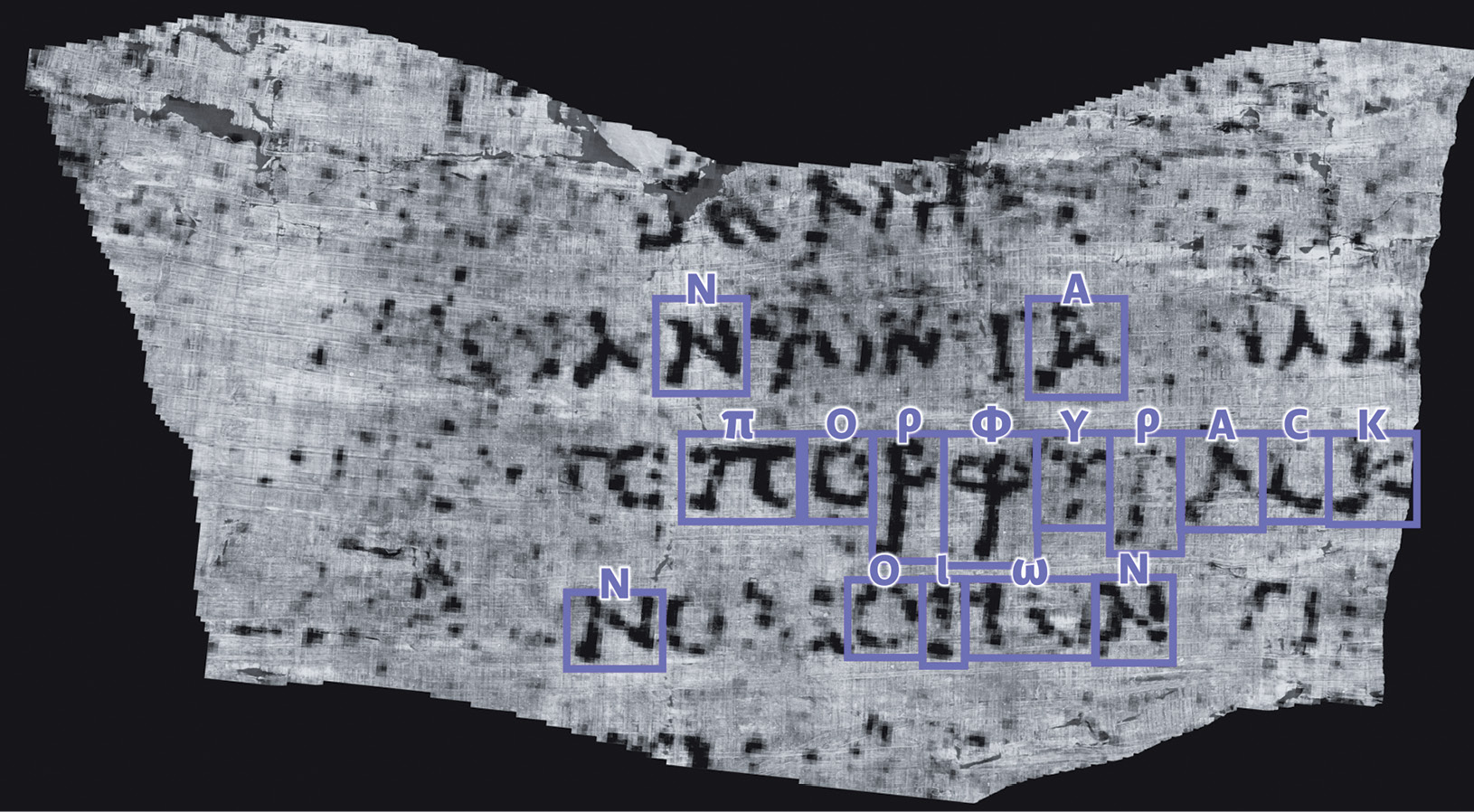
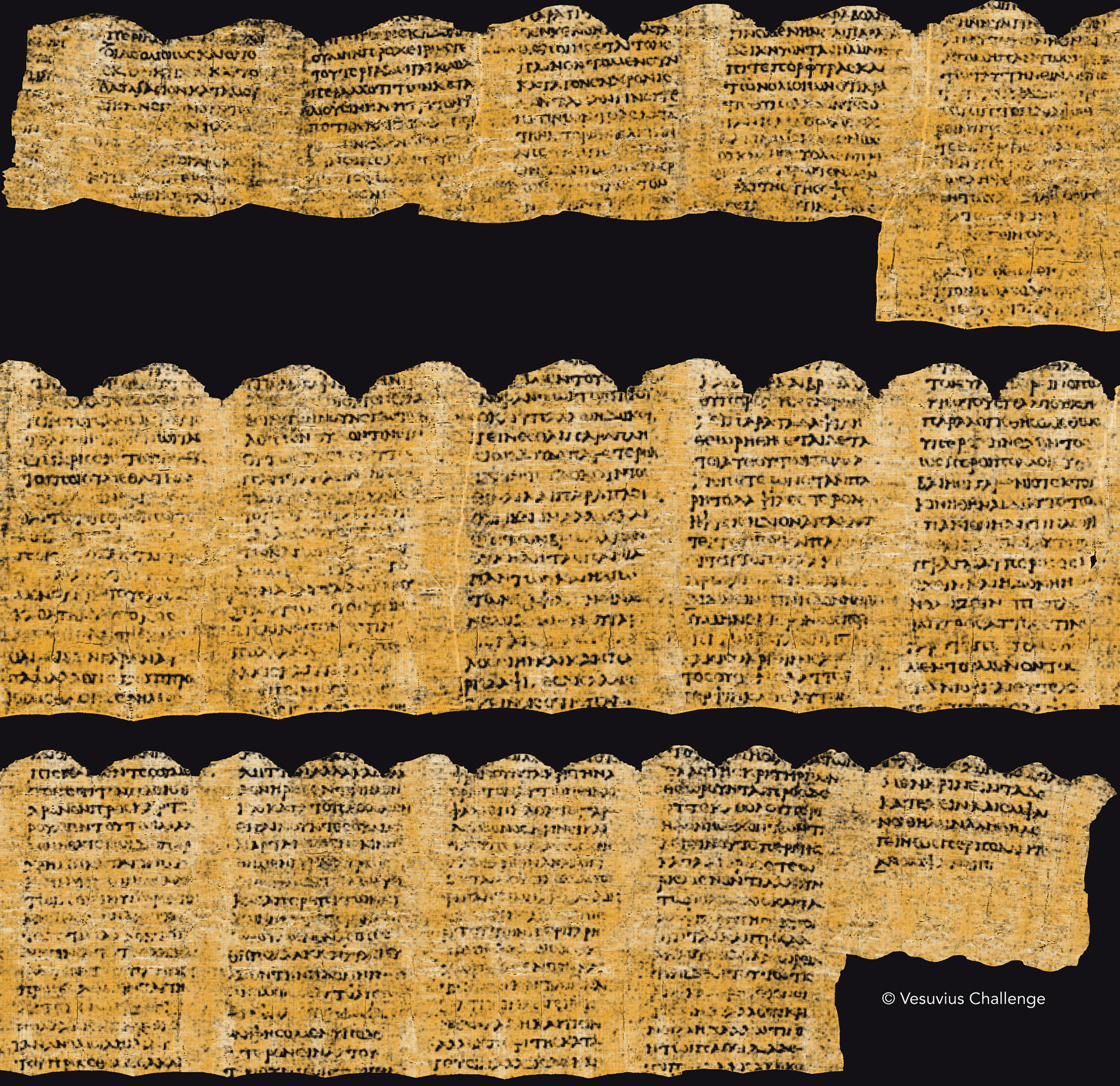
The first word to be read came from P.Herc.Paris 4 and was ‘πορφύραc’ or ‘purple’. While some found the word itself a little anticlimactic, the implications were seismic – with that breakthrough, the question turned from ‘if’ to ‘when’ the sealed scrolls would be read. Sure enough, by the end of 2023, P.Herc.Paris 4 had surrendered an impressive 15 columns of text. This allowed a team of three collaborators, comprising Youssef Nader, Luke Farritor, and Julian Schilliger, to claim the grand prize. Although this is still only a small portion of the text written on the scroll, it is enough to reveal that the contents are concerned with discussing perception, pleasure, and – appropriately – achieving knowledge, making it a good fit with the philosophical flavour of the library. Although the author of these musings is yet to be revealed, it would not be a huge surprise if they turned out to be another part of Philodemus’ canon. The answer will presumably come when the remainder of the text is digitally wrangled into visibility, as the title and author were often placed at the beginning and end of a scroll.

Reading the rest
Being able to read a full scroll is currently the aim of Phase 2 of the competition. ‘Achieving that is hard,’ says Brent, ‘because you can’t just find a section of the scroll that is comparatively straightforward to read. This is also true of the collection more generally. Some of the scrolls are crushed, so when you look at the cross-section, it’s not a nice, neat spiral. Instead, it’s flat with broken edges and tangled fibres. That makes it very difficult to localise the surfaces. At the same time, even though it’s damaged, it’s all there. Nothing is missing. It’s just a much harder challenge. But the aim is to read them all. There are about 400-600 fragments of unopened scrolls, which scholars think amount to around 250 books. We’re going to make a full inventory in 2025, so that we can approach this question with precision. It’s something that people have largely ignored before, because it was thought that nothing could really be done with them. But now they’re interested.’
‘At the moment, it feels as though a huge burden has lifted, because we’ve been able to make this one breakthrough. I feel a bit like a pioneer who has made it to a new place and can now set about building a settlement. That is exciting. If we can read all of the books, it will probably be the biggest gift from the Classical period that has been given to humanity since the Renaissance. But if we go back and dig more – because much of the Villa dei Papiri remains unexcavated – and additional scrolls are found there, it could be the single biggest offering in history. And these are works that would be right off the shelf from 2,000 years ago – not texts that have survived after being copied and filtered through the mindset of a medieval scribe. To be associated with anything on that scale is far beyond anything I expected when I started the project. It’s mind-blowing.’
FURTHER INFORMATION:
• For more information about the technique for recovering the text, see C Parker, S Parsons, J Bandy, C Chapman, F Coppens, and W B Seales (2019) ‘From invisibility to readability: recovering the ink of Herculaneum’, PLOS One (https://doi.org/10.1371/journal.pone.0215775).
• Further details about the Villa dei Papiri are available in K Lapatin (ed.) Buried by Vesuvius: the Villa dei Papiri at Herculaneum (Yale University Press, ISBN 978-1606065921).
• A symposium about the scrolls and the Vesuvius Challenge at the Getty can be viewed on YouTube: http://www.youtube.com/watch?feature=shared&v=uPefxeXfssA.