

Subscribe now for full access and no adverts
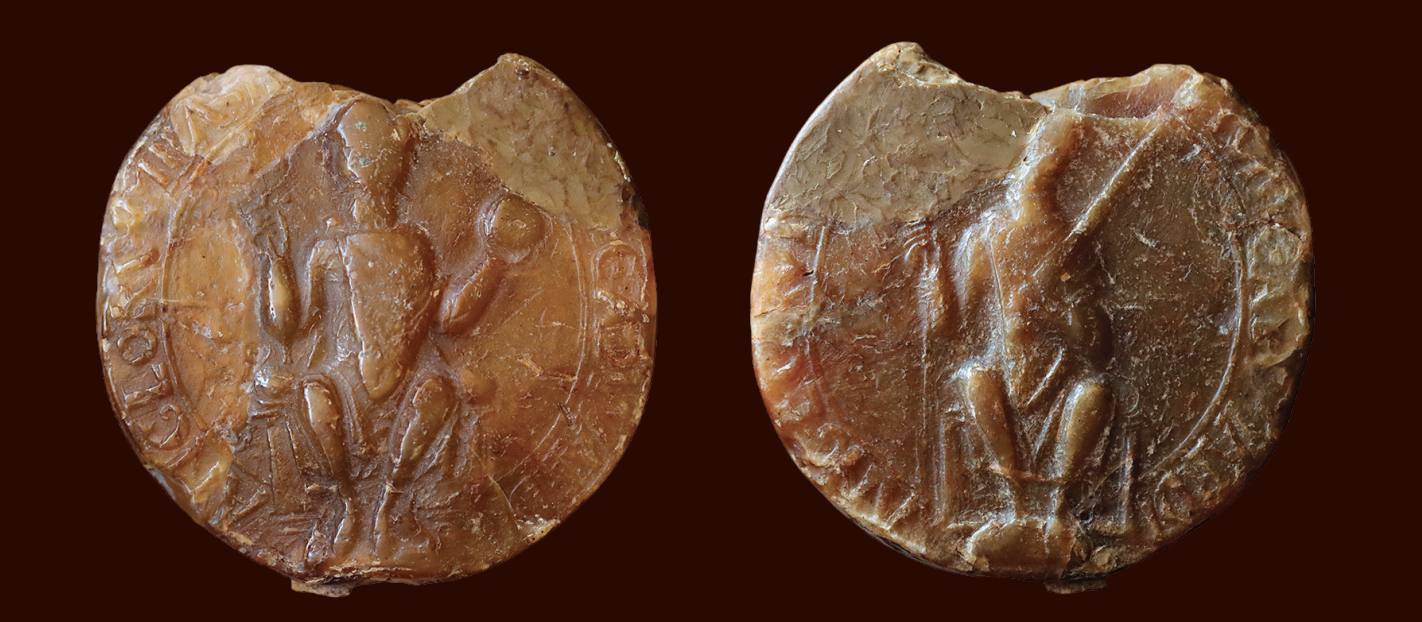
Royal seals offer vivid insights into the interests and aspirations of historical kings and queens, highlighting their cultural influences and the ways that they presented themselves to the wider world. In England, just three wax impressions from a monarch’s seal pre-dating the Norman Conquest are known to survive, all belonging to Edward the Confessor (r. 1042-1066). Two of these, preserved on writs of 1052-1066 (in the British Library) and 1062-1066 (in Westminster Abbey) are only very fragmentary, but the third is almost complete, with its imagery and inscription still clear. Known as the Saint-Denis seal, it was originally attached to a writ of 1053-1057, before being transferred to a diploma of 1059, granting lands at Taynton, Oxfordshire, to the Saint-Denis monastery in Paris. This latter manuscript remained in the religious community’s collections until the Archives nationales were founded in the 1790s. As the only intact – and possibly the earliest – example of an Anglo-Saxon royal seal, the impression’s historical significance has long been recognised – but in the 1980s it became disconnected from its associated documents and was registered as missing, presumed lost. Some four decades later, however, the seal has come to light once more.
The artefact was held in the detached seals (sceaux détachés) section of the Archives nationales, whose collections include a wide variety of historical seals that have become separated from their original manuscripts, ranging from well-preserved examples to fragmentary and unidentifiable pieces, issued by individuals from across the social spectrum. In 2021, the collection’s curator, Clément Blanc-Riehl, and Dr Guilhem Dorandeu, who was conducting a review of the detached seals as part of his PhD research, rediscovered the long-lost Saint-Denis seal. It had survived in the distinctive form of a well-preserved circle of brown wax bearing an image of an enthroned king on both sides.

Realising the importance of the discovery, Guilhem contacted several experts in the field, and in 2025 he was put in touch with Professor Levi Roach at the University of Exeter’s Department of Archaeology and History. The pair have collaborated on studying the Saint-Denis seal ever since, and have now co-authored a paper that was recently published in the journal Early Medieval England and its Neighbours, announcing the artefact’s rediscovery and using this development as a springboard to explore its iconography and its association with an innovative form of 11th-century charter. As Guilhem and Levi note in their research (open-access online; see ‘Further reading’ below), the seal suggests that Edward the Confessor consciously drew on ideas from continental Europe, and particularly the Byzantine Empire, to create a new way of presenting English royal sovereignty and his own dynastic ambitions.
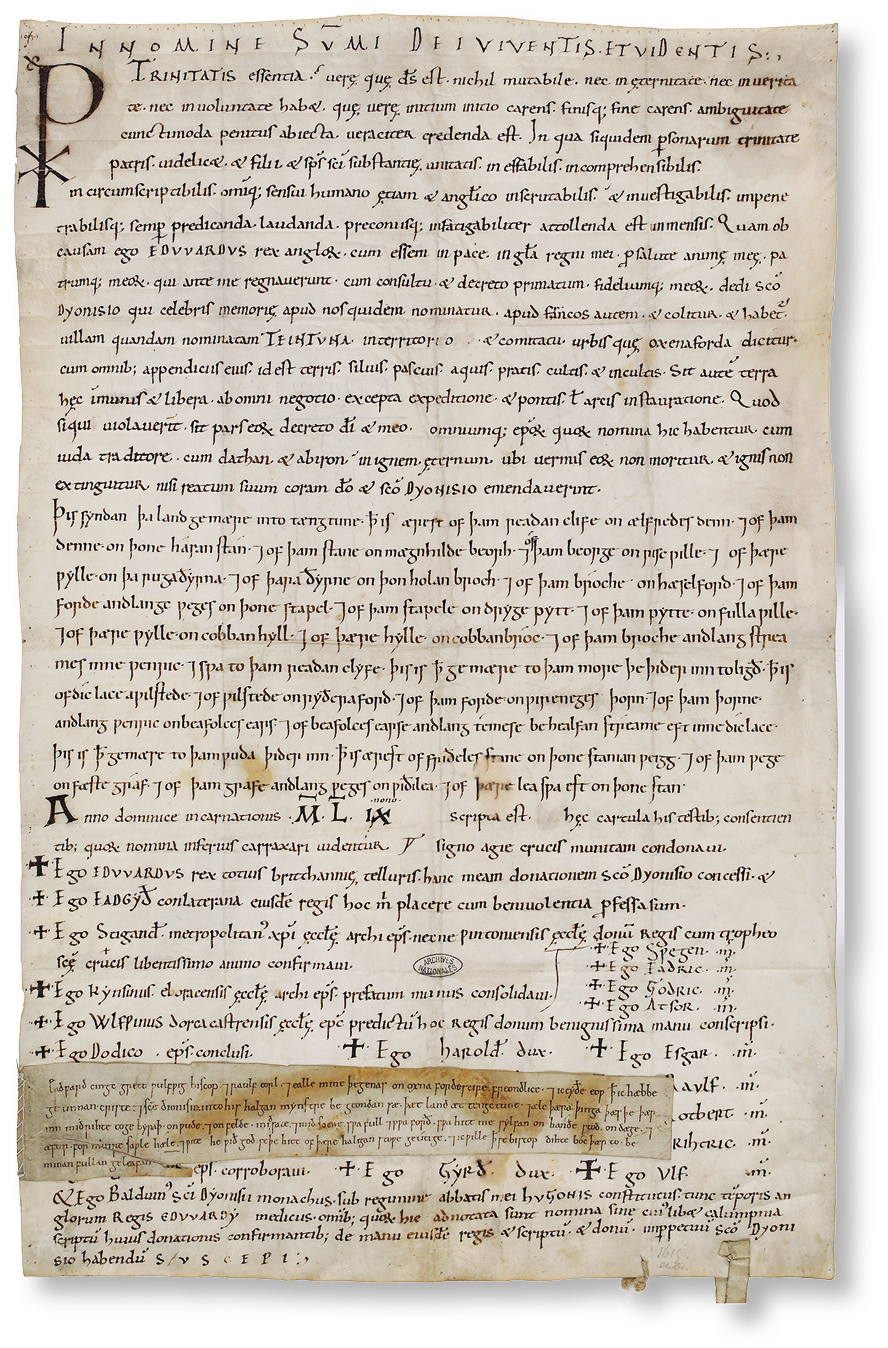
The Saint-Denis Writ and Diploma of Edward the Confessor: S 1105 (c.1053-1057) and S 1028 (1059), to which the seal was attached before it became lost in the 1980s. Image: © Paris, Archives nationales, AE/III/60 (olim K//19, no. 6)
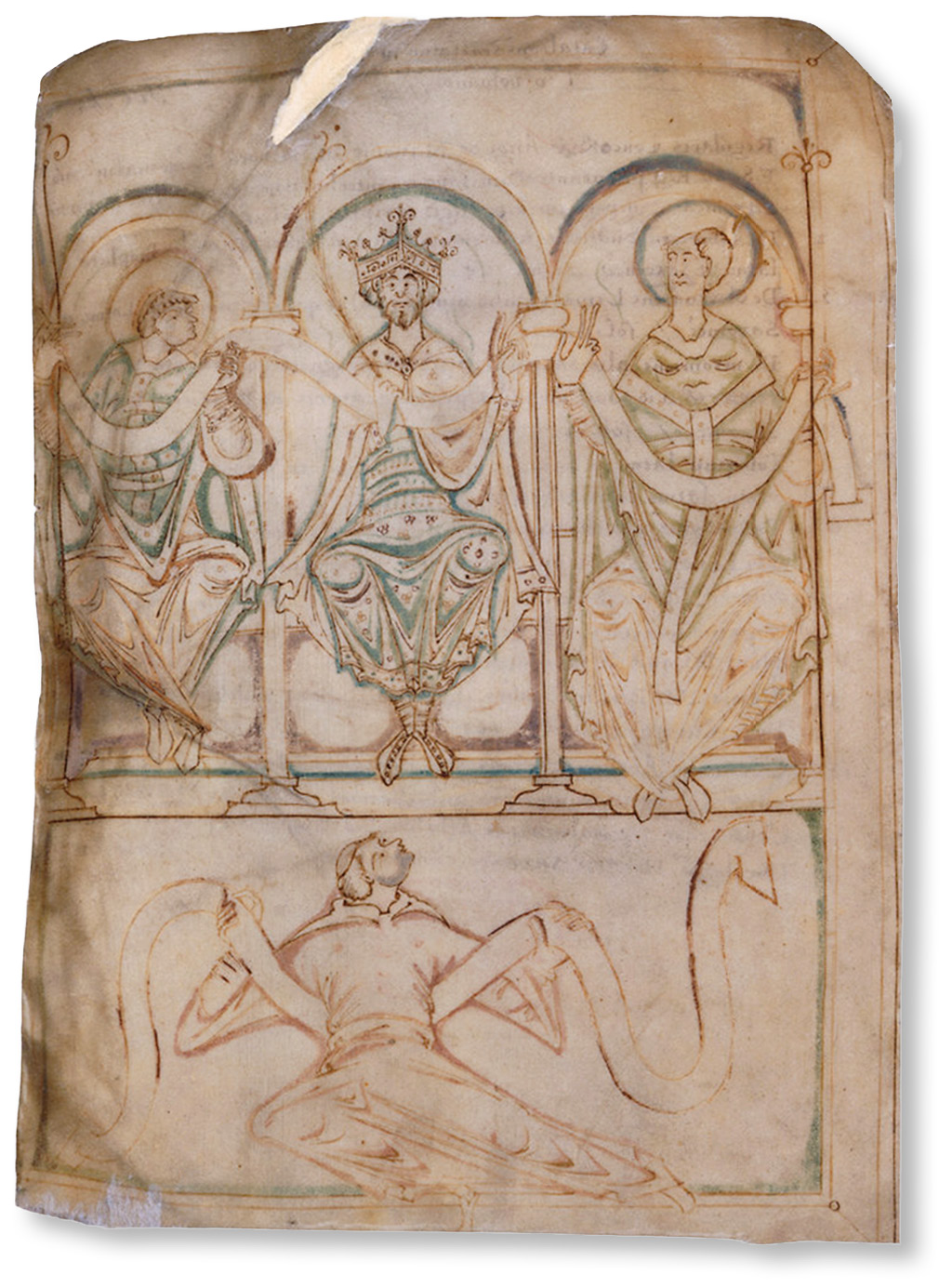
Edward the Confessor’s grandfather, Edgar (r. 959-975), shown crowned in majesty on the frontispiece of the Regularis Concordia. Image © London, British Library, Cotton Tiberius A. iii, 2v
Imperial aspirations
On one side of the 7cm-wide (3in) wax disc, Edward is shown on his throne, holding an orb and sceptre, while on the other he sits in a similar pose but this time with a sceptre and a sword. Both images are surrounded by the same text, which hails the king as Anglorum basileus. Βασιλεύς, Greek for ‘king’, was the traditional title used by the Byzantine Emperor from the early 7th century onwards, and while this style was periodically employed from the time of an earlier member of the West Saxon dynasty, Athelstan (r. 924-939), the researchers note that it was never a stable feature of English documents. Instead, Edward’s predecessors generally preferred to style themselves using Old English or Latin equivalents – cyning or rex – although some 10th-century rulers (particularly Athelstan) did also use Latin titles with more obviously imperial overtones, such as imperator and primicerius, when asserting authority over the whole of Britain. Edward’s use of basileus fits well within these hegemonic ambitions – a powerful statement whose tone, and Continental borrowings, are also reflected by the seal’s imagery.
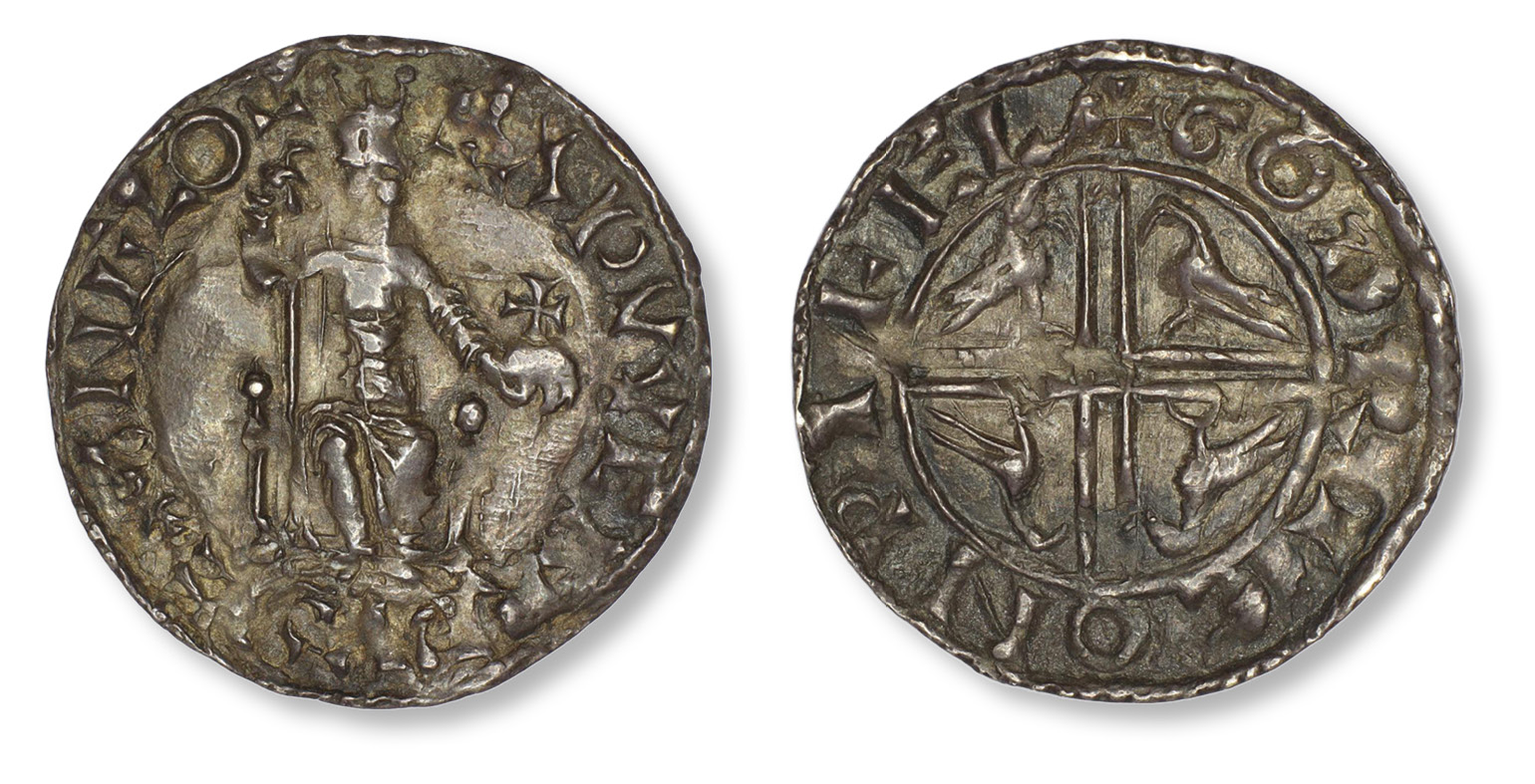
Both sides of the wax impression show the king enthroned, crowned, and holding various insignia of sovereignty: a combination that is known as a ‘seal of majesty’. This motif (which also appears on Edward’s coinage) has a long pedigree across the Channel. Ninth-century manuscripts depict the Carolingian emperors Lothair I (r. 817- 855) and Charles the Bald (r. 875-877) enthroned, while orbs and sceptres can be seen on Byzantine imperial seals from the turn of the 8th century. Otto III, German emperor from 996 to 1002, was the first ruler to use a full ‘seal of majesty’ in the Latin West, and this iconography was used by many of his successors. In 11th-century England, however, these ideas were still novel. Traditionally, only Christ and biblical figures were shown enthroned in majesty in Anglo-Saxon artwork, Guilhem and Levi note in their paper, and Edward’s seal is only the third English depiction of an enthroned royal figure, following his grandfather Edgar (on the frontispiece of the early 11th-century Regularis Concordia) and his mother Emma of Normandy (on the frontispiece of the 1042 Encomium Emmae).

Pointed imagery
Continental inspiration is even more evident in the image of Edward holding a sword which, the paper’s authors observe, is clearly drawn from Byzantine models. Though the Saint-Denis example is thought to represent the first time that this motif has appeared on a royal seal from Western Europe, images of sword-bearing monarchs were already in circulation on 11th-century Byzantine coinage, especially in the years immediately before Edward’s seal was created, such as issues of Constantine IX Monomachos (r. 1042-1055) and Isaac I Komnenos (r. 1057-1059).
‘You might think that it’s self-evident that a sword should be a royal attribute,’ said Guilhem. ‘But at this point in English history, it’s almost not been used. We do see it, however, in the Byzantine coinage, where it had been introduced no more than five to ten years earlier. So this suggests strong connections with, and quick responses to, Byzantine iconography, either directly or as it was transmitted through Europe.’
The fact that Edward the Confessor should be familiar with, and entirely comfortable with drawing on, Continental iconography is not surprising. His mother was a Norman noblewoman, and after his father Æthelred II died and Cnut conquered England in 1016 (CA 321), Emma married Cnut and Edward was sent into exile, spending his formative years in Normandy. As king, many of his advisors came from this region, including Robert of Jumièges, whom Edward appointed Bishop of London and then Archbishop of Canterbury. This is not to say that Edward’s seal is simply a copy-cat of Continental designs, however. Its composition is strikingly innovative, Guilhem and Levi emphasise, combining multiple emblems of imperial legitimacy – both Western and Byzantine – and also incorporating Anglo-Saxon ideas to evoke a potent model of kingship.
The wax artefact itself, being a double-sided hanging seal that would have been suspended from its manuscript, represents something new in Anglo-Saxon England, the researchers write – and this invention appears to have coincided with the emergence of a new kind of sealed document called a ‘writ-charter’. These were used by kings to grant land or rights, while simultaneously commanding local officials to enforce its contents, and Guilhem and Levi argue that such documents were a novelty during Edward’s reign. Perhaps, within this context, Edward also devised a new Continental-inspired seal to authenticate this new document-form – and, in doing so, created a new canvas on to which he could project his regal ambitions. The result is a striking statement of sovereign strength, one that adds colour to our image of a king who is best-known for his piety, and whose dynasty ended with his reign, sparking a succession crisis that culminated in the Norman Conquest.
G Dorandeu and L Roach (2026) ‘Lost and found: the Saint-Denis seal impression of Edward the Confessor (1053 x 1057) and the development of the Early English writ-charter’, Early Medieval England and its Neighbours 52:e8; https://doi.org/10.1017/ean.2025.10014 (open access).