
Subscribe now for full access and no adverts
Long before the white heat of the Industrial Revolution forged Sheffield into the ‘City of Steel’, the South Yorkshire settlement was renowned for the quality of the metal blades and tools produced within its bounds. When he wrote The Canterbury Tales in the late 14th century, Geoffrey Chaucer was clearly confident that his audience would understand a reference to a Sheffield thwitel (a kind of steel knife) in ‘The Reeve’s Tale’, and steel production would continue to shape the city’s destiny for centuries, taking on an unstoppable momentum when local manufacturer Benjamin Huntsman invented the revolutionary crucible process in 1742. Cutlery is a product particularly associated with the city (even before the invention of stainless steel by Sheffield-based chemist Harry Brearley in 1912), but if we turn our attention from Sheffield’s industrial heritage to the story of its origins, we find ourselves amid the clash of rather more lethal blades.
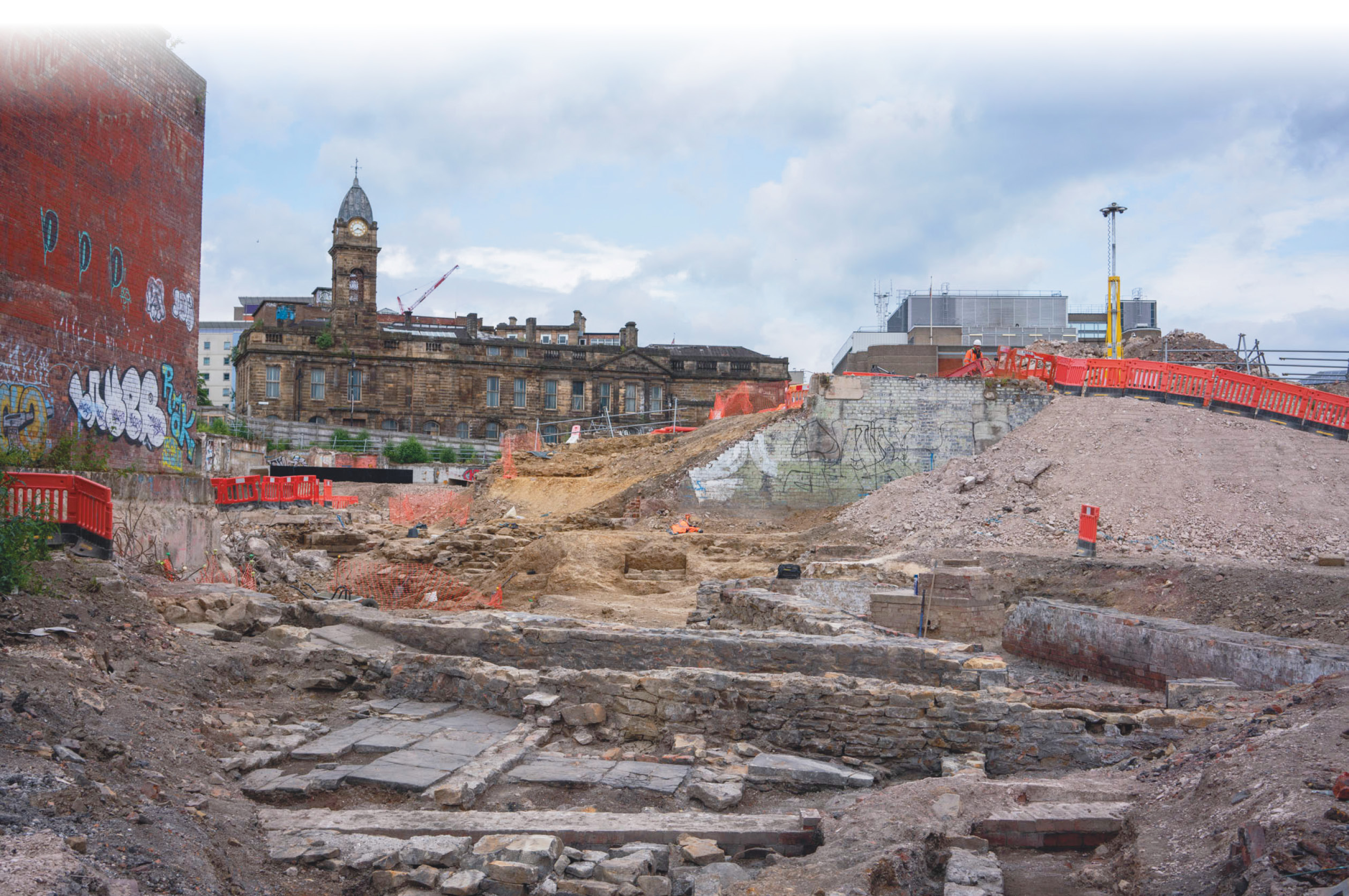
In the years after the Norman Conquest, castles sprang up across the country as an unmissable stamp of authority on the newly subdued landscape. The area that was to become Sheffield was no different, with an imposing fortification founded above a strategic double river-crossing at the confluence of the Sheaf and the Don. It was the earliest known element of the core settlement, and for this reason the castle site is often called ‘Sheffield’s birthplace’ – but until recently no trace of this influential building could be seen above the ground.

Sheffield Castle had been rebuilt and refortified over the centuries – by 1570 it was deemed a suitably secure prison for Mary, Queen of Scots, who was confined there on the orders of her cousin, Elizabeth I – but when England was again riven by conflict, the site suffered a dramatic change of fortunes. During the Civil War, Sheffield and its castle found themselves in a deadly tug of war, being first seized by Parliamentarian forces in 1642, then wrested back by Royalist troops in 1643, before suffering a ten-day siege in 1644. When the resident Royalists finally surrendered, the castle was slighted and its ruins left to stand as a stark symbol of defeat.
Over subsequent years, the castle’s crumbling remains were gradually robbed away and recycled into nearby building projects, while its footprint was ultimately covered over by a succession of industrial and commercial structures – most recently, the indoor Castle Market, which closed in 2013. Once dominating the local skyline, the fortifications became completely absorbed into their increasingly urban surroundings, invisible to passers-by – but this is now set to change.

When the city market was relocated to The Moor shopping precinct over a decade ago, the once-bustling Castlegate area entered a deep decline. Sheffield City Council is now working to counteract this, through the Castlegate Regeneration Project, which will see the derelict market site transformed into a new green space for the community to enjoy. This initiative will include uncapping the culverted section of the River Sheaf to create an attractive open watercourse flowing through the park – but, crucially for our purposes, that is not all that will be uncovered. The project also involves excavating and displaying some of the castle remains – which is where Wessex Archaeology come in.
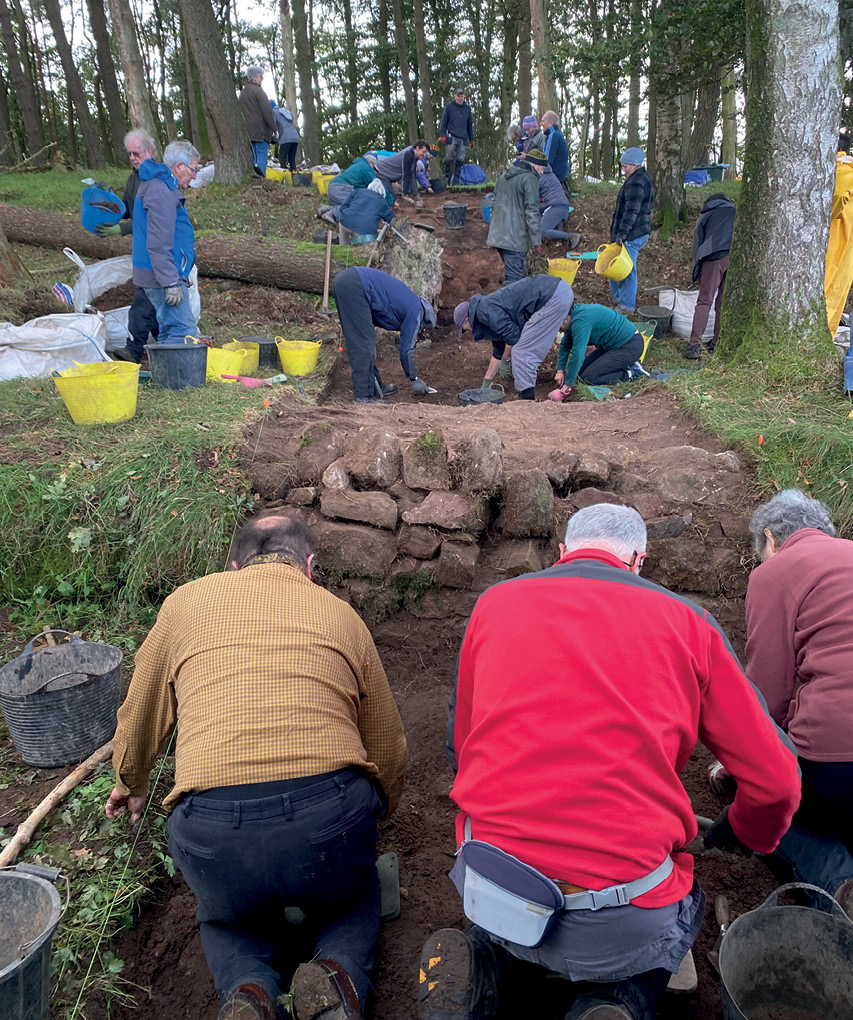
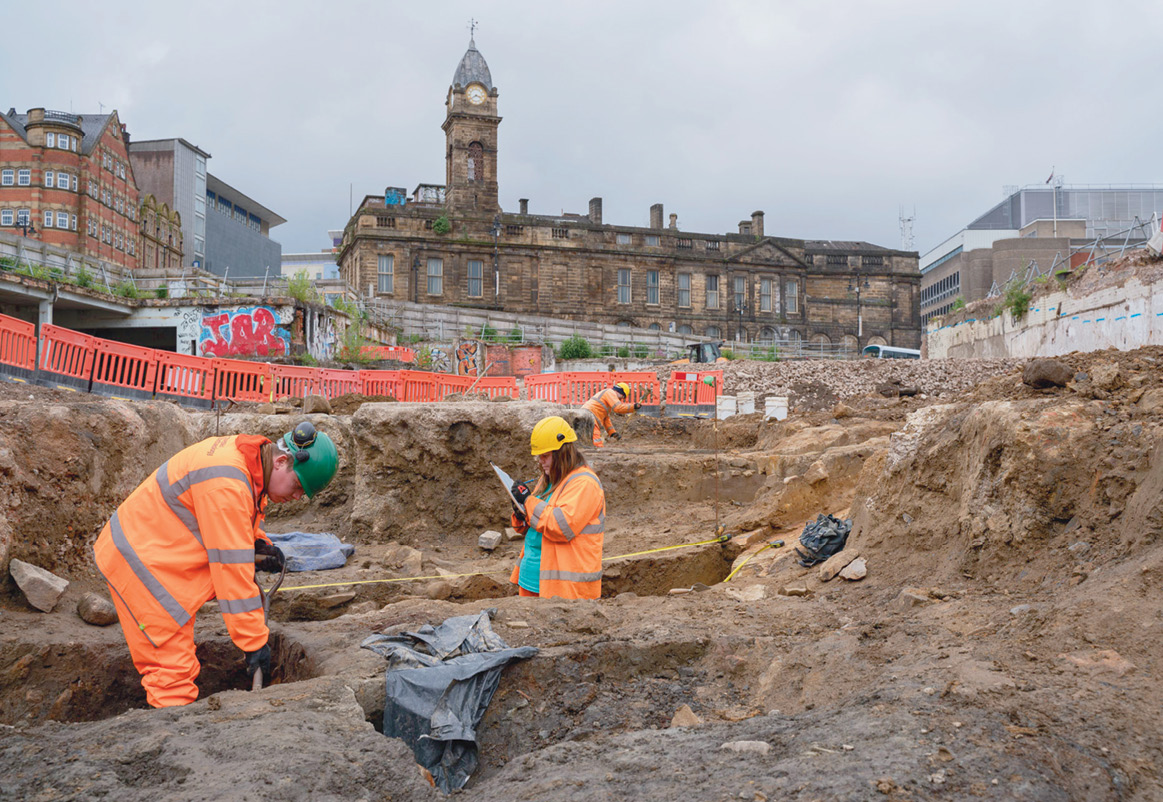
Following initial evaluations in 2018 (see CA 351), this summer Wessex Archaeology completed a 12-week excavation on the site on behalf of principal contractors Keltbray. They worked with local volunteers, and maintained good relationships with South Yorkshire Archaeology Service, the Friends of Sheffield Castle, and Sheffield University. Together, they have painstakingly peeled back layer after layer of later constructions covering the castle – and, in doing so, they have documented not only the first page in the Sheffield story, but intriguing snippets of subsequent chapters, tracing the settlement’s evolution from medieval stronghold to industrial innovator, and reflecting the city’s ongoing search for a post-industrial identity.

Slaughterhouses and steelworks
As we walked from the site office towards the excavation, Ashley Tuck (who is heading the investigations on behalf of Wessex Archaeology) described how the castle had come to fade from view. Upstanding elements of the ruin could still be seen into the 18th century, when its interior was transformed into a (no doubt rather picturesque) bowling green. Playing bowls was ‘the hot new sport for young men to show off their energy and virility’, Ashley said, and, in keeping with the upwardly mobile trajectory of the neighbourhood that this fashionable facility served, elegant houses soon flourished on the fringes of the castle site – many of them reusing its stonework in their foundations.
The area’s residents were in for a shock, however, when they gained rather unwelcome new neighbours. The local slaughterhouses, which had previously operated in the town centre, relocated en masse to the banks of the Sheaf and Don, where they could sweep waste directly into the waters below. It was no doubt a convenient move for the owners of the abattoirs, and an improvement for public health, but the arrival of such noisy and pungent premises radically transformed the area’s fortunes. No longer a desirable residence for the well-to-do, the castle site instead became dominated by commercial buildings.
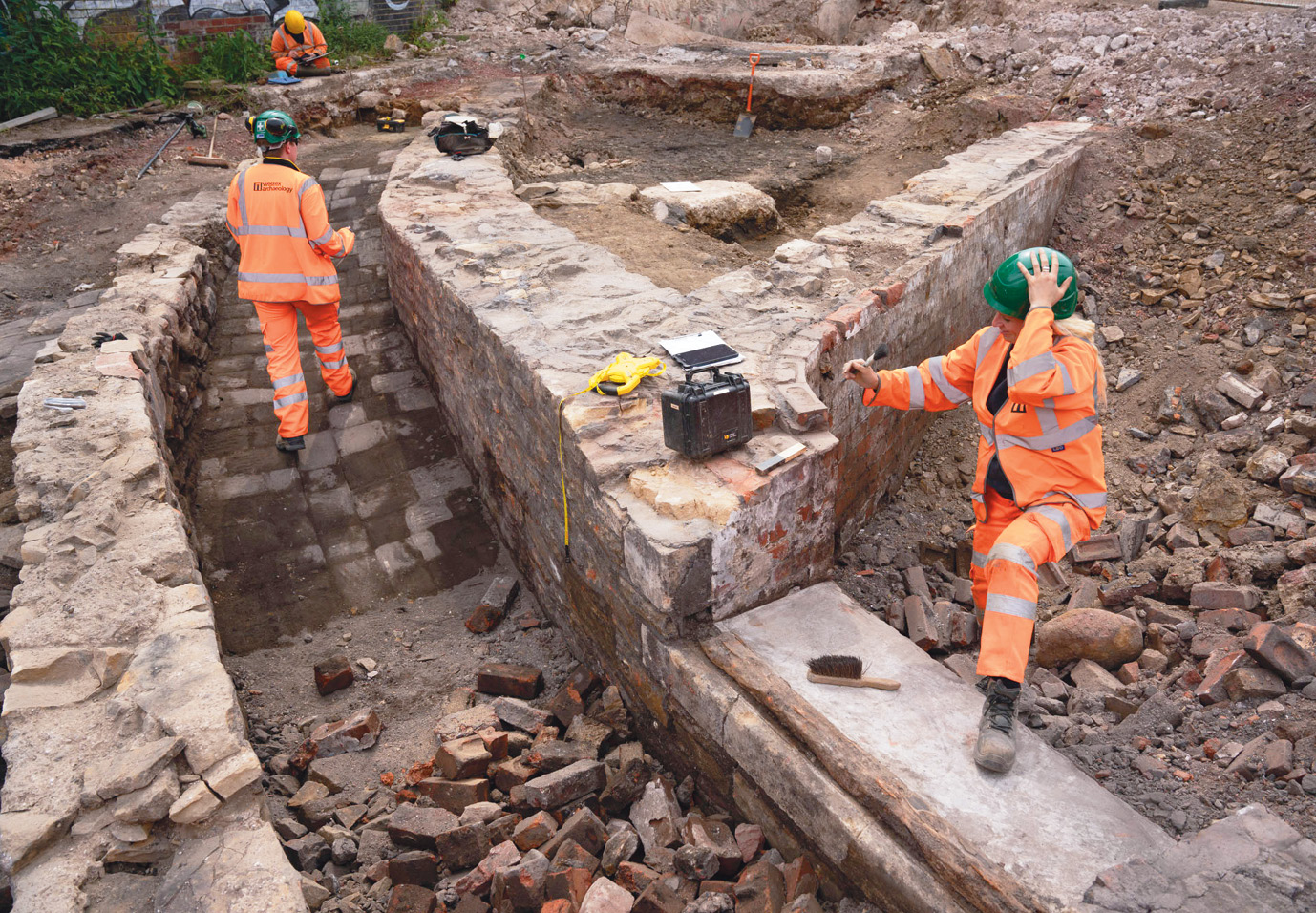
Part of a cold store belonging to one of the slaughterhouses was uncovered during Wessex Archaeology’s recent investigations, built against a narrow lane locally known as a ‘gennel’. A short section of the alley’s sloping floor and stone walls are impressively well-preserved, and they are going to be retained and incorporated into the design of the new green space. Any visitors who wander through the gennel will not only be following a Victorian route, but tracing a much earlier feature. The alley’s path is thought to fossilise the outer edge of the castle moat, showing how the medieval landscape and its defensive features continued to influence their surroundings long after they went out of use.
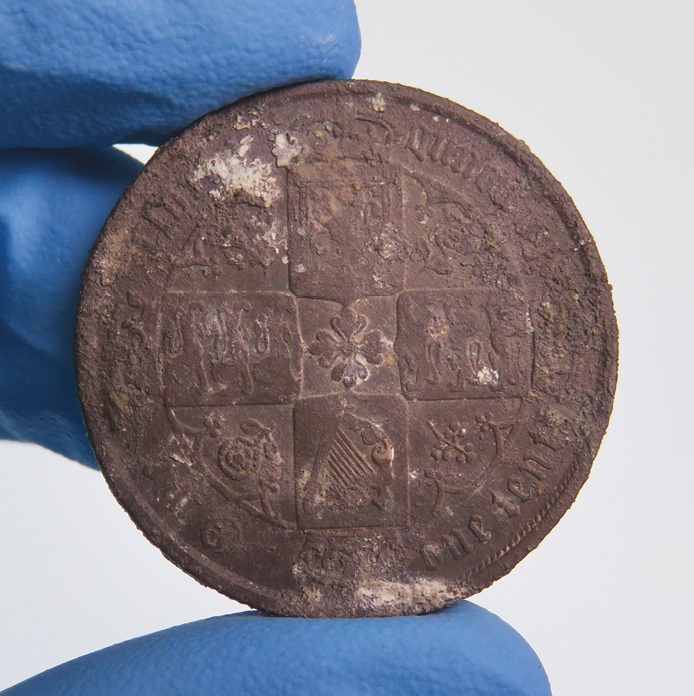
On the other side of the lane lay a series of foundations picking out the footprints of small blind back houses. Butting directly on to the gennel, these had been the homes of workers employed by the nearby slaughterhouses, and, as we stood looking over the remains, the poor quality and cramped conditions of the dwellings were plain to see. ‘Imagine raising children here,’ Ashley commented. ‘Imagine watching them play beside the stinking river, by now polluted by industry, and hearing the sounds of animals being slaughtered all day.’ The team are also analysing contemporary census records to learn more about the houses’ inhabitants, and artefactual evidence has already helped to illuminate their experiences, with finds like pottery fragments and pieces of clay tobacco pipes speaking of everyday activities and some creature comforts. One object spoke of a loss that must have been much more keenly felt, however: this was a florin, a silver coin worth two shillings, which would have been a significant contribution to the household budget to have slipped through the floorboards.
The slaughterhouses, which went out of use in the 1920s, were not the only industries whose sounds and smells would have dominated the site during the Victorian period. This area was also home to not one but three steelworks, and a portion of one of these was brought to light during the recent archaeological works.
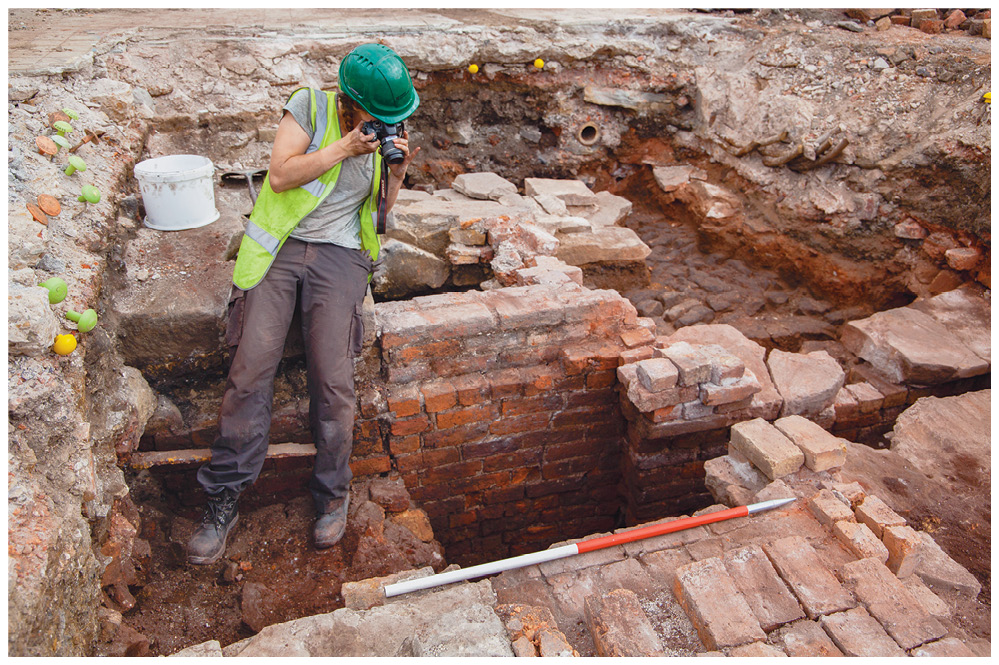
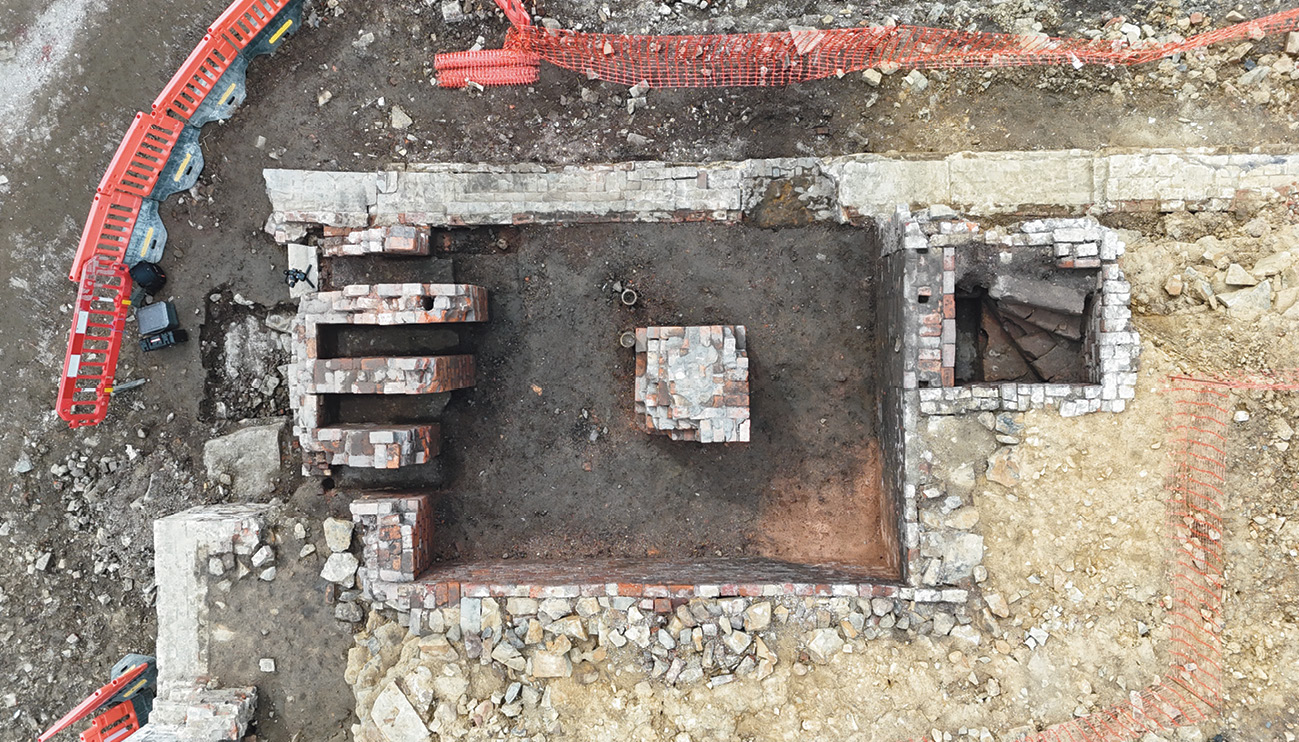
Industrial echoes were first noted during the 2018 evaluation, when Wessex Archaeology uncovered parts of a cementation furnace that would have been used to produce blister steel. After Benjamin Huntsman’s innovation in 1742, though, this material could be further refined into higher-quality crucible steel. During the 2024 excavation, the team was therefore excited to expose evidence of a crucible furnace, meaning that both elements of this process are now represented on the site. Beneath a brick vaulted ceiling and a series of stone steps leading into a cellar they found distinctive rows of brick bays: the rake-out pits that once stood beneath the furnace to catch the copious quantities of ash that the crucible process produced. Although the steelworks structures have now been taken out in order to examine the castle remains buried beneath them, they have been carefully documented and their bricks are destined to be reused as part of the Castlegate park.
Recapturing the castle
What of the castle itself? Although no trace of the fortifications could be seen above the surface, excavations by Leslie Armstrong during construction works on the site in the 1920s, and by Leslie Butcher and J Bartlett during post-Blitz redevelopment in the 1950s had previously confirmed the presence of substantial medieval masonry still buried in situ. More recently, investigations by ARCUS (the former archaeological unit based at Sheffield University) and research by Ed Dennison Archaeological Services (EDAS) have added to this picture.
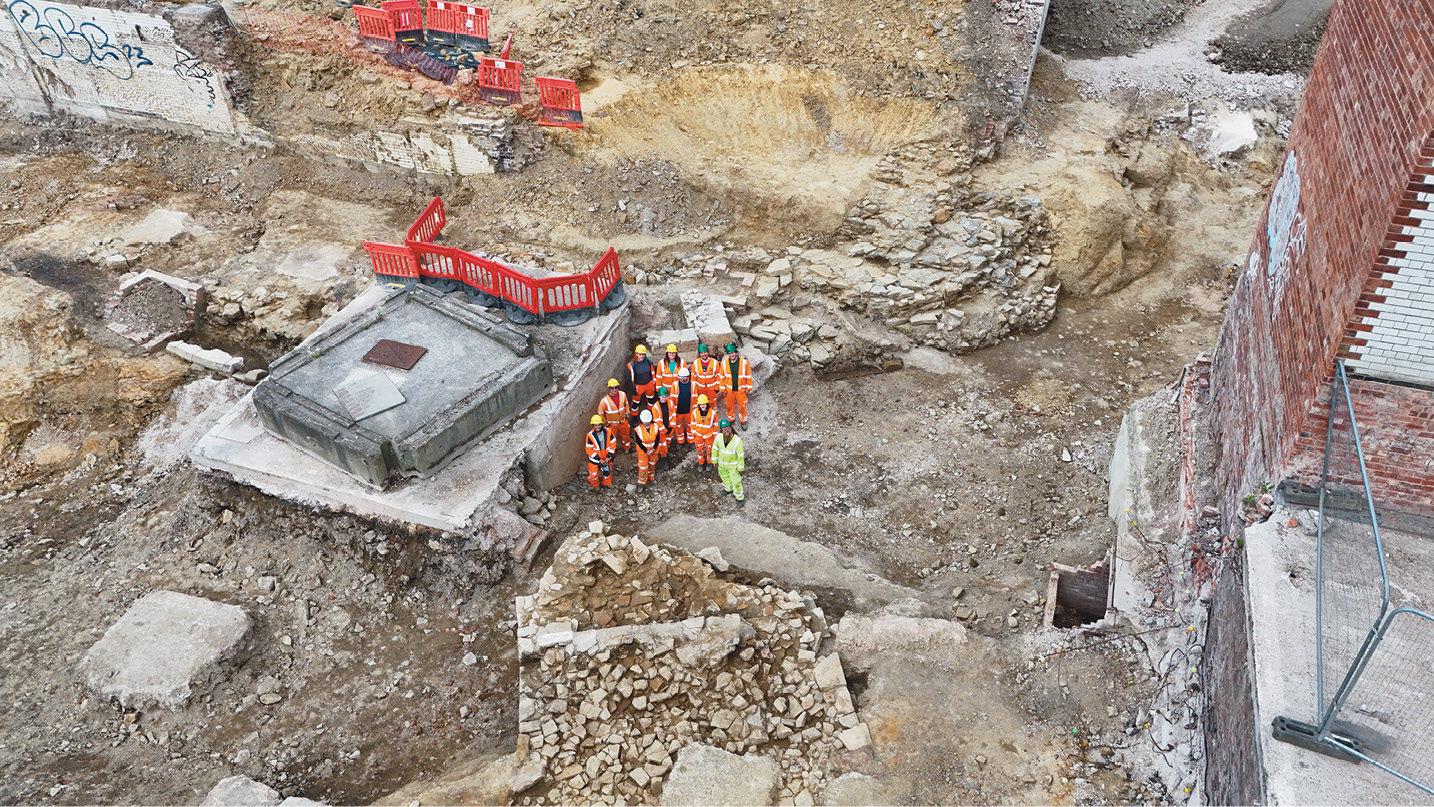
When Butcher (from the City Architect’s department) and Bartlett (Deputy Director of the City Museum) carried out their investigations 70 years ago, one of the most significant features that they identified was the western tower of the castle’s mighty gatehouse, which was found to stand largely intact, with many of its large facing stones still present. To preserve these remains for posterity, they were ultimately enclosed inside a concrete chamber within the basement of the main market building. Several of the project volunteers vividly recalled descending into the dimly lit space on a ladder in order to view the remains in their rather claustrophobic new home. The concrete box was still standing at the time of my visit, but it will be taken down as part of the regeneration project so that the gatehouse remains can be viewed more safely, and in daylight. Its construction might seem a forward-thinking gesture compared to the destruction wrought by modern services all around it, but, as Ashley highlighted, its creators had ploughed through other castle remains in order to build it.
What was not known at the outset of Wessex’s work was whether the eastern half of the gatehouse had also survived. It is depicted on Bartlett and Butcher’s site plan as a dotted line perfectly mirroring the western tower, raising questions about whether they had actually encountered the eastern one. Ashley had not been convinced that the present project would uncover anything of this latter feature – but he was delighted to be proved wrong when its imposing bulk came to light once more. This part of the gatehouse is rather more ragged in outline than its western neighbour, as much of its facing has been robbed away to expose its sturdily built core, but its scale was still impressive to see.
Close by, Ashley pointed out part of the north drawbridge abutment (the stone platform from which the wooden walkway was hinged and lowered) and south abutment (the masonry on to which it descended). This trio of features would have been the first elements of the castle encountered by medieval visitors after passing through the outer bailey, but they bore the scars of later activity on the site, their stonework spattered with globs of concrete from the construction of Castle Market. The gatehouse remains have also been sliced through by a drain that once served the women’s toilets linked to the shopping space, while the face of the drawbridge plinth had been sheared off by the installation of a cable connected to a small brick electricity substation that still stood nearby. Nonetheless, they represent a potent reminder of how impressive the approach to the castle would have been – and a final surprise came in the last week of the excavations, when the team found more of the western tower surviving outside the concrete chamber. All of the gatehouse remains will be consolidated and displayed within the new green space.
Of mottes and moats
Another dominant feature of the medieval landscape was the castle motte, although it had become completely obscured by modern buildings and was only reidentified in 2018. Since then, analysis of the mound’s make-up has been illuminating. It had long been thought that the motte was a natural hill that had been adopted as a defensive feature, but we can now tell that its clay-capped mass is entirely human-made, representing an enormous commitment of labour and resources.
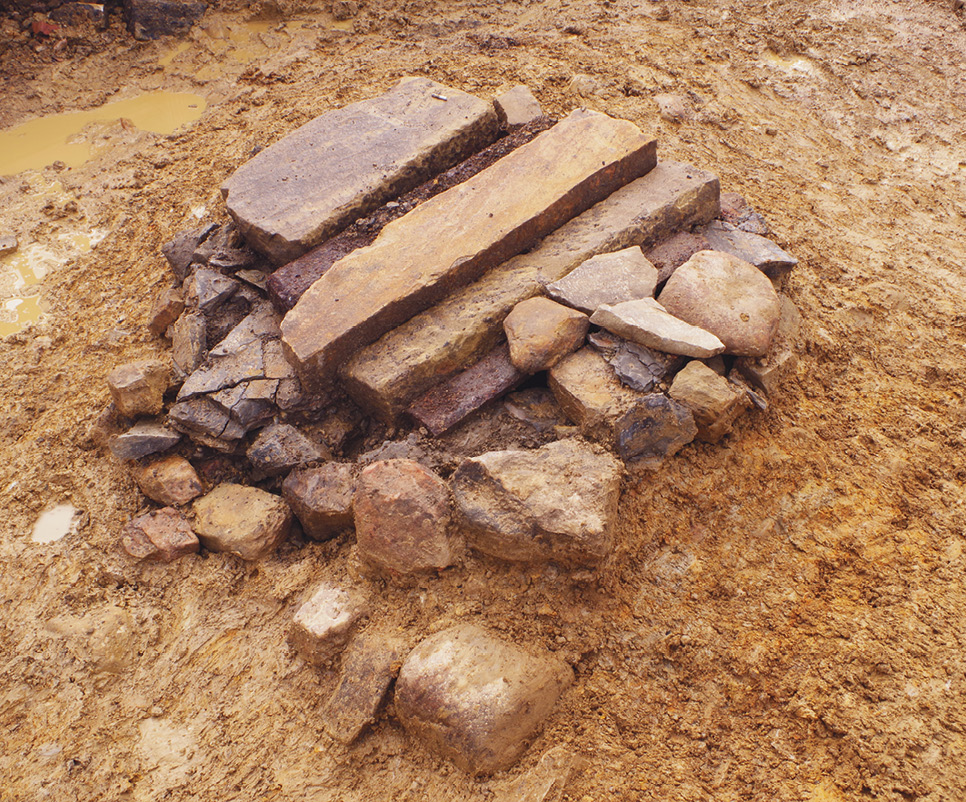
On its summit, the team identified the mouth of a well that had been blocked with iron bars in the 19th century, with one of the steelworks’ walls constructed over it. When Wessex Archaeology lowered a camera and a measuring tape into the feature, they found that it descended to a depth of 12.5m and still had water at its base.
Rather less substantial than the well, but potentially even more significant in terms of understanding the castle, were two other features that Ashley pointed out nearby. These were a large post-hole on the highest point of the motte, from which charcoal has been recovered, and a distinctive red patch of burning identified within the mound’s surface, which have been sampled for radiocarbon- and archaeomagnetic-dating respectively. The chronology of the castle’s construction is not currently well understood, so it is hoped that this analysis could help to clarify the matter, and establish the age of the motte.

Contrasting with the motte rising high above the landscape, the castle’s other key defensive feature would have been the moat dug around it. As mentioned above, part of its course is preserved by the line of the Victorian gennel, but Wessex Archaeology have traced another stretch through borehole survey. They then opened a chequerboard of slots along its length, revealing that although the moat had been disturbed by the market’s concrete foundations, a wealth of information was still preserved within surviving fills. From these deposits the team have recovered medieval green-glazed pottery, a copper-alloy jetton (a kind of token used in lieu of money) from mid-16th-century Nuremberg, and material from the time of the Civil War. Most excitingly, the excavations revealed the presence of another ditch in the same area. Its date is unknown, but as it is cut by the moat it must pre-date it; Ashley wonders if it might reflect an earlier iteration of this boundary.

Another important linear feature identified by the team was a long stretch of castle wall, well-preserved with medieval mortar still present in places. There had been no hint of its presence prior to the investigation, and its discovery saw the excavation extended by two weeks so that it could be documented in detail. It has been interpreted as part of an interior range of buildings and, with no surviving images of Sheffield Castle known, such tangible traces are invaluable for piecing together its layout.

More than that, though, this area of the excavations served as a neat visual summary of how the site, and the city of Sheffield, had evolved over the centuries. Running perpendicular to the castle stonework was another wall, this time with 18th-century facing – part of the high-status housing contemporary with the bowling green, Ashley said. Meanwhile, the medieval masonry itself was topped with a layer of later bricks that had belonged to a steelworks, and also butted up against the remains of a wall from the demolished market building.
‘Twenty years ago this was a vibrant, popular area with a thriving market, but when the market relocated it went into decline,’ Ashley said. ‘Finds like these can help to inform the identity and meaning not only of this site, but of post-industrial Sheffield – we now have an opportunity to put the city’s origins back on display, and in doing so revive this area’s fortunes and make it part of the community again.’
Further information: For more details of the Sheffield Castle project, including insights from the local community and video updates, see www.wessexarch.co.uk/our-work/sheffield-castle.


All images: Wessex Archaeology, unless otherwise stated