Subscribe now for full access and no adverts
The latter part of the 19th century was the Golden Age for Egyptological exploration and collecting. Many famous names are associated with this period of academic and amateur enthusiasm, such as Jesse Haworth, founder of the Manchester Museum, and William Flinders Petrie. But one name is less well-known and should perhaps be given more attention: the collector and polymath Aquila Dodgson.

Cotton and the Bible
The American Civil War (1861-1865) affected trade in cotton with the UK. The USA had supplied 80% of Britain’s raw cotton, but by August 1861 this supply was virtually non-existent, so new sources were needed to keep Britain’s cotton industry alive. The focus shifted to Egypt, which produced high-quality cotton goods, and where there was already a strong British influence.
At the same time, there was a strong religious tradition in Britain whose followers were particularly interested in proving the truth of the Bible, encouraged by the decipherment of hieroglyphs earlier in the century. This led to a huge growth in the study of Egyptology, and ministers of religion were frequently involved in the collection of Egyptian artefacts. In the early days, when there was little restriction on the removal of goods, consignments of textiles, sculptures, and papyri – and even human remains – arrived in Britain to help promote interest in the exploration work being done in Egypt. Wealthy individuals were encouraged to contribute to such projects.
One such sponsor was the Reverend Aquila Dodgson. He was born in Yorkshire in 1829, and worked as a Congregational minister in Ashton-under-Lyne (near Manchester), where he lived for a number of years. His ministry was cut short when a health problem affected his voice, which prevented him from preaching, but his forced retirement gave him the opportunity and time to build a successful business in the flourishing North-West cotton industry (the 1881 census records him as a cotton spinner employing 85 male and 41 female workers), and to develop his interests in ancient Egypt.

Collector and Egyptologist
Aquila Dodgson settled with his wife Jane and family at Limehurst House in Ashton-under-Lyne, from where he was able to build a network of influential contacts in the world of Egyptology. Locally he became friendly with a close circle of enthusiasts including the Bradbury family, the Armitages, and the Haworths. He became an active member of the Albion Literary Society, connected with the large Albion Congregational Church in Ashton, where he addressed his fellow members on topics such as ‘Three Pharaohs’ – allowing him to develop his interest still further.

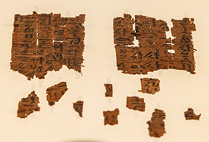
Dodgson became a prolific collector of artefacts and papyri, and in May 1887 loaned items for display in a huge exhibition at Old Trafford in Manchester to commemorate Queen Victoria’s Golden Jubilee. Surviving correspondence reveals a prolific and regular exchange of letters between Aquila and Samuel Birch, Head of Egyptian and Assyrian Antiquities at the British Museum. One of these relates to a papyrus acquired from another notable collector in his circle, Elkanah Armitage, who was at the time a minister in Oldham. Armitage had bought it from a street vendor in Elephantine. Apparently its seal was still intact when given to Aquila, and had been placed in a box for safety, but was later lost – perhaps accidentally – by one of the Dodgson family. This text, known as Papyrus Dodgson, is kept at the Ashmolean Museum in Oxford. There is even a record of Aquila asking Petrie to sell him a mummy. The going rate was apparently £5 for a ‘plain’ one and £10 for a ‘fancy’ one.

Other correspondence between Dodgson, Birch, and Theo Pinch of the British Museum reveals a wide range of material being studied by those interested in biblical and Egyptological matters. For example, a Babylonian clay tablet relating to the Flood story was of great interest because of its biblical connection. There were also regular discussions about hieroglyphic inscriptions and about antique objects collected by enthusiasts.
Petrie and Amelia Edwards
Dodgson enjoyed the company of many like-minded scholars who became regular visitors to the Manchester area. Some of these visits were recorded in the correspondence of such notable individuals as Flinders Petrie and Amelia Edwards, founder of the Egypt Exploration Fund. A visit to the Bradbury family in Ashton is recorded in Petrie’s letters. It describes Aquila and his wife joining a gathering where Petrie spent the afternoon studying the latest consignment of textiles. He was clearly impressed by them, writing that: ‘The Dodgsons were as pleasant as ever. I like Mrs D’s good sense.’

In 1891, Petrie invited Aquila to join him in Egypt. Apparently he had suffered some kind of disaster in his business, so perhaps Petrie hoped to distract him from his personal difficulties. Petrie was keen to have the company of both Dodgsons. In his letters, he points out that his guests would have to live in a tent, ‘but I see no difficulty in the way of a practical person like your prudent wife’. His description of the rations which would be available does not sound too encouraging (fish, tongue, vegetable soup, jam, wholemeal biscuits, cocoa, tea, coffee), but he notes that Mrs Dodgson would be reassured by the presence of soap, carbolic acid, and insect powders on the list. The Dodgsons accepted the invitation and set off by boat up the Nile, visiting Petrie at his excavations in Tell el-Amarna.
The Dodgsons were also in regular contact with Amelia Edwards, who was working tirelessly to increase knowledge of and enthusiasm for Egyptology through her book A Thousand Miles up the Nile, which had already encouraged many others to follow in her wake. She was a formidable correspondent with a wide range of contacts, and she became a close friend of many notable figures in the Egyptological world. As a regular visitor to Manchester, she met with many fellow Egyptophiles such as the Bradburys, Haworths, and Dodgsons, and gave lectures at Owens College.

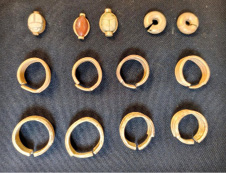
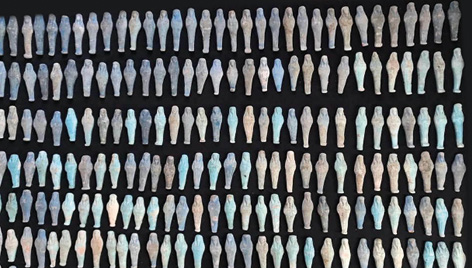
Aquila retired to Leeds c.1885 and, following his death in 1919 (at the age of 90), a large portion of his collection was given to the Leeds Museum; his son donated a number of other objects in 1945. The collection includes faience amulets of Anubis, Ptah, Bes, Taweret, Isis, Horus, Nephthys, Osiris, and Shu, as well as necklaces and small statuettes. Over the years, some items have been acquired by other museums, including the Ashmolean in Oxford, and some have even found their way to Melbourne, Australia (the Dodgson Collection of Egyptian Antiquities and Coptic Textiles in Queen’s College).
There were so many notable contributors to the study of ancient Egypt; Aquila Dodgson, though less well known, played a very important part and is certainly worthy of recognition.
Hilary Forrest is a regular contributor to AE magazine’s book review section, and is the author of Manufacturers, Mummies and Manchester: two hundred years of interest in and study of Egyptology in the Greater Manchester area, published by Archaeopress in 2011.