
Subscribe now for full access and no adverts

The Peloponnesian War – a titanic struggle for control of Greece between the opposing forces of Athens and Sparta in the 5th century BC – is known to us largely through the writings of a single individual. He was Thucydides, a wealthy Athenian who was himself a minor participant in the war. He was not the first historian of the Classical world – that was Herodotus, who was some 20 years his senior – but he was the first to adopt a recognisably professional approach to his subject. Where Herodotus retailed anecdotes with varying degrees of accuracy, Thucydides set out to produce a sober, reliably researched chronicle of his own time. He was deeply interested in the complex causes of historical events. Untypically for his time, he avoided explanations based on the presumed will of the Greek gods. He was a serious scholar, who explicitly intended to leave a legacy in prose to future generations: ‘It will be enough for me,’ he wrote, ‘if these words of mine are judged useful by those who want to understand clearly the events which happened in the past and which (human nature being what it is) will, at some time or other, and in much the same ways, be repeated in the future.’
An epic clash
Thucydides did not, of course, meet in full the stringent standards that would be expected of modern scholarship. It is striking that he does not reveal his sources. Although he aimed to report events faithfully, he did not apply the same rigour when relaying speeches. Indeed, he admits to presenting the speaker’s main points and what he felt the situation called for. Thucydides vividly evokes the nature of the competing powers and their allies. The reader has a ringside seat at the epic clash between maritime Athens – restless, expansionist, and risk-taking – and its more cautious, enduring, land-based Spartan antagonist. He also takes a keen interest in military matters, recounting sieges and battles in detail.
Thucydides is remarkably objective in his reporting of the war. He does not even seek to justify his own failure to avert the fall of Amphipolis to the Spartans, in spite of the lengthy exile imposed on him as a penalty. Yet he does have strong views on the forces that shaped the conflict, and on the individuals who held high command. Thucydides’ mistrust of the unrestrained power of Athenian democracy comes across clearly. His admiration for the aristocratic leadership of Pericles, in the early stages of the war, contrasts sharply with his portrayal of his successor, Cleon, whom he depicts as an unscrupulous manipulator of public opinion.
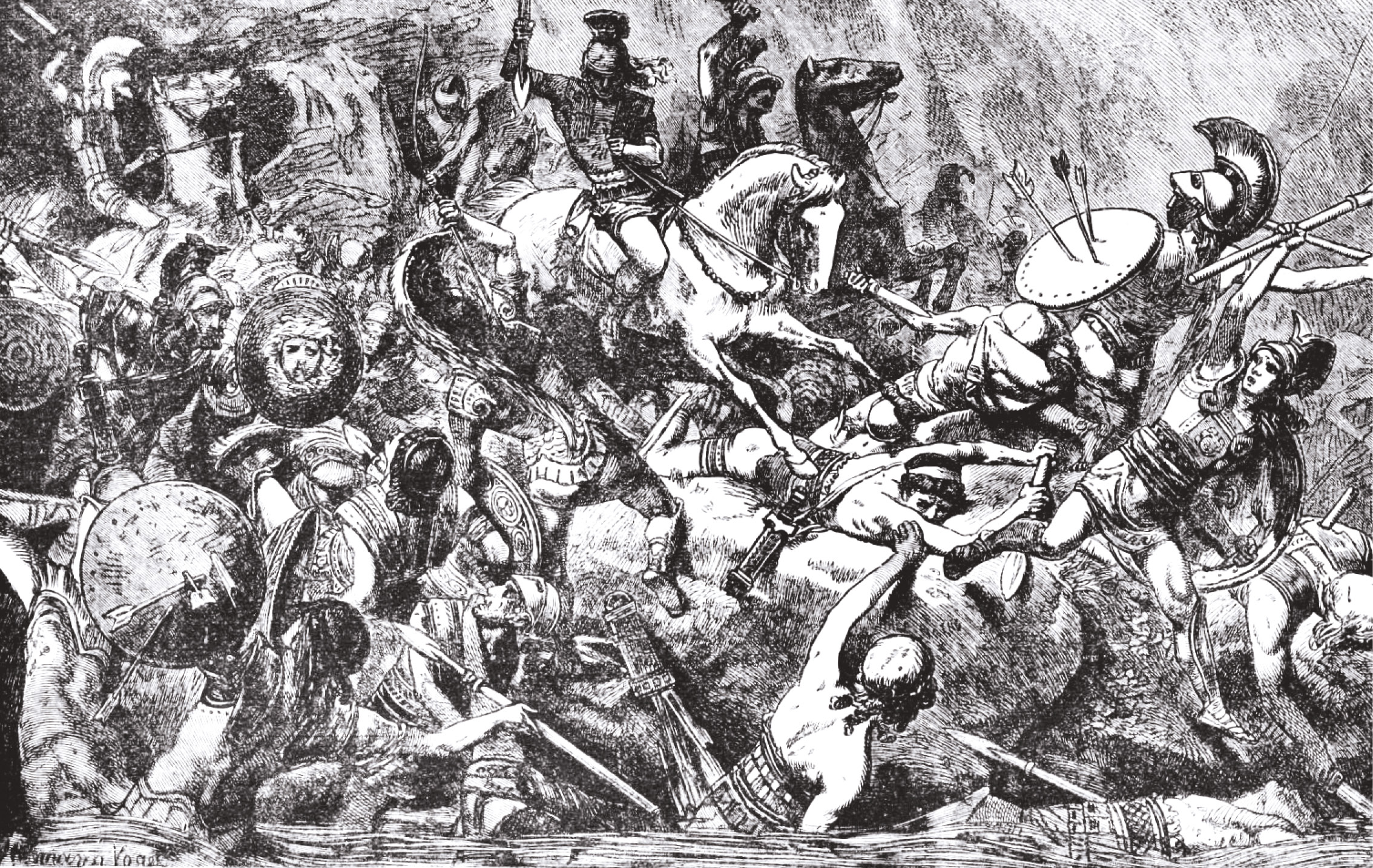
Perhaps the most outstanding episode in the history is the disastrous Athenian expedition to conquer Sicily in 415-413 BC, which ended in the death or enslavement of the greater part of the invasion force. In Thucydides’ narrative, the catastrophe comes to symbolise the fatal overreach of Athenian power. We may dispute the justice of Thucydides’ interpretation – he lets the inadequate expedition commander, Nicias, off very lightly, instead blaming the baleful influence of Athenian democracy over policy-making. But there can be no doubting the skill with which he chronicles the unfolding debacle. Here, for example, he describes the chaos as the desperate Athenian troops tried to escape the victorious Syracusans:
Once they reached the river, they rushed down into it, and now all discipline was at an end. Every man wanted to be the first to get across and, as the enemy persisted in his attacks, the crossing now became a difficult matter… They hurled down their weapons from above on the Athenians, most of whom, in a disordered mass, were greedily drinking in the deep river-bed… The water immediately became foul, but nevertheless they went on drinking it, all muddy as it was and stained with blood; indeed, most of them were fighting among themselves to have it.
There is an immediacy about the writing, and an eye for the telling detail, which brings to life the struggle of warriors who lived almost two-and-a-half thousand years ago.
The Thucydides trap
At the heart of Thucydides’ work is a keen appreciation of the nature of power and how it leads to conflict. He argues that states go to war for three reasons: fear, honour, and interest. In other words, they will take pre-emptive action against what they perceive as a future threat. They will seek to preserve their reputation or prestige – a vital ingredient of power – and they will always act with their own advantage in mind.
This analysis later gave Thucydides an honoured place in what has become known as the ‘realist’ school of international relations. The Melian Dialogue – a negotiation between Athenian envoys and representatives of a small island which refused to join their alliance network – is the best-known exemplar. Thucydides has the Athenians dismiss the arguments put forward by the people of Melos, bluntly warning that, as the weaker protagonist, they face annihilation if they do not submit at once. Might is right: ‘the strong do what they have the power to do, and the weak accept what they have to accept.’ After choosing to resist, when the island fell, the Melian menfolk were duly massacred, and their women and children enslaved.
Some commentators have come to see the Peloponnesian War as a template for any inevitable clash between diametrically opposed Great Powers. The bipolar division of the Cold War encouraged renewed interest in Thucydides. More recently, with the rivalry of the USA and China in mind, an American political scientist, Graham Allison, wrote of the ‘Thucydides trap’. By this he meant the likelihood, or at least the strong possibility, of war when an emerging power threatens to displace an established one.
The starting point for the theory is Thucydides’ claim that ‘it was the rise of Athens and the fear that this instilled in Sparta that made war inevitable.’ We should, however, be wary of drawing lessons with universal application. Four of the 16 case-studies presented by Allison, including the Cold War, ended without a cataclysmic clash of arms.
Yet we can learn a great deal about the dynamics of Great Power relations from Thucydides, without necessarily seeking particular analogies across the ages. The fate of the Melians is a stark warning of what may ensue if a country does not face up to harsh realities. The disaster that befell the Athenians on Sicily is an object lesson in the risks of imperial overreach. By deepening our understanding of the forces that drive states that engage in war, Thucydides gave us a work of history that has stood the test of time.

Thucydides
Born: c.460 BC – Died: c.400 BC
Nationality: Greek
Scattered clues in Thucydides’ own writings are virtually our only source for his life and personality. Even his dates of birth and death are uncertain. He was old enough, at the start of the great struggle between Athens and Sparta in 431 BC, to grasp its long term importance and to embark on a study of the conflict in real time.
Although he lived in Athens, Thucydides was the son of Olorus, whose Thracian name links him to north-eastern Greece. We know that Thucydides owned property there, including gold mines. This gave him the financial independence to devote himself to serious research and writing. He was elected in 424 BC as a strategos – one of ten senior magistrates exercising military command. He was exiled for 20 years as punishment for failing to prevent the capture of Amphipolis, a setback which gave him more time to work on his history.