Subscribe now for full access and no adverts
The Westminster Government has published its revised National Planning Policy Framework amid a flurry of boosterish phrases about ‘backing builders not blockers’, ‘unleashing billions in economic growth’, and introducing ‘seismic reforms to help builders get shovels in the ground quicker’. If pithy phrases, vivid metaphors, and a love of alliteration could deliver the housing we need, the Framework’s job would have been done.
As it is, the situation is far more nuanced. Housebuilders interviewed for their response on Radio 4’s Today programme said that ‘red tape’ was not to blame: the problem is that planning and conservation departments are under-resourced. They wanted more money to be spent on planning, not less, so that housebuilders can obtain pre-planning advice and understand legitimate constraints relating to heritage and biodiversity. They also want councils to speed up the whole process, which is supposed to take 13 weeks, but usually takes many months, again because of a lack of capacity.
New homes from vacant buildings
The recently published Historic England report on ‘New Homes from Vacant Historic Buildings’ makes a strong case for making fuller use of existing buildings. In answer to the question ‘How many vacant domestic historic properties are there in England?’, Historic England quotes the 2021 UK Census figures to show that approximately 1.4 million properties were empty and unused at the time (that’s 5.6% of the UK housing stock). Of this number, Valuation Office Agency figures estimate that 300,000 count as historic dwellings (that is, built before 1919).
More recent statistics from the Ministry of Housing, Communities, and Local Government (updated on 4 April 2025) put the number of empty and unfurnished homes in England slightly lower, but still very high, at 700,000, of which 261,471 are classed as ‘long-term empty’, meaning no one has lived there for six months or more. These are not just located in areas of deprivation and low employment. London has the highest number of vacant properties in England (271,248, or 7.5% of the total housing stock, of which some 81,375 are classed as historic). Wealthy Westminster currently has 11,000 empty properties.
On top of this, Historic England estimates that converting just 75% of the c.12 million square metres (c.2,965 acres) of vacant historic non-domestic (office, industrial, and retail) space in England could provide 251,000 one-bed homes or 140,000 two-bed homes. Much of this vacant property consists of unused space above shops in historic town and city centres.
All told, the potential for providing homes in vacant or underused historic properties is huge and would go a very long way towards meeting the Government’s housing targets, as well as bringing life and economic activity back to urban environments.
Adam Hug, Westminster City Council’s leader, thinks this is not just a pipe dream, and has called on the Government to make it easier for local authorities to issue Empty Management Dwelling Orders to enable them to take control of private sector properties when they have stood empty for more than six months, undertaking repairs and renting the property out for up to seven years to recover costs. Councils regard empty properties as an environmental health hazard, because they become a magnet for vandalism, fly-tipping, squatting, and vermin, harming the quality of life for people living nearby.
Nature charities respond
Charities that campaign for wildlife conservation have also asked the Government in Westminster to stop ‘scapegoating nature’ for the failures of the planning system. The RSPB, the National Trust, and the Wildlife Trusts pointed to a YouGov poll showing that 71% of the public would support increased planning protections for nature in any new planning legislation, including a legal duty to avoid harm to protected wildlife and strict rules to ensure that environmental benefits significantly outweigh harm from development. Only 12% of those polled believed current planning rules go too far in protecting the country’s natural heritage.
The Planning and Infrastructure Bill that is currently being debated in Westminster proposes that developers can offset local harm to the environment by paying in to a national Nature Restoration Fund – in effect, paying for the right to pollute. Richard Benwell, the chief executive of Wildlife and Countryside Link, called on MPs to amend the bill to ensure that the planning system is nature-positive, with every development ‘wilder by design’.
Sherds’ view
There is an underlying assumption in the Government’s planning reforms that local authorities and planning departments must make it as easy as possible for housebuilders to acquire development land – but volume housebuilders are not in business to be altruistic. Their perfectly reasonable objective is to make as much money as possible for their owners and shareholders, and it helps them to maximise their profits if they can get planners and regulators out of their way – they spend a large amount of money lobbying to this end.
But there is no reason why we should make it as easy as possible for those companies to make money by giving planning permission away cheaply and easily. Society has every right to ask for something in return, and it is Government’s job to balance public and private interests. As well as protecting nature and heritage, we need legislation that enforces the often-breached requirement for 10% of houses to be genuinely affordable and of decent quality. We should also require housebuilders to make use of their landbanks within, say, three years of gaining planning approval or hand the land back.
Ideally, too, there should be bias in the planning system in favour of small, local, family-run building firms who employ local people and spend their money in the local economy – what the more idealistic and optimistic commentators on the housing scene call ‘building communities, not just homes’. And if local authorities can be made to find land for developers, why can’t those same local authorities go the next step and build the homes themselves, returning to the days of ‘council housing’?
The ‘builders not blockers’ phrase sums up a mindset that sees everything in black and white, and looks for an enemy to blame for the lack of delivery. At the moment, the arguments are far too one-sided in favour of developers, and while the Government talks about simplifying the planning system it is in danger of offering simplistic solutions.
Overtourism in Athens
Of course, there is far more to the UK housing crisis than the lack of new homes – exacerbating that problem is the proportion of homes that have been bought as investments (second homes, holiday homes, Airbnbs, and buy-to-lets). This has risen from c.15% of the UK’s housing stock in 2016 to some 45% today.
In Athens, Elliniki Etairia (the Society for the Environment and Cultural Heritage) is celebrating the decision of the city’s mayor, Haris Doukas, to set up a taskforce to look at ways to protect Plaka from this kind of investment. The ancient quarter at the heart of the capital’s historic centre has been swamped by nightclubs, restaurants, terrace bars, and short-term rental property. Residents are being driven out by the all-night noise, congestion, litter, and the lack of community facilities, as well as the stresses on water supplies and the sewage system. In part, this is because of the rise in visitor numbers: 10 million visitors – nearly equal to the entire population of Greece – will visit the capital this year, many of them on short city breaks, placing pressure on the Plaka’s network of alleys and pedestrian streets. Lydia Carras, who co-founded the society in 1974, says that Plaka is in danger of turning into a lifeless stage-set rather than a residential neighbourhood.
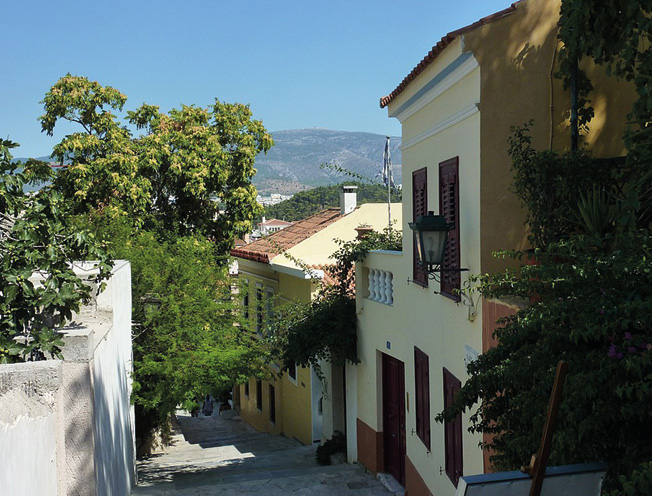
Measures are being proposed to preserve Plaka’s character, including an outright ban on the conversion of property to Airbnb units, land-use regulations that restrict hotel building to selected plots, and an end to residential buildings being used as ‘serviced accommodation’ – in other words, acting as clandestine hotels.
Many of the problems are blamed on the Greek debt crisis of a decade ago, when investors snapped up property at distressed prices. But the problem is not unique to Athens: ‘We don’t want to become the next Barcelona’, Plaka’s residents’ association is warning. City authorities around the world that are suffering from an excess of tourism will be watching what happens next in Plaka with interest.