Subscribe now for full access and no adverts
A well-worn joke goes that archaeologists find their careers in ruins. This is sometimes literally true: at least since the 1970s, and in cities on all inhabited continents, crises sparked by deindustrialisation, decay, and dereliction have been an assured portent of large-scale excavations. It is not just that when business goes down, archaeology goes in. In many cases, archaeology is brought in with the express belief that the trowels can offer a hope of regeneration and reinvigoration.
One example of the interplay between archaeology and industry can be found at Wallsend in Britain. This part of urban Tyneside is named for the eastern terminus of Hadrian’s Wall, and was once home to the Roman fort of Segedunum. In more recent centuries, it has played host to coal mining and shipbuilding, with the cranes of the Wallsend Shipyard once dominating the former fort site. The Roman archaeology itself seemed to have been a casualty of the jobs industry brought, as Segedunum disappeared beneath terraced houses. When they were demolished in the 1970s, rescue excavations demonstrated that the Roman fort remained better preserved than anticipated. As a result, large-scale excavations ensued and the fort was spared further development. Though unemployment was rampant, the idea that heritage might ameliorate an ailing economy did not dock at Tyneside at the time, however. It was largely an unplanned side effect of this digging that some unemployed local people were engaged on the project via a job-creation programme overseen by the Manpower Services Commission.
Attitudes had changed by the 1990s, when the fort was transformed into a major heritage attraction, which opened in 2000. As part of this, a former shipyard canteen became an attractive on-site museum, augmented with a spectacular new viewing platform shaped like a ship’s bridge, in commemoration of the town’s modern heritage. This time, aims included urban regeneration and drawing in tourists, at a point when the shipyard was facing difficulties. Although there were some hopes that the industry would rise once more, vessel construction at the yard ceased in 2006.
While Segedunum remains a notable element of the Wall heritage landscape, it would take more than Romans to fill the hole in Wallsend’s economy. One of Wallsend’s most famous sons, now the artist known as Sting, composed the musical The Last Ship as testimony to his home industry and its wrecking. The show has toured successfully across Europe and the US since 2013, keeping Wallsend’s memory buoyant. Yet, like some Flying Dutchman, heritage has not exactly been a portent of rescue.
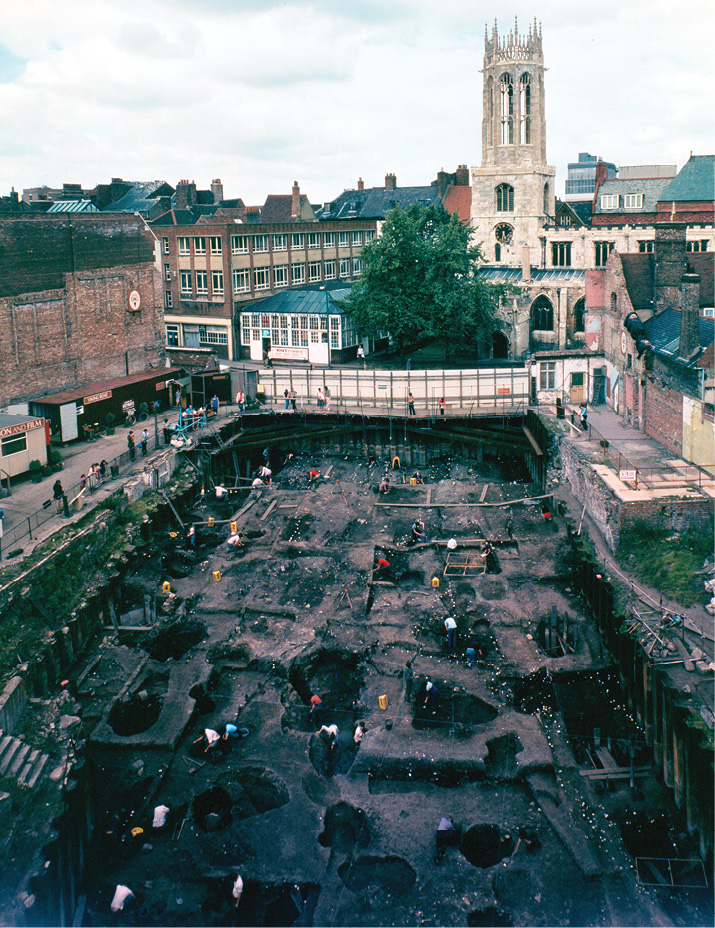
There are many places where archaeology has been summoned in an attempt to revive the fortunes of formerly prosperous areas. Sometimes, ruin is indeed turned into treasure, as at York, where the ‘Viking dig’ in the 1970s turned a former factory into the famous Jorvik Viking Centre, which played a key role in relaunching the city as a first-rate tourist destination. Attractive as they may be, however, sites and museums have often proven a weak strategy for crisis-ridden cities.

Shovelling for a better future
Archaeological heritage can do better, however, than reaching for one particular version of the past. Cities are reflections of the societies that inhabit them, and urban societies are often justly proud of having a long heritage. But cities are also places that are in constant development, and such change frequently comes at a cost to older buildings and neighbourhoods, resulting in the obscuring or erasing of remnants from eras that came before. Seen this way, the process involves layer on layer of forgetfulness as more venerable districts disappear, making modern cities palimpsests of erased memories, a situation that is ever present but rarely visible at such places.
While archaeology for most people resonates with thriving culture and prosperity, the discipline has been called on, too, to mitigate societal crises more than once in the past century. Shovel Ready: Archaeology and Roosevelt’s New Deal for America is the title of a book from 2013 by Bernard K Means, who penned an account of the ways in which archaeology came to play a role in the measures adopted by America’s leaders to grapple with the Great Depression.
American president Theodore Roosevelt got the ball rolling when he instituted a new Antiquities Act in the United States in 1906. This had a wide-ranging impact on both the preservation of historic sites and the role that archaeology played in the country, prompting a massive upswing in public archaeology projects. In the 1930s, as America underwent a severe economic recession and unemployment was raging across the country, President Franklin D Roosevelt’s New Deal took this a step further. It set the scene for government-funded archaeological projects that provided vital employment for many. In this case, archaeology and ruins became entangled in a very different form of wordplay than the one that opened this piece. This time, archaeology saved many individuals and families from ruin in an era when the entire world was racked by financial catastrophe.
Another example of the varied roles archaeology can play is illustrated by the profound transformation that Rome experienced under Mussolini in the 1920s and 1930s. Major excavations were driven by the dictator’s wish to expose the remains of the Roman imperial fora in the ancient city’s heart. This was not an area that had been vacant since the Roman era, though. Instead, it had developed into a densely built urban neighbourhood with a long and complex history, which has most recently been explored by a range of archaeological missions – including a Danish-Italian team (see CWA 113) – in the lead-up to the anniversary of Mussolini’s rise to power in 1922. While the dictator’s aim was to draw parallels between his regime and the Roman imperial past, his project also created numerous jobs in the city: jobs tied to earth-moving, the demolition of centuries-old and more modern structures, and the excavation of vestiges of imperial Rome that had been extracted from more recent settlement. Obliteration of the ‘now’ was replaced by a glorification of the Roman past, a tradition that persists to this day. Indeed, the modern Via dei Fori Imperiali or ‘Street of the Imperial Fora’ bisecting the site was originally called the more ambiguous Via del’Impero or ‘Street of Empire’, entwining ideas of a romanticised past with Mussolini’s desire to rebuild the Roman Empire under his own rule.
Urban decay and reuse
While some of these examples may seem rather modern, we do not need to look hard to find ancient examples of obliteration and destruction going hand in hand with urban renewal during times of instability and crises. Late Antiquity was a period when the growth of the Church as an institution was a driving factor for much societal organisation in the Mediterranean world. In many cities, church construction served as a means of expressing prosperity, while also presenting a way to repurpose or obliterate traces of the pagan past – quite literally, by taking over former temples or demolishing them and using the fabric in new buildings. A city like Gerasa in Jordan presents a fine example of this transformation. By the middle of the 8th century AD, it held at least 25 churches, which were partly constructed using spolia (building parts) taken from earlier structures.
We cannot tell how Late Antique builders in Gerasa felt about levelling former public buildings and feeding the marble from these monuments into lime kilns – some of which stood within the perimeters of major Roman complexes, such as the Sanctuary of Artemis – to make mortar for church buildings (see CWA 107). Yet it is possible that their vision was not so very different from some of those pinning hopes on heritage in the present day. After all, the inhabitants of Gerasa were building for an imagined future where providence and new patrons would return prosperity to their community.
Yet, as every archaeologist can tell you, careers and prosperity are hard to win from ruins, be they Gerasa’s temples or former industrial sites from more recent centuries. Perhaps the real value that excavations can offer an urban community in crisis is the opportunity to reconsider their place in the world. For archaeology to make a meaningful contribution, it is not enough to provide a career in ruins. It must offer vessels for new communities, rather than tour boats to dead-man’s island.
Rubina Raja is Professor of Classical Archaeology and Art and director of the Centre for Urban Network Evolutions, Aarhus University, Denmark.Together with Søren, she is founding editor of the Journal of Urban Archaeology.
Søren M Sindbæk is Professor of Medieval Archaeology at Aarhus University, Denmark, and co-director of the Centre for Urban Network Evolutions.