Subscribe now for full access and no adverts
A newly published book by Nicholas Orme – Going to Church in Medieval England (Yale, 2021) – has received widespread coverage in the media for what several reviewers have described as an ‘eye-opening’ account of the less-than-godly behaviour of churchgoers and clergy in medieval England. MailOnline, in particular, took delight in picking out all the juiciest plums of scandal in the book, under a banner that promised ‘sex in cemeteries, a brawl over a hunting hawk, and clergymen groped at the altar’. It all sounded reminiscent of the notorious (but actually very good) Ken Russell film The Devils (1971), based on Aldous Huxley’s 1952 work, The Devils of Loudun, about Cardinal Richelieu’s ruthless suppression of religious dissent in 17th-century France.
Among the heinous crimes attributed to medieval churchgoers was their habit of walking around the church during Mass to show off their fashionable clothes. Gossiping was commonplace, making the service difficult to hear, as was quarrelling, especially over who was entitled to sit in ‘the best’ pews. Clergy complained about being assaulted: one Kentish aristocrat took his hawk to church in 1514 and punched the vicar in the face when chastised for doing so. Worse still, thieves molested the vicar of Winchelsea, East Sussex, during Mass, before stealing the Bible and the proceeds of that day’s collection plate.
Clerical sinners
The clergy were not always as saintly as they should be. Thirty-nine priests were reported for adultery or for fornication with unmarried women between 1391 and 1394 in Berkshire, Dorset, and Wiltshire; while 54 were named in Herefordshire, Gloucestershire, and Shropshire as involved in illicit relationships.
Sexual behaviour in sacred areas seems to have been common enough for Geoffroy de la Tour Landry to warn his daughters against it in a book of instructions that he wrote in 1372 on proper behaviour for aristocratic young women. ‘Do not have intercourse in church,’ he said, before recounting the Dante-esque story of a couple who became literally inseparable – welded together for eternity – after having sex beneath an altar.
Late medieval wall paintings warn against breaking the Sabbath by working on a Sunday or by lying in bed and ignoring the call to Mass. Clearly this was a problem, as church courts were repeatedly faced with absenteeism, especially among the young. One poor youth in Essex in 1512 was candid enough to admit that the reason for not attending church was that ‘I was asleep’. On the other hand, efforts were made to stop those deemed unworthy from receiving Communion, including drunkards, those suffering from leprosy, and ‘women with yellow wimples’ – perhaps a covert reference to prostitutes.
Forging ahead
Further evidence of shenanigans in the past comes in the form of a book by Levi Roach on Forgery and Memory at the End of the First Millennium (Princeton University Press, 2021). The author shows that religious houses across Europe began falsifying documentary records on an unprecedented scale in the 10th and 11th centuries. They did so with a variety of motives: to claim a more ancient origin (Glastonbury Abbey, for example, was determined to prove that it was the oldest monastic foundation in Britain), or to lay claim to disputed property, or to demonstrate that one or other institution had authority over another (or the opposite – the right to determine its own affairs).
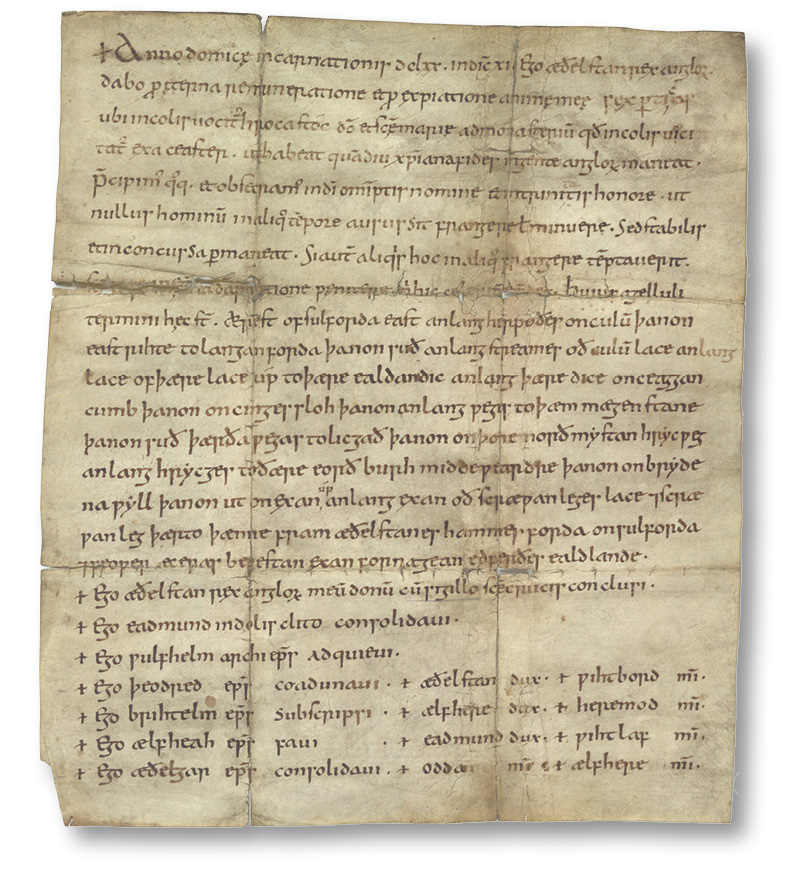
The upshot is that charters are far from reliable sources of information for dating purposes. But this does not mean that they are entirely useless for historical research. Scholars are increasingly able to distinguish later medieval forgery by the perpetrators’ generally unsuccessful attempts to imitate earlier handwriting and their misunderstanding of ancient legal formulae. This enables them to extract what is genuinely early and reliable.