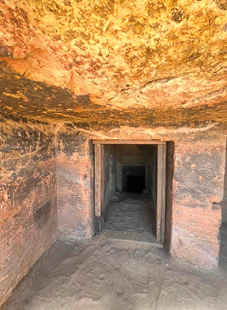
tomb

Bubasteion rock tombs

Three rock-cut tombs belonging to high officials of the early New Kingdom have been discovered by an Egyptian team in the Bubasteion necropolis at Saqqara. The tombs are inscribed with their biographies, and provide important evidence of Egypt’s foreign relations…
Newly discovered Qurna tomb

A Dutch team from Leiden University has discovered a previously unknown Ramesside tomb in Sheikh Abd el-Qurna. Wall inscriptions name the owner as an official called Paser. The tomb has a typical Theban layout, with an open courtyard containing a…

AE156 News 2a

Hyksos-era complex

A large multi-functional complex dating to the Fifteenth Dynasty (the Hyksos era) has been uncovered by an Egyptian mission at Tell el-Ku’a in Wadi Tumilat (Ismailia Governorate) in the eastern Nile Delta. The team discovered a walled residential compound, measuring…

20250815 TUMBA HUITZIO 27 © Luis Gerardo Peña Torres INAH

Zapotec tomb unearthed in Mexico

A spectacular tomb associated with the ancient Zapotec civilisation has been uncovered on Cerro de la Cantera, in San Pablo Huitzo, Oaxaca, south-western Mexico. The burial was brought to the attention of archaeologists from INAH thanks to an anonymous report…

New Graeco-Roman tombs in Aswan

A joint Egyptian–Italian archaeological mission (University of Milan) has discovered more rock-cut Graeco-Roman tombs in the necropolis surrounding the Aga Khan Mausoleum on Aswan’s West Bank (for previous finds, see AE 144). The most impressive tomb to be found so…

Restoration work

The Ministry of Tourism and Antiquities has completed the conservation of a Roman Period tomb at Athribis (Naga‘a el-Sheikh Hamad, west of Sohag). The brightly painted tomb, consisting of a square antechamber leading to a triangular burial chamber, belonged to…

Middle Kingdom finds

Intact burials containing a collection of beautiful jewellery have been discovered by the joint Egyptian-American South Asasif Conservation Project in a tomb located near the Twenty-fifth Dynasty Tomb of Karabasken (TT391). This is the first Middle Kingdom burial to be…

A royal Maya burial

A 1,700-year-old tomb belonging to a previously unknown Maya ruler has been discovered in northern Guatemala. The site of Chochkitam – a medium- sized Maya city with a monumental centre covering an area of c.1km2 – has been known since…

Peru North Highlands Pacopampa Chavin style Feline Mortar 1957.494.a Cleveland Museum of Art.jpg

This week: Pacopampa

Understanding burial practices and funerary customs is a vital part of any attempt to understand an ancient culture – for while the need to separate the living from the dead is common to all human societies, the way in which…

4 © Inrap (4)

Roman cemetery unearthed in Nîmes

One of the most exciting discoveries was that of a casket carved out of a single stone, which contained a glass cinerary urn, along with a wealth of stunningly-preserved funerary goods.

King

Valley of the Kings, 1923

‘Yes, wonderful things’ is the oft-quoted response Howard Carter gave when, on 26 November 1922, Lord Carnarvon asked if the archaeologist could see anything through a hole in the inner doorway of the tomb of the young king Tutankhamun.

Egyptian afterlives: an interview with Salima Ikram

As shown by the excitement surrounding the discovery of Tutankhamun 100 years ago, mummies and Egyptian tombs have an impressive ability to capture our imagination. Richard Marranca speaks to Egyptologist Salima Ikram to find out more about these funerary finds, from early medicinal mummies to recent revelations at Saqqara.

11 ebXcDPAssqbRJB4

Honouring Augustus

After centuries of reuse and years of closure, the Mausoleum of Augustus is now open to visitors. Dalu Jones examines the structure’s long history and how, with its neighbour the Ara Pacis, it forms a modern monumental complex to the ancient emperor in the heart of Rome.

Napoleon’s tomb

Finally completed in April 1861,Napoleon’s remains were transferred into this huge object of red aventurine quartzite from a quarry in northern Russia.

RIGHT Burial B10 is one of 14 people buried at Knowth between the 1st and 3rd centuries AD. Isotope analysis has established that some members of the group came from northern Britain. The choice of this Neolithic monument for their burial was perhaps intended to create a link between the newly arrived people and the indigenous ancestors.

Mounds and monasteries: burials in late Iron Age and early medieval Ireland

The Irish archaeologist Barry Raftery (1944-2010) wrote: ‘Death represents the ultimate confrontation between the human and the supernatural worlds. The surviving burial remains and the associated funerary monuments thus provide us with the clearest and most tangible surviving evidence of religious beliefs and practices’. With this as her theme, Elizabeth O’Brien has studied every excavated Irish burial dating from the period c.200 BC to c.AD 800. She found great diversity and one common strand – burial in close proximity to ancestors or to people regarded as saints, as Chris Catling reports.

BELOW One of Saqqara’s newly discovered coffins was opened for X ray analysis.

More mummies unveiled at Saqqara

As well as the coffins, which date to the Late Period (525-332 BC) and Ptolemaic Dynasty (323-30 BC), Egyptian archaeologists found shabtis, amulets, four gilded funerary masks, and 40 statues of Ptah Sokar, a prominent god of Saqqara.