Subscribe now for full access and no adverts
Abu Simbel actually presents us with several milestones. Probably completed by Year 24 in the reign of Ramesses II, the rock-cut temples left an awe-inspiring statement of power and permanence 140km south of Elephantine in the peripheral territory of Wawat (Lower Nubia). The Great Temple – with its imposing façade of four 20m- high colossi – celebrated Ramesses-Meryamun as a solar deity. Twice a year, the rising sun penetrated far into the cavernous interior of the monument, illuminating the innermost sanctuary where his statue shared equal status alongside seated figures of Amun-Ra, Ra-Horakhty, and Ptah. About 90m to the north, the smaller temple was dedicated to Queen Nefertari and Hathor of Ibshek (the name of the locality).
The first milestone occurred in 1813, when the temples were first seen by a Westerner in the modern era. The discovery is generally credited to the Swiss traveller Johann Ludwig Burckhardt, who had travelled widely in the Middle East under the guise of ‘Sheikh Ibrahim ibn Abdallah’.
The second milestone was the first entry into the Great Temple in the modern era.
When the British agent Giovanni Battista Belzoni arrived at Abu Simbel in early September 1816, he noted that the Great Temple presented just: ‘one figure of enormous size, with the head and shoulders only projecting out of the sand.’ He discovered that the French ex-consul Bernardino Drovetti had been there a few months previously, but that the local sheikh had failed to dig out the temple entrance. Belzoni succeeded in exposing the figure over the doorway, and the head and shoulders of the north-central colossus, before having to abandon the effort. In June the following year, Belzoni returned and eventually, after 22 days’ work, on 1 August 1817, he and his party entered the Great Temple.
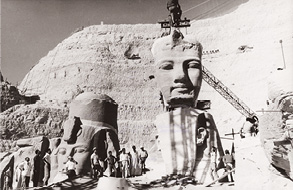
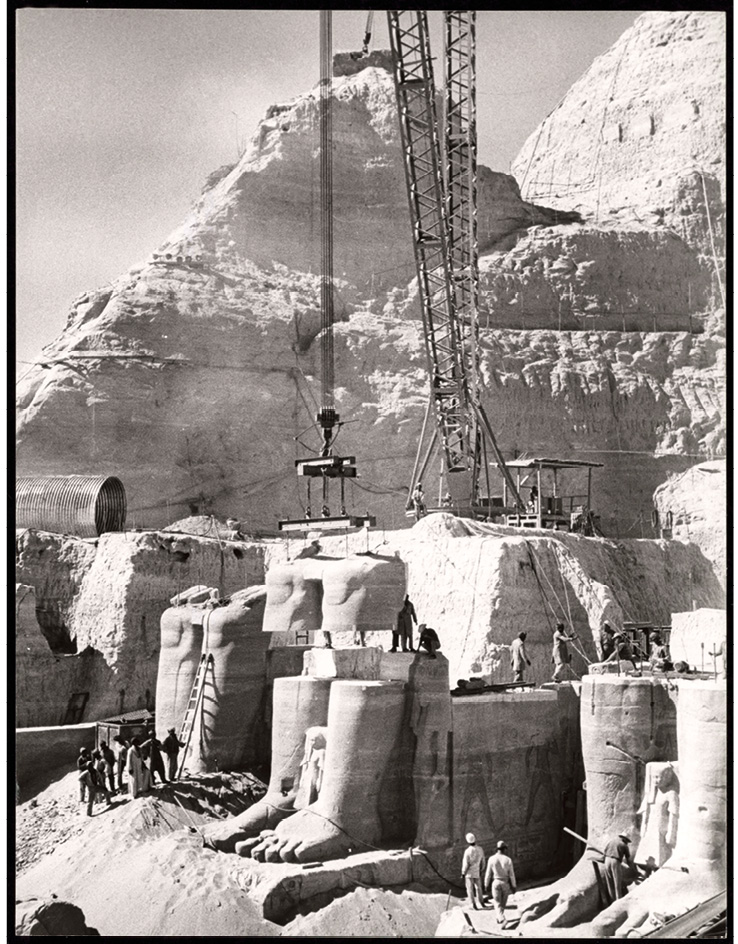
Of course, the most important milestone is the rescue of the temples from the rising waters of Lake Nasser following the construction of the Aswan High Dam. Originally the monuments of Nubia were destined to be submerged and lost. In an astonishing international collaborative UNESCO initiative, between 1964 and 1968 the monuments were dismantled and moved beyond the reach of the lake. As a gesture of gratitude, the Temple of Dabod was given to Spain (Madrid) and the Temple of Dendur to the USA (Metropolitan Museum, New York). The temples of Abu Simbel had to be cut from the rock into blocks and re-erected, some 210 metres further back and 65 metres higher, to escape the waters. The cost for Abu Simbel alone was $40 million ($388 million in current values).
Text: Dylan Bickerstaffe, Independent researcher / Images: © UNESCO/Nenadovic