
Subscribe now for full access and no adverts
The amazingly diverse finds from Star Carr, an 11,000-year-old lakeside settlement near Scarborough, have transformed our understanding of the Mesolithic period – and many of them are now showcased in an exhibition running at the Yorkshire Museum.
Star Carr: Life after the ice aims to immerse visitors in the everyday experiences and activities of Mesolithic hunter-gatherers. Objects reflecting these practices include barbed points and flint tools used to cut and prepare food, as well as the oldest complete hunting bow found in northern Europe, and possibly the world. Experimental archaeology indicates that it could have shot an arrow 25m, but was not strong enough to take down large game; instead, it may have been used for fishing, perhaps from one of the three wooden platforms known to have existed at Star Carr at different times (a section of one of these is on show, too).
The bow was found end-to-end with a willow digging stick in an apparently deliberate placement. The latter implement – one of eight found at Star Carr – could have been used for gathering roots or perhaps creating post-holes for structures like the ‘house’ that was recently reconstructed outside the museum’s main entrance (see here). Some of the most arresting items, however, are the smallest and least visually striking – among them, a unique group of paper-thin rolls of silver birch bark (below). Rich in resin and highly flammable, they could be carried as natural firelighters. Next to these is a piece of flint whose end bears marks containing traces of iron pyrite. It would have been used to make sparks – together, you have a Mesolithic fire-lighting kit.

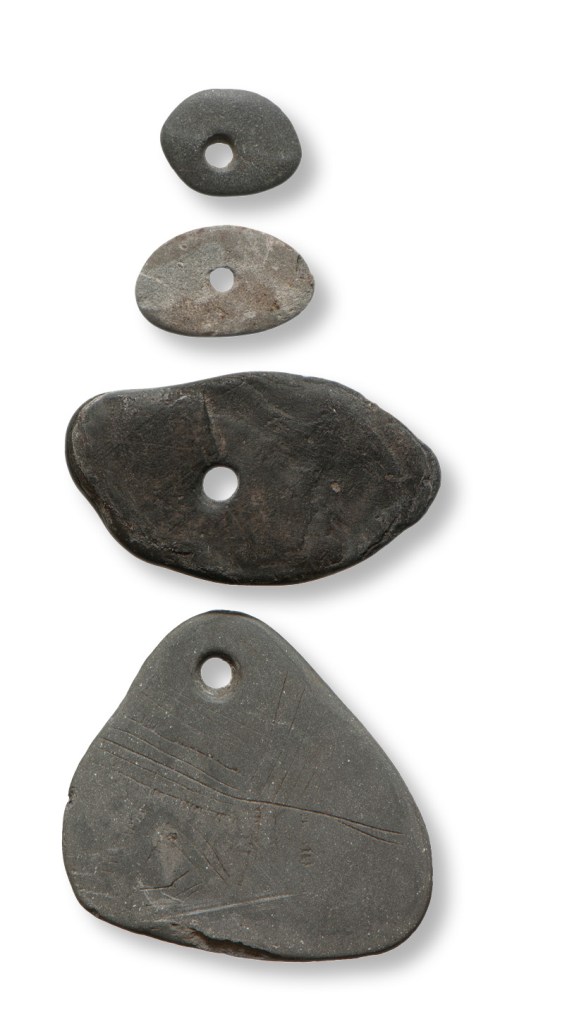
The exhibition also includes 11 of Star Carr’s 33 famous headdresses crafted from red and roe deer skulls. Each is different in design, and standing before so many in one place is a thought-provoking experience: were they for camouflage, hunting, or ritual use, and were they worn by the whole community in a shared activity or as a once-in-a-generation privilege for individuals? Other, more personal adornments appear as well, in the form of shale beads and an intriguingly scratched pendant that represents Britain’s earliest Mesolithic art (below; see CA 314 and 349).
Complementing these artefacts is an absorbing ‘digital mural’ based on archaeological and environmental evidence from the site. Over around 20 minutes, the animation cycles through day and night, and all four seasons, showing Star Carr populated by people and various animals. Together, the displays shed vivid light on a period of prehistory that is relatively obscure but, excitingly, is becoming less so.
Further information: Star Carr: Life after the ice will be at the Yorkshire Museum until spring 2026. The museum is open Tuesday-Sunday; entry to the exhibition is included in general admission (£9.50 adults, £4.75 children). See www.yorkshiremuseum.org.uk/exhibition/star-carr-life-after-the-ice/ for more details.

Images: © Yorkshire Museums Trust