Subscribe now for full access and no adverts
REVIEW BY CAMPBELL PRICE
This book takes as its subject a relatively unusual theme: books written about Egypt. But it is one that will probably interest Egyptophiles because many of us are avid collectors of books! As the author makes clear, the popularisation of (ancient) Egypt has much to do with the fashions in printing, publishing, disseminating images, and writing about Egypt. Certainly before the second half of the 20th century, the vast majority of people could only experience Egypt through printed media. The market for illustrated books about Egypt was, therefore, potentially a large one, and there was occasionally – maybe often – money to be made.
The illustrations and descriptions that appeared in these works were, inevitably, partial, selected, and often dependent on earlier sources. This is something anyone who consumes Egyptology today will recognise – publishers are generally risk-averse, and would rather rehash something in a well-known formula than risk the entirely new. Many will recognise the name of French archaeologist and artist Émile Prisse d’Avennes (1807-1879) from a steady stream of modern reproductions of his 19th-century sketches of pharaonic and Islamic Egypt. This book offers a fascinating insight into his methods on the two major trips he undertook to Egypt – locating, tracing, and sketching scenes and monuments. He once claimed to his French government funders that he had brought back with him 300 metres of tracing paper; the results included Oriental Album (1848) and L’Art Arabe (1877). Prisse d’Avennes emerges here, though, as a prime mover amid the competition to capture the imagination of (European) readers, often replicating or borrowing the work of others in order to make Egypt-on-the-page sell.
A particularly fascinating discussion concerns the tendency for scenes or vignettes depicting certain aspects of life in Egypt – such as the use of the bastinado for punishment – to be replicated, much as the ancient Egyptians themselves did when they appreciated a certain motif. The whole book is quite unlike anything else currently available and, although not centred on pharaonic sources, is a genuinely insightful investigation into how and why people went about publishing accounts of Egypt in the 19th century.
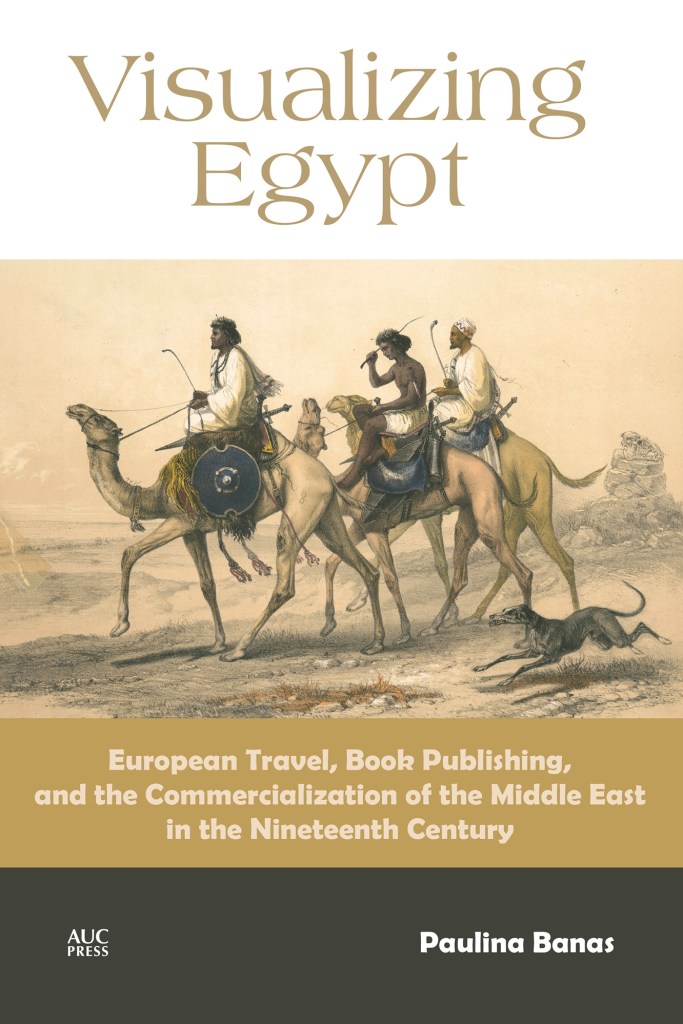
Visualizing Egypt: European Travel, Book Publishing, and the Commercialization of the Middle East in the Nineteenth Century
by Paulina Banas
The American University in Cairo Press, 2025
ISBN 978-1-61797-667-4
Hardback, £59.99