Subscribe now for full access and no adverts
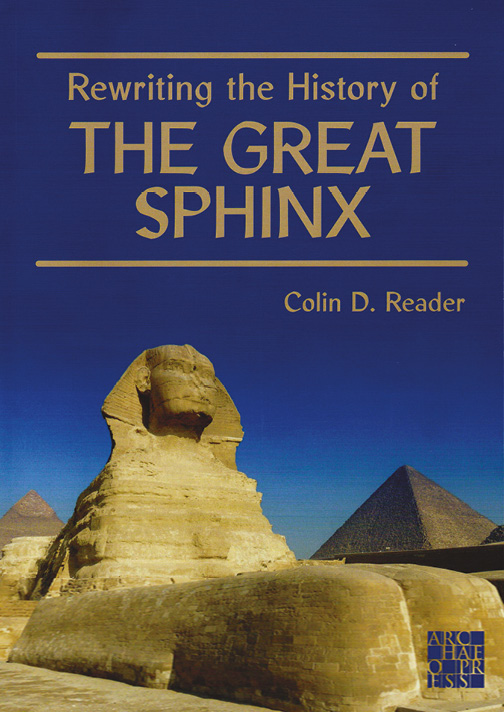
Colin Reader is a geologist by profession, but became fascinated by ancient Egypt, particularly the earliest phases of the civilisation. He has studied the Great Sphinx of Giza for nearly 30 years, applying his professional expertise to all the available archaeological and geological evidence, and this book is a comprehensive account of that research.
Although Reader concentrates on factors directly affecting the Great Sphinx, the book is also an introduction to the history of the Old Kingdom, and a companion to the author’s earlier work A Gift of Geology (2022; reviewed in AE 138), which gives an account of the geological processes that created Egypt. He records little-known evidence that the Giza plateau was occupied by people of the Ma’adi culture around 3500 BC, long before the Giza Pyramids were built. He has studied in detail the current condition of the walls of the Sphinx enclosure, which have been subject to erosion by run-off water during occasional flash flooding. He shows that the quarries excavated in the plateau by Khufu’s workmen to extract building materials for the Great Pyramid fundamentally altered the violence of the flooding, and so mitigated erosion after Khufu’s reign. By looking at all the monuments created before the Third Dynasty, he shows that the stone-working skills required to create the Great Sphinx were in place during the Second Dynasty.
Reader disputes the view that the Sphinx Temple was built in the Fourth Dynasty by Khafra. He analyses its different phases of construction, and the relationship between it and Khafra’s Valley Temple, which he contends is of a much later date. Most importantly, he convincingly argues that the Great Sphinx itself could not have been created during Khafra’s reign; rather it was carved during the Second Dynasty, long before the pyramids of Khufu, Khafra, and Menkaura were built. He believes the head of the Great Sphinx is out of proportion with its body because it originally represented the lion deity Mafdet. The head was later recarved by Khufu to represent him, as part of this major religious reformation.
The work is fully illustrated throughout with colour photographs and has a comprehensive bibliography. The sources of all the facts are scrupulously recorded in footnotes, but the clarity and flow of the author’s arguments are well maintained throughout, despite some idiosyncratic punctuation. This book fundamentally alters our understanding of the archaeology of Giza, and of the history of the Second, Third, and Fourth Dynasties.
REVIEW BY JPP
Rewriting the History of the Great Sphinx
by Colin D Reader
Archaeopress, 2026
ISBN 978-1-805-83209-6
Paperback, £35; e-book, £16
Win a copy of this book! See here