Subscribe now for full access and no adverts
Another Anglo-Saxon cemetery associated with Bronze Age monuments was recently uncovered by Wessex Archaeology in Lincolnshire.
The discovery was made during excavations in advance of the National Grid’s ambitious new infrastructure project, the Viking Link, which will allow for the connection and sharing of green energy between the UK and Denmark. Since work began in 2020, 50 archaeological sites have been excavated along the onshore cable route, providing new evidence of life across south-east Lincolnshire, from prehistory to the present day. One of the most striking discoveries so far, however, is an Anglo-Saxon cemetery.
Like the New Alresford cemetery described above, the burials are focused in and around an earlier Bronze Age ring- ditch – attesting to how widespread the practice was of reusing significant ‘ancestral’ features in the landscape and hinting at how Anglo-Saxon communities viewed the past. In total, the remains of 23 individuals were revealed, all buried with a wide range of grave goods, including knives, jewellery, and pottery vessels. Analysis of the 250 artefacts recovered suggest that the cemetery dates to the 6th and 7th centuries AD.
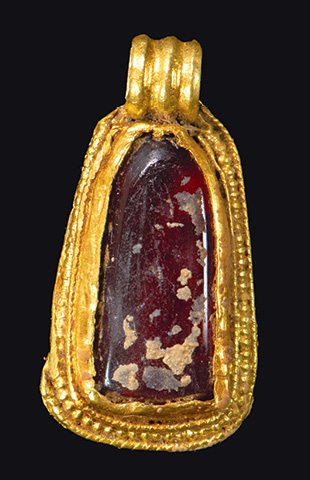
One notable grave was the only double interment found in the cemetery, containing the remains of a probably female teenager aged between 15 and 17, and a 3- to 5-year-old child. Both had been laid on their sides, with the younger child tucked in behind the older. The teenager also appears to have been adorned with fine grave goods, including two small gold pendants set with garnets (right) and a delicate silver pendant with an amber mount, as well as two small blue glass beads and an annular brooch. While the relationship between the child and teenager is not currently known, it is hoped that isotope and aDNA analyses will help elucidate any familial connections. Extending this analysis into the wider cemetery population will help identify broader genetic links within the community as a whole, too, as well as evidence of any migration. Watch this space for a fuller feature on the site once this research has progressed, while further details of the excavation can also be found in the latest series of Digging for Britain.
Jacqueline McKinley, Principal Osteoarchaeologist at Wessex Archaeology, said: ‘Although many Anglo-Saxon cemeteries are known in Lincolnshire, most were excavated decades ago, when the focus was on the grave goods, not the people buried there. Excitingly, here we can employ various scientific advancements, including isotope and DNA analyses. This will give us a far better understanding of the population, from their mobility to their genetic background and even their diet.’
Text: Kathryn Krakowka