Subscribe now for full access and no adverts
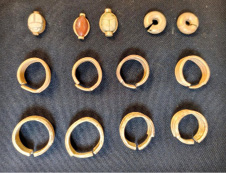
Jacques de Morgan (1857-1924) was one of the most-fortunate excavators in Egypt. In 1894 and 1895, he worked at Dahshur, south of modern Cairo, where he found the intact tombs of several king’s daughters with an array of wonderful golden jewellery.
Dahshur is the location of two pyramids belonging to the Fourth Dynasty king Sneferu (c.2613-2589 BC), as well as three Twelfth Dynasty pyramids (Amenemhat II, Senusret III and Amenemhat III) and some smaller pyramids belonging to Thirteenth Dynasty rulers. Focusing on the area around the Middle Kingdom pyramids, de Morgan discovered the mud-brick mastabas of Old and Middle Kingdom officials, a number of them adorned with carved reliefs. Some of these belonged to men described as a ‘king’s son’, which was the title given to the son of a pharaoh, but also to high officials who were grandsons of a king, and even to courtiers with no direct relationship to the king.

Old Kingdom tomb scenes
Although several Old Kingdom mastabas with carved decoration are known, few survive with painted scenes intact. The best-known example is the Tomb Chapel of Itet at Meidum, dating to the beginning of the Fourth Dynasty, which was found in 1871. Although most of the paintings were not well preserved, one particular scene depicting a row of geese survived in good condition, and is now one of the most-famous works of ancient Egyptian art. Another example of well-preserved Old Kingdom tomb paintings is the Tomb of Kaemankh at Giza, which has well-preserved scenes of daily life (and also has depictions of geese) inside the burial chamber, although this was not discovered until 1926. So when, in a small cemetery north of the Pyramid of Amenemhat II, de Morgan came across a mastaba with its wall paintings intact, he was fully aware of the importance of his find, and published photographic plates of many of the scenes in his final excavation report in 1903.

The Tomb of Insneferuishetef
The mastaba belonged to an official known as Insneferuishetef (read: In-Sneferu-ishetef: ‘May Sneferu bring his belongings’), also known as Sneferuinishetef. Following its discovery, the paintings were cut off the walls as panels measuring about 1 to 1.5 metres wide, and were taken to the Egyptian Museum in Cairo, where they were included in a volume of the Catalogue général des antiquités égyptiennes du Musée du Caire by Ludwig Borchardt, published posthumously in 1964. The book included photographic images of all the paintings, albeit only in black and white, together with some descriptions and copies of the hieroglyphic inscriptions (but no translations). Over the years, these paintings have been reproduced several times and have been mentioned sporadically in academic publications. However, in the newly opened Grand Egyptian Museum, they now have a prominent place as one of the highlights of the Old Kingdom gallery, and can receive the public attention they deserve.
The mastaba
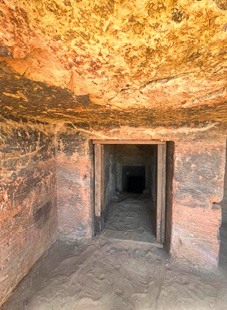
The mastaba of Insneferuishetef is rather modest in size, and is connected to two further mastabas to the north. Insneferuishetef’s structure is made of mud brick and measures about 10 by 5 square metres. The entrance is on the east side, opening on to a long corridor (B2) running north–south. At the south end is a chapel (A2) with a false door on the west side. Behind the false door is a serdab (S2), a room for statues, where a double statue of a man and woman was found. Sadly, their heads were missing, and it is not known where the statue is now. Behind the long corridor, there were four shafts leading down to burial chambers. Both the corridor and the chapel were adorned with scenes painted on plaster.

Painted scenes
The fragments were, in general, well preserved, but some colour has faded. The paintings must have received some form of restoration when they arrived at the museum, and yet even today they are still covered with patches of mud. Evidently it was seen as too risky to remove these – perhaps a wise choice, considering the number of damaging restorations that have been carried out on other Egyptian artefacts.
De Morgan did not record the exact locations of these scenes in the tomb, so their placement on the walls and in relation to each other is not known. But the names and titles of Insneferuishetef, while not included in the painted scenes, were preserved on his false door (now in the McManus galleries in Dundee). Insneferuishetef did not hold high office, and bears some middle-ranking titles perhaps connected with the cult of Sneferu, although that king is not explicitly mentioned in the titles. These include ‘royal acquaintance’, ‘inspector of the tenants of the palace’, ‘leader of the tenants of the palace’, and ‘keeper of the secret’. The name Insneferuishetef is only attested here for the tomb-owner and his son. His wife was perhaps a woman called Qedetes – also the name of a daughter. The rather modest titles might explain why the mastaba was decorated with paintings rather than carved scenes: it seems that Insneferuishetef simply did not have the resources for more costly stone reliefs.
The preserved scenes cover a wide range of subjects found in other Old Kingdom mastabas. Many paintings depict funeral rituals. There are the remains, too, of scenes showing agriculture and fishing, and several panels have depictions of boats. Only the lower parts of the walls and paintings have survived; the upper parts of the walls are lost.

Hunting in the marshes
The tomb-owner is often depicted far larger than other people, perhaps once even covering the full height of a wall. One example of this difference in scale is a fragment that shows him hunting in the marshes. Insneferuishetef stands on a boat with the wife behind him, his daughter sitting at his feet, and his son in front of him, spearing fish. His image is preserved only to about the height of his chest, so his head and face have been lost.

A banquet
One beautiful scene depicts a banquet and is preserved on two panels. One panel shows Insneferuishetef (again without a head) sitting on an armchair before a table bearing different foods. Under his chair, a monkey sits eating fruit. The table has a strange shape, and the painting might actually represent an oven for heating up vegetables or meat.
Another panel – which may be a continuation of this scene – depicts a woman sitting on the ground. She wears an elaborate headdress with three flower-like objects on top of her head. In front of her is a small table with food. Behind her sits a young woman playing a harp. A caption reads ‘his daughter Qedetes’, but it is not clear whether this refers to the seated woman or the harpist.
Several further members of a small orchestra follow, including a male singer with the caption ‘singing for your ka’, another female harpist with the caption ‘playing the beauty’ (exact translation uncertain), and a man playing a flute (confirmed by the caption ‘playing the flute’). In the register above them, the feet of female dancers are visible. In this scene, all the women have been painted in yellow, including their dresses, while the men are shown with red skin.


Funeral scenes
The funeral scenes from the tomb are also significant. One panel shows a boat carrying the yellow coffin of Insneferuishetef, which is placed on some kind of sledge, under a canopy. At each end of the coffin, there is a kneeling man and woman. The captions above the women clearly state that these ladies are mourners. Behind the boat, a funerary priest stands in a small shrine reciting liturgies.
The boat carrying the coffin is towed by three men. In front of them is a priest carrying out a ritual, and a second priest reciting liturgies from inside a shrine-like structure that might be the embalming tent. Behind the tent, two men slaughter a bull.


Bed-making
An interesting scene next to the banquet is only partly preserved. It depicts a servant (only his legs remain) preparing a bed, which is under a canopy. Usually in such bed-making scenes, a head rest is shown, but that part of the fragment has broken away here. The scene is known from several tombs and might represent an important ritual rather than an ordinary scene from daily life. Sleeping was some kind of transition from life to death, and preparing the bed might be seen as a preparation for the afterlife. The importance of this is seen in the funerary goods of Queen Hetepheres I, the wife of Sneferu, which included a bed, head rest, and canopy for her use in the afterlife.


Ships and boats
Another remarkable feature of the painted tomb of Insneferuishetef is the depiction of several boats. One fragment has three freight boats with a central cabin-like structure, each loaded with food. With only a few rowers, this type of boat was not a fast sporting model: rather it was built for making short journeys, perhaps for crossing a river or canal.
However, a different type of boat is depicted on a separate fragment. This has a two-legged mast with a sail, and a large number of rowers (seven or eight on each side). In this case, it was designed for fast travel. The boat has a central cabin painted with geometrical patterns, which perhaps indicates matting. The figure standing in front of the cabin is Insneferuishetef, the son of the tomb-owner who has the same name as his father.


Daily life
Other paintings from the tomb depict scenes of daily life, including a row of female offering-bearers, women winnowing grain, and fishermen bringing fish to Insneferuishetef.
Dating
There has been much discussion over the dating of the tomb. Due to the fact that Insneferuishetef’s name includes that of Sneferu, it was first thought to date to the Fourth Dynasty. This is also suggested by the tomb’s location in a cemetery known mainly for Sneferu’s two pyramids. However, some scholars have argued it is more likely to date to the Sixth Dynasty, or even shortly after. It is hoped further evidence will one day be uncovered confirming which of these dates is correct. Notwithstanding, now that the tomb’s paintings have been placed on prominent display in the newly opened Grand Egyptian Museum, they can be studied and enjoyed as true treasures of ancient Egyptian art.

You can find out more about the work of Jacques de Morgan at Dahshur in an article by Julian Heath that is coming up in the next issue.
Images: the author, unless otherwise stated